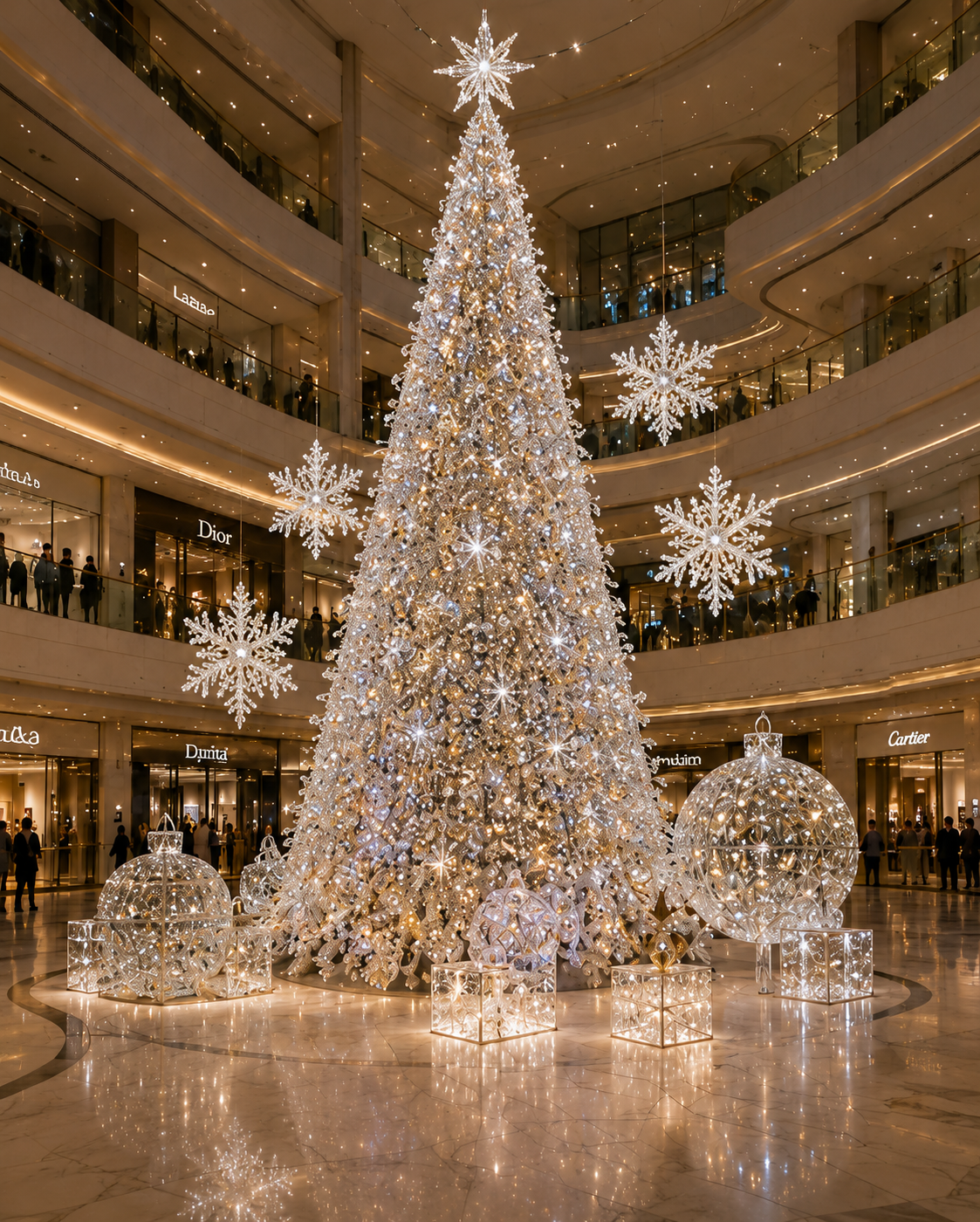
Hotel public areas are often judged by their visible styling: the chandelier, the lobby sofa, the feature wall, the floral installation, or the photogenic reception desk. Yet the real atmosphere of a hotel is usually decided by something quieter and more fundamental: material. Materials determine how light is reflected, how footsteps sound, how warm a reception counter feels under the palm, how a lounge corner photographs, how easily a corridor remains clean, and whether the first impression still feels refined after five years of operation.
In practical hotel design, public areas are the highest-pressure parts of the property. Guests arrive with luggage, children run across polished floors, staff move trolleys, events change room layouts, food and beverage traffic crosses the lobby, and thousands of small touches occur every day. A material that looks elegant in a rendering may become noisy, slippery, scratched, cold, or visually heavy in real use. This is why the question is not simply “Which material looks beautiful?” but “What kind of spatial temperament does this material create under daily operation?”
Research also supports this point. A hotel-lobby study published in Research in Hospitality Management proposed a “lobbyscape” framework and examined 277 valid responses from guests of four- and five-star hotels, finding that atmospheric elements in hotel lobbies are meaningful to customer satisfaction. In other words, the public area is not a neutral passage; it is part of the guest experience product itself. Materials are one of the clearest ways to control that experience because they influence aesthetics, space perception, atmosphere, and physiological comfort at the same time.
The following six points explain the most easily overlooked material decisions in hotel public areas, with practical examples from lobbies, lounges, elevator halls, corridors, restaurants, restrooms, and transitional zones.
1. The First Impression Is Built by Material Hierarchy, Not Decoration
Many hotel public areas fail not because they lack decoration, but because their material hierarchy is unclear. A lobby may use stone, metal, wood veneer, fabric panels, glass, acrylic displays, decorative paint, and patterned carpets at the same time, but without a disciplined hierarchy the space becomes visually noisy. Guests may remember that the hotel felt “busy” or “cheap,” even if the project used expensive finishes.
A strong public-area design normally has three levels of material language. The first is the base material: flooring, main wall surfaces, ceiling planes, and large structural elements. These define the overall weight of the space. The second is the touch material: reception counters, handrails, door pulls, chair arms, bar tops, table edges, and restroom vanity surfaces. These define perceived quality because guests physically interact with them. The third is the accent material: feature panels, decorative screens, art bases, display plinths, signage, acrylic furniture pieces, lighting details, or custom installations. These create memory points, but they should not fight the base layer.
In a business hotel, for example, a calm stone or terrazzo floor, warm timber wall panels, and brushed metal details can create a stable and efficient tone. In a resort lobby, locally sourced stone, textured plaster, woven panels, rattan, or weather-resistant timber may create a slower and more relaxed sense of place. In a lifestyle hotel, transparent acrylic furniture, colored glass, polished metal, and high-contrast textiles can make the public area feel lighter, younger, and more social. The material choice is already a brand decision before any logo appears.
The overlooked issue is scale. A small material sample can look elegant in a meeting room, but a 30-meter lobby wall magnifies color variation, joint lines, reflectivity, and texture. Designers should review material boards under real project lighting, create mockups for key interfaces, and test how materials behave at guest eye level, staff working height, and camera height. In the age of online reviews and social media photos, the material surface must perform both in person and through a phone camera.
Practical rule: define one dominant material tone, one supporting texture, and one memorable accent. When every surface is treated as a feature, the hotel loses spatial confidence. When the hierarchy is clear, even restrained materials can feel premium.
2. Light Interaction Decides Whether a Space Feels Heavy, Transparent, or Expensive
Materials do not exist alone. They are seen through light. A dark stone wall under weak light can feel luxurious in a rendering but oppressive in a real lobby. A glossy floor may look glamorous at opening but produce glare, show footprints, and make guests feel cautious. A transparent acrylic chair or display plinth may disappear visually and expand perceived space, while a bulky upholstered piece may make the same corner feel congested.
This is particularly important in hotel public areas because guests move through different lighting conditions: daylight at the entrance, warm artificial light at reception, decorative lighting in the lounge, low illumination in bar areas, and functional lighting in corridors and restrooms. The same material can change character across these zones. Honed stone feels quiet and architectural. Polished stone feels ceremonial but may create glare. Fluted glass offers privacy while maintaining depth. Clear acrylic furniture can reduce visual weight in compact lounges, elevator waiting areas, retail corners, and café-adjacent spaces. Brushed metal reflects light softly, while mirror metal can look dramatic but also exaggerate clutter.
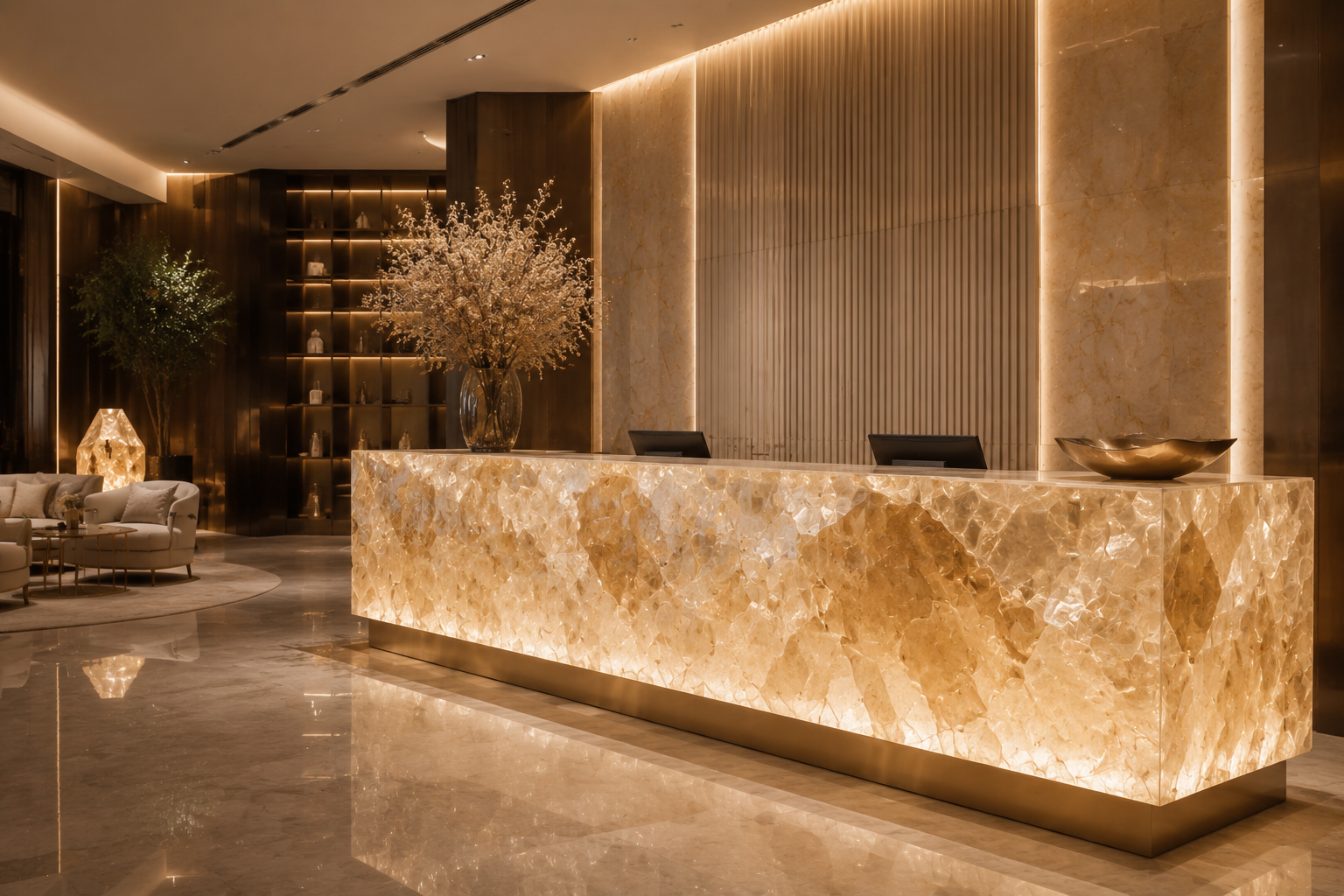
Designers should therefore treat material reflectance as a spatial tool. A narrow corridor can feel wider with light-toned wall panels, low-sheen finishes, and controlled linear lighting. A high lobby can feel warmer if timber, textile, or textured plaster absorbs some of the visual coldness. A compact waiting area can feel less crowded if transparent side tables, acrylic chairs, or glass screens allow sightlines to continue. A reception desk can feel more premium if the countertop material has depth, edge detail, and controlled reflection rather than a flat decorative surface.
Gensler’s 2025 Design Forecast describes the future of design in terms of sustainable, human-centered spaces and changing urban life. For hotel public areas, “human-centered” should not be interpreted only as furniture comfort. It also means controlling how materials and lighting affect orientation, mood, and stress. A guest arriving late at night should immediately understand where to check in, where to sit, where to wait, and where to move next. Materials can help create this order: a different floor insert can mark the arrival path, a warmer wall finish can identify the lounge zone, and a more tactile counter surface can signal the service point.
Practical rule: test materials under the actual color temperature and intensity planned for the site. A finish approved under office lighting may look completely different under warm lobby lighting. Material selection should always be reviewed together with lighting design, not after it.
3. Acoustic Comfort Is a Material Decision Guests Notice Only When It Fails
Noise is one of the most underestimated design problems in hotel public areas. A dramatic marble lobby, metal ceiling, glass wall, and hard leather furniture may look premium, but together they can create a harsh acoustic environment. Guests may not say “the reverberation time is too high,” but they will say the lobby feels chaotic, tiring, or uncomfortable. Staff will feel the same problem during long shifts.
The World Health Organization notes that excessive noise is associated with annoyance, sleep disturbance, hypertension, ischemic heart disease, cognitive impairment, and other health impacts. Although hotel lobbies are not the same as industrial noise environments, the principle is relevant: sound affects well-being and behavior. In public hospitality spaces, acoustic comfort influences whether guests want to sit, talk, work, order a drink, or leave quickly.
Materials are the first line of acoustic control. Carpets, rugs, acoustic plaster, upholstered seating, fabric wall panels, timber slats with absorptive backing, perforated panels, curtains, and textured ceilings all help soften sound. Hard materials such as stone, porcelain tile, glass, and metal should be balanced rather than simply multiplied. The goal is not to make a lobby silent, but to create a controlled soundscape: active near the bar, calm near the lounge, clear at reception, and quiet enough in waiting areas for guests to speak comfortably.
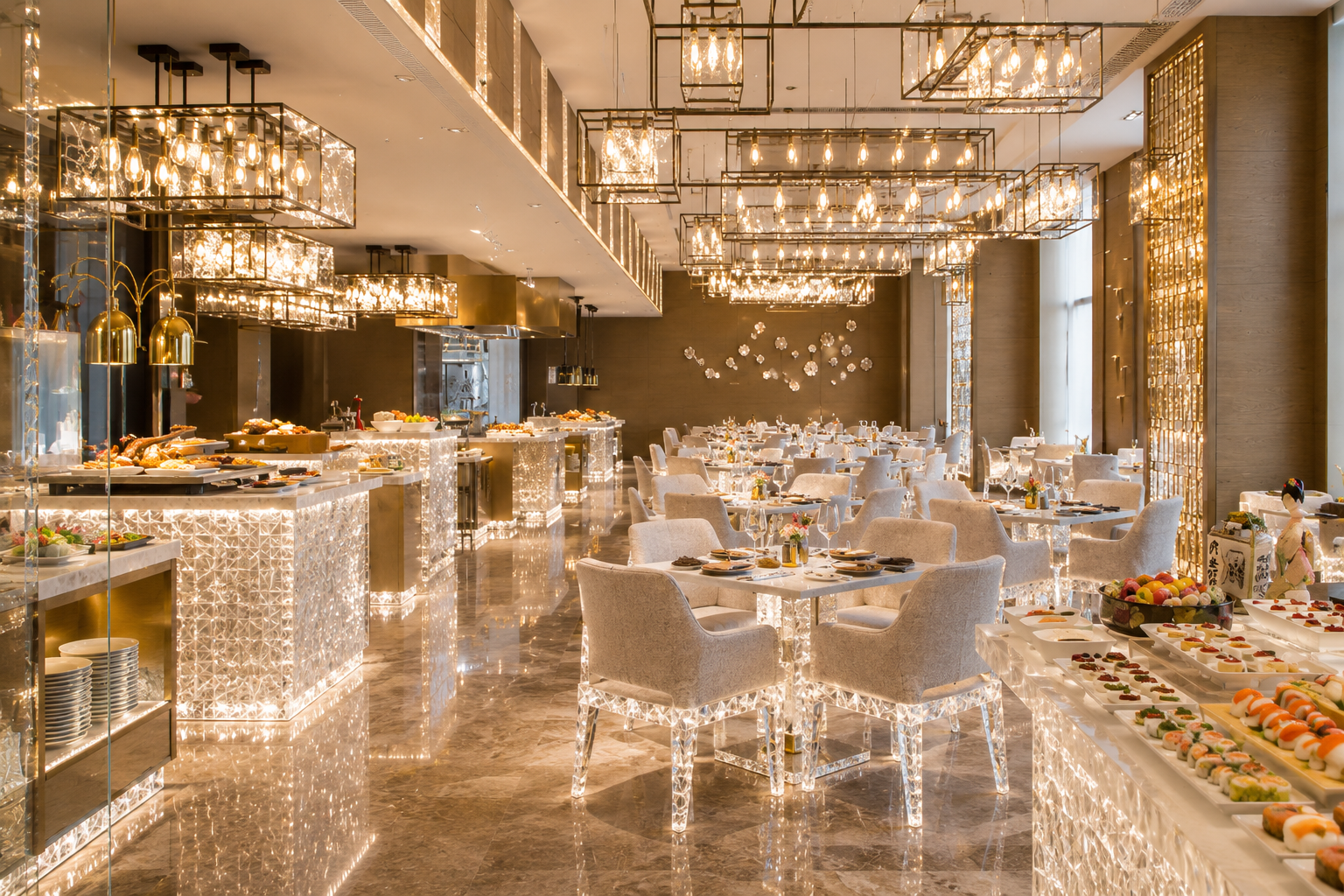
Consider a common hotel scenario. A lobby café is added to increase revenue and make the public area more social. The furniture looks stylish, but the floor is polished tile, the ceiling is gypsum board, the walls are glass, and the tables have metal legs. During breakfast and evening drinks, the space becomes loud. Guests avoid sitting for long, and staff struggle to hear orders. The design problem is not the café concept; it is the material mix. Adding acoustic ceiling zones, fabric-backed banquettes, area rugs, wood baffles, or upholstered partitions can preserve energy while reducing fatigue.
Acoustic comfort is also important in elevator halls and corridors. Hard corridors amplify rolling luggage, housekeeping carts, and door closings. A hotel may invest heavily in guest rooms but allow the public-to-private transition to feel noisy. Carpet runners, acoustic wall protection, softer wallcoverings, and better door details can make the journey from lobby to room feel more refined.
Practical rule: when a public area contains more than three major hard surfaces, introduce an acoustic strategy immediately. Sound should be designed, not corrected after opening.
4. Health, Air Quality, and Touch Safety Begin with Material Specification
Public-area materials influence not only appearance but also indoor environmental quality. Paints, adhesives, sealants, wood composites, wallcoverings, carpets, furniture, and cleaning chemicals can affect what guests and staff breathe. The U.S. Environmental Protection Agency identifies building materials and furnishings as potential sources of volatile organic compounds, and notes that products such as paints, solvents, wood preservatives, cleansers, disinfectants, and office equipment can release organic chemicals into indoor air. The American Lung Association similarly warns that building materials, plywood, furniture, pressed-wood products, paint, and furnishings can emit formaldehyde and other VOCs.
For hotels, this issue is practical rather than theoretical. Public areas are occupied by many types of users: children, elderly guests, business travelers working for hours, event attendees, staff, and visitors who may not stay overnight. A lobby that smells strongly of new finishes may be interpreted as “new,” but it can also be perceived as irritating or unhealthy. In luxury hospitality, real quality is often quiet: low odor, clean air, stable humidity, comfortable touch, and surfaces that do not feel chemically artificial.
The WELL Building Standard, administered by the International WELL Building Institute, is a performance-based framework that addresses built-environment features affecting human health and well-being, including air, light, comfort, and mind. ASHRAE’s Indoor Air Quality Guide is also written for architects, engineers, contractors, commissioning agents, and building professionals concerned with indoor air quality. These references show that material specification is part of building performance, not only interior styling.
In actual hotel projects, healthier material decisions include low-VOC paints and adhesives, certified wood products, formaldehyde-conscious panel selection, cleanable upholstery, antimicrobial claims that are verified rather than used as marketing language, and finishes compatible with the hotel’s cleaning protocols. A beautiful textured wallcovering may fail if it traps dust in a high-traffic corridor. A porous stone counter may stain quickly if used in a beverage-heavy lounge. A matte surface may look refined but show oil marks at hand-contact points. Material health and maintenance must be evaluated together.
Touch safety is another overlooked point. Reception counters, handrails, restroom vanities, elevator buttons surrounds, and dining surfaces are touched constantly. Materials should resist staining, support effective cleaning, and maintain their finish after repeated wiping. During specification, designers should ask operators what cleaning products are actually used, how often surfaces are cleaned, and whether the selected material can tolerate those routines.
Practical rule: do not approve public-area materials only by appearance. Review VOC information, cleaning compatibility, stain resistance, slip resistance, edge safety, and replacement availability before final selection.
5. Durability and Sustainability Are Part of Spatial Atmosphere
A hotel public area may look impressive on opening day, but its true design quality is revealed after years of operation. Scratched metal, chipped stone corners, stained fabric, yellowed plastics, swollen wood veneer, loose trims, and uneven floor joints quickly reduce perceived value. Guests may not know the material name, but they can read wear. A tired material makes the whole hotel feel poorly managed.
Durability should be considered as emotional design. A floor that remains flat, clean, and stable makes the lobby feel trustworthy. A counter edge that does not chip makes the service point feel cared for. A lounge chair that keeps its shape suggests comfort and investment. A corridor wall protection system that integrates with the design prevents the “back-of-house” feeling that appears when maintenance patches are added later.
Sustainability adds another layer. The World Green Building Council states that buildings are responsible for 39% of global energy-related carbon emissions, with 28% from operational emissions and 11% from materials and construction. This means that material selection affects not only the design image but also the environmental footprint of the project. In hospitality, the World Sustainable Hospitality Alliance provides the Hotel Carbon Measurement Initiative, a free methodology and tool for hotels to calculate the carbon footprint of stays and meetings. These frameworks show that hotels are increasingly expected to understand, measure, and communicate environmental performance.
For public-area design, sustainable material thinking should move beyond a simple “green material” label. A locally sourced stone that lasts 20 years may be more responsible than an imported trend material that needs replacement after three years. Refinishable timber may have better long-term value than a thin decorative surface. Modular carpet tiles can reduce replacement waste because damaged areas can be changed without removing the entire floor. Recycled-content acrylic or recyclable transparent furniture components may be useful in selected display, lounge, or retail areas when they reduce visual weight and can be maintained responsibly. The best sustainable choice is often the one that balances embodied carbon, durability, maintenance, repairability, and guest experience.
Design teams should also consider lifecycle cost. A cheaper surface may require frequent polishing, sealing, cleaning, or replacement. A more expensive material may be financially smarter if it reduces downtime and protects brand quality. In operating hotels, renovation work disrupts revenue. Therefore, durable public-area materials are not only design choices but also business-risk controls.
Practical rule: specify materials with a lifecycle plan. Ask how the material ages, how it is repaired, how it is cleaned, how it is replaced, and whether the replacement will still be available when the hotel needs it.
6. Local Storytelling Works Best When It Is Embedded in Material, Not Added as Theme Decor
Hotels increasingly want to feel connected to their location. However, many projects reduce local identity to artwork, pattern, or decorative props. This can feel superficial. A more convincing approach is to embed place into the material strategy: local stone, regional craft techniques, timber species, woven textures, ceramic traditions, color palettes drawn from the landscape, or contemporary interpretations of local architectural details.
Material storytelling is powerful because it is not limited to what guests consciously read. It is felt through temperature, texture, weight, shadow, and rhythm. A coastal hotel may use mineral plaster, pale timber, translucent glass, and woven seating to create a light, breezy atmosphere. An urban business hotel may use darker stone, bronze metal, leather, and clear acrylic accents to create precision and speed. A mountain resort may use heavy timber, rough stone, wool textiles, and soft lighting to create shelter and warmth. In each case, the material language tells guests where they are before signage explains it.
Public areas are especially important because they connect different hotel experiences. The lobby introduces the brand. The lounge invites dwell time. The elevator hall transitions to privacy. The restaurant threshold shifts the mood from arrival to dining. The restroom confirms hygiene and detail quality. The meeting pre-function area must feel efficient but not cold. Materials should create a sequence. When the sequence is coherent, guests feel that the hotel has a point of view.
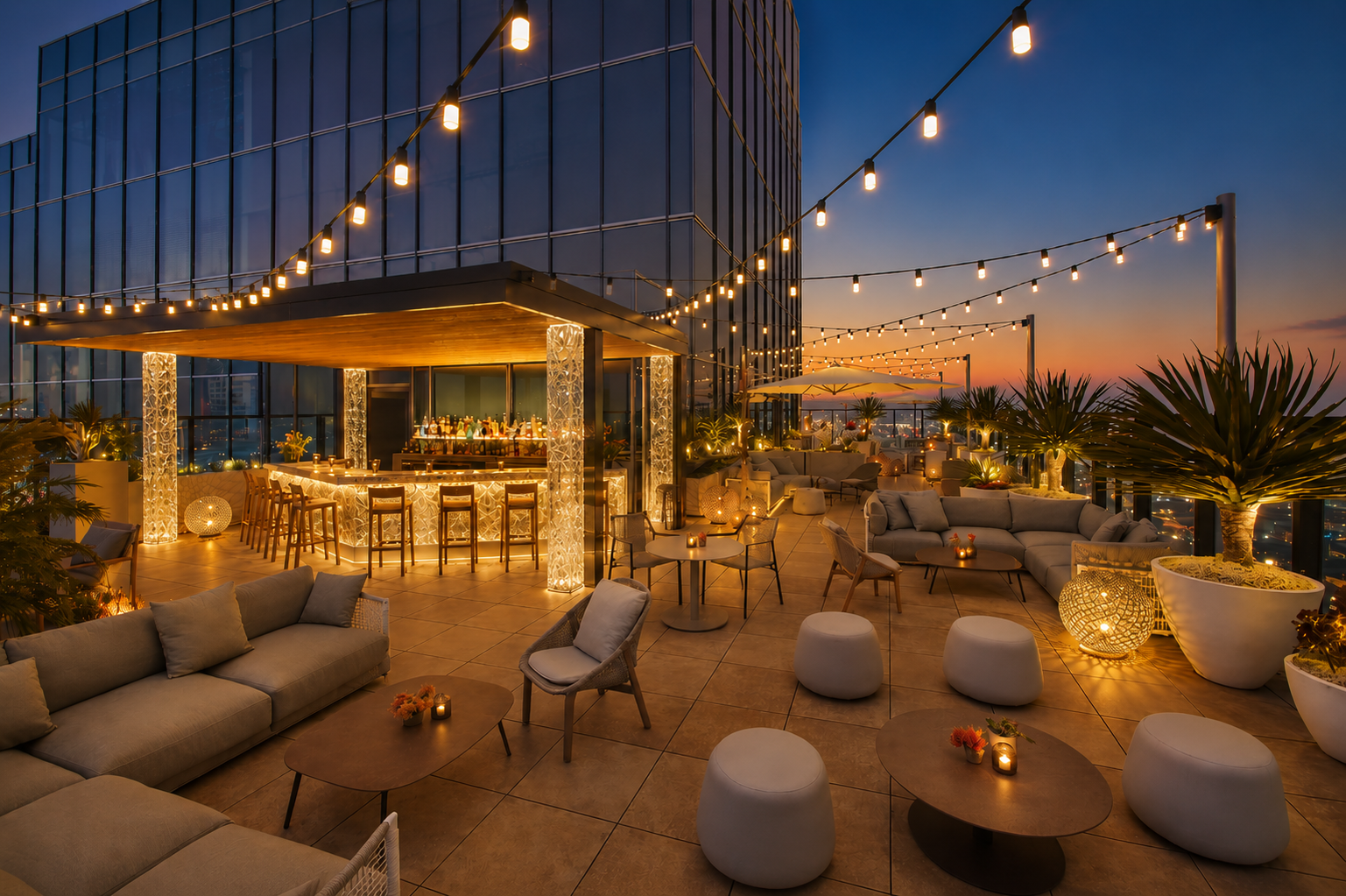
Actual practice requires restraint. Local material does not mean every surface should become rustic or symbolic. A refined hospitality project often uses local references through proportion, craft, and detail rather than literal imitation. For example, a lobby feature wall may reinterpret regional screen patterns in metal or acrylic. A reception counter may use local stone with a contemporary edge profile. A lounge may combine traditional weaving with modern upholstery. A display area may use transparent acrylic plinths so local art or products appear to float rather than being visually crowded by heavy furniture.
The key is authenticity. Materials should support the hotel’s operating model and target guest group. A luxury hotel can express locality through rare craft and precise detailing. A lifestyle hotel can express it through color, transparency, graphic material combinations, and flexible furniture. A resort can express it through tactile natural finishes and indoor-outdoor transitions. A convention hotel can express it through durable, large-scale materials that create identity without slowing circulation.
Practical rule: use material storytelling as part of the architectural system, not as decoration applied after the space is finished. The strongest local identity is felt before it is explained.
Conclusion: Material Is the Silent Manager of Hotel Public Space
The most overlooked design points in hotel public areas are not always hidden technical details. They are often ordinary surfaces that guests touch, hear, smell, photograph, and walk across every day. Flooring determines pace and safety. Walls determine warmth and identity. Ceilings determine sound and scale. Counters determine service quality. Furniture determines visual weight and dwell time. Transparent elements such as glass or acrylic furniture can open sightlines and reduce crowding. Textiles soften both sound and behavior. Durable materials protect the hotel’s investment. Low-emission materials support comfort and trust.
For hotel owners, designers, and procurement teams, the lesson is clear: material selection should not be postponed until the styling stage. It should begin with the business model, guest profile, maintenance capacity, brand positioning, and desired atmosphere. A hotel public area is successful when it looks beautiful, operates efficiently, ages gracefully, and makes guests feel that the space has a distinct character. Materials are the foundation of that result.
In professional hospitality design, the real question is not “What material is fashionable?” The better question is: “What will this material make guests feel, how will it perform under pressure, and what will it say about the hotel after years of use?”