1. Resort Furniture Is Becoming Part of the Destination Experience
Material selection in a resort hotel is no longer a purely decorative decision. It influences how guests perceive the destination, how they photograph and remember the property, how efficiently the hotel operates, and how well the furniture retains its value under demanding environmental conditions.
Unlike an urban business hotel, a resort is normally sold as an experience of place. Guests are not simply purchasing a room; they are purchasing access to a coastline, island, forest, mountain, desert, cultural community, or wellness environment. The furniture must therefore support the destination story rather than look as though it could have been installed in any hotel anywhere in the world.
This shift is visible in current hospitality research. Booking.com’s 2025 travel and sustainability study found that 77 percent of global travelers were seeking authentic experiences representative of local culture, while 73 percent wanted the money they spent to benefit local communities. These expectations directly affect interior design because locally relevant materials, regional craftsmanship, and destination-specific furniture are among the most immediate ways a hotel can communicate cultural authenticity.
Leading hospitality designers are also moving away from standardized luxury. In its 2025 trend analysis, Wimberly Interiors identified authentic cultural storytelling, local material sourcing, artisan collaboration, multisensory design, and sculptural furniture as important directions in hospitality interiors. The firm observed that guests increasingly want the hotel itself to become part of the journey rather than function only as accommodation.
Hotel Management reported a similar change after interviewing design leaders from Arcadis. The designers argued that “cookie-cutter” hotel concepts are losing relevance and that customization is becoming important even in more standardized hotel categories. According to the report, distinctive properties increasingly use location-specific programming, flexible layouts, and personalized design to create a stronger sense of exclusivity.
For furniture manufacturers, this development changes the sales conversation. A resort buyer is not only asking whether a table, console, bench, or reception desk looks attractive. The buyer also wants to know whether the product supports the hotel concept, can survive the destination’s climate, is practical for housekeeping, can be manufactured consistently, and is sufficiently distinctive to justify a premium price.
Five major material trends are shaping these decisions. Natural textures are being used to establish emotional warmth and a connection to place. Transparent materials are reducing visual weight and protecting valuable views. Bespoke pieces are becoming tools for brand storytelling. Sustainability claims are being replaced by traceable data and lifecycle thinking. Finally, designers are combining natural and engineered materials to achieve the appearance of handcrafted luxury without sacrificing commercial performance.
These trends should not be understood as temporary fashions. They reflect deeper changes in how resort developers define value. The most successful material is no longer necessarily the most expensive or visually extravagant. It is the material that combines emotional impact, operational reliability, documented quality, and a clear relationship to the destination.
For manufacturers of synthetic crystal furniture, artistic cast resin, and premium cast acrylic furniture, this creates an important opportunity. Transparent furniture can respond to several trends simultaneously: it can preserve views, carry customized colors and embedded elements, create a recognizable visual signature, and form a controlled contrast with stone, timber, metal, and woven materials. To gain acceptance in international projects, however, it must be presented not simply as decorative clear furniture but as a technically documented hospitality product.
2. Trend One: Natural Texture Is Replacing Generic Luxury
Natural texture has become one of the strongest visual languages in resort design. Instead of relying on polished surfaces throughout the property, designers are using stone grain, timber character, woven fibers, handmade ceramics, textured plaster, rammed earth, linen, leather, and deliberately irregular finishes to create spaces that feel grounded and sensory.
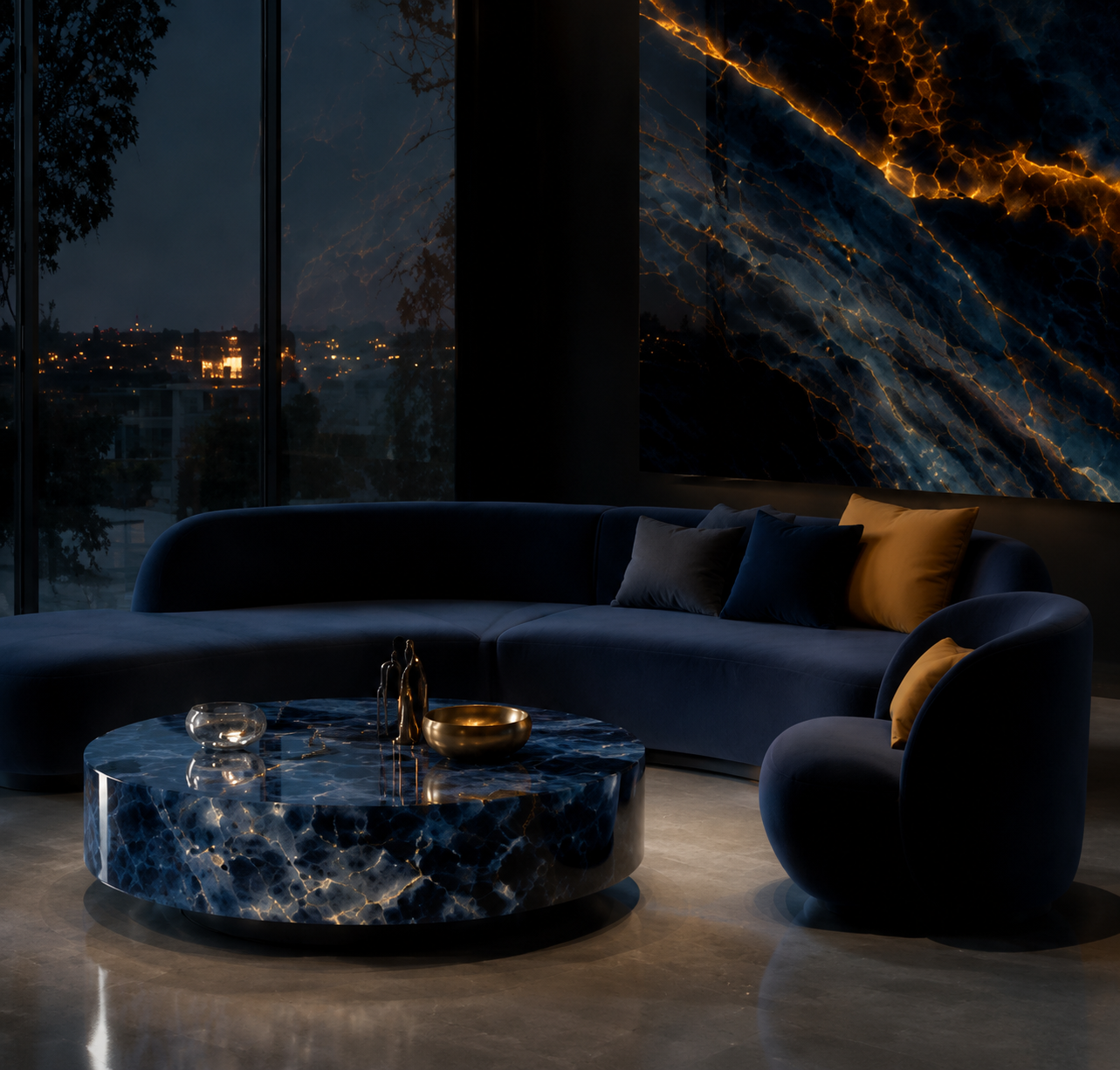
This movement does not mean that resort interiors are becoming rustic. In high-end hospitality, natural texture is usually carefully edited. A rough stone wall may be paired with precisely finished furniture. A woven rattan panel may sit within a metal frame. A timber table may be combined with a transparent resin base. The objective is to retain the emotional qualities of natural materials while controlling their performance and visual composition.
Hotelito MUSA on Mexico’s Pacific coast provides a useful example. According to Design Hotels, the property uses natural materials, organic textures, and locally handmade elements throughout its public spaces. Its black terrazzo floors were made onsite with stone and granite found on the land, custom tiles and mosaics were produced by craftspeople in Oaxaca, and bespoke furniture made from Parota and palm wood was built by local carpenters. The result is not a generic “tropical” interior but a design language directly connected to the site and its creative community.
A different interpretation appears at the cōmodo in Bad Gastein, Austria. The Alpine hotel combines custom furniture, natural wood floors, organic textiles, oak, pine, original terrazzo, and panoramic windows. These materials reference the surrounding landscape while supporting the property’s midcentury and Viennese design influences. The example demonstrates that a sense of place does not require literal decoration. Material texture, color, craftsmanship, and proportion can communicate location more convincingly than obvious cultural symbols.
For resort furniture, natural texture offers several commercial advantages. It makes large spaces feel warmer, improves the perception of craftsmanship, and creates visual depth under changing daylight. In guestrooms, textured headboards, timber cabinets, woven panels, and stone-topped tables can make standardized room plans feel more individual. In lobbies and restaurants, natural variation gives guests more details to discover as they move through the property.
The challenge is that natural appearance does not automatically guarantee commercial suitability. Timber can expand or contract when humidity changes. Natural stone can stain, etch, or chip. Woven fibers may loosen, absorb moisture, or be difficult to repair. Handmade products can vary beyond the tolerances accepted by an international hotel operator.
The trend is therefore moving toward controlled naturality. Designers want surfaces that retain variation, but procurement teams still require approved color ranges, dimensional tolerances, moisture controls, finish specifications, replacement procedures, and maintenance instructions.
Responsible sourcing is also becoming a practical requirement. The Forest Stewardship Council reports that more than 6,000 FSC-certified companies operate in the indoor furniture sector worldwide. FSC certification gives furniture buyers a recognized chain-of-custody framework for verifying forest-based materials rather than relying solely on a supplier’s environmental claims.
Transparent resin and acrylic furniture can complement this trend rather than compete with it. A clear table base allows the grain of a timber top to remain visually dominant. A transparent console placed in front of a stone wall preserves the texture instead of hiding it. Cast resin can also encapsulate selected natural materials, such as mineral fragments, shells, dried botanical elements, wood pieces, or woven structures, transforming them into a controlled artistic surface.
The key is restraint. Artificially embedding too many natural objects can make a piece look like a souvenir rather than luxury furniture. For an international resort, the inclusion should be conceptually connected to the destination, professionally composed, and approved through full-size samples. A subtle layer of local stone, metallic sand tones, or botanical forms can create a stronger impression than an overloaded decorative casting.
The buyer’s underlying concern is authenticity. Natural texture works when the guest believes that the furniture belongs to that particular property. A manufacturer should therefore begin with the hotel’s location, architecture, landscape, and cultural narrative before proposing colors or inclusions. The material story should be specific enough that the same product would not make equal sense in every resort.

3. Trend Two: Visual Transparency Is Being Used to Protect Space, Light, and Views
Resort architecture is frequently organized around valuable views. Ocean horizons, tropical gardens, mountain scenery, pools, and landscaped courtyards are central to the room rate and guest experience. Furniture that interrupts these views can weaken the architecture, even when the furniture itself is expensive.
This is why visually lightweight materials are gaining importance. Clear acrylic, translucent resin, glass, slim metal structures, open-weave materials, and floating forms allow designers to furnish a space without creating excessive visual obstruction.
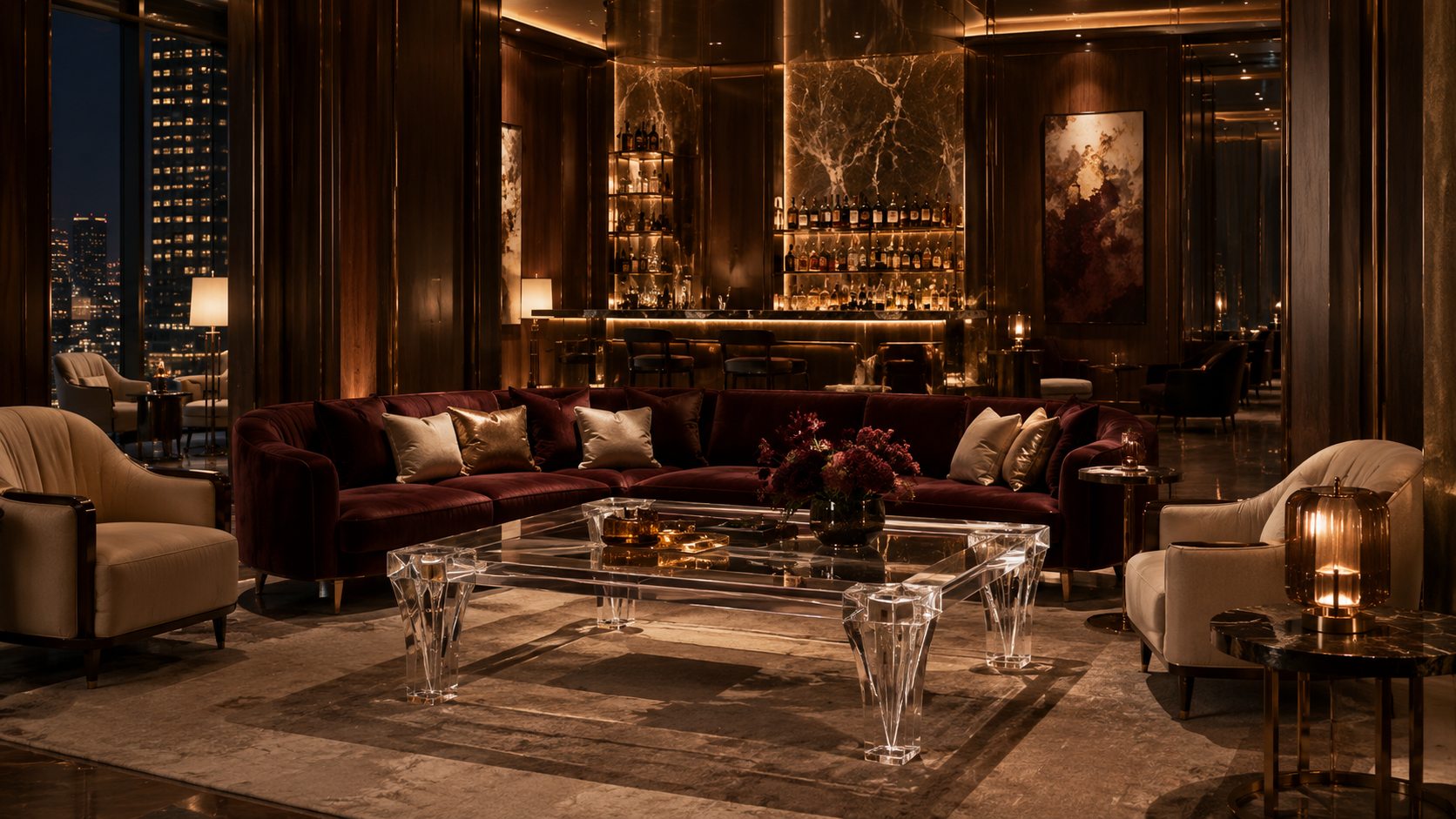
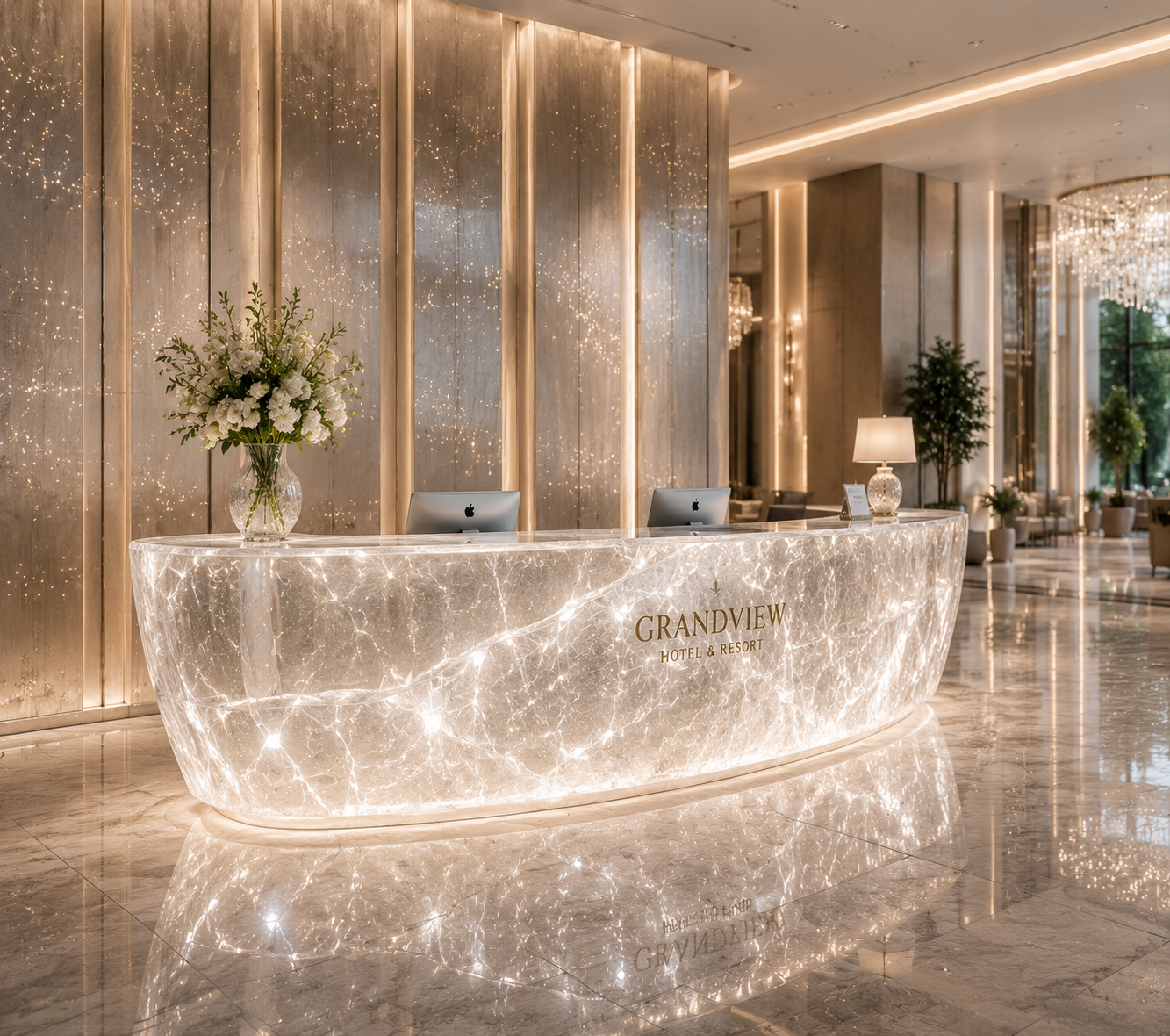
Transparency is particularly useful in sea-view villas, rooftop lounges, pool areas, spa reception spaces, and guestrooms with floor-to-ceiling windows. A solid dark console can divide a room visually, while a clear acrylic console performs the same function without closing the space. A transparent side table can sit beside a lounge chair without competing with the landscape. A translucent reception desk can provide presence while still allowing light to move through the lobby.
The practical value of preserving views is illustrated by resort projects such as Hilton Wenchang, where the design team treated the ocean view as a central lobby priority. Hospitality Design reported that the architecture was arranged to preserve those views and create a strong visual progression through the public space. This principle extends naturally to furniture selection: the closer a piece is to an important sightline, the more carefully its visual mass should be controlled.
Premium cast acrylic is particularly effective because it combines transparency with fabrication flexibility. According to Röhm, clear transparent PLEXIGLAS acrylic products can provide visible-light transmission of up to 92 percent. The company also states that selected clear products retain very high light transmission over extended outdoor exposure because of the material’s inherent UV stability. Performance varies by product grade, thickness, region, fabrication process, and application, so the precise grade must always be confirmed for a furniture project.
High light transmission gives designers more than a “clear” appearance. Thick acrylic can create optical depth, reflections, edge highlights, and refracted color without the greenish cast that can appear in some thick transparent materials. Colored or translucent grades can soften light, produce atmospheric shadows, or reinforce a resort’s brand palette.
Artistic resin offers a different type of transparency. While acrylic is often chosen for precision, optical clarity, clean bonding, and architectural geometry, cast resin is particularly useful for sculptural shapes, organic edges, gradients, layered colors, suspended elements, and one-of-a-kind artistic effects.
The Hotel MdR Marina del Rey demonstrates how resin can be used as a hospitality focal point. Hospitality Design reported that its lobby combined reclaimed wood, metal accents, blue lighting, and sculptural resin reception desks. The contrast between warm natural materials and contemporary resin created a strong connection to the hotel’s coastal identity without requiring the entire interior to be made from a single material.
This mixed-material approach is commercially more effective than filling a resort with transparent furniture. When used everywhere, clear furniture can feel cold, repetitive, or overly theatrical. When concentrated in selected locations, it becomes a visual signature.
Suitable applications include a lobby console, reception desk, communal table, bar feature, display pedestal, presidential-suite dining table, pool-villa side table, sculptural bench, or illuminated room divider. These pieces occupy locations where transparency, light, and artistic impact create measurable design value.
The international buyer will nevertheless evaluate transparent furniture very closely. Scratches, cloudy edges, bubbles, visible joints, internal stress, yellowing, distortion, and poor packaging are more obvious in transparent products than in opaque furniture. A small imperfection that would disappear in timber can become highly visible inside a thick clear block.
Manufacturers should avoid unsupported statements such as “completely scratch-proof” or “never yellows.” A more credible approach is to identify the exact resin or acrylic system, explain its intended environment, provide test data where available, and define the cleaning and refurbishment process.
ASTM D1044 provides a recognized method for estimating the abrasion resistance of transparent plastics by measuring changes in optical properties after surface abrasion. ASTM D4329 covers procedures for fluorescent ultraviolet and water exposure of plastics. These methods do not guarantee furniture performance on their own, but they provide an objective basis for discussing surface durability and weathering behavior.
For export communication, “platinum acrylic” should normally be positioned as a proprietary collection or premium product name unless it corresponds to a documented technical grade. The specification should also state the underlying material clearly, such as premium cast acrylic or cast PMMA. Overseas designers and procurement teams need to know what they are specifying, how it is manufactured, and what performance documentation supports the product.
4. Trend Three: Bespoke Furniture Is Becoming a Form of Brand Storytelling
Customization in luxury resorts is moving beyond changing the upholstery color or adjusting a standard table dimension. Designers increasingly use bespoke furniture to translate the resort’s location, brand values, architecture, and guest journey into physical objects.
Hotel Management’s 2025 design coverage reported that local culture, artisanal craftsmanship, and bespoke elements are gaining importance as standardized, purely opulent luxury loses relevance. Designers interviewed by the publication described a shift toward more purposeful environments with distinctive local identities and flexible, personalized experiences.
This trend is commercially significant because furniture is one of the design elements guests encounter at close range. They touch the reception desk, place belongings on the console, sit at the bar, use the bedside table, and gather around communal furniture. A custom piece can therefore communicate the hotel concept more directly than an architectural feature that remains physically distant.
A beach resort may commission a resin table with layered blue-green tones inspired by shallow and deep water. A desert property may use amber, sand, smoke, and mineral effects. A mountain retreat may select a clear sculptural base that references ice, rock fractures, or flowing water. An urban resort may use embedded metal mesh, architectural fragments, or controlled colored layers that connect the piece to the city.
The most successful custom furniture does not simply copy a natural form. A table shaped exactly like a shell or a wave can quickly become literal or themed. More sophisticated projects extract an abstract quality from the destination: movement, transparency, erosion, reflection, rhythm, color transition, or geological layering.
This is where synthetic crystal, artistic resin, and premium cast acrylic offer strong design potential. Their color, thickness, transparency, translucency, inclusions, edge profiles, and lighting effects can all be customized. Unlike natural stone, which is limited by available blocks and geological variation, cast materials allow the manufacturer to control composition while still creating unique visual effects.
Customization must, however, remain manufacturable. A concept rendering may show a seamless, perfectly transparent object with an impossible span, an extremely sharp edge, or an unsupported form. The manufacturer’s role is to preserve the design intention while resolving structure, casting sequence, bonding, polishing, internal stress, tolerances, installation, and shipping.
Full-scale mockups are particularly important for transparent furniture. A small color chip cannot demonstrate optical distortion, the visibility of a joint, the depth of an inclusion, or the way a large surface reacts to daylight. A one-to-one corner sample, edge sample, or complete prototype gives the designer and buyer a more reliable basis for approval.
Custom work also requires disciplined sample control. The approved sample should define acceptable color variation, bubble limits, embedded-element placement, transparency, edge quality, surface gloss, joint appearance, and dimensions. Photographs are useful, but physical samples remain important because transparent and reflective materials can look very different under various lighting conditions.
From a sales perspective, the strongest proposition is not “we can make any design.” That promise can create risk because not every concept is structurally safe, commercially practical, or repeatable. A more professional message is that the manufacturer can translate a creative concept into a controlled hospitality product through material engineering, prototyping, testing, production planning, and quality inspection.
The manufacturer should also understand where customization produces the greatest return. A hotel may not need a unique design for every bedside table in 300 rooms. The cost, production time, and replacement complexity may be difficult to justify. Instead, custom transparent furniture can be concentrated in the lobby, signature restaurant, spa, presidential suite, show villa, or other highly visible areas.
A practical strategy is to create a design family. One signature resin or acrylic concept can be adapted into a reception desk, console, side table, sculpture, and lighting detail. The pieces remain related without being identical. This creates stronger brand consistency and allows the manufacturer to reuse approved colors, molds, detailing, and technical solutions.
Customization can also support storytelling after the hotel opens. Guests may ask how a transparent table was made, what the embedded material represents, or why a particular color was selected. These questions give the hotel an opportunity to communicate its relationship with the destination and its collaboration with designers, artists, craftspeople, and manufacturers.
In this sense, bespoke furniture is no longer only a product. It becomes part of the resort’s content, marketing, photography, guest conversation, and long-term identity.
5. Trend Four: Sustainability Is Moving from Visual Style to Verifiable Performance
Natural colors, recycled-looking textures, and plant-filled spaces may appear sustainable, but appearance is not evidence. Resort developers and international design firms are increasingly asking suppliers to support environmental claims with material declarations, certification, emissions information, responsible sourcing records, durability data, and realistic end-of-life strategies.
Consumer expectations are helping to drive this change. Booking.com’s 2025 research found that sustainable travel remained important to 84 percent of global travelers, while 93 percent said they wanted to make more sustainable travel choices and had taken action to some extent. The same study found growing interest in supporting local communities and protecting destinations, showing that environmental and social considerations are becoming connected in the traveler’s mind.
The World Travel & Tourism Council has established Hotel Sustainability Basics as a globally coordinated framework of 12 fundamental actions for hotels. WTTC describes the framework as an initial step that can lead to more ambitious sustainability pathways, while also helping hotels address customer expectations, management, reporting, reputation, operational efficiency, and evolving regulation.
For furniture selection, the sustainability discussion increasingly focuses on the full lifecycle. The World Green Building Council reports that buildings account for 39 percent of global energy-related carbon emissions, with 11 percentage points associated with materials and construction. It has called for greater transparency, verification, and reductions in embodied carbon across the building lifecycle.
This has important implications for resort furniture. Replacing damaged furniture every few years consumes raw materials, production energy, packaging, freight, installation labor, and disposal capacity. A durable piece that can be refinished, polished, repaired, or partially replaced may provide greater long-term value than a lower-cost product with a short service life.
For timber and other forest-based components, recognized certification can strengthen a proposal. FSC’s chain-of-custody system helps buyers verify responsible forest sourcing through a documented supply chain.
For resin and acrylic furniture, sustainability requires particularly careful language. These materials should not be described as environmentally friendly merely because they are transparent, lightweight in appearance, or visually minimal. Suppliers need to explain their actual practices.
Relevant measures may include optimizing molds to reduce casting waste, controlling rejection rates, reusing suitable offcuts, designing separable metal and acrylic components, reducing unnecessary material thickness, using durable grades, offering surface refurbishment, replacing damaged components instead of complete products, minimizing packaging volume, and documenting the disposal or recycling routes available in the destination market.
Chemical emissions and indoor air quality may also be relevant, especially for furniture installed in guestrooms, spas, restaurants, and other occupied interiors. UL Solutions states that GREENGUARD certification evaluates products against scientific criteria for low chemical emissions and can support indoor-air-quality requirements in building programs and procurement specifications. Certification should only be claimed for the exact tested product or material system, not assumed from a similar product.
The distinction between durability and sustainability is also important. A long-lasting product can reduce replacement, but longevity alone does not answer questions about raw materials, manufacturing emissions, repairability, or end-of-life handling. Similarly, a product containing recycled content is not automatically suitable for a hotel if it fails quickly under commercial use.
A credible supplier should therefore present a balanced material profile. It should identify what is known, what has been tested, what can be documented, and what remains project-specific. International buyers generally respond more positively to transparent limitations than to exaggerated green claims.
A useful export package may include the material composition, country of origin, manufacturing process, available environmental declarations, recycled content where verified, VOC or emissions data where applicable, estimated packaging volume, maintenance requirements, repair options, expected service conditions, and end-of-life recommendations.
Sustainability is becoming a procurement discipline rather than a visual theme. Manufacturers that can provide documentation, reduce replacement risk, and demonstrate responsible production will be better positioned than suppliers relying only on attractive photography and broad environmental language.
6. Trend Five: Hybrid Material Design Is Balancing Luxury with Resort-Level Performance
The final trend is the growing use of hybrid material systems. Resort designers are combining stone, timber, metal, woven fibers, resin, and acrylic so that each material performs the role for which it is best suited.
This approach recognizes a fundamental reality: no single material can satisfy every requirement in a resort. Natural stone provides weight and permanence but may be difficult to move and vulnerable to certain stains. Timber adds warmth but can react to humidity. Metal creates thin, strong structures but may corrode in coastal environments if the wrong grade or finish is selected. Transparent acrylic preserves sightlines but requires careful surface maintenance. Artistic resin enables complex forms but requires strict control over casting, UV exposure, color stability, and structural design.
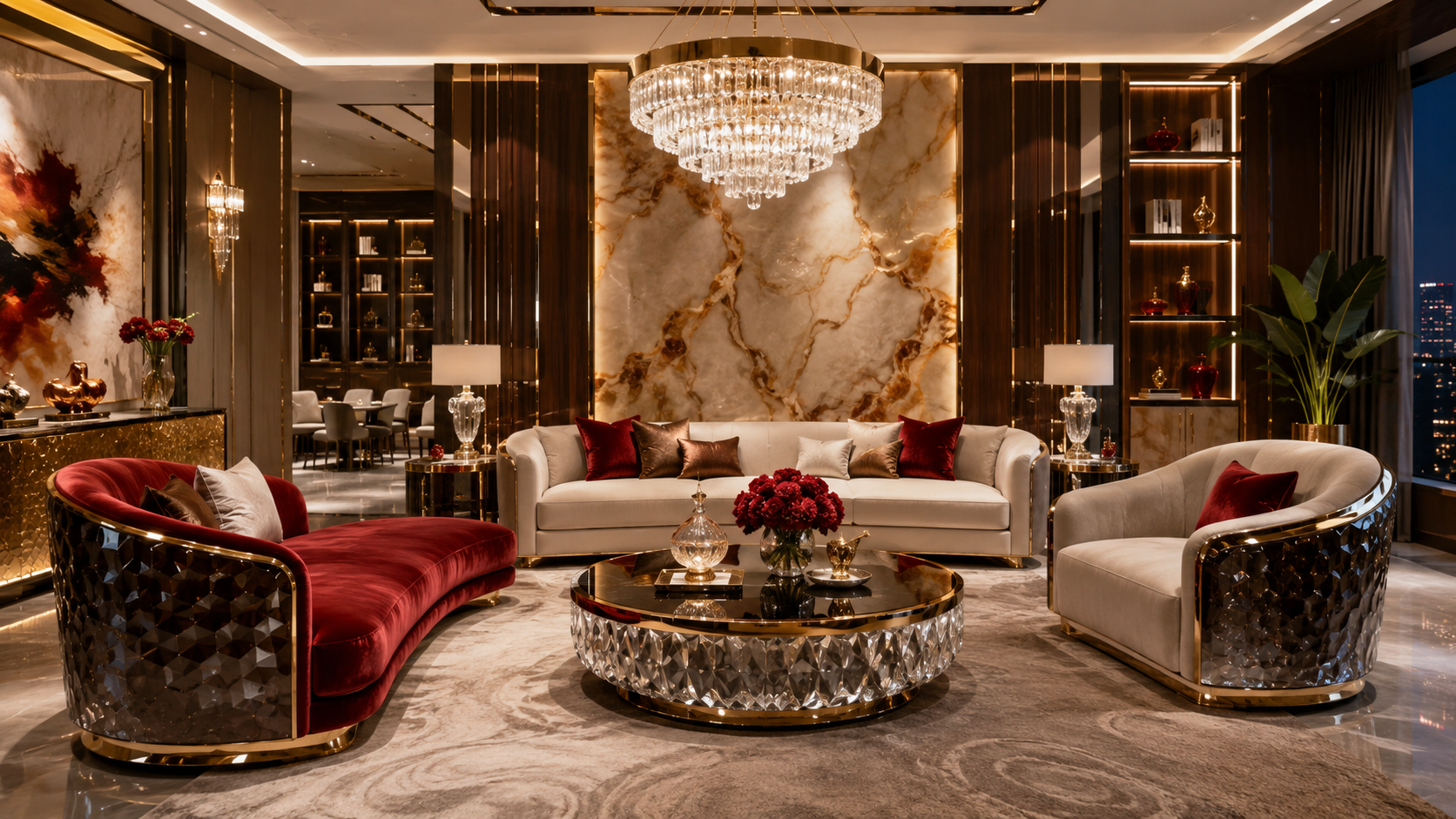
By combining materials, designers can create furniture that appears visually expressive while remaining practical. A stone top can be supported by a transparent acrylic base, reducing visual heaviness. A resin tabletop can contain a concealed metal reinforcement system. A timber console can use acrylic legs to preserve views. A clear pedestal can display local craft without competing with it. A woven panel can be mounted in a replaceable frame rather than permanently bonded into the furniture.
Material contrast also makes each component more noticeable. Rough stone appears more tactile beside a polished transparent surface. Warm timber feels richer next to clear acrylic. Brushed metal becomes more precise when seen through cast resin. The objective is not to use as many materials as possible, but to give every material a clear visual and technical function.
Resort conditions make this performance-led approach essential. Coastal air, humidity, ultraviolet exposure, wet swimwear, sunscreen, food and beverage spills, housekeeping chemicals, luggage impact, and continuous guest turnover place significant stress on furniture.
A product that performs well in a residential showroom may not be suitable for a pool villa or lobby. Transparent horizontal surfaces in high-contact areas may require a harder surface treatment, a replaceable protection layer, or a defined polishing process. Resin pieces positioned in strong sunlight require an appropriate UV-stability strategy. Metal components near the sea require correct grade selection and coating preparation. Timber parts require controlled moisture content and a finish suitable for the destination climate.
Commercial performance standards can provide a useful reference point. BIFMA develops safety, performance, and sustainability standards for furniture, helping buyers and manufacturers discuss durability through recognized testing rather than appearance alone. The exact applicable standard will depend on the product type and project requirements, but the broader principle is relevant to hospitality procurement: furniture must be evaluated as equipment used repeatedly by the public, not merely as decoration.
Maintenance planning should begin during product development. Housekeeping teams need to know which cloths, cleaning agents, and techniques are approved. Engineering teams need access to repair procedures and replacement components. Purchasing teams need to know whether the original color, resin formulation, acrylic grade, metal finish, or stone type can be reproduced several years later.
Packaging must also be considered part of the product. Transparent furniture can leave the factory in perfect condition and still arrive damaged if protective materials rub against polished surfaces, if crates allow movement, or if lifting pressure is applied in the wrong location. Export packaging should account for vibration, impact, humidity, container temperature changes, unloading equipment, and the final route from the loading area to the installed position.
Large monolithic-looking pieces may need to be divided into transportable sections. The challenge is to design joints that are structurally reliable and visually controlled. Installation drawings should identify lifting points, component weights, assembly sequences, acceptable floor tolerances, electrical requirements for illuminated products, and the procedures for removing protective film.
For manufacturers of synthetic crystal, high-end resin, and premium cast acrylic furniture, the strongest competitive position lies at the intersection of art and engineering. A visually dramatic product attracts the designer, but documented performance gives the hotel owner confidence. Custom color and form create differentiation, while controlled production, inspection, packaging, and after-sales support reduce project risk.
The future of resort furniture will not be defined by a choice between natural and engineered materials. It will be defined by how intelligently those materials are combined.
Natural textures will provide warmth and authenticity. Transparent materials will preserve views and manipulate light. Custom design will create recognizable brand moments. Verified sustainability will influence procurement decisions. Hybrid construction will help furniture survive demanding resort conditions.
When these five trends are treated as one integrated strategy, furniture becomes more than an interior component. It becomes a connection between the destination, the architecture, the guest experience, and the operational needs of the hotel.
For a specialist transparent-furniture manufacturer, this means selling more than synthetic crystal, resin, or acrylic. The real product is a customized hospitality solution: one that translates the resort’s story into a memorable object, provides clear technical documentation, supports international installation and maintenance, and continues to look valuable long after the opening photographs have been taken.
READ MORE:
READ MORE:
READ MORE:
- From Island Hotels to Desert Resorts: Material Design Inspiration for International Resort Projects
- Making Hotel Spaces Feel Lighter: The Application of Transparent Resin and Acrylic Furniture in Resort Projects
- Natural Stone, Wood, Resin, or Acrylic? A Comparative Guide to Resort Hotel Furniture Materials
- Four Materials Commonly Used in International Luxury Resorts: From Natural Texture to Transparent Art Furniture
- Synthetic Crystal Acrylic Furniture: Why It Is Becoming the “Finishing Touch” in High-End Spaces
- When Furniture Gains a Crystal-Like Texture: How the Buying Logic of High-End Customers Is Changing
- Synthetic Crystal Acrylic Furniture: A New Direction for Brands to Escape Homogeneous Competition
- Why the Future of Furniture Competition Is Not Only About Design, but Also About Materials
- From Transparency to Luxury: How Synthetic Crystal Acrylic Enhances the Perceived Value of Furniture


