
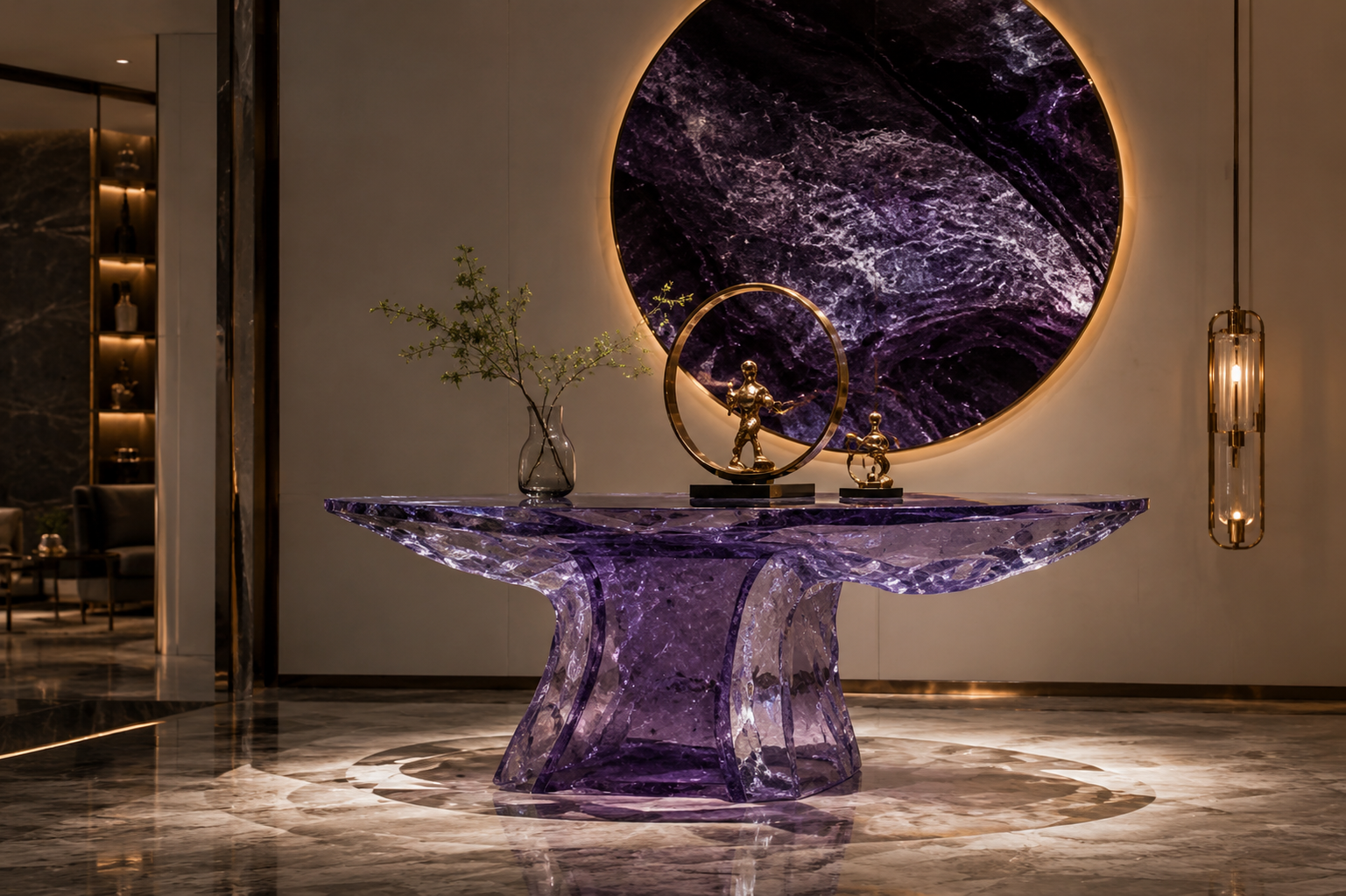
Transparent and translucent furniture has moved far beyond the novelty category. In contemporary homes, crystal-clear console tables, sculptural resin bases, acrylic dining chairs, illuminated cabinets, decorative pedestals, and translucent room dividers are increasingly used to make interiors feel lighter, larger, and more distinctive.
However, materials that appear similar in a showroom can perform very differently after five or ten years of daily use. Sunlight, cleaning chemicals, hot objects, repeated loading, children, pets, moving, humidity, and manufacturing quality all influence whether a transparent furniture piece remains elegant or gradually becomes yellow, scratched, cloudy, cracked, or unstable.
For homeowners, designers, furniture brands, and project buyers, the real question is therefore not simply which material looks most luxurious when new. The more important question is which material can maintain its appearance, structural reliability, indoor suitability, and serviceability over the longest practical period.
Synthetic crystal, high-end resin, and platinum acrylic can all be appropriate for residential furniture, but they are not interchangeable. Each material solves a different design problem. Platinum acrylic generally offers the strongest all-around balance for long-term transparent furniture, high-end resin provides the greatest freedom for artistic casting and embedded designs, while synthetic crystal is especially effective when visual mass, brilliance, and a gemstone-like appearance are the main priorities.
The final result, however, depends on the actual chemical formulation, stabilization system, fabrication process, structural design, surface treatment, and quality-control standards—not on the commercial name alone.
1. The First Decision Should Be Based on Material Chemistry, Not Marketing Names
The most important step in comparing these materials is understanding what the names actually represent. “High-end resin” describes a broad family rather than one specific material. Transparent furniture resins may be based on epoxy, unsaturated polyester, polyurethane, acrylic-modified systems, or proprietary hybrid formulations. Two products sold under the same general description can have very different hardness, ultraviolet resistance, heat resistance, curing shrinkage, odor, color stability, and repairability.
Transparent epoxy casting systems, for example, are frequently used for river tables, decorative furniture, embedded objects, artistic panels, and deep transparent forms. Sika describes one of its professional transparent epoxy systems as suitable for furniture, art, decoration, embedded objects, and deep castings of up to 45 millimeters under specified processing conditions. The same technical information emphasizes that temperature, casting volume, layer thickness, sealing, degassing, and polishing must be controlled carefully. This demonstrates an important reality: resin performance is closely connected to processing quality. A premium resin formula can still produce an inferior product when the mixing ratio, curing temperature, mold preparation, or post-curing process is poorly controlled.
“Synthetic crystal” is even more dependent on supplier definition. In furniture and decorative-product markets, it often refers to a transparent cast material designed to imitate the depth and brilliance of natural crystal rather than to a laboratory-grown crystalline mineral. In some manufacturing systems, synthetic-crystal furniture is produced from specially formulated transparent polyester resin. A Chinese patent for crystal-style artistic furniture, for example, describes casting a mixture based on unsaturated polyester “crystal resin,” curing agents, accelerators, ultraviolet absorbers, and anti-deformation additives before post-curing, sanding, and applying a transparent protective layer. This does not mean every synthetic-crystal product uses the same formulation, but it shows why the commercial name alone cannot identify the underlying chemistry.
“Platinum acrylic” should likewise be treated as a premium product category rather than a universally standardized polymer grade. In most furniture applications, it refers to high-quality polymethyl methacrylate, commonly known as PMMA or acrylic glass, selected and processed for superior transparency, color consistency, polished edges, thickness control, and visual refinement. The “platinum” designation may also communicate a particular tint, finish, manufacturing standard, or premium positioning. Buyers should therefore confirm whether the product is cell-cast PMMA, extruded PMMA, impact-modified acrylic, coated acrylic, recycled-content acrylic, or another transparent polymer.
This distinction matters because cast and extruded acrylic do not always behave identically. NIST research published in 2025 examined more than 20 commercially available PMMA products and found measurable differences between formulations, including differences between cast and extruded materials during thermal decomposition and fire testing. The study did not evaluate furniture service life directly, but it confirms that “acrylic” is not a guarantee that all sheets will perform identically. Material grade and manufacturing route matter.
A professional furniture specification should therefore identify the polymer family, casting or extrusion method, sheet or casting grade, UV-stabilization system, surface coating, recommended service temperature, emissions documentation, load requirements, and cleaning restrictions. Technical data sheets, safety data sheets, third-party test reports, and approved physical samples are more valuable than descriptions such as “premium,” “crystal grade,” “high-end,” or “platinum.”
For long-term residential use, platinum acrylic has an advantage because PMMA is a clearly identifiable engineering material with established fabrication practices and extensive historical use in glazing, displays, lighting, transportation, and furniture. Resin and synthetic crystal can also perform well, but the buyer must investigate the formulation more carefully because the category contains a wider range of possible chemistries and performance levels.

2. Optical Quality and Design Freedom Create Different Kinds of Luxury
The three materials do not create the same visual experience. Platinum acrylic is most successful when a design requires clean transparency, precise geometry, controlled reflections, polished edges, and a visually weightless appearance. It allows a console, side table, chair, shelf, or display cabinet to occupy physical space without making a room feel crowded. This is especially valuable in apartments, narrow entrances, modern living rooms, dressing areas, and interiors where natural light must continue through the furniture.
Premium PMMA can provide exceptionally high clarity while remaining much lighter and less vulnerable to dangerous shattering than conventional glass. Röhm states that its furniture-grade PLEXIGLAS products can be supplied in transparent, translucent, matte, high-gloss, colored, textured, and light-integrating formats. The company also reports that suitable PLEXIGLAS furniture products are substantially more break-resistant than glass and can be shaped, machined, joined, polished, and illuminated for interior applications.
Long-term optical stability is one of PMMA’s most important advantages. Röhm states that almost all of its clear transparent PLEXIGLAS products can retain as much as 90 percent light transmission after 30 years of use, depending on the product and region. That statement is a manufacturer-specific warranty rather than a guarantee for every acrylic product, but it illustrates the level of weathering performance available from a properly stabilized premium PMMA grade.
Research also shows why formulation quality is essential. A study involving Case Western Reserve University, Pacific Northwest National Laboratory, and Lawrence Livermore National Laboratory compared stabilized and unstabilized PMMA formulations under accelerated exposure. The unstabilized material developed a yellowness index of 59.5, while stabilized formulations remained in a much lower range of approximately 2 to 12 under the study conditions. Accelerated testing cannot be converted directly into a fixed number of years in a home, but the result clearly demonstrates that two visually identical acrylic samples may age very differently when their stabilizer packages are different.
High-end resin creates a different form of luxury. It is less dependent on perfectly minimal geometry and more suitable for visual depth, internal movement, embedded natural materials, sculptural curves, artistic color transitions, metallic effects, bubbles used intentionally as decoration, and irregular forms that would be difficult to fabricate from acrylic sheet. Resin can surround wood, stone, dried flowers, textiles, metal components, pigments, or artistic objects, producing a one-of-a-kind furniture surface or volume.
This makes high-end resin particularly attractive for collectible tables, art furniture, hotel statement pieces, luxury reception areas, illuminated panels, customized headboards, sculptural table bases, and limited-edition residential products. When the objective is emotional impact and customization rather than absolute optical neutrality, resin may provide more design value than acrylic.
Synthetic crystal is most effective when the designer wants the object to appear dense, brilliant, luxurious, and jewel-like. It works well for decorative bases, large sculptural legs, art pedestals, accessories, lighting elements, handles, ornaments, and furniture components that need to catch and refract light. Compared with visually weightless acrylic, synthetic crystal often creates a stronger perception of mass and material richness.
Its visual success depends heavily on bubble control, internal clarity, color consistency, edge finishing, mold quality, polishing, and resistance to yellowing. A large transparent casting reveals every defect. Small bubbles, cloudiness, uneven cure, internal stress, polishing marks, and contaminated molds can become more visible as the size and thickness of the object increase.
The practical conclusion is that platinum acrylic is usually the strongest option for clean, architectural, contemporary transparency. High-end resin is better for artistic customization and complex cast designs. Synthetic crystal is best for decorative brilliance and visual mass. Choosing among them should begin with the intended emotional effect of the furniture, not simply with the assumption that all transparent materials communicate the same type of luxury.
3. Daily Durability Depends on Scratches, Loads, Sunlight, and Fabrication
Long-term home furniture must survive more than static showroom display. A coffee table may experience keys, ceramic objects, toys, spilled drinks, cleaning products, moving boxes, and people placing their weight on the edge. A dining table receives repeated abrasion and occasional heat. A chair must tolerate dynamic loading rather than simply supporting a decorative object. A console near a window may receive ultraviolet exposure every day.
Platinum acrylic offers good impact performance compared with glass, but it is not impossible to scratch or crack. Its surface is softer than stone, ceramic, and many types of glass. Dry dusting, abrasive cleaners, rough sponges, grit trapped under decorative objects, and careless moving can produce visible marks. Stress can also concentrate around poorly drilled holes, sharp internal corners, over-tightened fasteners, improperly bonded joints, or unsupported long spans.
This means the material must be engineered rather than treated as a decorative sheet. The correct thickness, span, support geometry, adhesive, edge radius, joint design, and allowance for thermal movement should be determined before production. A thick acrylic panel is not automatically a structurally reliable table, and a thin panel is not automatically unsuitable. Performance depends on the complete design.
Surface technology can significantly improve suitability. Röhm markets hard-coated optical acrylic for heavily used furniture and display surfaces, while standard acrylic can be used for less aggressive applications. The existence of hard-coated grades shows that buyers should distinguish between ordinary polished acrylic and acrylic engineered for higher scratch resistance.
Cleaning behavior is equally important. ACRYLITE recommends mild soap or detergent, lukewarm water, and a clean soft cloth for ordinary acrylic. It warns against abrasive cleaners and several common solvents because incompatible chemicals can cause scratching, weakening, discoloration, or fine surface cracks known as crazing. The same guidance explains that fine scratches can often be polished, while deeper damage may be wet-sanded and professionally buffed. This repairability is a major advantage: a worn acrylic surface is not always permanently ruined.
High-end resin can feel more substantial and may hide minor surface variation better when it includes color, texture, or embedded material. It can also be sanded, polished, recoated, or refinished in many cases. However, resin performance varies more widely than acrylic performance. A hard resin can still be brittle. A flexible resin may resist impact but mark more easily. A thick casting may develop internal stress, localized overheating, bubbles, shrinkage, or incomplete cure if manufacturing controls are inadequate.
Ultraviolet stability is a critical concern for clear resin. Even products described as UV-resistant are not necessarily UV-proof. NIST research on an amine-cured epoxy found detectable early-stage photodegradation near the surface during controlled accelerated UV exposure. The reported reaction half-life near the exposed surface was on the order of 100 hours under the laboratory conditions. This must not be interpreted as a 100-hour furniture lifespan; accelerated exposure is designed to study degradation mechanisms rather than predict direct household life. It does show, however, that epoxy surfaces can begin changing chemically well before severe yellowing becomes obvious.
For resin furniture placed beside large windows, under skylights, or in sunrooms, buyers should ask for accelerated-weathering results, the testing standard used, specimen thickness, color-change measurements, gloss retention, exposure duration, and whether a UV-resistant clear coat is part of the system. Simply adding the words “UV resistant” to a product description does not define the level of protection.
Synthetic crystal made from polyester or another casting resin shares many of the same variables. Its thickness can create impressive depth but also increases the importance of exotherm control during curing. Poorly controlled heat can lead to distortion, cracking, discoloration, or residual internal stress. The previously cited furniture patent specifically addresses UV absorption, deformation control, vacuum bubble removal, staged demolding, post-curing, sanding, and surface coating—evidence that successful crystal-style casting requires a controlled production system rather than a simple pour-and-dry process.
For heavily used dining surfaces, kitchen-adjacent furniture, children’s furniture, or households that expect maintenance-free performance, a replaceable glass, stone, ceramic, or specially hard-coated top may be advisable even when the base is acrylic, resin, or synthetic crystal. This hybrid approach preserves the transparent visual effect while protecting the most abused horizontal surface.
Among the three materials, premium cast PMMA normally provides the most predictable balance of clarity, impact resistance, dimensional consistency, and long-term color stability. High-end resin provides greater sculptural freedom but demands stronger formulation and curing controls. Synthetic crystal can perform well as a decorative structural component, but its durability cannot be assessed until its underlying resin system and test data are known.
4. Indoor Air Quality, Curing, Heat, and Fire Safety Must Be Evaluated Separately
Furniture buyers sometimes assume that a material with little odor is automatically safe, or that a strong odor means the finished product will remain unsuitable for a home. Neither assumption is reliable. The health and emissions profile of a fully cured furniture item may be very different from the risks associated with mixing, casting, sanding, spraying, or polishing it during production.
The United States Environmental Protection Agency reports that concentrations of several organic pollutants are often two to five times higher indoors than outdoors. Building materials and furnishings can be among the sources of volatile organic compounds, particularly when coatings, adhesives, solvents, cleaners, or incompletely cured materials are present.
For this reason, the emissions performance of the complete furniture product matters more than the base material name. An acrylic panel may have low inherent emissions, but the assembled furniture could also contain solvent-based adhesive, printed decoration, paint, protective coating, rubber components, MDF, or packaging residues. A cured resin casting may be stable, but an incorrect mixing ratio or insufficient post-cure can leave unreacted components or persistent odor.
UL’s GREENGUARD program evaluates chemical emissions from furniture and other indoor products. GREENGUARD Gold applies lower emission limits intended for more sensitive environments and addresses more than 360 individual VOCs in addition to total chemical emissions. For furniture intended for bedrooms, nurseries, healthcare spaces, schools, or customers particularly concerned about indoor air, product-level emissions testing offers stronger evidence than a general “eco-friendly,” “non-toxic,” or “low-odor” claim.
Production safety is particularly important for resin furniture manufacturers. NIOSH-supported guidance warns that uncured epoxy systems can cause skin irritation, allergic sensitization, asthma, lung inflammation, and other occupational effects. Once a worker becomes sensitized, even small later exposures may trigger a reaction. Appropriate ventilation, protective clothing, suitable gloves, housekeeping, training, and respiratory protection are therefore important during mixing, casting, machining, and finishing.
This occupational hazard should not be confused with the normal use of a correctly formulated and fully cured finished table. Nevertheless, a professional manufacturer should be able to explain its mixing controls, cure schedule, post-curing process, ventilation, quality checks, and criteria for releasing finished products.
Heat is another practical residential issue. Acrylic is a thermoplastic, which means elevated temperature can soften or deform it. It should not be positioned directly beside open flames, high-output heaters, or other concentrated heat sources, and hot cookware should never be placed directly on an acrylic surface. Resin systems also have service-temperature limits that depend on their glass-transition temperature, degree of cure, formulation, and thickness. A resin table that performs normally in an air-conditioned living room may mark or deform when exposed to a hot pan or intense sunlight behind glass.
Fire performance must be discussed honestly. Acrylic is combustible and should not be marketed as fireproof. Röhm classifies standard PLEXIGLAS as normally flammable under the cited European system, although it also reports low smoke formation and no acutely toxic smoke gases under its specified tests. Local building and fire requirements remain relevant for large panels, public interiors, wall coverings, partitions, illuminated installations, and furniture located near exits or ignition sources.
The most responsible residential specification therefore considers the whole product. It should review the base polymer, adhesive, coating, pigments, embedded objects, hardware, substrate, emissions, curing, fire behavior, heat exposure, edge safety, stability, and intended room. No transparent furniture material should be considered universally safe or unsafe on the basis of its marketing category alone.
5. Maintenance, Repairability, and Total Ownership Cost Determine Real Longevity
A long-lasting furniture material is not necessarily the one that looks perfect without care. It is often the one that can be cleaned correctly, repaired locally, refinished economically, disassembled when necessary, and supported with replacement parts.
Platinum acrylic requires disciplined but relatively simple maintenance. Dust should be removed with a soft damp cloth rather than a dry abrasive cloth. Mild soap and water are appropriate for routine cleaning, while aggressive solvents, abrasive powders, rough paper towels, and scouring pads should be avoided. Decorative objects may benefit from soft protective pads, especially when moved frequently. Fine scratches can often be polished, and professionally refinished edges can recover much of their original brilliance.
Static electricity can attract dust to acrylic, making it appear to require more frequent cleaning than opaque furniture. Anti-static products approved for acrylic can reduce this problem, but unapproved household chemicals should not be applied casually. The manufacturer should supply clear care instructions with every product rather than assuming customers know that acrylic and glass require different cleaners.
High-end resin may be easier to maintain visually when it contains intentional texture, color, metallic effects, or embedded decoration. On a perfectly clear glossy resin surface, however, fine scratches and swirl marks can be as noticeable as they are on acrylic. Recoating may restore gloss, but the new coating must be compatible with the original resin. Local repairs can also produce differences in color or refractive appearance, particularly after the original piece has aged.
Synthetic crystal can maintain a strong luxury appearance when used in protected decorative areas. Its greater visual mass may make moving and installation more difficult, and accidental edge damage can be harder to disguise. Before purchasing a large crystal-style table or sculpture, buyers should consider access routes, floor loading, packaging, future relocation, and whether damaged components can be removed individually.
Sustainability must also be assessed across the complete product life rather than through a single marketing claim. PMMA is technically recyclable, and premium suppliers now offer products containing recycled acrylic. Röhm, for example, promotes a furniture-grade sheet containing 90 percent recycled acrylic. This demonstrates that circular options are possible, although actual environmental benefit still depends on collection, separation, transportation, manufacturing energy, product lifespan, and whether the furniture has been designed for disassembly.
Cast thermoset resins are generally more difficult to remelt and reshape than thermoplastic acrylic. Embedded wood, metal, pigments, fabrics, stones, or electronic lighting can make material separation more complex. Nevertheless, a durable resin statement piece that remains in use for decades may be more responsible than a lower-quality product that is replaced every few years. Longevity, emotional attachment, repairability, modular construction, and timeless design all influence environmental value.
The lowest initial purchase price is therefore rarely the most useful comparison. A better calculation includes expected service life, risk of yellowing, maintenance requirements, ability to polish or recoat, replacement-part availability, transport risk, warranty terms, and the cost of replacing a large custom item.
For manufacturers, providing a care kit, written cleaning guide, repair service, replacement hardware, refinishing program, and documented material grade can transform a transparent furniture product from a fragile decorative purchase into a long-term investment.

6. The Best Overall Choice Depends on the Furniture’s Actual Job
For most long-term residential furniture requiring clean transparency, repeatable dimensions, refined edge finishing, low visual weight, and predictable aging, premium cast PMMA—marketed here as platinum acrylic—is generally the strongest overall choice. Its key advantages are established material identity, high optical quality, low weight compared with glass, good impact performance, strong weathering potential in properly stabilized grades, broad fabrication options, and the possibility of polishing minor damage.
Platinum acrylic is particularly suitable for console tables, side tables, display cabinets, shelves with properly engineered spans, transparent chairs, table bases, room dividers, bedside furniture, vanities, art pedestals, lighting components, and luxury retail-style storage within the home. Hard-coated grades should be considered for surfaces receiving frequent contact. Long unsupported spans, highly concentrated loads, sharp internal corners, unsuitable adhesives, and direct heat exposure should be avoided.
High-end resin is the better choice when the design depends on deep casting, free-form sculpture, embedded materials, artistic color, visual movement, one-piece irregular forms, or a handmade collectible identity. It is especially effective for river tables, decorative panels, sculptural bases, customized art furniture, illuminated objects, and designs that cannot be fabricated efficiently from flat or formed acrylic.
For long-term use, high-end resin should be supported by clear information about its chemical type, UV stabilizers, cure schedule, post-cure, heat resistance, hardness, coating system, emissions, and accelerated-weathering results. A manufacturer should retain batch records and approved samples because pigment, resin, catalyst, humidity, temperature, and curing conditions can influence the final appearance.
Synthetic crystal is most suitable where the furniture must communicate brilliance, visual mass, depth, and a precious-object character. It works especially well for decorative table legs, sculptural consoles, bases, trophies, art pedestals, lighting features, ornaments, handles, and statement components. Before specifying it for a load-bearing or frequently handled product, the buyer should identify whether the underlying material is polyester, epoxy, acrylic, mineral composite, or another formulation.
In practical family homes, hybrid construction is often the most intelligent solution. A platinum-acrylic base can be combined with a replaceable glass or stone top. A resin sculpture can be mounted on a metal internal frame. A synthetic-crystal base can support a separately replaceable tabletop. Protective feet, rounded edges, hidden reinforcement, removable hardware, and replaceable high-contact surfaces can extend service life without weakening the visual concept.
The final purchasing decision should also consider the household. A formal living room used mainly for entertaining has different requirements from a home with toddlers, large pets, frequent parties, or direct afternoon sunlight. A decorative console can prioritize appearance, while a dining table must prioritize abrasion, heat, stability, and repairability. Furniture near windows requires stronger UV performance than furniture in a shaded hallway.
Therefore, the most accurate answer is not that one material is superior in every category. Platinum acrylic is the best balanced option for most long-term, transparent, modern household furniture. High-end resin is the best creative option for sculptural customization and embedded artistic effects. Synthetic crystal is the best decorative option for gemstone-like depth and luxury presence.
For a professional furniture manufacturer, the strongest market position is not to present these materials as direct substitutes. Instead, each material should be connected to the customer problem it solves. Platinum acrylic solves visual heaviness and long-term clarity. High-end resin solves creative limitations and customization. Synthetic crystal solves the need for brilliance, mass, and collectible visual impact.
When the material is matched to the correct application—and supported by controlled manufacturing, verified specifications, responsible installation, and realistic maintenance guidance—all three can deliver long-term value in residential interiors.
READ MORE:
- Arredo trasparente di alta gamma su misura: perché non basta giudicare il campione?
- Temperatura, umidità e progettazione strutturale: come influenzano insieme la stabilità degli arredi trasparenti?
- Lo stesso materiale trasparente, ma colori e finiture diversi: perché ogni lotto può apparire differente?
- Come prevenire in anticipo deformazioni e differenze di colore nei mobili in cristallo sintetico, resina e acrilico?
- Imballaggio, trasporto e installazione: come proteggere arredi artistici delicati fino alla consegna finale
- Come scegliere dimensioni e proporzioni corrette per un arredo scultoreo senza appesantire lo spazio
- Sette dettagli da verificare prima di acquistare un mobile in cristallo sintetico di fascia alta
- Come allineare designer, responsabili acquisti e proprietari nella scelta dei materiali
- Cosa significa davvero "materiale di qualità"? Tre criteri che cambiano da cliente a cliente


