
1. Begin With the Space, Not the Material Trend
Natural stone, glass, and synthetic crystal can all create visually impressive furniture, but they solve very different interior design problems. Choosing correctly requires more than comparing photographs or following a current design trend. The right question is not simply, “Which material looks more luxurious?” It is, “What must this piece of furniture do every day, and what risks will it face in this particular space?”
A dining table in a family home must tolerate repeated cleaning, hot dishes, spilled drinks, moving chairs, children and heavy tableware. A console in a hotel lobby has a different role: it may function primarily as a visual landmark, but it must also survive luggage impacts, cleaning chemicals and constant public contact. A transparent display table in a fashion boutique must preserve visual openness while carrying merchandise safely. An art-like side table in a private residence may be selected mainly for colour, sculptural form and light interaction.
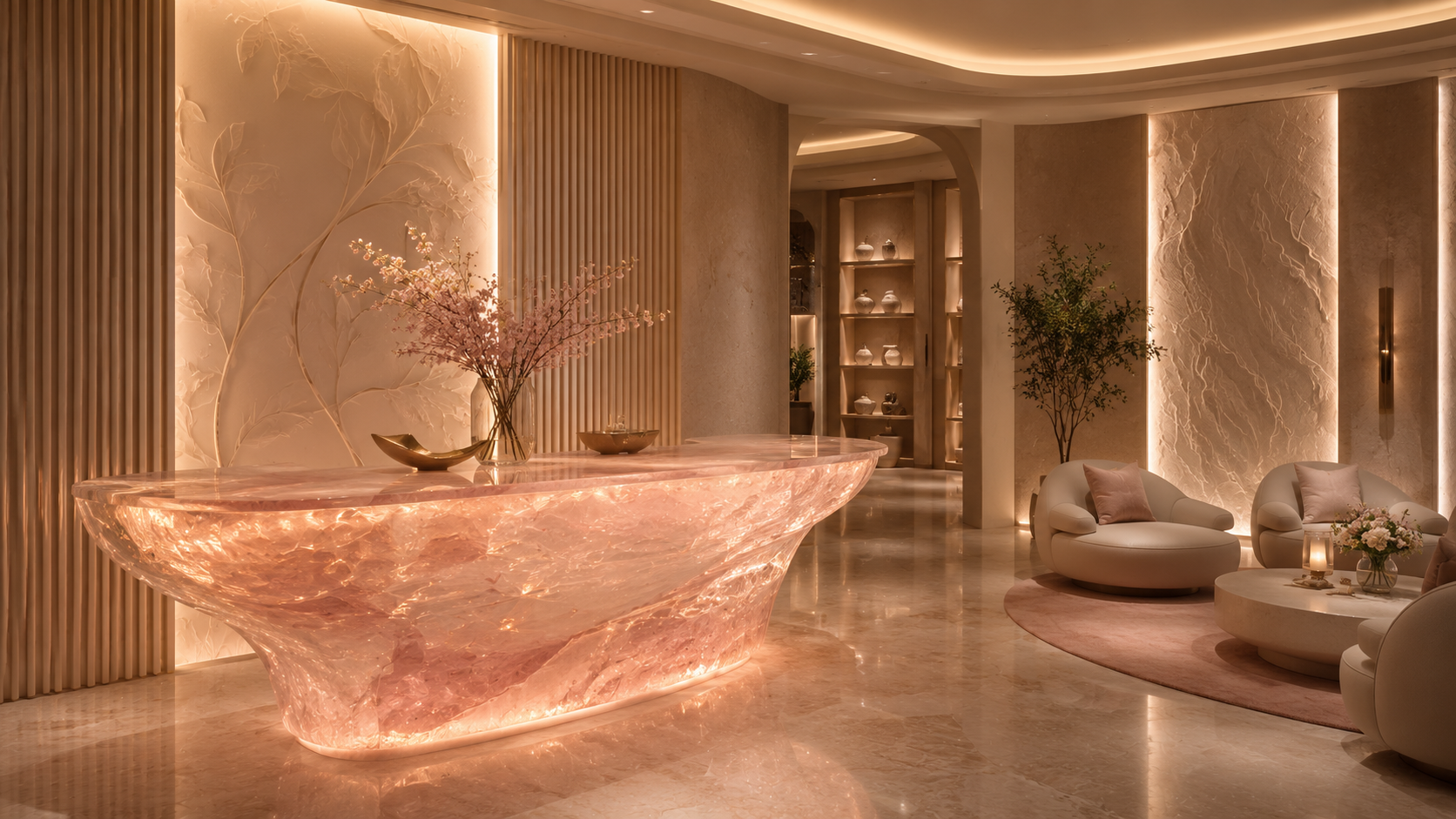
Natural stone is generally chosen for permanence, geological character, weight and a sense of architectural value. Glass is selected when visual lightness, reflection and transparency are the priorities. Synthetic crystal, high-end resin and premium acrylic are most valuable when a designer needs transparency combined with colour, curved geometry, embedded decorative elements or forms that would be difficult to produce in stone or glass.
Even within one category, performance varies. The U.S. Geological Survey identifies granite, limestone, marble, sandstone and slate among the principal dimension-stone types, while also noting that durability, strength, polishability, colour, grain and texture are all important selection criteria. In other words, “natural stone” is not one uniform material. A polished marble table, a honed granite counter and a porous limestone console should not be expected to perform in the same way.
The same principle applies to transparent furniture. A product described as crystal, crystal-clear, platinum acrylic or resin crystal may be made from cast PMMA acrylic, modified acrylic, polyester resin, epoxy resin or a hybrid material. These commercial descriptions communicate appearance, but they do not automatically confirm composition, impact resistance, UV stability, heat resistance or chemical performance. Professional buyers should therefore evaluate the actual technical specification rather than relying on the material name alone.
2. Choose Natural Stone When Permanence and Authenticity Matter Most
Natural stone is particularly effective in spaces that need visual authority. Marble dining tables, travertine coffee tables, granite consoles and onyx feature furniture have a physical presence that transparent materials cannot fully reproduce. Each slab carries natural veining, mineral variation and geological irregularities, which makes every finished piece slightly different. This uniqueness is especially valuable in luxury residences, executive offices, hotel reception areas and high-end restaurants where materials are expected to communicate permanence and authenticity.
However, the beauty of stone comes with practical obligations. Marble, limestone and travertine are largely calcareous materials containing calcium carbonate. According to the Natural Stone Institute, calcium carbonate is sensitive to acidic solutions, which is why mild, non-acidic cleaning products are recommended. Citrus juice, wine, vinegar and some bathroom cleaners can therefore etch a polished surface even when they do not create a deep stain. Granite and other siliceous stones are generally more resistant to common kitchen acids, although the institute still advises against aggressive acidic cleaners because individual stones can contain acid-sensitive minerals.
This means marble is often a better choice for a formal dining room, statement console or occasional table than for a heavily used family breakfast table unless the owner accepts patina and regular care. Granite and dense quartzite are usually more practical for high-use dining surfaces, worktops and hospitality furniture. Travertine can work beautifully in a lounge or hotel lobby, but its open pores and cavities require appropriate filling, finishing and maintenance.
Weight is another important consideration. A large stone table requires a properly engineered base, reliable joints, suitable flooring and a realistic installation plan. It may be inconvenient in rented properties or spaces where furniture is rearranged frequently. In contrast, that same weight can be an advantage in permanent luxury installations because it gives the piece stability and a strong architectural identity.
Stone can also support sustainability goals when it is responsibly sourced and specified with verified documentation. The Natural Stone Institute has published industry-wide, cradle-to-grave Environmental Product Declarations for natural-stone cladding, flooring and countertops. These declarations account for quarrying, fabrication, installation, maintenance and end-of-life stages, giving designers a more credible basis for comparison than vague claims that a material is environmentally friendly simply because it is natural.
For the best result, natural stone should be selected when the customer values authenticity, long service life, heat tolerance and material individuality more than low weight, easy relocation or perfectly consistent colour.

3. Use Glass for Visual Lightness, but Engineer It Around Safety
Glass remains one of the most effective furniture materials for making a small or visually crowded room feel more open. Because it allows the eye to travel through the furniture, a glass dining table or coffee table occupies less visual space than an equally sized opaque piece. It can reveal a sculptural base, reflect architectural lighting and coordinate with almost any colour palette.
This makes glass useful in compact apartments, contemporary dining rooms, minimalist offices and retail environments where the furniture should not compete with the surrounding products. It is also relatively resistant to common beverages and many household cleaning products, and a properly finished glass top can provide a flat, hygienic surface.
The main limitation is not appearance but breakage risk. The U.S. Consumer Product Safety Commission explains that tempered glass is designed to break into relatively small fragments rather than large, sharp shards. It also notes that the voluntary ASTM standard for horizontal glass surfaces requires tempered glass for desks and tables. This requirement is significant: the commission estimated that approximately 20,700 injuries associated with glass tables were treated in U.S. emergency departments in 2016.
Tempering reduces the likelihood of severe cutting injuries, but it does not make glass unbreakable. The CPSC states that scratches, installation errors and other factors can contribute to spontaneous breakage because the surface of tempered glass remains under internal stress. A product recall involving approximately 5,400 West Elm glass tables followed nine reports of tops shattering unexpectedly, illustrating why brand reputation alone cannot replace correct engineering and quality control.
For this reason, a glass table should be evaluated as a complete structure rather than as a decorative top placed on a base. The thickness must suit the span and load. Supporting points should be properly positioned. Metal-to-glass contact should be isolated with appropriate pads or connectors. Edges need careful finishing, and any holes or cut-outs must be designed before tempering.
Glass is less suitable where children frequently climb on furniture, where hard objects may strike exposed edges, or where the table will be moved repeatedly by untrained staff. In these situations, laminated safety glass, impact-modified acrylic or a hybrid construction may provide a better risk profile.
Glass should therefore be selected when optical neutrality, scratch resistance and visual openness are essential, but only when its thickness, edge treatment, support system and safety-glazing specification have been professionally confirmed.
4. Select Synthetic Crystal, High-End Resin or Platinum Acrylic for Creative Freedom
Synthetic crystal furniture occupies the space between conventional transparent furniture and functional sculpture. It can deliver the luminous appearance associated with crystal or glass while allowing designers to introduce colour gradients, bubbles, metallic particles, embedded objects, layered textures and seamless curved forms. This versatility makes it especially effective for luxury side tables, console bases, artistic dining-table supports, retail displays and hotel feature pieces.
However, synthetic crystal should be treated as a visual category rather than a precise technical definition. Some products are primarily cast acrylic, while others are based on polyester, polyurethane or epoxy resin. High-end resin furniture may be cast in thick sections and polished to a glass-like finish. Premium or platinum-grade acrylic furniture is generally positioned as a higher-clarity, carefully processed form of PMMA, but terms such as “platinum acrylic” are commercial quality descriptions, not universal international material standards.
ASTM D4802 provides a more reliable technical reference for acrylic sheet. Under the standard, methacrylate sheet must be composed of polymerised acrylic monomers containing at least 80 percent methyl methacrylate. The standard addresses measurable properties such as luminous transmittance, haze, water absorption, thermal stability, tensile strength, impact strength, abrasion resistance and chemical resistance. These are the types of test results that professional buyers should request when comparing transparent furniture, rather than accepting “crystal clear” as a complete performance claim.
High-quality clear acrylic can offer exceptional transparency. Röhm reports that clear PLEXIGLAS products can achieve visible-light transmission of up to 92 percent. Depending on the product type and market, certain clear sheets are guaranteed to retain up to 90 percent light transmission after 30 years, reflecting the importance of UV stabilisation in long-term transparent applications.
Acrylic also reduces weight. ACRYLITE technical documentation states that cast acrylic sheet weighs approximately half as much as glass. This can make a major difference for large console bases, transparent table legs, retail fixtures and furniture that must be transported or installed in upper-floor spaces. The same documentation notes, however, that acrylic is not as rigid as glass or metal. Large unsupported spans can therefore bend or creep under continuous loading, making structural design, thickness and reinforcement essential.
The main practical weaknesses are scratching, heat exposure and chemical sensitivity. Acrylic surfaces generally scratch more easily than glass, although light marks on high-quality cast acrylic can sometimes be professionally polished. Certain alcohols, aromatic solvents, chlorinated solvents, lacquer thinners, ketones and similar chemicals may attack acrylic or cause crazing, especially around stressed joints.
Resin quality also varies significantly. Poorly formulated or inadequately cured resin may yellow, trap visible bubbles, develop internal stress or release unwanted odours. Furniture intended for bedrooms, hospitality suites, offices or enclosed retail environments should therefore be supported by credible chemical-emission documentation. UL Solutions notes that furniture and interior products can influence indoor air quality and that GREENGUARD certification evaluates products against chemical-emission limits through manufacturing review and routine testing.
Synthetic crystal, high-end resin and platinum acrylic are best chosen when custom geometry, visual impact, lower weight and artistic flexibility are more important than maximum scratch resistance or direct exposure to high heat.
.png)
5. Match the Material to the Real Behaviour of Each Room
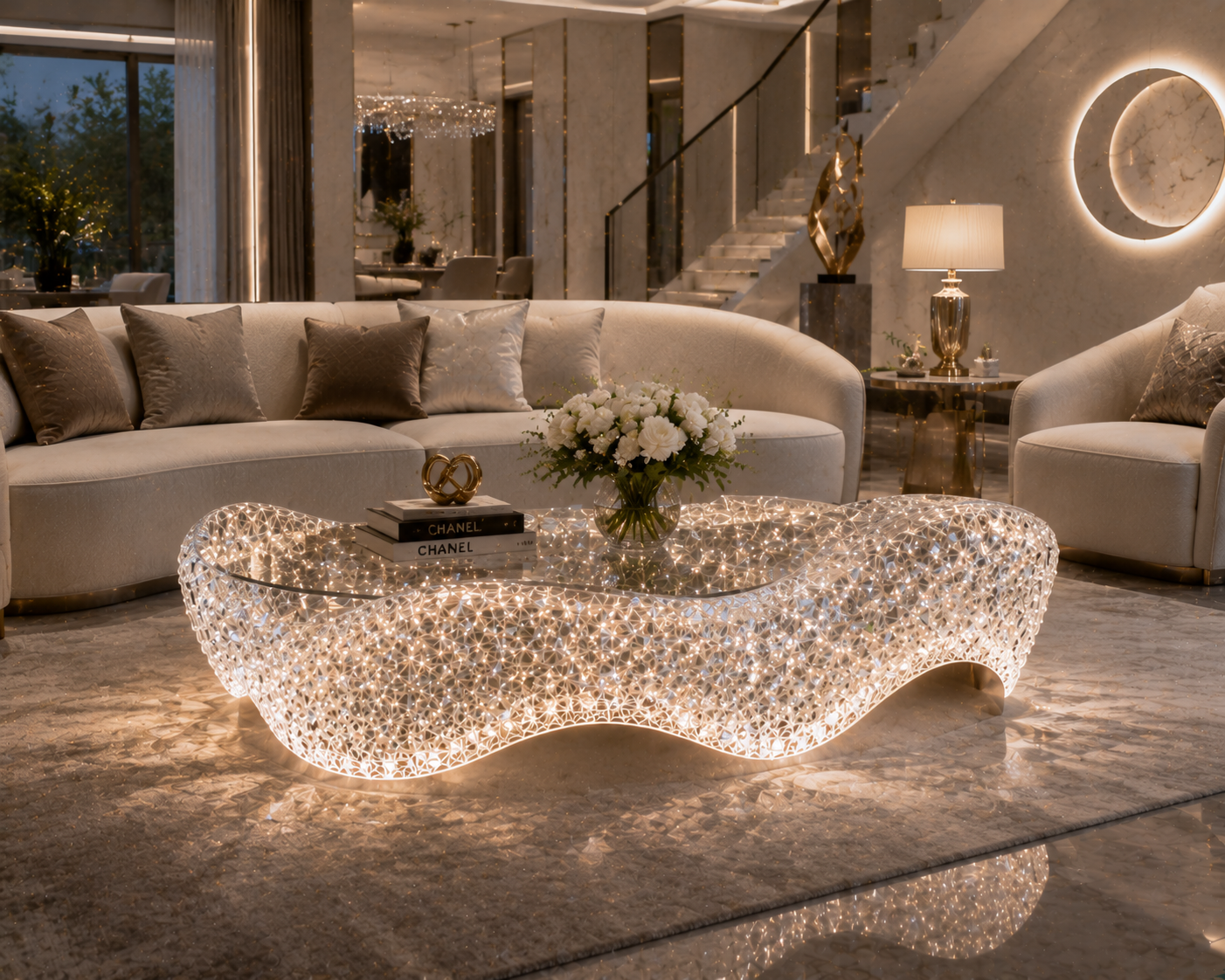
In a formal living room, all three material families can work, but they create different emotional effects. A marble coffee table makes the room feel grounded and permanent. A glass table keeps the composition visually open and allows a rug or sculptural base to remain visible. A synthetic-crystal or platinum-acrylic table can become an art object, particularly when it uses tinted transparency, embedded textures or a bold monolithic form.
In a family living room, impact behaviour and maintenance become more important. Sharp glass corners and unsupported stone overhangs should be avoided. Rounded acrylic or resin furniture can be useful because it allows softer geometries and has lower weight than stone or glass, although the surface must be protected from abrasive cleaning and dragged objects.
For dining rooms, the expected style of use should determine the decision. Natural stone suits customers who want an enduring centrepiece and are prepared to use coasters, trivets and suitable cleaners. Tempered glass is appropriate when the room needs visual lightness, but edge protection and structural certification are essential. High-end acrylic or resin dining tables offer dramatic shapes and transparent bases, yet hot cookware should not be placed directly on the material, and long spans must be engineered for continuous load rather than appearance alone.
In hotel lobbies, restaurants and commercial lounges, furniture receives more abuse than it does in photographs. Suitcases hit console corners, cleaning takes place repeatedly, and guests may sit on pieces that were not intended as seating. Stone performs well when permanence and stability matter. Thick cast acrylic or resin can produce memorable brand features, but replaceable protective elements, repair procedures and verified load testing should be considered before installation. UL Solutions identifies mechanical strength, structural integrity, fire hazards and other performance factors as central parts of residential and commercial furniture safety testing.
Retail spaces benefit greatly from transparent acrylic and synthetic crystal because these materials can support merchandise without visually blocking it. Acrylic also allows drilled, bonded, bent and illuminated forms that are difficult to produce economically in thick glass. For jewellery, cosmetics and fashion displays, optical quality is particularly important because haze, bubbles, glue marks and polishing distortion become visible under strong lighting.
Bathrooms and humid areas require caution. Dense natural stone can perform well when properly detailed and maintained, but porous stone and joints must be protected against moisture and staining. Glass is suitable for wet environments when it complies with the applicable safety-glazing requirements. Resin and acrylic should be used only after confirming resistance to bathroom cleaners, alcohol-based products, heat and prolonged humidity.
Outdoor or sunlit spaces require verified UV and weathering data. Some premium acrylic products are designed for long-term exterior use, but generic clear resin may yellow or degrade. Natural stone can be highly durable outdoors, although freeze-thaw conditions, moisture absorption and the stone’s geological structure must be considered. The correct outdoor material is therefore determined by documented weather resistance, not by indoor showroom appearance.
6. Avoid Expensive Mistakes by Specifying Performance Before Appearance
The safest selection process begins with a written performance brief. Before approving any natural-stone, glass, acrylic or resin furniture, the buyer should define the intended location, expected load, frequency of use, cleaning method, exposure to sunlight, temperature range, relocation requirements and acceptable level of maintenance.
For natural stone, the specification should identify the geological type, slab thickness, finish, reinforcement method, edge profile, stain behaviour and recommended care procedure. Samples should be reviewed under the project’s actual lighting because polished, honed and textured finishes can make the same stone appear significantly different. Buyers should also accept that natural veining and colour variation are part of the material rather than manufacturing defects.
For glass, the specification should confirm whether the product is tempered, laminated or both. It should include thickness, edge finishing, drilling details, support locations and applicable safety standards. A generic description such as “clear glass top” is not sufficient for a large dining or conference table.
For synthetic crystal, resin and platinum acrylic, the buyer should request the exact polymer type, casting method, density, UV performance, light transmission, heat resistance, chemical resistance, load-test results and repair instructions. Thick transparent components should be inspected for bubbles, haze, internal cracks, colour inconsistency, polishing waves and visible adhesive lines. Low-emission test reports are particularly important for furniture used in bedrooms, hotels, offices and other enclosed interiors.
The most successful interiors rarely depend on one material alone. A stone top can be paired with a platinum-acrylic base to combine natural permanence with visual lightness. A glass top can reveal a coloured resin sculpture underneath. A high-end resin tabletop can incorporate natural stone fragments, metallic details or controlled translucent layers. These hybrid combinations allow designers to assign each material the role it performs best.
Natural stone is usually the strongest choice for authenticity, weight and timeless architectural character. Glass is ideal for visual openness and a neutral contemporary appearance when safety is properly engineered. Synthetic crystal, premium resin and platinum acrylic provide the greatest freedom in colour, transparency, scale and sculptural form.
The decision that “does not go wrong” is therefore not the decision to use the most expensive material. It is the decision to match appearance with real performance, verify the technical data and design the furniture around how the space will actually be used.
READ MORE:
- Future Furniture Design Trends: How Synthetic Crystal Acrylic Connects Aesthetics with Commercial Value
- Synthetic Crystal Acrylic Furniture: Why Is It Becoming a Highlight Choice in Designer Projects?
- Synthetic Crystal Acrylic Furniture: Creating High-End Market Differentiation Through Unique Transparency
- From Spatial Decoration to Visual Focal Point: The Changing Role of Synthetic Crystal Acrylic Furniture
- Synthetic Crystal Acrylic Furniture: Why Are High-End Clients Increasingly Focused on Material Value?
- Elevare il valore percepito di un mobile senza accumulare materiali costosi: la vera chiave è la combinazione materica
- Dal render alla realtà: i 5 errori più comuni nella scelta dei materiali per mobili di alta gamma
- COME PUÒ UN PROGETTO DI ARREDAMENTO DI ALTA GAMMA CONCILIARE TRASPARENZA, DURATA E QUALITÀ DEL RISULTATO FINALE?
- Arredamento di alta gamma: estetica e durata devono davvero escludersi?


