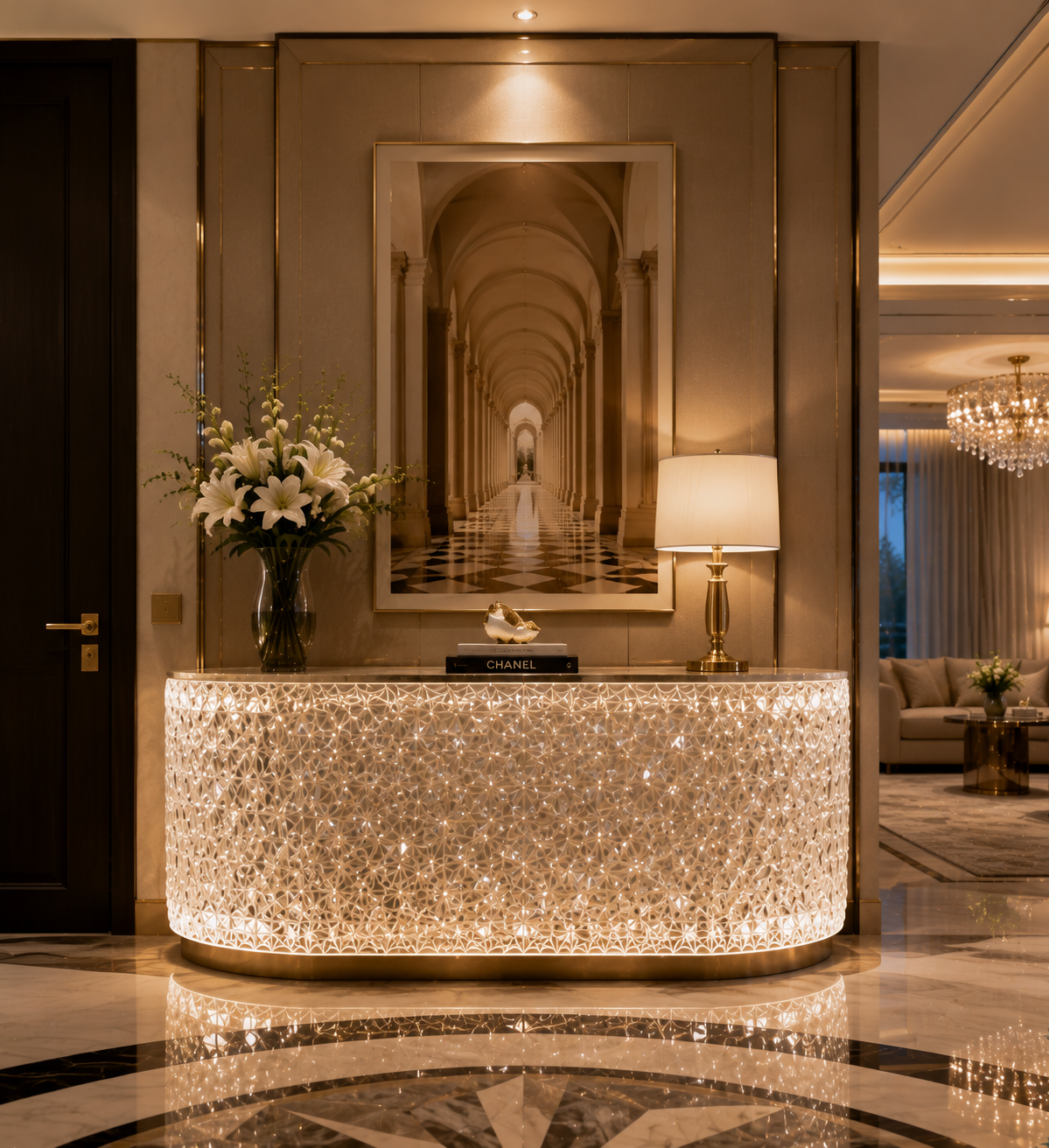
Introduction
For many years, high-end furniture was identified through a familiar group of materials. Solid wood represented tradition and craftsmanship. Marble represented permanence and wealth. Leather suggested comfort and status. Brass and bronze communicated luxury through their color, weight, and decorative value.
These materials continue to play an important role in premium interiors. However, the definition of luxury is changing.
Today, high-end furniture is not judged only by whether it uses an expensive material. It is also judged by whether it has a recognizable identity, whether it responds to contemporary architecture, whether it can be customized, and whether it creates a memorable emotional experience.
This change has created new opportunities for synthetic crystal acrylic.
Synthetic crystal acrylic is increasingly used in premium tables, chairs, consoles, cabinets, benches, display systems, reception desks, decorative objects, and custom installations. It offers a combination of transparency, optical depth, structural flexibility, color, and surface precision that is difficult to reproduce with conventional furniture materials.
Its visual effect can be quiet or dramatic.
In one interior, a clear acrylic table may appear almost invisible, allowing the architecture, flooring, and surrounding furniture to remain visually dominant. In another, a thick colored acrylic console may become the central sculptural feature of the room.
This ability to move between visual lightness and strong presence is one reason why acrylic is becoming a new symbol of high-end furniture.
The material also represents a broader shift in luxury design. Modern luxury is becoming less dependent on heavy decoration and more dependent on precision, atmosphere, originality, and material intelligence.
Acrylic responds to this direction because it can make a simple form look technically advanced and visually refined. It can transform light into decoration, transparency into structure, and ordinary furniture into a memorable design object.
This article explores why synthetic crystal acrylic is gaining importance in the premium furniture market and why it is increasingly viewed as a new sign of contemporary luxury.
1. The Changing Definition of Luxury Furniture
The idea of luxury furniture has never been fixed.
In different periods, luxury has been associated with different materials, production methods, and visual styles. Historically, rare woods, hand carving, gilded details, silk upholstery, and imported stone were used to demonstrate social position and wealth.
The value of the furniture was often visible through decoration.
Modern luxury, however, is becoming more restrained.
Many premium residences, hotels, boutiques, galleries, and offices now prefer clean lines, carefully controlled proportions, and a limited material palette. Instead of filling a room with ornamental details, designers focus on a smaller number of distinctive objects.
The value is communicated through precision rather than abundance.
This change has made material identity more important.
Material identity refers to the qualities that make a material immediately recognizable and emotionally meaningful. It includes appearance, texture, weight, transparency, reflection, surface finish, and the way a material interacts with the surrounding environment.
Synthetic crystal acrylic has a strong material identity because it behaves differently from traditional furniture materials.
Wood absorbs and softens light. Metal reflects it. Stone creates a sense of mass. Acrylic can transmit, reflect, distort, and concentrate light at the same time.
This gives it an active relationship with the space.
Acrylic furniture changes according to the background, the viewing angle, the time of day, and the lighting conditions. A clear chair placed in front of a dark wall appears different from the same chair placed near a bright window. A colored acrylic table may look pale in daylight but become more saturated under evening lighting.
This changing character makes acrylic furniture feel less static.
Contemporary luxury increasingly values this kind of experience.
High-end clients are not only asking whether furniture is expensive. They are asking whether it feels special, whether it belongs to the architecture, and whether it helps create an atmosphere that cannot be easily copied.
Synthetic crystal acrylic can support these expectations.
It can be customized in color, thickness, form, scale, transparency, and surface treatment. It can be produced as a one-of-a-kind piece, a limited edition, or a project-specific installation.
This makes it suitable for interiors where individuality is more important than standardization.
Another important change is the growing relationship between furniture and art.
Many luxury consumers no longer separate furniture, sculpture, lighting, and decorative objects in the same way. A table can be functional and artistic. A cabinet can provide storage while also acting as a visual installation. A chair can be used daily and still be treated as a collectible design object.
Acrylic is especially suitable for this area because it can create shapes that appear lighter, more fluid, or more optical than conventional furniture.
The material can be bent into seamless curves, laminated into thick transparent volumes, polished into reflective planes, or combined with lighting to create glowing effects.
These possibilities allow furniture designers to create objects that feel closer to sculpture.
Luxury is therefore becoming less about following traditional material rules and more about creating a strong, coherent design language.
Synthetic crystal acrylic fits this new definition because it represents modernity, technical precision, visual clarity, and creative freedom.
2. Crystal-Like Transparency and Strong Visual Recognition
The most obvious characteristic of synthetic crystal acrylic is transparency, but its premium value comes from much more than simply allowing people to see through it.
High-quality acrylic can create an optical effect similar to crystal or polished glass. Its surfaces can appear clean and smooth, while its edges can capture light and become brighter than the central area.
This contrast gives the material depth.
When acrylic is used in thick sections, the visual effect becomes stronger. The furniture may appear solid and transparent at the same time. It has physical presence, but it does not create the same visual weight as stone, timber, or opaque metal.
This combination is highly attractive in modern interiors.
Designers often want furniture to provide structure without making the room feel crowded. A transparent coffee table can define a seating area while allowing the rug beneath it to remain visible. A clear console can provide function in a narrow entrance without blocking the wall or creating visual heaviness.
This ability to reduce visual density is especially valuable in high-end urban apartments, hotel suites, boutiques, dressing rooms, galleries, and compact commercial environments.
However, acrylic can also be visually powerful.
Colored synthetic crystal acrylic can produce deep, jewel-like effects. Amber, blue, green, pink, red, smoky gray, and fluorescent tones can appear to exist inside the material rather than only on its surface.
This gives color greater dimension.
A painted wooden table has a flat surface color. A colored acrylic table can change depending on its thickness, the background, and the amount of light passing through it.
The color may become darker at the edges, lighter in the center, or more intense where multiple layers overlap.
This optical behavior creates visual complexity without requiring decorative patterns.
Refraction is another important quality.
Light passing through acrylic can bend, distort, and create unusual reflections. Curved edges may enlarge or shift the appearance of the objects behind them. Layered acrylic can produce overlapping visual fields.
These effects make the furniture more interactive.
The viewer notices different details from different positions. The object cannot be fully understood from only one angle.
This quality increases visual recognition.
In luxury interiors, recognition is valuable because memorable objects help define the identity of the space. A sculptural acrylic dining table, a thick transparent reception desk, or a glowing acrylic bar can become a signature element.
Visitors may not remember every material used in the room, but they may remember the transparent table that seemed to float or the colored acrylic console that reflected the evening light.
This memorable quality is one reason why acrylic is increasingly used in branded spaces.
Luxury hotels, fashion boutiques, jewelry stores, restaurants, and private clubs need distinctive visual features. Acrylic furniture can create these features while remaining compatible with many different design styles.
It can feel futuristic when combined with stainless steel and cool lighting. It can feel glamorous when combined with brass and warm tones. It can feel artistic when used in bold sculptural forms. It can feel calm and minimal when used in clear, simple shapes.
The same material can therefore support different brand identities.
High-end recognition also depends on finishing quality.
Poorly finished acrylic can look ordinary or inexpensive. Scratches, bubbles, cloudy surfaces, visible adhesive, uneven joints, and rough edges immediately reduce the premium effect.
High-quality acrylic furniture requires precise polishing and clean production.
The better the finish, the stronger the crystal-like appearance.
This is why premium acrylic furniture is not simply transparent furniture. It is furniture that uses transparency with technical control.
.png)
3. Sculptural Freedom and Contemporary Design Expression
Synthetic crystal acrylic is becoming a symbol of high-end furniture because it gives designers unusual freedom.
Traditional furniture materials each have structural and visual limitations. Solid wood depends on grain direction, moisture control, joints, and available dimensions. Stone is heavy and difficult to shape into thin or curved structures. Metal can be strong and flexible, but it does not offer transparency.
Acrylic combines several useful qualities.
It can be cut into precise geometric forms, heated and bent into curves, bonded into seamless structures, laminated into thick blocks, engraved with patterns, polished to a crystal-like finish, and integrated with lighting.
This makes it suitable for both minimal and highly expressive furniture.
A designer can begin with a simple rectangular sheet and transform it into a continuous side table by heating and bending the material. The resulting form may have no visible legs or separate supports.
This visual continuity creates sophistication.
The object appears simple, but the production requires careful control of temperature, radius, thickness, and stress.
The apparent simplicity is therefore supported by technical complexity.
This is a common characteristic of high-end furniture.
Luxury objects often look effortless because the difficult technical work has been hidden.
Acrylic also allows designers to explore negative space.
With opaque furniture, the solid parts of the object usually dominate the design. With transparent furniture, the empty spaces become equally important.
The architecture can be seen through the object. Reflections create additional lines. Shadows overlap with transparent surfaces.
The furniture becomes part of a larger visual composition.
This makes acrylic especially effective in architectural interiors.
A transparent table can frame the pattern of a stone floor. A clear chair can preserve a view through a window. An acrylic shelf can allow a textured wall to remain visible behind displayed objects.
The furniture supports the space rather than separating itself from it.
Acrylic can also create floating effects.
A stone tabletop supported by thick transparent acrylic legs may appear to hover. An upholstered bench placed on clear acrylic supports can seem visually lighter than its size suggests. A cabinet with transparent side panels can make shelves and objects appear suspended.
These effects give familiar furniture categories a more artistic identity.
A table is no longer only a table. It becomes an optical composition.
This is particularly important in the collectible design market.
Collectors and high-end clients often look for objects that are both functional and conceptually strong. They want furniture that can begin a conversation, express a design philosophy, or demonstrate a unique production technique.
Synthetic crystal acrylic offers many possibilities for limited-edition furniture.
Designers can use embedded materials, internal color layers, carved surfaces, unusual thicknesses, or integrated light. They can create pieces that resemble ice, liquid, glass, crystal, or futuristic architectural fragments.
This creative potential attracts collaboration between furniture manufacturers, artists, architects, fashion designers, and lighting specialists.
These collaborations can raise the cultural value of acrylic furniture.
Instead of being seen as a substitute for glass, acrylic becomes an independent design medium.
The material is also suitable for digital design and fabrication.
Three-dimensional modeling can be used to test curves, thicknesses, balance, and structural performance. Computer-controlled cutting and routing can create precise patterns and components. Digital visualization can show how transparent furniture will interact with a particular interior before production.
This connection between advanced technology and craftsmanship strengthens acrylic’s contemporary identity.
High-end furniture increasingly represents the combination of design intelligence, engineering, and hand finishing.
Acrylic can bring all three together.
4. Customization and Material Combinations
Customization is one of the strongest reasons synthetic crystal acrylic is entering the high-end market.
Luxury clients rarely want furniture that looks exactly like products found in many other homes or commercial spaces. They want pieces that respond to their architecture, color palette, lifestyle, brand identity, and practical requirements.
Acrylic can be customized in many ways.
Its dimensions can be adjusted to fit a specific wall, room, or circulation path. Its transparency can range from completely clear to frosted or opaque. Its color can be subtle, saturated, fluorescent, smoky, or layered.
Edges can be polished, beveled, rounded, frosted, or carved.
The material can also contain engraved patterns, embedded graphics, metal mesh, fabrics, decorative objects, or lighting elements.
This allows each piece to become highly specific.
A private residence may require a custom acrylic console that matches the exact width of an entrance and repeats the color of a nearby artwork. A hotel may want reception furniture in a signature shade. A fashion boutique may need display units that include brand graphics and integrated illumination.
These products cannot be fully standardized.
Their value comes from the relationship between the object and the project.
This is one of the main differences between mass-market furniture and high-end furniture.
Mass-market products are designed for many spaces. High-end products are often designed for one space.
Synthetic crystal acrylic supports this project-based approach.
It also works well with other premium materials.
The combination of acrylic and wood creates a balance between technology and warmth. Transparent legs can make a solid timber table appear lighter. Clear doors can modernize a wooden cabinet while preserving its natural character.
This combination is suitable for residences that want contemporary design without losing comfort.
Acrylic and stone create a stronger contrast.
Marble, granite, and other stone surfaces communicate weight, texture, and permanence. Acrylic introduces clarity and visual lightness.
A stone tabletop supported by transparent acrylic may appear to float. A marble shelf inside an acrylic frame can become more visually dramatic because of the contrast between mass and transparency.
Acrylic and metal can create precision and glamour.
Brass or bronze can add warmth and luxury. Stainless steel can make the furniture feel cleaner and more technical. Blackened metal can provide strong outlines and structural contrast.
Metal details may be used for frames, handles, joints, bases, hinges, or decorative inserts.
Acrylic also works with leather and fabric.
Transparent chairs, benches, and stools can be combined with upholstered seats to improve comfort. The hard, polished structure contrasts with the soft textile surface.
This contrast gives the furniture both visual and tactile richness.
Lighting is another important material partner.
LED systems can be installed inside acrylic bases, edges, shelves, and panels. The material can distribute light and create glowing effects.
This is especially useful in hotels, restaurants, clubs, boutiques, and reception areas.
Furniture can become part of the lighting atmosphere.
A reception desk may appear clean and transparent during the day, then glow in a brand color at night. A bar counter may change tone for different events. A display shelf may illuminate products without visible fixtures.
This multifunctionality increases commercial value.
Customization also allows furniture to solve technical problems.
Acrylic furniture can include hidden storage, cable management, product supports, removable panels, modular sections, charging systems, or adjustable lighting.
The object can be visually refined while still serving complex practical needs.
For high-end clients, this combination of beauty and tailored function is highly attractive.
They are not simply purchasing an object. They are commissioning a solution.
5. Commercial Value in Luxury Residential and Branded Spaces
Synthetic crystal acrylic is becoming a new symbol of high-end furniture because it creates commercial value in several important markets.
The first is luxury residential design.
High-end homeowners increasingly want interiors that feel personal, open, and carefully curated. They may prefer fewer furniture pieces, but each piece must have a stronger visual identity.
Acrylic works well in this environment.
A clear dining table can preserve the visual openness of a large living area. A colored acrylic side table can introduce a focal point without making the room feel heavy. A transparent console can highlight art, lighting, or a decorative wall.
In villas, penthouses, luxury apartments, and private clubs, acrylic furniture can be customized to specific dimensions and materials.
This increases exclusivity.
The second major market is hospitality.
Hotels, restaurants, bars, lounges, spas, and clubs compete through atmosphere. Guests remember spaces that create a strong visual and emotional experience.
Acrylic furniture can help create that experience.
In a hotel lobby, a thick transparent coffee table may communicate contemporary luxury. In a bar, illuminated acrylic surfaces can create a dramatic evening identity. In a spa, frosted or pale-colored acrylic can support a calm and clean atmosphere.
The material can change character through lighting, making it useful in spaces that operate from day to night.
Retail is another important area.
Luxury boutiques need display furniture that supports products rather than competing with them. Transparent acrylic allows merchandise to remain visually dominant.
Jewelry, handbags, shoes, cosmetics, watches, and decorative objects can appear to float on clear platforms.
This creates a sense of precision and exclusivity.
Acrylic can also be produced in brand colors and combined with logos, patterns, and lighting.
The furniture becomes part of the brand system.
For temporary retail, exhibitions, and product launches, acrylic offers additional advantages. Modular display blocks, shelves, counters, and pedestals can be reused and reconfigured.
This creates opportunities for rental, customization, and event-based business models.
Galleries and showrooms also benefit from acrylic’s visual neutrality.
Furniture and display structures can provide function without distracting from artworks or products. Transparent benches, plinths, and information stands can support the visitor experience while preserving the visual focus of the exhibition.
Acrylic furniture also performs well in photography.
This is increasingly important because high-end spaces are experienced online as well as physically.
Visitors photograph hotel lobbies, restaurants, boutiques, homes, and exhibitions. Distinctive acrylic furniture can become a recognizable background in these images.
A glowing bar, a transparent table, or a colored acrylic display can contribute to the online identity of a space.
This gives the furniture marketing value.
Commercial clients are therefore not only buying function. They are buying atmosphere, recognition, and photographic impact.
Acrylic can support all three.
For manufacturers and design brands, the greatest opportunity may come from moving beyond individual product sales.
They can provide project services such as design consultation, material selection, technical development, mockups, custom fabrication, logistics, installation, maintenance, and restoration.
This creates a deeper relationship with architects, interior designers, hotels, retailers, and developers.
A successful supplier becomes a project partner rather than only a furniture vendor.
This can lead to repeat business and larger contracts.
.png)
6. Craftsmanship, Sustainability, and Future Market Potential
Although acrylic has strong visual potential, its future in the high-end market depends on quality.
Transparent materials reveal mistakes.
Cloudy surfaces, scratches, bubbles, excess adhesive, uneven polishing, misaligned joints, and structural instability are immediately visible.
This means premium acrylic furniture requires a high level of craftsmanship.
The grade of the material matters. Thickness must be selected correctly. Cutting must be precise. Heating and bending must be controlled. Bonding must be clean. Edges must be polished consistently.
Large furniture also requires structural engineering.
A transparent table may appear visually simple, but it must support weight, resist movement, and remain stable over time.
The design must consider stress concentration, connection methods, temperature changes, and daily use.
These technical requirements create a barrier to entry.
Companies that master the process can distinguish themselves from low-cost producers.
Craftsmanship can become part of the brand story.
Manufacturers should explain how acrylic is selected, formed, bonded, polished, inspected, packaged, and installed.
This helps customers understand why high-quality acrylic furniture has premium value.
Maintenance is also important.
Acrylic requires suitable cleaning products and soft materials. Abrasive cloths, harsh chemicals, and excessive heat can damage the surface.
Premium suppliers should provide clear maintenance instructions.
They may also offer professional polishing, repair, or restoration services.
These services can extend product life and create recurring commercial value.
Sustainability will become increasingly important.
Acrylic is a synthetic material, so designers and manufacturers must address questions about production waste, durability, repairability, recycling, and responsible use.
One of the strongest sustainability arguments is long service life.
A well-designed acrylic table or cabinet can remain visually relevant for many years. Its surface may sometimes be restored through polishing. Hardware can be replaced. Modular elements can be reconfigured.
This is more responsible than treating furniture as a short-term disposable product.
Manufacturers can also reduce waste by optimizing cutting plans and reusing offcuts for smaller objects, samples, decorative accessories, or components.
Recycled acrylic may become more common in applications where perfect optical clarity is not required.
However, environmental claims must be accurate.
Premium customers increasingly expect clear information rather than vague sustainability language.
Brands should communicate material content, production methods, repair options, packaging choices, and end-of-life possibilities honestly.
Digital manufacturing will also shape the future.
Computer-controlled cutting, engraving, routing, and forming can increase accuracy and reduce production errors. Three-dimensional modeling can help designers test structural ideas before fabrication.
Digital tools can make customized furniture more efficient.
Customers may be able to select dimensions, colors, finishes, and material combinations through digital platforms. Designers may use virtual visualization to show how transparent furniture will appear in a specific room.
This can expand the market for customization.
International demand is also likely to grow.
Synthetic crystal acrylic fits several global design trends: minimalism, contemporary luxury, collectible design, experiential retail, branded hospitality, transparent architecture, and multifunctional furniture.
Different markets may prefer different expressions.
Some clients may prefer clear, minimal furniture. Others may prefer strong colors, embedded decoration, or illuminated effects. Residential buyers may focus on personalization, while hotels and retailers may focus on durability and branding.
Successful companies will need flexible product strategies.
They may offer standard collections, custom projects, limited editions, artist collaborations, and commercial systems.
The market will likely separate into different levels.
Entry-level products will compete mainly on price. Mid-range products will use acrylic as a decorative or structural detail. Premium products will emphasize material quality, thickness, craftsmanship, customization, engineering, and original design.
The strongest long-term growth is likely to come from the premium segment.
In that segment, acrylic is not used because it is a cheaper alternative to glass or another material. It is used because its optical and structural qualities are essential to the design.
Conclusion
Synthetic crystal acrylic is becoming a new symbol of high-end furniture because it reflects the changing meaning of luxury.
Modern luxury is no longer defined only by rare materials, heavy decoration, or visible cost. It is increasingly defined by originality, visual clarity, customization, craftsmanship, and emotional experience.
Acrylic responds to all of these qualities.
Its transparency reduces visual weight. Its thickness creates crystal-like depth. Its polished edges interact with light. Its color can appear rich and three-dimensional. Its flexibility allows designers to create curves, floating structures, sculptural forms, and integrated lighting.
It can make familiar furniture categories feel new.
A table can become an optical object. A cabinet can become a display installation. A chair can appear to float. A reception desk can become part of the lighting design.
Acrylic also works well with wood, stone, metal, leather, fabric, and digital technology.
This allows it to enter many different design styles rather than remaining limited to futuristic interiors.
Its commercial potential is equally broad.
Luxury residences can use acrylic to create personalized statement pieces. Hotels and restaurants can use it to strengthen atmosphere. Retailers can use it to improve product visibility and brand recognition. Galleries, showrooms, and clubs can use it to create memorable spatial experiences.
However, the material only becomes truly high-end when it is supported by quality.
Material selection, thickness, polishing, bonding, engineering, proportion, packaging, installation, and after-sales service all affect the final result.
Poor acrylic furniture can look temporary and inexpensive. Well-designed acrylic furniture can look architectural, artistic, and collectible.
This difference is important.
The future of synthetic crystal acrylic furniture will depend on whether manufacturers and designers treat it as a serious design material rather than a simple transparent substitute.
When acrylic is used with intelligence and craftsmanship, it has the ability to express a distinctly contemporary form of luxury.
It is visually light but physically present. It is technically advanced but emotionally expressive. It can disappear into a space or become its strongest focal point.
That balance is why synthetic crystal acrylic is increasingly becoming a new symbol of high-end furniture.
READ MORE:
- A New Approach to Building a High-End Furniture Brand: From Design Differentiation to Material Differentiation
- Synthetic Crystal Acrylic Furniture: Giving Ordinary Furniture a High-End Design Language
- From Transparent Aesthetics to Commercial Value: Where Are the Growth Opportunities for Synthetic Crystal Acrylic Furniture?
- Synthetic Crystal Acrylic Furniture: Why Are High-End Spaces Paying More Attention to Material Identity?
- The Hidden Cost of Low-Quality Furniture in Premium Commercial Projects
- How Light Interacts with Crystal Materials to Create Memorable Commercial Spaces
- Why Luxury Interiors Need Statement Pieces Instead of More Decorations
- How Material Quality Shapes Brand Trust Before a Customer Speaks to You
- Commercial Space Upgrades: Choosing Materials That Transform Perception Fast


