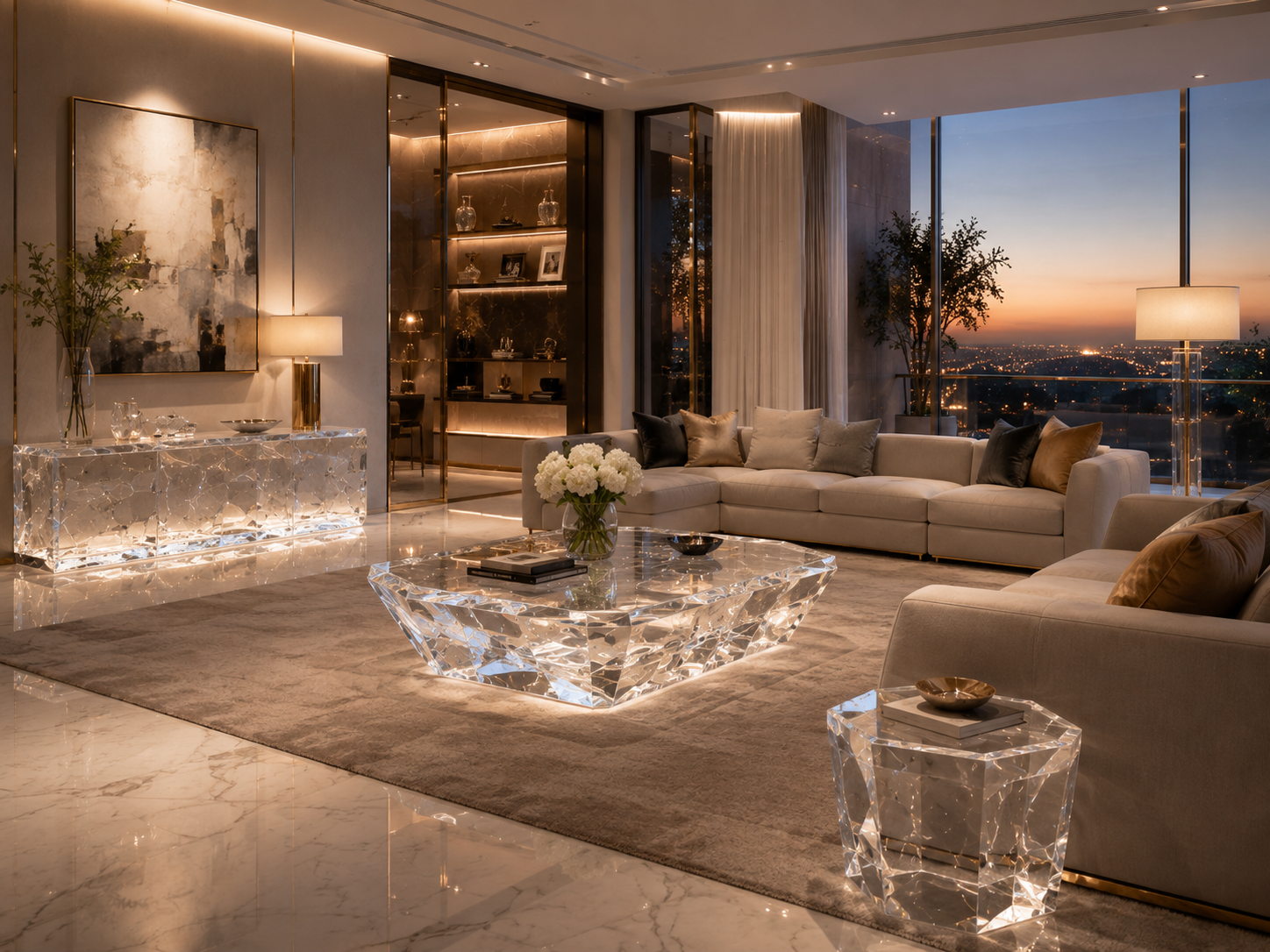
Introduction
Ordinary furniture is usually designed to solve ordinary problems. A table provides a surface, a chair provides a place to sit, a cabinet provides storage, and a shelf displays objects. These functions are necessary, but function alone rarely creates a high-end interior.
The difference between ordinary furniture and premium furniture is not always related to complexity. A luxurious piece does not need to contain elaborate carving, expensive decoration, or excessive detail. In many contemporary interiors, the most impressive furniture is often visually simple.
What makes it feel valuable is the design language behind it.
Design language includes proportion, material, surface quality, structure, craftsmanship, color, light, and the relationship between an object and its surrounding space. When these elements are controlled carefully, even a familiar furniture category can appear distinctive and sophisticated.
Synthetic crystal acrylic is one of the materials capable of creating this transformation.
A basic side table made from an ordinary opaque board may disappear into the background. The same table produced in thick, highly polished acrylic can become a sculptural object. A standard cabinet may feel heavy and conventional, while acrylic doors or transparent structural elements can make it feel lighter, cleaner, and more architectural.
The appeal of acrylic lies not only in transparency. High-quality synthetic crystal acrylic can interact with light, create optical depth, introduce color without visual heaviness, and form curves or geometric structures that are difficult to achieve with traditional furniture materials.
It can also work with wood, metal, stone, leather, fabric, and lighting systems. This makes it suitable for upgrading existing furniture forms rather than replacing every traditional material.
For furniture manufacturers, interior designers, architects, retailers, and hospitality brands, acrylic creates an opportunity to add perceived value to relatively familiar products. The design may begin with an ordinary table, chair, console, or shelf, but careful use of acrylic can turn it into a recognizable high-end product.
This article explains how synthetic crystal acrylic furniture gives ordinary furniture a premium design language and why the material is becoming increasingly relevant in modern residential and commercial interiors.
1. Why Ordinary Furniture Often Lacks a Premium Identity
Ordinary furniture is not necessarily poorly made. Many conventional products are practical, durable, and affordable. The problem is that they often lack a distinctive identity.
Mass-market furniture is typically designed to appeal to the largest possible customer group. To control costs and simplify production, manufacturers often use common dimensions, familiar shapes, standard colors, and widely available materials.
The result is functional, but visually predictable.
A rectangular coffee table with four legs, a basic storage cabinet, or a simple dining chair may perform perfectly well. However, when similar products are available from many suppliers, it becomes difficult for the customer to recognize a meaningful difference between them.
This leads to price competition.
When products look similar, buyers compare them according to cost, delivery time, or basic specifications. Design becomes secondary because the product does not communicate a strong reason to be valued differently.
Premium furniture follows a different logic.
It creates a recognizable impression before the customer fully examines its function. Its proportions may feel more balanced. Its materials may interact with light in a special way. Its joints may appear cleaner. Its surfaces may create depth. Its structure may look simple but technically precise.
This visual and material identity allows a product to move beyond ordinary comparison.
Material choice is one of the fastest ways to create this difference.
Wood can introduce warmth, grain, and natural character. Stone can create weight and permanence. Metal can express strength, precision, or industrial refinement. Leather and fabric can add comfort and tactile richness.
Synthetic crystal acrylic contributes something different: optical presence.
It can appear solid and transparent at the same time. It can physically occupy space while remaining visually light. It can reflect surrounding colors without hiding the architecture behind it. Its edges can become brighter than its surfaces, creating a crystal-like effect.
These qualities allow a simple furniture form to appear more sophisticated without requiring excessive ornamentation.
Consider a standard console table.
If it is made from an ordinary painted board, the viewer mainly notices its shape and color. If the same form is made from thick clear acrylic, the viewer also notices the depth of the material, the polished edges, the shadows, the reflections, and the way the object changes from different angles.
The design becomes active.
It responds to daylight, artificial lighting, nearby walls, flooring, and decorative objects. The furniture is no longer only a fixed object. It becomes part of the atmosphere.
This is one of the central differences between ordinary and high-end furniture.
Ordinary furniture usually exists independently from the space. High-end furniture participates in the space.
Acrylic can support this participation because it reflects and transmits visual information from its surroundings. A transparent table placed on a patterned carpet allows the carpet to remain visible. A tinted acrylic cabinet beside a stone wall picks up the wall’s texture and color. A clear shelf in front of decorative plaster appears connected to the wall rather than placed in front of it.
The furniture and architecture begin to communicate.
This relationship gives even simple products a stronger design identity.
2. Transparency, Light, and the Visual Power of Acrylic
Transparency is the most recognizable characteristic of acrylic furniture, but its design value is more complex than simple invisibility.
When used carefully, transparency can make furniture feel light, spacious, and refined. This is particularly useful in contemporary interiors where designers want to preserve sightlines and reduce visual clutter.
A transparent chair occupies the same physical space as an opaque chair, but it does not block the view in the same way. A clear coffee table provides a functional surface without visually dividing the seating area. Acrylic shelves can hold objects while allowing the wall, lighting, and architecture to remain visible.
This visual lightness can make ordinary furniture forms feel more elegant.
However, high-end acrylic design depends on more than using a clear material. The interaction between transparency, thickness, edge quality, and light is what creates the premium effect.
Thin acrylic can look delicate and minimal. Thick acrylic can look solid, jewel-like, and architectural. The material may appear almost invisible from the front but become bright and reflective along the edges.
This contrast creates visual depth.
Light entering the material can travel through it, collect at polished surfaces, and produce highlights that change according to the viewing angle. In natural daylight, acrylic may appear calm and clean. Under focused artificial lighting, the same object may become more dramatic.
This changing quality gives the furniture a sense of movement.
The effect is especially strong when acrylic is used in simple geometric forms. A thick rectangular table, for example, may appear basic in shape, but the material transforms it into a composition of reflections, transparent planes, and illuminated edges.
The simplicity of the form allows the optical qualities to become the decoration.
Color can further strengthen this effect.
Synthetic crystal acrylic can be produced in clear, smoky, amber, blue, green, pink, red, fluorescent, frosted, and partially opaque finishes. Unlike a painted surface, acrylic color can appear to exist inside the material.
This creates depth rather than flatness.
A pale amber acrylic side table can introduce warmth without the visual heaviness of dark timber. A smoky gray console can complement metal and stone in a modern interior. A deep blue acrylic block can become a strong focal point in a neutral room.
Gradient colors and layered sheets can create even more complex effects.
The furniture may appear darker from one angle and lighter from another. Overlapping surfaces can produce new colors. Curved edges can distort and soften the visual background.
These characteristics allow designers to create high-end effects using relatively simple furniture categories.
Light integration offers another opportunity.
LED lighting can be introduced into acrylic edges, bases, shelves, or internal channels. Because acrylic can guide and distribute light, the furniture may appear to glow from within.
A standard reception desk can become a luminous architectural feature. A basic display shelf can highlight products without visible lighting fixtures. A side table can create soft ambient light in a hotel room or lounge.
This combination of furniture and lighting increases both visual impact and functional value.
It also helps create different atmospheres at different times.
During the day, a clear acrylic bar may feel open and minimal. In the evening, integrated lighting can make it feel warmer, more dramatic, or more energetic.
The furniture becomes adaptable.
For high-end spaces, this adaptability is valuable because luxury is increasingly associated with experience rather than decoration alone.
.png)
3. Turning Basic Furniture into Sculptural Design
One of the greatest strengths of acrylic is its ability to make familiar furniture forms appear sculptural.
A table, chair, cabinet, bench, shelf, or console does not need to become impractical in order to look artistic. The transformation can happen through material thickness, structural clarity, proportion, curvature, and the careful control of visual weight.
Acrylic is particularly suitable for this because it can be cut, bent, molded, laminated, engraved, polished, bonded, and combined into complex forms.
A simple sheet can be heated and bent into a continuous table structure. A thick block can be carved into a sculptural support. Multiple transparent layers can create depth without adding opaque mass.
These techniques allow designers to reinterpret ordinary products.
A standard C-shaped side table, for example, is usually a practical object. When made from a single curved acrylic sheet with clean edges and precise proportions, it can look seamless and highly refined.
A basic bench can be transformed by using transparent supports beneath an upholstered seat. The seat appears to float, while comfort is preserved.
A cabinet can use clear or tinted acrylic doors to reveal selected objects inside. The storage function remains, but the cabinet also becomes a display structure.
A dining table can combine a simple top with thick transparent legs. The structure appears lighter, and the top may seem suspended in space.
This floating effect is an important part of the high-end acrylic language.
Traditional furniture often emphasizes weight and construction. Acrylic can reduce the visibility of structural support. The viewer sees the object, but the method of support may appear less obvious.
This creates visual surprise.
Furniture that appears lighter than its physical size attracts attention because it challenges expectation. A large transparent console may occupy a substantial area but still feel delicate. A thick acrylic chair may look solid yet visually open.
This contradiction gives the furniture personality.
Sculptural design also depends on negative space.
With opaque furniture, the object itself usually dominates. With transparent acrylic, the spaces inside and around the object become equally important.
The viewer sees the room through the furniture. Architectural lines overlap with furniture edges. Reflections create additional shapes. Shadows become part of the composition.
The product therefore changes according to its environment.
This quality is especially valuable in luxury interiors where furniture is expected to support the architecture rather than compete with it.
Acrylic can make an ordinary design look custom because it visually integrates with the space.
A clear console placed against a textured wall allows the wall to remain part of the design. A transparent table over a decorative rug preserves the rug’s importance. Acrylic seating near a window does not interrupt the view.
The furniture becomes a frame rather than a barrier.
This approach is useful in both large and small interiors.
In a spacious residence, acrylic can create elegant focal points without making the room feel crowded. In a compact apartment, it can provide necessary function while preserving openness.
The same principle applies to commercial spaces.
In boutiques, acrylic display units can support products without becoming visually dominant. In galleries, benches and pedestals can serve visitors while maintaining attention on the artwork. In hotels, transparent tables and consoles can contribute to luxury without adding heavy visual mass.
By making the structure less visually obvious, acrylic gives ordinary furniture a more architectural and sculptural character.
4. Combining Acrylic with Wood, Stone, Metal, Leather, and Fabric
Acrylic does not need to be used alone to create a high-end effect.
In many cases, its strongest design value comes from contrast with other materials.
Cross-material combinations allow designers to maintain the familiarity, warmth, comfort, or durability of traditional furniture while introducing the visual lightness and optical depth of acrylic.
Wood and acrylic create one of the most balanced combinations.
Wood provides grain, warmth, and natural variation. Acrylic provides transparency, smoothness, and technical precision. Together, they can make ordinary furniture feel both comfortable and contemporary.
A timber tabletop with transparent acrylic legs appears lighter than a fully wooden table. An acrylic cabinet with wooden shelves can combine visual openness with a sense of warmth. A sideboard may use clear doors to display selected objects while keeping a solid timber frame.
This combination is particularly effective in residential interiors, where fully transparent furniture may feel too cold if used excessively.
Stone and acrylic create a stronger contrast.
Stone communicates weight, permanence, and natural texture. Acrylic communicates lightness, clarity, and modernity. When the two are combined, each material becomes more noticeable.
A marble top placed on transparent acrylic supports may appear to float. A stone pedestal connected to a clear acrylic shelf can create visual tension between mass and transparency. A console may use an acrylic frame with a natural stone insert.
These combinations are suitable for luxury residences, hotel lobbies, reception areas, and premium retail environments.
Metal can add structural precision and decorative detail.
Brass, bronze, stainless steel, blackened metal, aluminum, and chrome each create a different relationship with acrylic.
Brass can make clear or amber acrylic feel glamorous. Stainless steel can create a clean, technical appearance. Black metal can outline transparent forms and create strong contrast. Aluminum can support lightweight modular structures.
Metal fittings can also increase functionality.
Hinges, connectors, frames, handles, and support systems can be integrated into acrylic furniture. When these components are designed carefully, they become part of the visual language rather than hidden technical necessities.
Leather and fabric introduce comfort.
Acrylic chairs and benches can be visually striking, but seating often requires softness. Upholstered cushions, leather pads, or fabric panels can make the product more practical while preserving the transparent structure.
A clear acrylic chair with a leather seat can appear refined and comfortable. An acrylic bench with a fabric cushion can suit bedrooms, dressing rooms, hotel suites, and reception spaces.
The contrast between the hard transparent frame and the soft upholstered surface creates tactile richness.
Textiles can also introduce color and pattern without making the furniture visually heavy.
Removable cushions allow the product to adapt to different interiors. Seasonal fabrics can change the appearance. Custom upholstery can match a hotel, restaurant, or residential project.
Mirror and glass may also be combined with acrylic, though the relationship must be controlled carefully.
Acrylic is generally lighter and easier to shape than glass, while glass may offer greater scratch resistance in certain applications. A product can use acrylic for curved or structural elements and glass for selected surfaces.
Mirror can amplify light and create additional depth.
Acrylic furniture may include mirrored bases, internal panels, or decorative inserts. These details can make the furniture appear more luminous and complex.
Cross-material design helps expand the market for acrylic furniture.
Some customers may not want an entirely transparent product, but they may appreciate acrylic as an accent, support, door, handle, frame, or decorative layer.
This allows ordinary wooden, metal, or upholstered furniture to gain a high-end visual identity without losing familiarity.
The key is balance.
Acrylic should not be added as an afterthought. Its proportion, thickness, color, and relationship with other materials should support the overall design.
When used intelligently, it becomes the element that gives the product distinction.
5. Customization, Craftsmanship, and High-End Product Differentiation
The difference between premium acrylic furniture and inexpensive transparent furniture is often found in the details.
At a distance, two products may appear similar. Both may use clear material and basic geometric forms. However, close inspection can reveal major differences in thickness, optical clarity, joints, polishing, proportions, structural stability, and surface quality.
These differences determine whether the furniture communicates luxury.
Material quality is the starting point.
High-grade synthetic crystal acrylic should have consistent clarity, controlled color, limited distortion, and a clean internal appearance. Poor-quality material may look cloudy, uneven, or visually thin.
Thickness also influences perception.
A thin sheet may be appropriate for light decorative applications, but substantial furniture often requires greater thickness to create both strength and visual authority.
Thick acrylic can make a simple object feel architectural. It also produces stronger edge reflections and deeper color effects.
However, thickness must be balanced with proportion. Using heavy material without thoughtful design can make the product appear awkward rather than luxurious.
Edge treatment is equally important.
Acrylic edges may be cut, sanded, polished, beveled, rounded, frosted, or shaped. Each treatment affects the way light moves through the material.
Highly polished edges create a crystal-like brightness. Frosted edges produce a softer effect. Beveled edges can make the furniture feel more jewel-like.
Poorly finished edges immediately reduce perceived quality.
Bonding is another critical area.
Transparent furniture reveals its connections. Excess adhesive, bubbles, misalignment, and uneven joints are difficult to hide. High-end production requires controlled bonding methods and clean assembly conditions.
The best joints may appear almost invisible.
Bending and forming also require precision.
If heat is applied unevenly, the material may distort, develop stress, or lose optical consistency. Curves must be smooth, symmetrical, and structurally stable.
Large acrylic furniture often demands experienced technicians and specialized equipment.
This craftsmanship should be communicated as part of the product’s value.
Customers may initially assume acrylic furniture is easy to produce because the form looks simple. Brands and manufacturers need to explain that simplicity often requires greater precision.
A transparent table with only a few visible components leaves no place for errors.
Customization increases differentiation.
Furniture can be adjusted according to exact dimensions, color requirements, edge details, structural needs, lighting conditions, and surrounding materials.
A designer may request a specific amber tone to match a hotel interior. A homeowner may need a console sized precisely for an entrance. A retailer may require display units in brand colors with integrated logos and lighting.
These products cannot be compared directly with standard retail furniture.
The value includes design consultation, technical development, sampling, engineering, and project coordination.
Customization also allows acrylic furniture to solve practical problems.
A table can be designed around a difficult room shape. A shelf can follow a curved wall. A cabinet can combine transparent display areas with hidden storage. A reception desk can include lighting, cable management, signage, and equipment access.
The furniture becomes a tailored spatial solution.
Small-batch and limited-edition production offer another path to premium positioning.
Brands can collaborate with designers, artists, architects, or fashion companies to create distinctive collections. Unique colors, embedded elements, engraved patterns, or experimental forms can make the products more collectible.
The story behind the object becomes part of its value.
A customer may not purchase only a table. The customer may purchase a limited design, a specialized technique, and a recognizable creative identity.
For manufacturers, this reduces dependence on price competition.
The company is no longer selling a commodity. It is selling expertise.
Packaging, transportation, installation, and maintenance are also part of the high-end experience.
Acrylic surfaces require protection during shipping. Large products may need professional installation. Customers need clear guidance about cleaning, scratch prevention, heat exposure, and suitable maintenance materials.
A premium brand should manage these details carefully.
After-sales services such as polishing, repair, part replacement, and restoration can strengthen customer trust and extend product life.
High-end differentiation therefore comes from the entire system surrounding the furniture, not only the object itself.
.png)
6. Commercial Applications and Future Growth Opportunities
The ability of acrylic to give ordinary furniture a high-end design language creates opportunities across many markets.
In residential interiors, the material can upgrade familiar furniture categories such as coffee tables, dining tables, consoles, desks, chairs, benches, cabinets, and bedside tables.
Homeowners increasingly want interiors that feel personal and visually distinctive. Acrylic allows them to introduce statement furniture without making the room feel crowded.
A clear or lightly tinted piece can add character while preserving openness.
Luxury residences provide opportunities for custom dimensions, unique colors, mixed materials, and one-of-a-kind forms. Smaller urban homes create demand for visually lightweight and multifunctional products.
In hospitality, acrylic can transform practical furniture into memorable design elements.
Hotel reception desks, lobby tables, bar counters, display units, guest-room furniture, spa consoles, and restaurant features can all benefit from transparency, color, and lighting.
A standard hotel table may become a signature object through thick acrylic supports or illuminated edges. A basic reception counter may become an architectural focal point.
These features help hotels create stronger arrival experiences and more recognizable interiors.
Retail provides another major opportunity.
Stores need furniture that supports products without visually overwhelming them. Acrylic platforms, shelves, pedestals, counters, and display cases can make merchandise appear more important.
Transparent structures are especially effective for jewelry, cosmetics, handbags, shoes, watches, electronics, and decorative objects.
Brand colors, logos, lighting, and graphics can be incorporated into the furniture.
This turns ordinary display equipment into branded design.
Restaurants, bars, and clubs can use acrylic to create different daytime and nighttime experiences.
During the day, transparent furniture can feel open and clean. At night, colored or illuminated acrylic can create a stronger atmosphere.
Acrylic can also respond well to photography and social media. Distinctive furniture often becomes part of the visual identity of a commercial space.
Showrooms, galleries, and exhibitions benefit from the same qualities.
Acrylic furniture can provide function while maintaining attention on products or artwork. Modular systems can be reused for temporary events, pop-up stores, product launches, and trade shows.
This creates opportunities for rental as well as direct sales.
Office interiors represent another developing market.
Transparent partitions, acrylic meeting tables, reception furniture, shelves, and collaborative work structures can make workplaces feel more open and modern.
Combined with metal, wood, acoustic materials, and lighting, acrylic can contribute to a professional but distinctive environment.
Furniture brands can also use acrylic strategically within broader collections.
They do not need to become specialist acrylic companies. Instead, they can introduce acrylic as a premium detail in existing product categories.
Transparent legs, colored panels, handles, shelves, doors, and decorative inserts can make ordinary collections more recognizable.
This allows brands to test the market without redesigning every product.
For specialist manufacturers, the strongest opportunity may come from combining products with services.
Design consultation, technical development, custom fabrication, on-site measurement, project coordination, installation, maintenance, and restoration can all generate value.
Commercial clients often need more than furniture. They need a reliable project partner.
Sustainability will also influence future growth.
Acrylic is a synthetic material, so companies must address durability, repairability, production waste, recycling, and responsible use.
Long-lasting furniture can reduce replacement. Scratched surfaces may sometimes be restored through professional polishing. Offcuts can be reused for smaller products or samples. Modular furniture can be repaired or reconfigured.
Clear and accurate communication will be important.
Customers increasingly want to understand how products are made, how long they will last, and what happens at the end of their service life.
Brands that combine strong design with responsible production may gain greater trust.
Digital manufacturing will expand creative possibilities.
Computer-controlled cutting, engraving, routing, forming, and modeling can help manufacturers produce complex forms more accurately. Digital visualization can show customers how transparent or colored furniture will appear in a specific room.
This makes customization more accessible.
Online design tools may eventually allow customers and designers to select dimensions, colors, finishes, materials, and lighting options before requesting a quotation.
However, physical samples and professional consultation will remain important because acrylic’s depth, clarity, and weight are difficult to understand through images alone.
The future market will likely include several levels.
Entry-level products will focus on simple transparency and affordability. Mid-range products will combine acrylic with familiar materials. High-end products will emphasize thickness, craftsmanship, customization, optical quality, and original design.
The strongest growth opportunity lies in the premium segment, where acrylic is treated as a design material rather than a substitute material.
Conclusion
Synthetic crystal acrylic furniture can give ordinary furniture a high-end design language because it changes how familiar objects interact with space, light, color, and architecture.
A basic table becomes more than a surface when its transparent structure creates the illusion of floating. A cabinet becomes more than storage when tinted acrylic reveals selected contents and reflects the surrounding interior. A chair becomes more than seating when its frame combines optical lightness with sculptural form.
The material upgrades furniture through perception.
It reduces visual weight while increasing visual interest. It can make small spaces feel more open, heavy materials feel more balanced, and simple forms feel more sophisticated.
Its value is not limited to transparency.
Thickness, polished edges, color depth, reflection, refraction, curvature, and lighting all contribute to the final effect. When combined with wood, stone, metal, leather, or fabric, acrylic can introduce a contemporary identity without removing warmth or comfort.
However, the material alone does not guarantee luxury.
High-end results depend on proportion, craftsmanship, material quality, bonding, polishing, structural engineering, and careful detailing. Poor execution can make acrylic appear inexpensive, while precise execution can make a simple object feel architectural and collectible.
Customization further increases its value.
Furniture can be designed for a particular room, brand, function, color palette, or commercial environment. This allows manufacturers and designers to transform standard categories into project-specific solutions.
The commercial potential is broad.
Residential interiors can use acrylic to create visually light statement pieces. Hotels and restaurants can use it to strengthen atmosphere. Retailers can use it to improve product visibility and brand recognition. Offices, galleries, showrooms, and event spaces can use it to combine function with contemporary identity.
For furniture companies, acrylic provides a way to move beyond ordinary price competition.
Instead of selling only function, they can sell material experience, craftsmanship, customization, and visual distinction.
That is the real power of synthetic crystal acrylic furniture.
It does not require furniture to become excessively complicated. It allows familiar forms to become clearer, lighter, more expressive, and more memorable.
In a market filled with similar tables, chairs, cabinets, and shelves, the ability to create a recognizable design language is a major advantage.
Synthetic crystal acrylic provides that language by turning transparency into structure, light into decoration, and ordinary furniture into high-end design.
READ MORE:
- A New Approach to Building a High-End Furniture Brand: From Design Differentiation to Material Differentiation
- Why Is Synthetic Crystal Acrylic Becoming a New Symbol of High-End Furniture?
- From Transparent Aesthetics to Commercial Value: Where Are the Growth Opportunities for Synthetic Crystal Acrylic Furniture?
- Synthetic Crystal Acrylic Furniture: Why Are High-End Spaces Paying More Attention to Material Identity?
- The Hidden Cost of Low-Quality Furniture in Premium Commercial Projects
- How Light Interacts with Crystal Materials to Create Memorable Commercial Spaces
- Why Luxury Interiors Need Statement Pieces Instead of More Decorations
- How Material Quality Shapes Brand Trust Before a Customer Speaks to You
- Commercial Space Upgrades: Choosing Materials That Transform Perception Fast


