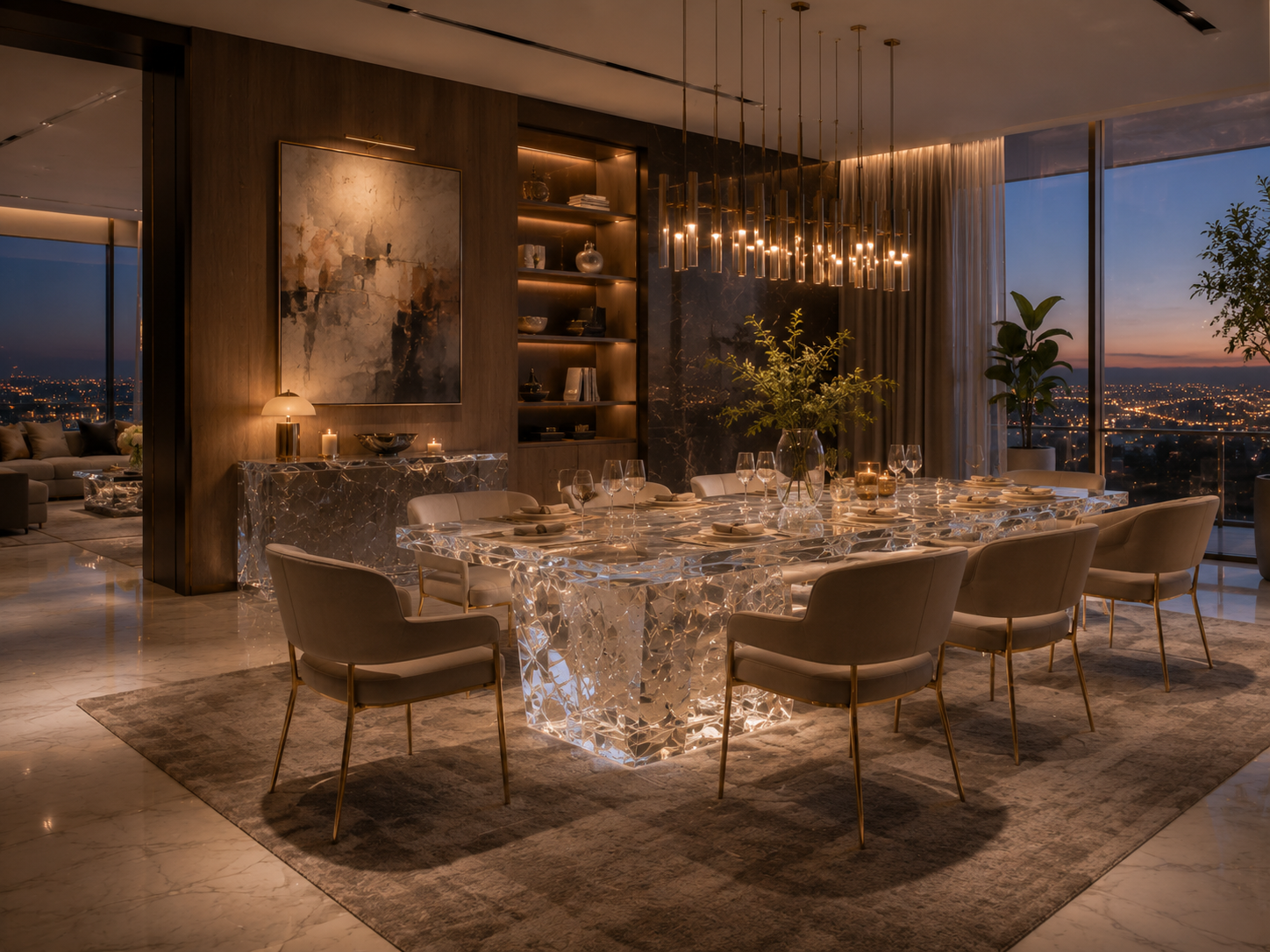
Introduction
High-end interior design is undergoing a significant transformation. In the past, luxury was often communicated through expensive stone, rare wood, decorative metal, elaborate craftsmanship, or recognizable designer brands. Today, these elements still matter, but they are no longer enough to make a space feel truly distinctive.
Modern luxury spaces are increasingly concerned with a deeper question: Can people recognize the character of a space through its materials?
This question has brought “material identity” to the center of interior design. Material identity refers to the visual, tactile, emotional, and symbolic qualities that make a material immediately recognizable. It is not simply about whether a material is expensive. It is about whether the material creates a strong impression, supports the design concept, and gives the space a memorable personality.
Synthetic crystal acrylic furniture has become especially relevant in this context. With its exceptional transparency, high-gloss surface, optical depth, sculptural flexibility, and ability to interact with light, it offers qualities that traditional furniture materials cannot easily reproduce.
Acrylic can appear almost invisible in one setting and visually dramatic in another. It can resemble crystal, ice, glass, polished resin, or a futuristic architectural object. It can be colorless, tinted, layered, embedded, illuminated, carved, bent, or combined with metal, stone, wood, leather, and fabric.
For this reason, high-end residential interiors, luxury hotels, retail boutiques, clubs, showrooms, art spaces, and premium commercial environments are increasingly using synthetic crystal acrylic furniture to create stronger material recognition.
The growing interest in acrylic furniture is not simply a temporary style trend. It reflects a broader change in how designers, property owners, brands, and consumers understand luxury. Luxury is becoming less dependent on visual complexity and more dependent on clarity, originality, atmosphere, and emotional impact.
This article explores why high-end spaces are paying more attention to material identity and why synthetic crystal acrylic furniture is becoming an important part of that movement.
1. Material Identity as a New Definition of Luxury
Luxury interiors were once strongly associated with visible cost. Heavy marble, carved timber, gold-plated details, crystal chandeliers, silk fabrics, and handcrafted ornaments were used to communicate wealth and exclusivity.
However, contemporary luxury has become more subtle.
Many high-end spaces now avoid excessive decoration. Instead, they focus on proportion, lighting, spatial flow, surface quality, craftsmanship, and material selection. The goal is no longer to fill a room with expensive objects. The goal is to create a space that feels intentional, controlled, and unmistakably different.
This is where material identity becomes important.
A material with a strong identity can communicate several ideas at the same time. It can suggest innovation, craftsmanship, purity, modernity, artistic value, technical precision, or exclusivity. When used correctly, the material becomes part of the space’s story.
Synthetic crystal acrylic is a powerful example.
Unlike ordinary transparent plastic, high-quality acrylic furniture has optical clarity, weight, depth, and surface refinement. Thick acrylic panels can create a crystal-like visual effect. Polished edges can capture and reflect light. Layered colors can produce an almost liquid appearance. Curved acrylic forms can soften the atmosphere of a room, while geometric forms can make the space feel more architectural.
These qualities allow acrylic furniture to occupy a unique position between furniture, sculpture, and light installation.
In a minimalist interior, a clear acrylic table may appear visually light and almost disappear into the space. In a dramatic hotel lobby, a thick colored acrylic console may become the main visual focus. In a luxury boutique, transparent acrylic display furniture can support the products without visually competing with them.
The same material can therefore express restraint, glamour, futurism, elegance, or artistic experimentation.
This flexibility is essential in modern luxury design. High-end clients increasingly want spaces that cannot be easily copied. They want interiors that feel specific to their identity, property, brand, or lifestyle.
Acrylic furniture helps designers achieve this because it can be highly customized. Dimensions, thickness, transparency, color, edge treatment, embedded materials, lighting effects, and structural forms can all be adjusted.
As a result, acrylic is not simply selected as a substitute for glass. It is selected because it offers a recognizable design language.
Material identity also affects how people remember a space. Visitors may not remember every piece of furniture in a hotel lobby or private residence, but they often remember a distinctive visual experience. A glowing acrylic reception desk, a transparent staircase console, or a sculptural crystal-like table can become that memorable element.
In this way, luxury is shifting from obvious expense to meaningful distinction.
The most successful high-end spaces are not necessarily the ones that use the largest number of premium materials. They are the ones that use materials with confidence, consistency, and purpose.
Synthetic crystal acrylic furniture supports this new definition of luxury because it can create visual purity while maintaining a strong personality. It can be quiet without being ordinary and dramatic without becoming heavy.
2. The Visual Character of Synthetic Crystal Acrylic
The appeal of synthetic crystal acrylic begins with its optical character.
Acrylic interacts with light differently from wood, metal, stone, or fabric. Its transparency allows light to pass through the material, while its polished surfaces and edges reflect and redirect light. This creates a sense of depth that can change throughout the day.
In natural daylight, clear acrylic furniture often feels light, clean, and almost weightless. Sunlight can illuminate the edges, producing subtle highlights. In the evening, artificial lighting can create reflections, shadows, and glowing effects that make the same object appear more dramatic.
This ability to change with lighting gives acrylic furniture a dynamic identity.
Color also plays an important role.
Synthetic crystal acrylic can be produced in clear, frosted, translucent, fluorescent, smoky, metallic, or saturated colors. Designers can select tones that coordinate with the surrounding architecture or deliberately introduce contrast.
For example, a pale amber acrylic chair can bring warmth to a neutral stone interior. A deep blue acrylic console can create a strong visual focus in a white gallery-like space. A smoky gray acrylic coffee table can complement brushed metal and dark timber in a contemporary apartment.
Because the color exists within the material rather than only on its surface, acrylic can achieve a visual depth that painted furniture often lacks.
Thickness further strengthens this effect.
Thin acrylic may appear delicate and minimal, while thick acrylic can look solid, luxurious, and jewel-like. A substantial acrylic block can capture light internally, creating visual layers that change depending on the viewing angle.
This is one reason why high-end acrylic furniture often uses thicker material sections and carefully polished edges. The quality of the edge finishing directly affects how light travels through the object.
Poorly finished acrylic can appear industrial or inexpensive. High-quality acrylic craftsmanship, by contrast, produces smooth joints, clear surfaces, precise corners, and controlled optical effects.
The difference is similar to the difference between ordinary glass and finely cut crystal. The base material may appear simple, but the quality of processing determines the final impression.
Acrylic also offers exceptional sculptural flexibility.
It can be cut, bent, molded, laminated, engraved, carved, and assembled into complex forms. This allows furniture designers to create seamless curves, floating surfaces, thick transparent legs, layered structures, and unusual geometric shapes.
Traditional furniture materials often reveal their structural logic immediately. A wooden chair shows joints, grain, and frame construction. A metal table shows welded connections and supporting elements. Acrylic can conceal or visually soften these structural relationships.
A table may appear to be formed from one continuous transparent plane. A chair may look as if it has been folded from light. A console may seem to float without visible support.
These visual illusions are highly valuable in luxury interiors because they create surprise without requiring excessive ornamentation.
Synthetic crystal acrylic also works well with other materials.
Combined with brass, it can feel glamorous and refined. Combined with stainless steel, it can feel technical and futuristic. Combined with marble, it creates a contrast between visual lightness and physical solidity. Combined with timber, it introduces transparency while preserving warmth. Combined with leather or fabric, it can balance softness and structure.
This compatibility makes acrylic useful in a wide variety of design styles.
It is not limited to futuristic interiors. It can be adapted to Art Deco, contemporary classic, minimalist, coastal, artistic, retro, or luxury commercial environments.
The key is to use the material intentionally.
When acrylic furniture is treated as a cheap transparent alternative, it loses its identity. When it is treated as an optical, sculptural, and architectural material, it becomes highly expressive.
.png)
3. The Relationship Between Material Identity and Spatial Branding
High-end spaces increasingly function as brands.
This applies not only to hotels, restaurants, boutiques, and showrooms, but also to luxury residences, private clubs, offices, galleries, and wellness environments.
Every material choice communicates something about the space.
A boutique that uses dark wood, aged bronze, and velvet creates a different identity from one that uses clear acrylic, polished steel, and white stone. A hotel lobby dominated by natural textures creates a different emotional response from one defined by transparent furniture and illuminated surfaces.
Material selection therefore becomes a form of visual branding.
Synthetic crystal acrylic is especially valuable because it can create recognizable signature elements.
A luxury fashion store may use custom acrylic display tables with brand-specific colors. A jewelry boutique may use transparent acrylic showcases to create a sense of precision and visual purity. A hotel may use illuminated acrylic reception furniture to make the arrival experience more memorable.
These objects do more than serve a function. They become part of the brand environment.
In premium retail spaces, product visibility is essential. Furniture must support the merchandise rather than compete with it. Transparent acrylic is effective because it reduces visual weight while maintaining physical structure.
Shoes, handbags, jewelry, cosmetics, watches, and decorative objects can appear to float when displayed on clear acrylic platforms. This gives the products more visual importance and allows lighting to reach them from multiple directions.
Acrylic can also be customized to match a brand’s visual system.
Specific colors, gradients, embedded logos, engraved patterns, metal details, and lighting effects can be incorporated into the furniture. This level of customization allows brands to create interiors that are difficult for competitors to imitate.
In hospitality design, material identity influences the guest experience.
Guests often form an impression of a hotel within the first few minutes. The lobby, reception desk, seating area, lighting, and decorative furniture communicate the level and personality of the property.
A distinctive acrylic installation can immediately signal that the hotel is contemporary, creative, and design-focused. It can also provide a strong background for photography and social media.
This is increasingly important because many high-end spaces are experienced both physically and digitally.
Visitors photograph hotel lobbies, restaurants, boutiques, and private clubs. Visually distinctive materials help these spaces become recognizable in images. A unique acrylic table or illuminated acrylic wall may become part of the property’s online identity.
For luxury residences, the branding function is more personal.
Homeowners use materials to express their taste, lifestyle, and cultural preferences. A custom acrylic dining table, sculptural console, or transparent bar cabinet can communicate an interest in contemporary art, modern craftsmanship, or experimental design.
The object becomes a personal signature.
This is particularly valuable in residences where the architecture is restrained. In a neutral interior, one distinctive material can define the atmosphere without overwhelming the space.
Material identity also creates consistency.
A designer may repeat the same acrylic color or edge treatment across tables, shelves, lighting elements, screens, and decorative accessories. This creates a visual connection between different areas of the interior.
For example, a warm amber acrylic detail may appear in the entrance console, bar shelving, bedroom side tables, and decorative objects. The repetition helps the interior feel coherent and carefully designed.
This approach is more sophisticated than using matching furniture sets. The connection is created through material language rather than identical forms.
High-end spatial branding depends on this kind of subtle consistency. It allows the space to feel unified while still containing variety.
4. Functional Advantages Behind the Aesthetic Appeal
Although synthetic crystal acrylic furniture is often selected for its visual impact, its practical advantages are equally important.
One of its main benefits is its combination of transparency and structural strength.
Acrylic is lighter than glass and generally more resistant to impact. This makes it useful for furniture that needs to appear delicate while remaining practical.
In hospitality, retail, and residential environments, this lower weight can simplify transportation, installation, and repositioning. Large furniture pieces can achieve a substantial visual presence without becoming as difficult to handle as similarly sized glass objects.
Acrylic also offers greater freedom in shaping and fabrication.
It can be formed into curves, angles, thick blocks, layered panels, and integrated structures. This gives designers more control over both appearance and function.
A custom acrylic table can be designed around a specific room layout. A console can follow the curve of a wall. A display unit can incorporate hidden storage, lighting channels, product supports, or branding elements.
This flexibility is particularly valuable in high-end projects, where standard furniture dimensions often do not fit the architectural concept.
Synthetic crystal acrylic furniture can also make compact spaces feel larger.
Because transparent furniture does not visually block the room, it helps maintain sightlines. This is useful in apartments, dressing rooms, boutiques, corridors, and smaller hospitality spaces.
A clear acrylic chair occupies physical space but creates less visual interruption than a solid chair. A transparent coffee table allows the floor, carpet, or rug beneath it to remain visible. A narrow acrylic console can provide function without making an entrance area feel crowded.
This visual lightness can improve spatial balance.
Acrylic surfaces are also relatively easy to maintain when treated properly. Dust, fingerprints, and minor marks can be cleaned with suitable products and soft materials. Professional polishing can sometimes restore surfaces affected by fine scratches.
However, maintenance quality depends on proper care.
Harsh chemicals, abrasive cloths, excessive heat, and incorrect cleaning methods can damage the finish. High-end furniture suppliers should therefore provide clear maintenance guidance.
Durability is also connected to material quality.
Not all acrylic furniture offers the same performance. The grade of the acrylic sheet, material thickness, internal stress control, bonding quality, edge polishing, and structural design all affect the final product.
High-quality synthetic crystal acrylic furniture should have consistent clarity, minimal distortion, precise joints, stable construction, and smooth finishing.
For this reason, craftsmanship is essential.
Transparent materials reveal mistakes. In opaque furniture, internal connections can often be hidden. In clear acrylic, bubbles, uneven bonding, scratches, misaligned joints, and poorly polished edges are immediately visible.
This creates a higher technical standard.
Well-made acrylic furniture requires accurate cutting, controlled heating, careful bonding, repeated polishing, and clean assembly conditions. Large or complex forms may require specialist equipment and experienced technicians.
The production process can therefore become part of the furniture’s luxury value.
Customization is another major functional advantage.
Designers can control dimensions, colors, transparency levels, surface finishes, engraving, embedded elements, and combinations with other materials.
Acrylic may be produced with frosted sections for privacy, transparent sections for lightness, and colored sections for emphasis. Metal inserts can strengthen structural points. LED lighting can be integrated into edges or internal channels.
This makes the material suitable for furniture that serves multiple purposes.
A reception desk can combine lighting, storage, branding, and customer interaction. A retail display can include shelves, product supports, electrical access, and illuminated signage. A residential bar cabinet can combine transparent doors, colored panels, mirror, and metal hardware.
When designed carefully, synthetic crystal acrylic furniture is not simply decorative. It can solve complex spatial and functional requirements while maintaining a refined appearance.
5. Emotional Experience, Light, and Spatial Atmosphere
High-end interior design is not only about objects. It is about the emotional experience created by the entire environment.
Materials influence how a space feels.
Stone can create permanence and strength. Wood can create warmth and familiarity. Metal can create precision or industrial energy. Fabric can create softness and comfort.
Synthetic crystal acrylic creates a different emotional response.
Its transparency can suggest openness, purity, calmness, and modernity. Its reflective surfaces can create glamour and energy. Its colored forms can feel playful, artistic, or dramatic.
Because acrylic interacts so strongly with light, its emotional effect is never completely fixed.
During the day, natural light may make a transparent acrylic table feel almost invisible. At sunset, the same table may reflect warm tones from the surrounding environment. At night, focused lighting may turn its polished edges into bright lines.
This changing character gives the interior a sense of movement.
In luxury spaces, lighting design and acrylic furniture should therefore be planned together.
Acrylic placed near a window can capture daylight. Acrylic positioned under a pendant light can create layered reflections. Edge lighting can make a thick acrylic panel glow. Colored lighting can transform clear acrylic into a temporary visual feature.
This relationship between material and light can create powerful spatial moments.
For example, an acrylic dining table under a sculptural chandelier can reflect light without visually competing with the fixture. A transparent console in a hallway can catch light from wall washers, creating subtle highlights along its edges.
In a hotel bar, amber or smoked acrylic furniture can amplify a warm, intimate atmosphere. In a wellness space, frosted or pale blue acrylic can support a sense of cleanliness and calm.
The material can therefore be adjusted to match the desired emotional experience.
Transparency also affects the perception of boundaries.
Solid furniture divides space clearly. Transparent furniture allows the eye to continue through the object. This can make a room feel more open and connected.
In high-end residential interiors, this quality is useful when designers want to preserve views, architectural details, or decorative flooring.
A clear acrylic table placed on a custom carpet allows the carpet pattern to remain visible. Transparent stools at a marble kitchen island reduce visual density. Acrylic shelves in front of a textured wall allow the wall surface to continue contributing to the composition.
The furniture supports the space without dominating it.
At the same time, acrylic can create visual tension through contrast.
A transparent object placed beside rough stone creates a strong difference between smoothness and texture. A colored acrylic chair in a room of neutral fabrics becomes a focal point. A crystal-like table on a dark timber floor appears luminous.
These contrasts make the material more noticeable and strengthen its identity.
Emotional value also comes from surprise.
People are familiar with wood tables, upholstered chairs, and metal shelving. A large sculptural acrylic object can challenge expectations. It can appear lighter than its size suggests or more solid than its transparency implies.
This contradiction creates curiosity.
In memorable interiors, curiosity is important. It encourages people to look more closely, move around the object, touch the surface, and experience the space from different angles.
Acrylic furniture can therefore create interaction.
Its reflective qualities may capture the movement of people. Its transparency may reveal overlapping layers of architecture and furniture. Its color may change depending on the background.
The object becomes part of a changing visual composition.
This is one reason why acrylic furniture is often used in galleries, concept stores, design hotels, and artistic residences. It creates an experience that is difficult to communicate through photographs alone.
The viewer must move through the space to fully understand the material.
This physical and emotional engagement is a key characteristic of contemporary luxury. High-end spaces are no longer designed only to look expensive. They are designed to create memorable sensory experiences.
.png)
6. The Future of High-End Acrylic Furniture Design
The future of synthetic crystal acrylic furniture will be shaped by customization, technological development, craftsmanship, sustainability, and cross-material experimentation.
Customization will remain one of the strongest market drivers.
Luxury clients increasingly expect furniture to respond to a specific space rather than forcing the space to accommodate a standard product. They want unique dimensions, custom colors, personalized details, and exclusive forms.
Digital design tools are making this process more efficient.
Three-dimensional modeling allows designers to test proportions, transparency, color, and lighting before production. Digital fabrication equipment can cut and shape acrylic with greater precision. Computer-controlled processes can support complex patterns, curved surfaces, and repeated modular elements.
These technologies will expand the range of forms that can be produced.
However, technology alone will not define quality.
Hand finishing, polishing, assembly, and inspection will remain essential, especially for transparent furniture. The most successful products will combine digital precision with skilled craftsmanship.
The future of acrylic furniture will also involve greater integration with lighting.
LED systems can be embedded into edges, bases, shelves, and internal channels. Smart lighting controls can change brightness and color according to time, activity, or atmosphere.
This will allow furniture to function as both an object and a lighting element.
A reception desk may glow softly during the day and become more dramatic in the evening. A home bar may change lighting according to different events. A retail display may use programmable light to highlight seasonal products.
The combination of acrylic and light will create more adaptable interiors.
Cross-material design will also become more sophisticated.
Instead of using acrylic as a separate transparent component, designers will integrate it structurally and visually with stone, metal, timber, glass, leather, textile, resin, and composite materials.
Acrylic may be used to connect heavy materials, create floating transitions, reveal hidden structures, or introduce color without covering the natural character of another material.
These combinations will help acrylic move beyond the image of purely futuristic furniture.
It will become part of a broader luxury material vocabulary.
Sustainability will be an important challenge and opportunity.
Clients and designers are increasingly asking where materials come from, how they are produced, how long they will last, and whether they can be reused or recycled.
Acrylic is a synthetic material, so responsible sourcing, production efficiency, waste reduction, long product life, repairability, and recycling systems will become more important.
High-end furniture can support sustainability by emphasizing durability and long-term value.
A well-designed acrylic table that remains visually relevant for many years may be more responsible than low-quality furniture that is frequently replaced. Custom furniture can also be designed for disassembly, repair, refinishing, or adaptation.
Manufacturers may increasingly use recycled acrylic content or develop closed-loop systems for production waste.
Transparency about materials and processes will become part of luxury credibility.
Another future direction is artistic collaboration.
Furniture brands may work with artists, architects, lighting designers, and digital creators to develop limited-edition acrylic pieces.
Because acrylic can hold color, light, embedded objects, engraved patterns, and layered imagery, it is well suited to collectible design.
Acrylic furniture may increasingly be treated as functional art.
This development is already consistent with the direction of high-end interiors, where clients often prefer a smaller number of distinctive pieces rather than a large quantity of conventional furniture.
A sculptural acrylic table or console can serve as both a practical object and an artistic statement.
The future of material identity will also depend on authenticity.
As acrylic furniture becomes more popular, the market will include both high-quality and low-quality versions. Visual similarity alone will not guarantee luxury value.
Clients will pay more attention to clarity, thickness, edge quality, structural stability, originality, customization, and craftsmanship.
The strongest products will be those that use acrylic because the material is essential to the design, not simply because transparency is fashionable.
Conclusion
The growing importance of material identity reflects a major change in high-end interior design.
Luxury is no longer defined only by price, rarity, decoration, or brand recognition. It is increasingly defined by the ability of a space to create a clear, memorable, and emotionally meaningful experience.
Synthetic crystal acrylic furniture responds directly to this change.
Its transparency creates visual lightness. Its thickness creates crystal-like depth. Its color creates atmosphere. Its polished surfaces interact with light. Its flexibility allows custom forms, sculptural structures, and integrated functions.
Most importantly, it has the ability to give a space a recognizable character.
In residential interiors, it can express personal taste and contemporary sophistication. In hotels and restaurants, it can strengthen the guest experience. In boutiques and showrooms, it can support product display and brand recognition. In galleries and artistic spaces, it can become a functional sculpture.
Its value lies not only in how it looks, but also in how it changes the perception of the surrounding environment.
Acrylic can make heavy spaces feel lighter, compact rooms feel more open, neutral interiors feel more dynamic, and branded spaces feel more distinctive.
However, the success of acrylic furniture depends on quality.
Material grade, thickness, optical clarity, structural design, bonding, polishing, customization, and installation all influence the final result. High-end acrylic furniture must be designed and produced with precision.
When these factors are controlled, synthetic crystal acrylic becomes much more than transparent furniture.
It becomes a material language.
As high-end spaces continue to pursue originality, emotional value, visual recognition, and customized design, material identity will become even more important.
Synthetic crystal acrylic furniture is likely to play a growing role in this future because it offers something that many traditional materials cannot: the ability to appear present and almost invisible at the same time.
It can define a space without making it feel crowded. It can attract attention without relying on excessive decoration. It can reflect light, color, architecture, and movement while maintaining its own identity.
That balance between visibility and transparency, function and sculpture, technology and craftsmanship is precisely why high-end spaces are paying more attention to synthetic crystal acrylic furniture.
In the new language of luxury design, materials are no longer silent surfaces.
They are active participants in the identity of the space.
READ MORE:
- A New Approach to Building a High-End Furniture Brand: From Design Differentiation to Material Differentiation
- Why Is Synthetic Crystal Acrylic Becoming a New Symbol of High-End Furniture?
- Synthetic Crystal Acrylic Furniture: Giving Ordinary Furniture a High-End Design Language
- From Transparent Aesthetics to Commercial Value: Where Are the Growth Opportunities for Synthetic Crystal Acrylic Furniture?
- The Hidden Cost of Low-Quality Furniture in Premium Commercial Projects
- How Light Interacts with Crystal Materials to Create Memorable Commercial Spaces
- Why Luxury Interiors Need Statement Pieces Instead of More Decorations
- How Material Quality Shapes Brand Trust Before a Customer Speaks to You
- Commercial Space Upgrades: Choosing Materials That Transform Perception Fast


