
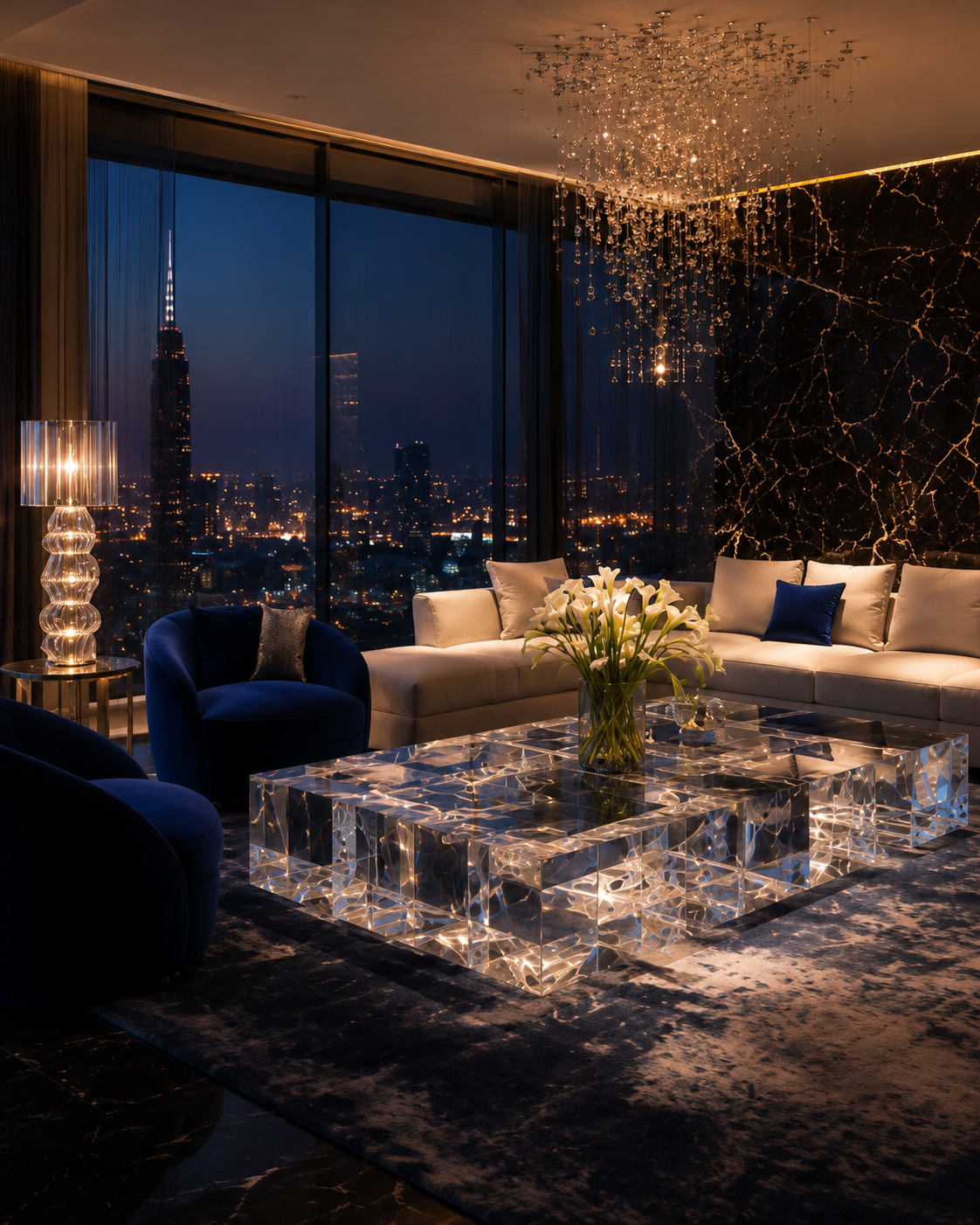
For several years, commercial interiors were judged increasingly through images. Hotels wanted a lobby that would stop a guest mid-scroll. Restaurants wanted a table setting that could become a social-media backdrop. Retailers wanted display furniture that looked unmistakable in campaign photography. That visual ambition has not disappeared, but it is no longer enough. Owners, operators, architects, and procurement teams are asking a harder question: will the furniture continue to support the business after thousands of guests, cleaning cycles, deliveries, layout changes, and seasonal campaigns?
This shift is especially important for furniture made from synthetic crystal, premium resin, and platinum acrylic—understood here as high-grade, furniture-grade cast PMMA selected for optical clarity and precision fabrication. These materials can deliver light, depth, color, transparency, and a strong sense of luxury. They are also visually unforgiving. Scratches, poorly resolved joints, yellowing, chips, trapped contamination, and incorrect repairs are easier to notice on a transparent or highly polished surface than on many conventional finishes. The future of high-end commercial furniture is therefore not a move away from beauty. It is a move toward beauty that has been engineered for use.
The market context supports this change. CBRE’s European Retail Occupier Survey 2024 found that 97% of surveyed retailers considered physical retail a continuing strategic priority, while 79% believed stores also increase online sales in their local catchments. Physical space still has to generate attention, but it must also work as an operating environment, a service channel, and a durable expression of the brand.
1. Visual Impact Is Being Measured Against Business Performance
The first change is that “Instagrammable” design is being reframed as only one part of commercial performance. A sculptural synthetic-crystal console may create a powerful arrival moment in a flagship store, and a luminous resin desk may become the visual signature of a hotel. Yet the value of those pieces depends on what happens around them. Do they guide movement? Do they keep sightlines open? Can staff work comfortably behind them? Can merchandise be changed without damaging the finish? Can guests approach safely with luggage, shopping bags, or children?
Retail research helps explain why this broader view matters. CBRE reported that retailers rated brick-and-mortar stores as more effective than online channels across nearly every assessed metric, with particularly strong advantages in customer engagement and cross-selling. That means commercial furniture cannot be treated as stage scenery. It participates in the sale: it frames products, controls pacing, creates opportunities for conversation, and determines whether staff can serve customers efficiently.
In practice, designers are moving from isolated “hero shots” to planned visual hierarchies. Synthetic crystal can be reserved for the memorable centerpiece; premium resin can carry a custom color, embedded texture, or illuminated brand narrative; platinum acrylic can provide transparent shelving, display cubes, table bases, or partitions that support the experience without visually crowding it. This hierarchy is more effective than using the most dramatic material everywhere.
The key specification question is changing from “Will people photograph it?” to “What business task must it perform before, during, and after the photograph?” A beautiful reception desk that slows check-in, a display plinth that cannot be moved safely, or a restaurant table that quickly records every cleaning error becomes expensive content rather than valuable furniture.

2. Durability Is Moving From Assumption to Documented Performance
High-end furniture was once too often approved by sample appearance and brand reputation. Today, serious commercial buyers are asking for evidence: load limits, stability tests, impact resistance, cleaning protocols, UV behavior, edge details, joint design, and repair procedures. This is particularly important for custom polymer-based furniture because “resin,” “acrylic,” and “synthetic crystal” are broad commercial descriptions, not single technical specifications.
ISO 19682:2023 sets out test methods for the stability, strength, and durability of tables and desks, including horizontal and vertical loading, durability, stiffness, and impact procedures. The standard applies across materials and construction methods, which reinforces an essential principle: a visually premium material does not remove the need to test the finished structure.
For a synthetic-crystal side table, the critical risk may be edge impact during housekeeping. For a resin communal table, it may be heat, surface abrasion, incomplete curing, or a coating that cannot tolerate the operator’s disinfectant. For a platinum-acrylic console, it may be stress around a bonded joint, scratching in a high-contact zone, or distortion caused by an unsupported span. None of these risks can be assessed from a small color chip.
The practical response is to prototype at meaningful scale and test the actual assembly. Commercial clients should approve not only color and transparency but also edge radius, base stability, hardware access, cleaning response, packaging, and installation method. Where a pristine horizontal surface is essential, a replaceable top or protective layer may be more intelligent than expecting one finish to remain flawless indefinitely. Long-term luxury increasingly depends on designing the future maintenance event before the furniture leaves the factory.
3. Health, Cleanability, and Material Disclosure Are Becoming Part of Luxury
The third change is that invisible performance now affects perceived quality. Guests may never ask which adhesive was used inside an acrylic base, how completely a resin component was cured, or whether a coating has been tested for emissions. Developers, designers, and certification teams increasingly do ask, because indoor environmental quality and safe maintenance influence project approvals, operating procedures, and brand risk.
The U.S. Environmental Protection Agency states that concentrations of many volatile organic compounds can be up to ten times higher indoors than outdoors and identifies building materials, furnishings, coatings, cleaners, and related products as potential sources. Its Indoor AirPlus guidance emphasizes low-emission materials and recognized emissions-testing methods. WELL also addresses furniture and furnishings within its VOC-reduction requirements and includes cleanability, material safety, ergonomics, and transparency among the ways furniture can contribute to healthier interiors.
For manufacturers of premium resin and acrylic furniture, this creates a clear opportunity. Controlled factory casting, complete curing, documented coatings, compatible adhesives, and written cleaning instructions can become part of the product’s luxury proposition. The buyer should know which products may be used, which solvents must be avoided, how a polished surface should be wiped, and how a damaged area can be restored without creating haze or stress.
Cleanability must also be designed physically. Tight decorative grooves beside food service, inaccessible seams near a wash area, or a transparent cavity that collects dust can turn a beautiful object into a maintenance problem. The new standard of refinement is not merely a flawless surface on installation day. It is a piece that can be kept hygienic and visually consistent by real facilities teams using realistic time, tools, and training.
4. Repairability and Replaceable Components Are Entering the Language of Luxury
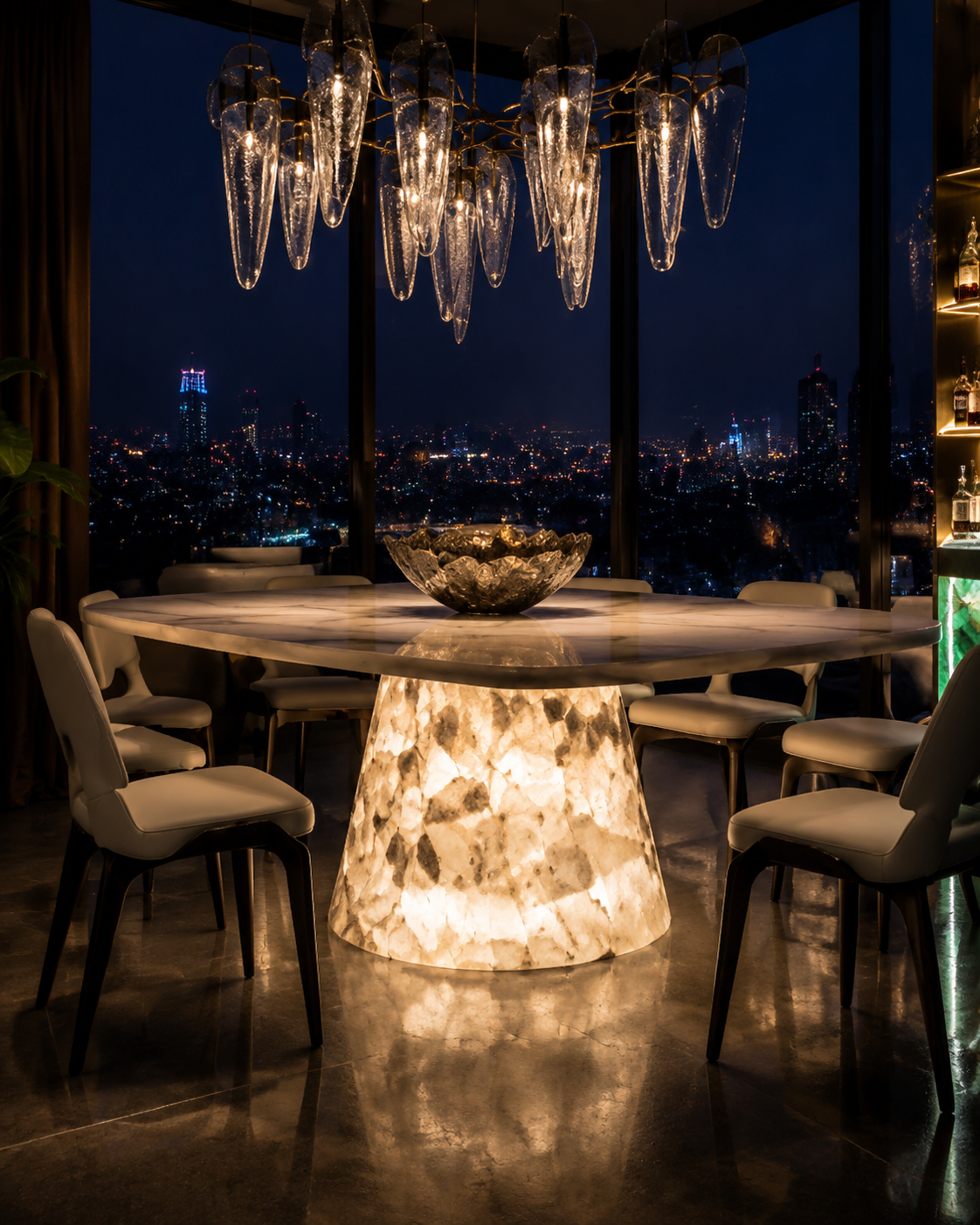
Traditional luxury often emphasized rarity, permanence, and seamless construction. Commercial luxury is increasingly adding another quality: recoverability. A piece is more valuable when a damaged component can be removed, refinished, replaced, or upgraded without discarding the entire object or closing a revenue-generating area for days.
The Ellen MacArthur Foundation presents repair, reuse, refurbishment, and modularity as practical routes for retaining the value already invested in furniture. In one China-based office-furniture case, Deartree reported circulating 940,000 pieces since 2021, avoiding an estimated 22,312 tonnes of carbon emissions; buyers were reported to save 40% to 69% on procurement. The example concerns office furniture rather than luxury transparent furniture, but the business lesson is directly relevant: value can be recovered when products and logistics are designed for multiple lives.
For synthetic crystal, premium resin, and platinum acrylic furniture, repairability may require discreet mechanical connections, replaceable protective surfaces, removable lighting, standardized feet, access panels, separate decorative inserts, and accurate production records. A resin reception desk can be divided into serviceable modules rather than cast as one impossible-to-move mass. A platinum-acrylic display can use replaceable shelves and concealed fasteners rather than permanent bonds at every joint. Synthetic-crystal details can be mounted as protected accents instead of becoming exposed structural corners.
This approach does not make furniture look less bespoke. Done well, it makes the engineering more sophisticated. The customer still sees a coherent object, while the operator gains a realistic response to scratches, broken hardware, electrical failure, store refits, and transportation damage. In commercial settings, the ability to recover gracefully from use is becoming a more credible sign of quality than the promise that nothing will ever go wrong.
5. Adaptability Is Replacing the One-Scene Interior
Commercial spaces now change faster than the furniture procurement cycle. Retail floors move from launch to launch. Hotel lobbies shift between everyday use, events, and seasonal programming. Offices need individual work, collaboration, hospitality, and technology-supported meetings within the same footprint. JLL’s workplace research describes human-led design, flexibility, wellbeing, and sustainability as defining forces in current fit-outs; its 2024 survey also found that 56% of companies were operating as “hybrid adopters,” while nearly nine in ten respondents expected AI to change how their workforce operates within five years.
Furniture therefore has to work as a system rather than a fixed photograph. A visually dramatic object that dictates one layout can become an obstacle when the operating model changes. High-end materials should be used in forms that can be moved, reconfigured, connected, separated, relit, or repurposed without losing their premium identity.
Platinum acrylic is particularly effective where designers want physical definition without blocking light or views. It can form modular risers, shelving, screens, and tables that visually recede while layouts change. Premium resin can become the branded layer within a repeatable system: interchangeable panels, colored inserts, illuminated modules, or tabletops that carry a local story. Synthetic crystal can serve as a signature element that moves between configurations rather than anchoring the entire plan permanently.
The practical test is to model several future scenes before production. How does the furniture work during normal trading, a private event, a product launch, deep cleaning, and a partial renovation? Can two people move it safely? Can components pass through lifts and doors? Can power and lighting be disconnected without specialist demolition? Adaptability does not weaken the design concept; it protects the concept from becoming obsolete.
6. Lifecycle Value and Credible Sustainability Are Defining the Next Generation
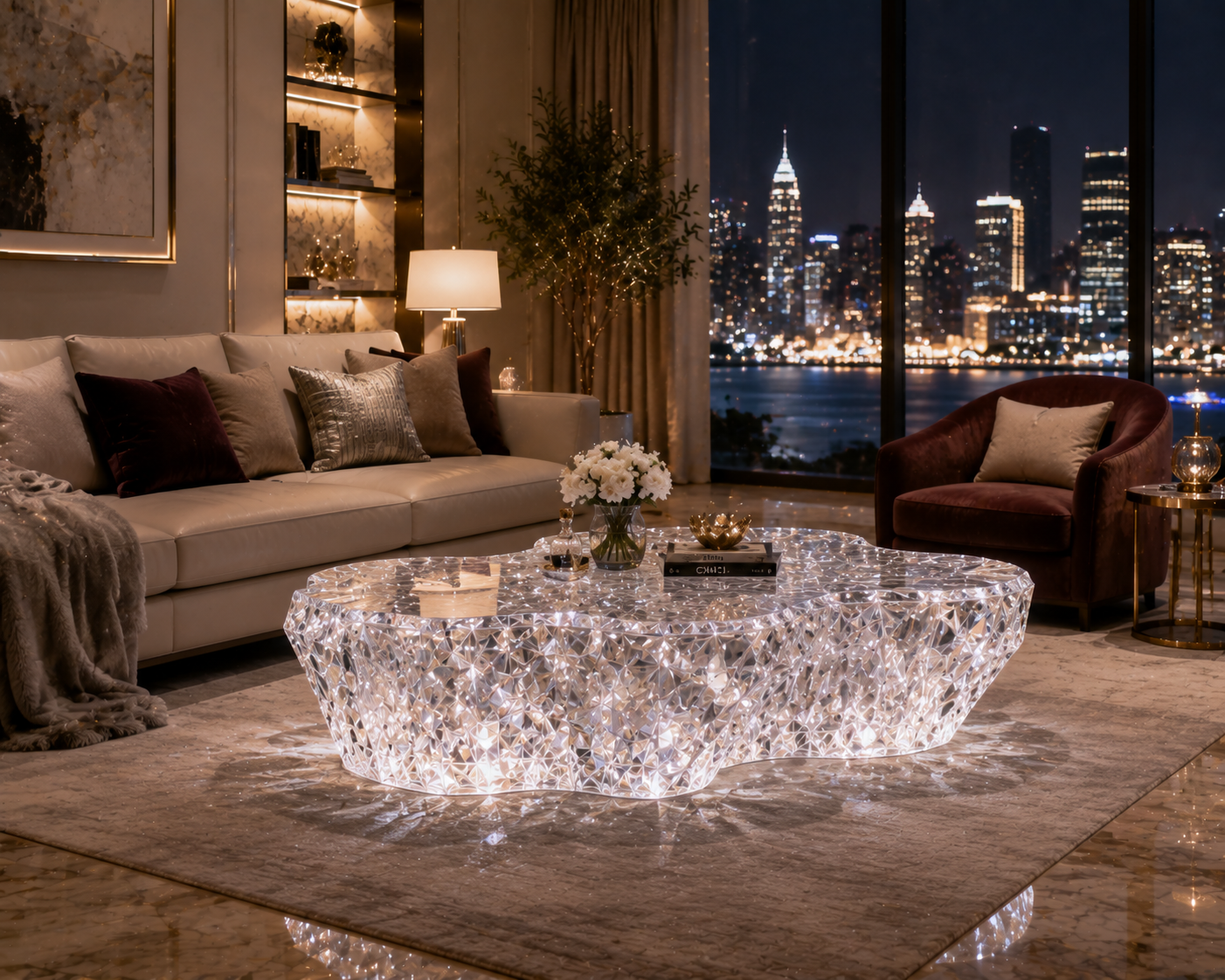
The final change is financial as much as environmental. Procurement teams are looking beyond purchase price toward total cost of ownership: development, molds, samples, freight, installation, cleaning, repair, downtime, replacement, storage, and end-of-use options. A less expensive piece that must be replaced after one campaign may cost more than a better-engineered object that can be refinished and reused across several locations.
The World Green Building Council estimates that buildings account for 39% of global energy-related carbon emissions, with 11% associated with materials and construction. Although furniture is only one part of that total, the organization’s whole-life approach strengthens the case for extending service life, reducing premature replacement, and documenting material impacts. BIFMA’s e3-2024 furniture sustainability standard similarly evaluates furniture through environmental, health-and-wellness, and social criteria, while its LEVEL program uses independent third-party certification against those multi-attribute requirements.
For manufacturers of synthetic crystal, premium resin, and platinum acrylic furniture, credible sustainability should avoid vague claims. The strongest offer is specific: long service life, controlled production, documented ingredients where possible, efficient nesting and machining, replaceable high-wear parts, repair services, take-back options, recyclable metal subframes, and packaging designed for repeated transport. Material choice should also follow the application. A premium transparent polymer may be justified when its optical effect, durability, and repairability allow one piece to serve for many years; it is harder to justify when it is used as disposable visual decoration.
The direction of travel is clear. High-end commercial furniture is moving from a photogenic object to a managed asset. The winning piece will still attract attention, but it will also withstand real traffic, support staff, meet documentation requirements, adapt to new layouts, and recover from damage. Synthetic crystal can deliver the unforgettable moment, premium resin can deliver the proprietary story, and platinum acrylic can deliver clarity and repeatable precision. The most successful projects will combine those strengths with the less visible disciplines of testing, maintenance planning, modularity, and lifecycle thinking.
The future is not “beauty versus function.” It is beauty whose function has been designed, verified, and protected over time.

READ MORE:
- Come trasformare un arredo distintivo in un elemento riconoscibile del brand
- Dove collocare un elemento artistico per migliorare il percorso del cliente all'interno dello spazio
- Come abbinare mobili in cristallo sintetico, illuminazione e superfici senza creare un ambiente eccessivo
- I 3 aspetti dei materiali più importanti nella riqualificazione degli hotel internazionali
- Come mantenere nel tempo l'eleganza di uno spazio commerciale
- What Designers Really Care About Isn't Just Furniture Price—It's These Four Long-Term Costs
- Why Low-Cost Transparent Furniture Loses Its Shine—and How Premium Materials Preserve Long-Term Quality
- Synthetic Crystal, Premium Resin, or Platinum Acrylic: How Should Commercial Spaces Choose?
- One Transparent Furniture Project: How to Balance Visual Impact, Transport Safety, and Long-Term Maintenance


