Commercial furniture is never selected on appearance alone. A reception desk must communicate the brand immediately, a retail display must support the merchandise, and a hotel table must survive continuous use and cleaning. Synthetic crystal, premium resin, and platinum acrylic can all create luminous, high-value furniture, but they solve different design problems.
Here, “platinum acrylic” means premium furniture-grade cast PMMA with high optical clarity, controlled color, polished edges, and documented fabrication quality. “Synthetic crystal” means a crystal-like cast or engineered decorative material, while “premium resin” covers high-quality epoxy, polyester, or polyurethane systems used for furniture and architectural features. Because these commercial names are not interchangeable technical standards, buyers should request the exact composition, test reports, finish samples, and maintenance instructions.
1. Begin With the Business Function, Not the Material Name
The correct choice starts with what the space must achieve commercially. In a luxury hotel lobby, the furniture may need to create a memorable first impression and photograph well from several angles. In a jewelry boutique, transparency may be valuable because it keeps attention on the merchandise. In a busy restaurant, however, cleanability, edge safety, resistance to repeated contact, and fast replacement may matter more than maximum visual drama. The same transparent console that performs beautifully in a low-touch executive lounge may be unsuitable beside a luggage route or a crowded host station.
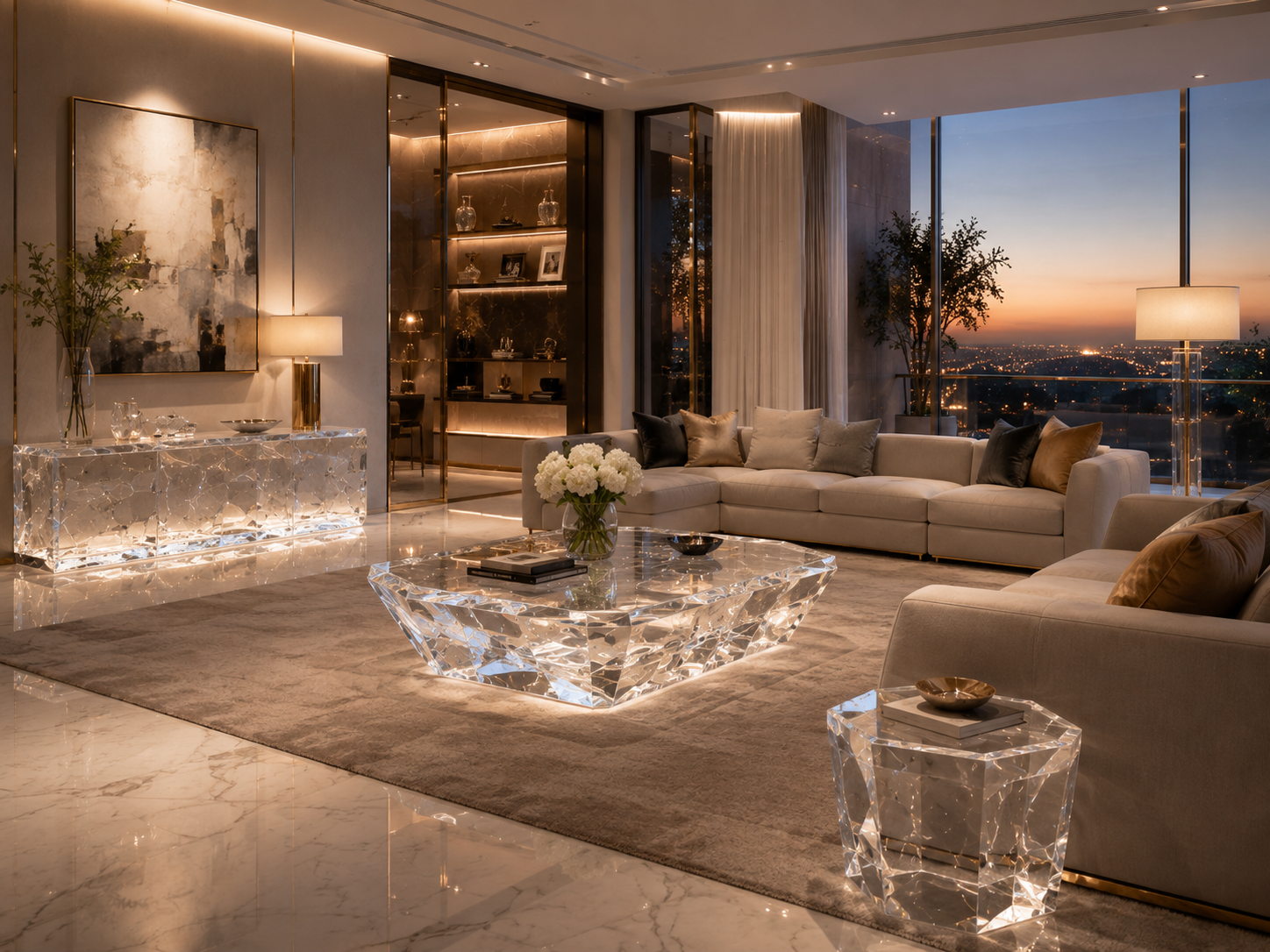
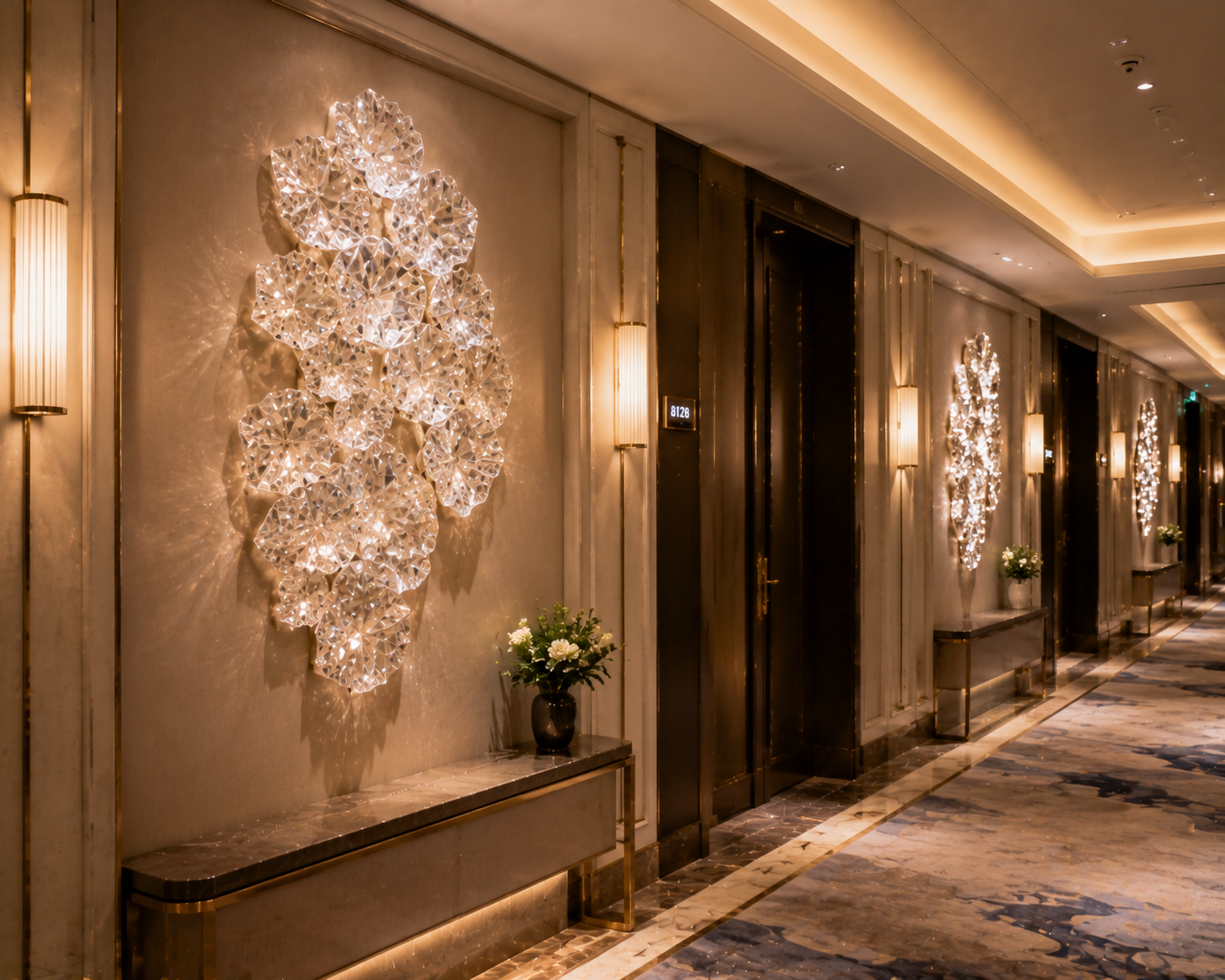
Synthetic crystal is strongest when the furniture acts as a visual focal point. Its apparent depth, sparkle, mass, and faceted character can make a lobby console, ceremonial table, display plinth, or VIP-room accent feel closer to jewelry than conventional furniture. It is therefore most effective when the piece is viewed more often than it is touched. Premium resin is the most expressive option when the design requires embedded objects, pigments, gradients, stone-like clouds, metallic effects, organic forms, or illuminated depth. It can support a distinctive brand story that would be difficult to achieve with a standard sheet material. Platinum acrylic is usually the most rational choice when visual openness, precision, repeatability, and a clean contemporary appearance are the priorities.
Before approving a sample, the brief should define traffic, load, cleaning frequency, sunlight, heat, impact risk, service life, installation route, and replacement strategy. This prevents a spectacular showroom choice from becoming an operational problem.

2. Match the Optical Character to the Brand Experience
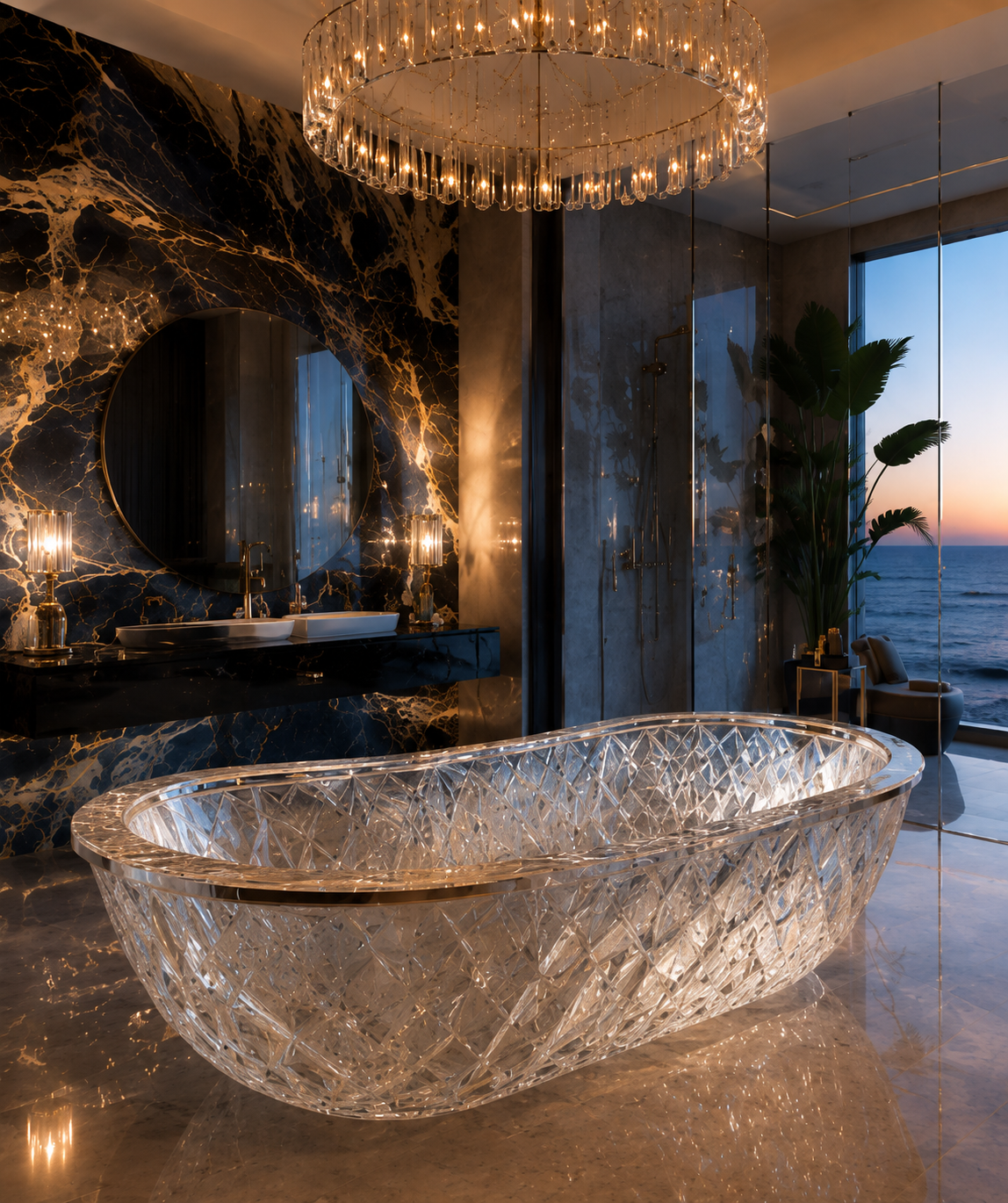
Although all three materials can appear transparent, they communicate luxury differently. Synthetic crystal produces a jewel-like presence under controlled lighting, where polished surfaces, bevels, inclusions, or facets create highlights and refractions. In hospitality and luxury retail, a relatively small piece can become a ceremonial landmark.
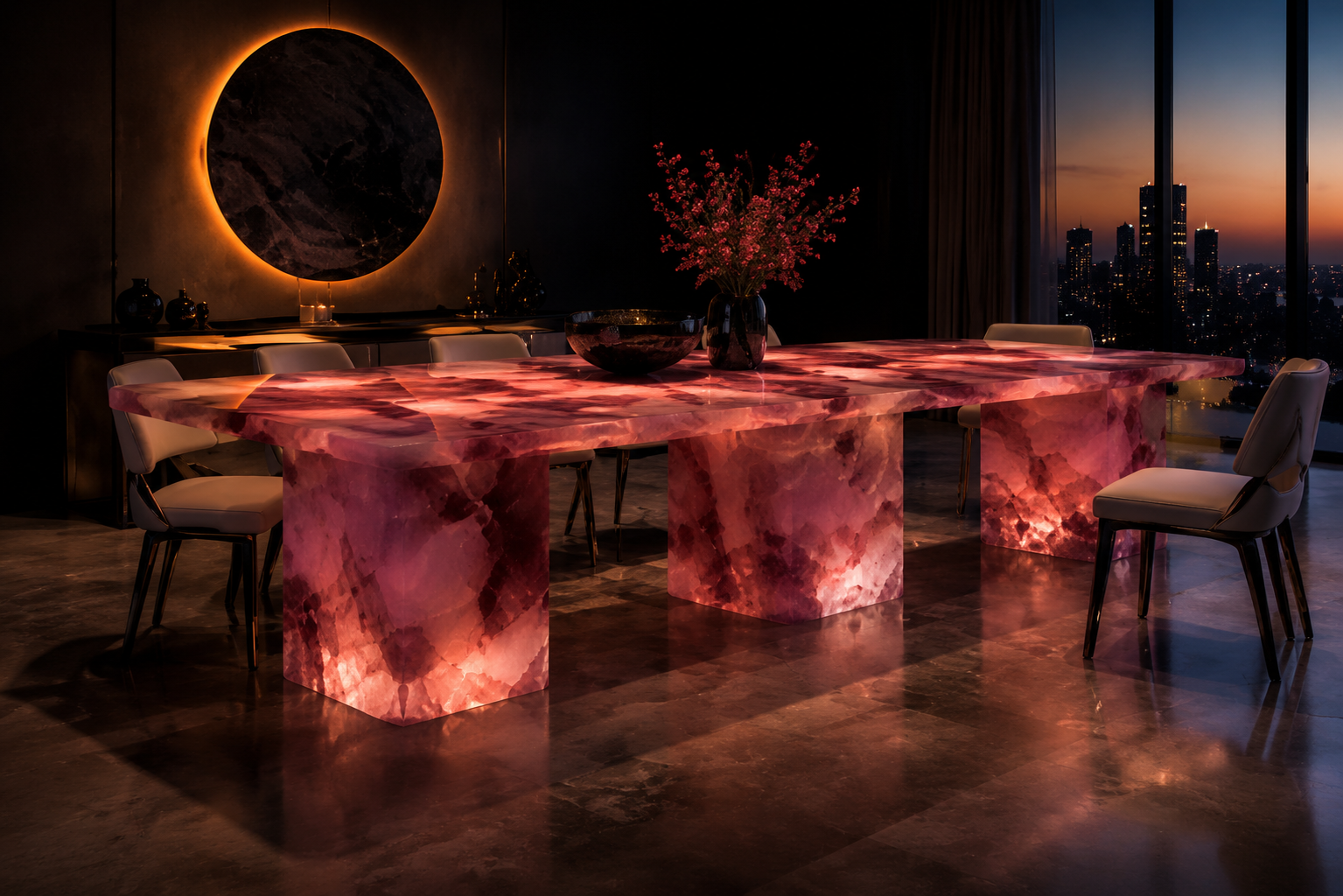
Premium resin offers narrative depth rather than perfect invisibility. Designers can introduce color, suspended textures, natural fragments, metallic powders, fabric, printed graphics, or layered translucency. This makes resin suitable for resorts, concept restaurants, beauty stores, galleries, and branded reception areas that need a unique story rather than a neutral transparent object. The trade-off is that every artistic effect must be controlled through sampling. A small color chip cannot reliably predict the appearance of a large cast table or wall panel because thickness, lighting temperature, pigment distribution, and background color all influence the result.
Platinum acrylic communicates precision, lightness, and modernity. Clear PMMA can transmit up to 92% of visible light, according to PLEXIGLAS technical information, which helps furniture occupy physical space without visually blocking sightlines. The manufacturer also documents long-term light-transmission performance for specific products, although actual results depend on grade, thickness, climate, fabrication, and use. This quality is valuable in compact boutiques, modern offices, museum shops, and hotel suites where designers want the room, view, floor finish, or merchandise to remain visually dominant. Better Homes & Gardens reported that clear acrylic furniture was highly visible across the 2025 High Point Furniture Market, with designers emphasizing its ability to preserve views and add structure without making a room feel crowded.
The decision is not “Which looks most luxurious?” but “Which type of luxury supports the brand?” Crystal suggests ceremony, resin suggests artistry, and platinum acrylic suggests clarity and contemporary precision.
3. Evaluate Durability Through Real Use, Cleaning, and Repair
Commercial durability cannot be judged by hardness alone. The issue is how the finished furniture responds to load, abrasion, impact, chemicals, temperature, and maintenance. Transparent materials make fine scratches, edge chips, adhesive marks, and incorrect cleaning especially visible.
Platinum acrylic has excellent optical performance and can be polished, machined, bonded, and formed into precise furniture components, but its surface can scratch and improper chemicals can cause hazing or stress cracking. PLEXIGLAS advises cleaning with water, mild dishwashing detergent, and a soft lint-free cloth, and warns against dry rubbing and unsuitable cleaners. Its guidance also notes that scratches can often be sanded and polished, which gives acrylic an important maintenance advantage when the furniture is designed with accessible surfaces and sufficient material thickness. For retail fixtures, side tables, shelving, plinths, and transparent bases, this repairability can extend the visual life of the product. For a high-contact dining top, however, a replaceable protective layer or a hybrid construction may be more practical.
Premium resin varies more widely because performance depends on chemistry, cure quality, fillers, pigments, UV stabilizers, topcoat, and casting thickness. A well-engineered resin piece can be stable and durable, while a poorly cured one may remain soft, print under pressure, yellow, crack, or develop surface defects. Buyers should require a full-size control sample and written limits for heat, sunlight, cleaning chemicals, and maximum load. Synthetic crystal may resist light surface wear well, but edges and corners can be vulnerable to chipping or impact depending on its composition and geometry. It is better placed away from trolley paths, children’s zones, and areas where chairs or luggage repeatedly strike the furniture.
Testing should be product-specific. ASTM D7027 exists to compare scratch behavior in polymeric coatings and plastics under controlled conditions, while ISO 19682 covers stability, strength, and durability test methods for tables and desks. BIFMA also publishes standards for desks, tables, public seating, and VOC emissions. A commercial specification should therefore request evidence from a representative finished assembly, not only a generic raw-material data sheet.
4. Make Fire Safety, Emissions, and Material Disclosure Non-Negotiable
A beautiful sample is not automatically suitable for a public interior. Projects may be subject to fire, smoke, indoor-air-quality, accessibility, and sustainability requirements. The applicable tests depend on the jurisdiction and whether the product is movable furniture, built-in furniture, a finish, lighting component, or decorative installation.
ASTM E84, for example, measures comparative surface flame spread and smoke development for exposed building-material surfaces, but ASTM explicitly states that the test does not by itself provide a complete fire-hazard assessment. This distinction matters. A resin panel installed across a wall may require different documentation from a freestanding resin side table. Likewise, a large illuminated acrylic installation near an exit route demands more scrutiny than a small movable accessory. Suppliers should provide current reports for the exact material, thickness, finish, backing, adhesive, and assembly being proposed; a test for a different formulation or thickness should not be treated as automatic approval.
Indoor air quality is equally important, especially when resin is cast, repaired, coated, or bonded on site. The U.S. Environmental Protection Agency notes that concentrations of several common organic pollutants are often two to five times higher indoors than outdoors and identifies building materials, furnishings, adhesives, paints, and related products as potential VOC sources. OSHA documentation also identifies certain epoxy-related components as skin irritants or sensitizers, reinforcing the need for controlled fabrication, curing, ventilation, protective equipment, and safe installation practices before the furniture enters an occupied space.
For offices, hotels, healthcare spaces, and premium developments, third-party documentation can become a competitive advantage. UL GREENGUARD evaluates chemical emissions from furniture and building products, while WELL and LEED frameworks reward low-emitting materials and greater ingredient transparency. Specify cured, documented, traceable products and complete wet fabrication in a controlled factory environment wherever possible.
5. Compare Customization, Production Risk, Installation, and Lifetime Cost
Material price is only one part of commercial cost. The full calculation includes design development, molds, prototypes, machining, polishing, reinforcement, packaging, freight, installation, protection, maintenance, repair, and replacement. Transparent furniture is unforgiving because joints, bubbles, scratches, adhesive lines, and supports are difficult to hide.
Synthetic crystal often carries the highest visual reward per piece, but large or complex objects can become heavy, difficult to transport, and expensive to replace. It is therefore best used selectively, where one centerpiece can elevate the entire room. Premium resin can create almost unlimited colors and forms, but bespoke molds and long curing cycles can increase lead time. Large casts may require staged pouring, thermal control, post-curing, precision sanding, and repeated polishing. The buyer should approve color, translucency, inclusions, edge profile, and lighting conditions through progressive samples rather than relying on a digital rendering.
Platinum acrylic is generally more predictable for repeatable furniture programs because sheet thickness, machining, polishing, bonding, and forming can be standardized. It is particularly effective for multi-store retail rollouts, hotel room collections, display systems, and modular furniture where consistency matters across many units. Yet precision is essential: poor edge polishing, visible glue, inadequate joint design, or internal stress will quickly reduce the premium effect. Large installations also need appropriate tolerances and connection details.
Operational cost should be evaluated by zone. A low-touch lobby sculpture may justify specialized care; a café table used continuously cannot. A professional solution may combine a resin art core with a replaceable glass top, a platinum acrylic base with an abrasion-resistant work surface, or synthetic crystal accents on an independent metal frame. Hybrid design places each material where its strengths create value.
6. Use a Zone-by-Zone Specification to Make the Final Choice
For luxury hotel lobbies, flagship stores, private clubs, and ceremonial spaces, choose synthetic crystal when the object must function as a visual signature and contact is limited. Suitable applications include statement consoles, sculptural side tables, illuminated plinths, decorative legs, and artistic inserts. Protect vulnerable edges, separate the piece from circulation routes, confirm structural support, and include a realistic cleaning plan.
Choose premium resin when the project needs a proprietary visual language. It is ideal for backlit reception desks, artistic wall panels, branded tables, organic-form benches, color-gradient displays, and furniture containing custom inclusions. The most important controls are formulation consistency, complete curing, UV and heat performance, surface protection, sample approval, and repair strategy. In restaurants or hospitality environments, consider resin as the expressive body of the piece and use a replaceable top where heavy abrasion, hot objects, or aggressive cleaning are expected.
Choose platinum acrylic when the design requires transparent volume without visual heaviness, especially in contemporary retail, beauty stores, galleries, offices, compact hospitality spaces, and luxury residential sales centers. It performs well in shelving, display cubes, consoles, table bases, chairs, partitions, and merchandise stands. Specify cast grade where appropriate, polished edges, engineered joints, compatible cleaners, and a maintenance kit. For high-contact horizontal surfaces, add protection or design the top as a replaceable component.
In many commercial projects, the best answer is not one material but a hierarchy. Use synthetic crystal for the memorable moment, premium resin for the customized story, and platinum acrylic for the repeatable functional system. Then verify every proposed item against six questions: Does it support the brand? Is it appropriate for the traffic level? Can it be safely cleaned? Does it have the required fire and emissions documentation? Can it be repaired or replaced without disrupting operations? Does the installed cost make sense over the intended service life?
That method turns material selection from a subjective style debate into a commercial decision. The most successful transparent furniture is not simply the clearest, heaviest, or most expensive. It is the furniture whose optical effect, engineering, compliance, maintenance, and lifecycle cost are aligned with the exact role it must play in the space.

READ MORE:
- Come trasformare un arredo distintivo in un elemento riconoscibile del brand
- Dove collocare un elemento artistico per migliorare il percorso del cliente all'interno dello spazio
- Come abbinare mobili in cristallo sintetico, illuminazione e superfici senza creare un ambiente eccessivo
- I 3 aspetti dei materiali più importanti nella riqualificazione degli hotel internazionali
- Come mantenere nel tempo l'eleganza di uno spazio commerciale
- What Designers Really Care About Isn't Just Furniture Price—It's These Four Long-Term Costs
- Why Low-Cost Transparent Furniture Loses Its Shine—and How Premium Materials Preserve Long-Term Quality
- One Transparent Furniture Project: How to Balance Visual Impact, Transport Safety, and Long-Term Maintenance
- From "Photogenic" to "Built to Last": How High-End Commercial Furniture Is Changing


