
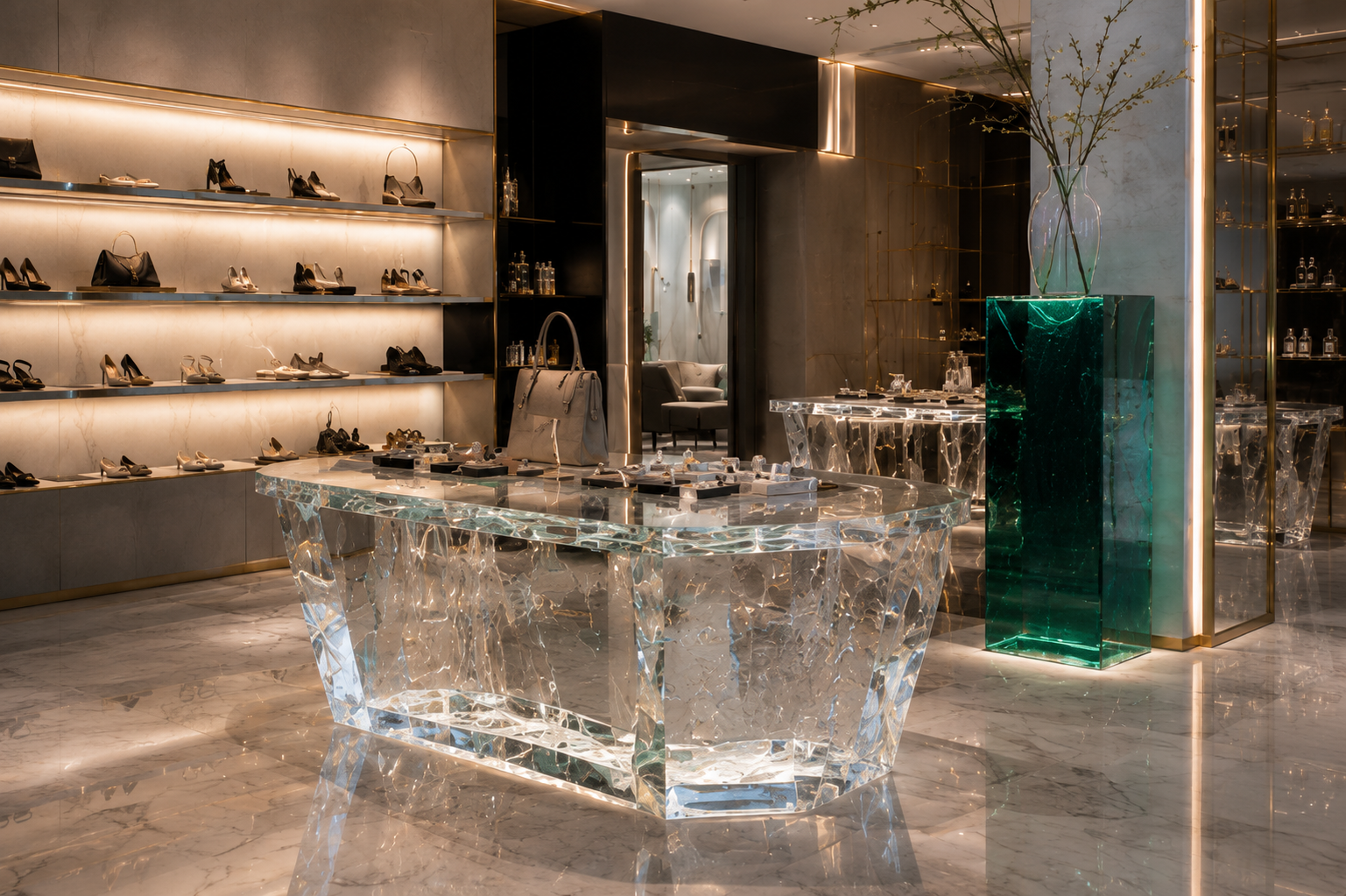
Transparent furniture is often sold through a photograph: a crystal-clear console floating in a hotel lobby, a resin table glowing under warm light, or an acrylic display that seems to disappear around the product. Yet a successful commercial project is not judged only on installation day. It must arrive without edge damage, stand securely under real loads, tolerate routine cleaning, remain visually consistent, and be repairable without closing the space.
Here, “platinum acrylic” refers to premium furniture-grade cast PMMA with controlled optical quality and polished edges. It is a commercial description rather than a universal technical grade. “Synthetic crystal” and “premium resin” are also broad categories whose performance depends on formulation, thickness, reinforcement, coating, and production method. The project team should therefore approve exact technical data, samples, and finished assemblies rather than relying on material names alone.
1. Define the Visual Result as a Measurable Requirement
The first mistake is describing the goal only as “luxurious,” “clear,” or “high-end.” These words do not tell the manufacturer how much color variation is acceptable, whether the piece should disappear visually or become a focal point, how visible joints may be, or how the material should behave under daylight and artificial lighting. A useful brief defines viewing distance, lighting temperature, background colors, camera angles, acceptable bubbles or inclusions, edge finish, and whether minor marks will be visible during normal use.
Platinum acrylic is usually strongest when a project requires high clarity, precise geometry, repeatability, and a light visual footprint. PLEXIGLAS technical information states that colorless PMMA can achieve light transmission of up to 92%, depending on product type and design. That helps explain why clear acrylic preserves sightlines in boutiques, galleries, hotel suites, and showrooms, but it is not a blanket promise for every finished object. Thickness, adhesive joints, internal stress, tint, edge polishing, and ambient lighting all influence the result.
Synthetic crystal is better when furniture must feel jewel-like, substantial, and ceremonial. Premium resin offers the broadest artistic range because pigments, suspended objects, metallic effects, translucent layers, and organic forms can be integrated into the body. Resin, however, is also the category in which a small sample can be misleading: a color chip may appear uniform, while a full-size table reveals pigment migration, clouding, or differences across varying thicknesses.
Use staged approvals: material swatch, full-thickness sample, representative joint, then full-scale prototype under project lighting. The specification should identify “show surfaces,” permissible parting lines, acceptable inclusions, and polishing quality. Visual quality then becomes an inspectable deliverable rather than a subjective argument.
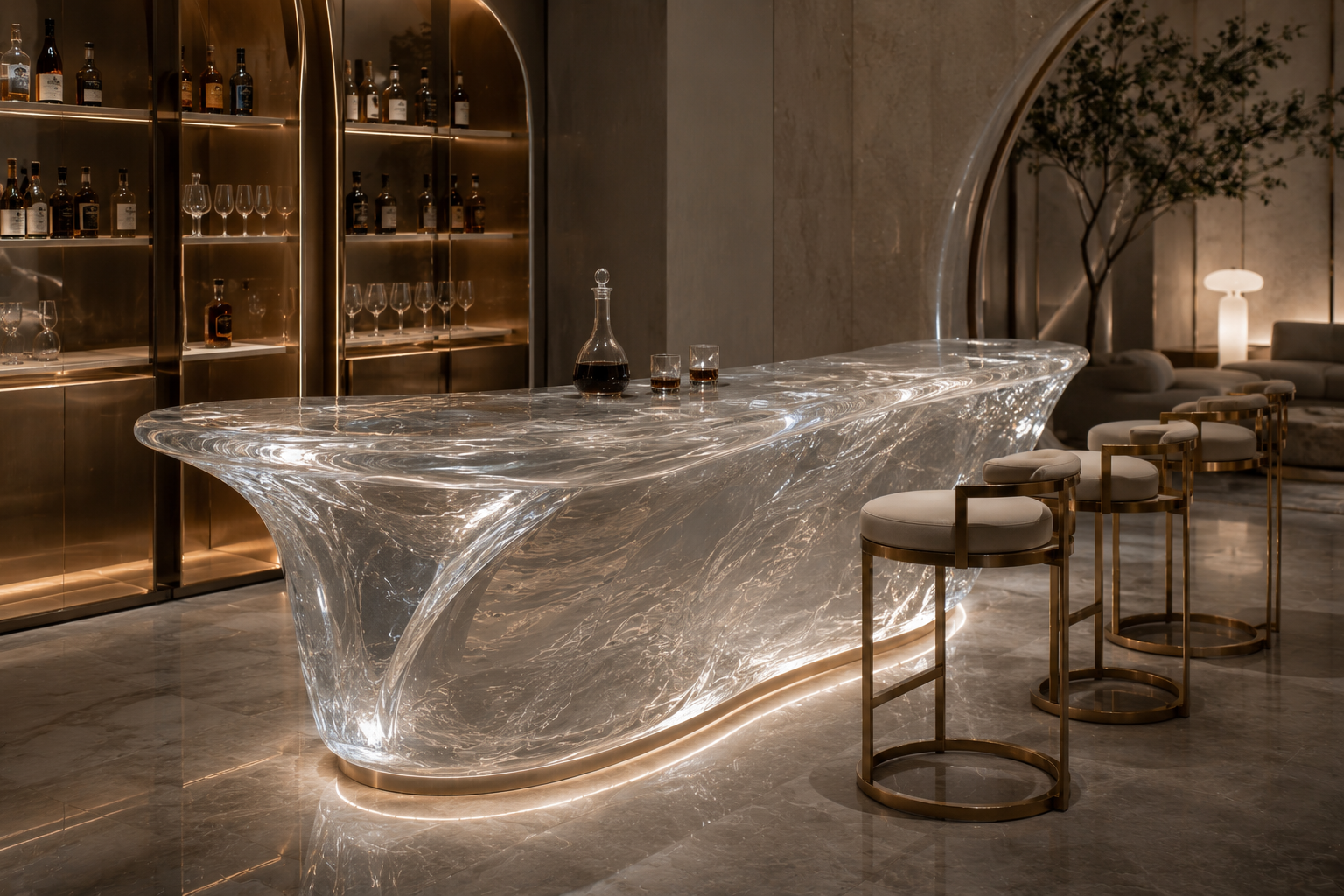
2. Engineer Loads, Joints, and Replaceable Components Early
A transparent object exposes its engineering. Metal plates, fasteners, adhesive lines, frames, and reinforcement cannot be hidden as easily as they can inside opaque cabinetry. The structural concept must therefore be designed with the visual concept. If engineering is postponed, the project often ends with oversized brackets, visible repairs, or a fragile monolithic piece that is difficult to ship.
The team should identify real load cases: a guest leaning on a console, staff moving a table by its top, a plinth carrying concentrated weight, a chair being dragged sideways, or a trolley striking a corner. BIFMA states that voluntary standards support furniture safety, durability, and performance. Its published standards include ANSI/BIFMA X5.5 for desk and table products and standards for public and lounge seating; BIFMA also references ISO 19682 for stability, strength, and durability testing of desks and tables. These standards do not automatically certify a custom transparent piece, but they provide a disciplined basis for choosing tests.
For large acrylic or resin furniture, modular construction is often safer than one dramatic casting. A transparent top, base, internal frame, and protective surface can be separate components with controlled interfaces. This reduces package weight, allows worn parts to be replaced, and limits the cost of damage. A resin feature table may use a replaceable glass or hard-coated top over an expressive body. An acrylic console may use concealed metal reinforcement while keeping visible surfaces optically clean. Synthetic crystal elements can be mounted on an independent frame rather than carrying every structural load.
Edge geometry also matters. Sharp polished corners may look precise in renderings but are vulnerable during handling and risky in busy spaces. A controlled radius, chamfer, recessed base, or sacrificial protector can preserve the design while reducing impact exposure. The best transparent furniture is not the piece with the least visible structure; it is the piece in which structure and future replacement were made visually intentional.
3. Treat Packaging and Transport as Part of the Product
Transparent furniture is often damaged because packaging is designed after production. A foam-lined crate cannot compensate for a piece with no safe lifting points, unsupported spans, protruding corners, or surfaces that rub against protective films. Transport engineering should begin before the final geometry is frozen.
ISTA describes packaged-product testing as a way to evaluate how the product-and-package combination performs against distribution hazards. Procedure 2C specifically addresses individual packaged furniture, while ISTA 3-Series procedures simulate conditions such as vibration, drops, impacts, and atmospheric exposure. ASTM D4169 similarly provides a laboratory framework for evaluating shipping units through sequences representing anticipated distribution hazards. Both approaches reinforce the same principle: the furniture and its packaging must be tested together.
The transport plan must reflect the real route. A one-piece lobby table moving by dedicated truck faces different risks from a display system traveling by ocean freight, warehouse transfer, and last-mile delivery. Document crate orientation, stacking limits, forklift entry points, center of gravity, lifting locations, temperature variation, and every handoff. For repeated units, send one packaged prototype through a route-representative trial before mass production. For a unique piece, test a mechanically representative sample when the finished object cannot be sacrificed.
Protection must be material-specific. Acrylic can be scratched by trapped grit or incompatible films; resin coatings can mark if packed before full cure; synthetic crystal edges can chip when pressure is concentrated at one point. Soft wrapping should not permit movement, while rigid restraints should distribute load away from show surfaces. ACRYLITE guidance warns that acrylic may craze, crack, or discolor when exposed to incompatible cleaners, adhesives, sealants, gasketing, or packaging materials.
A good crate also supports installation: it opens in the right sequence, keeps components identified, protects the piece during positioning, and includes lifting diagrams. Packaging is therefore an extension of product engineering, not an emergency layer around a finished object.

4. Control Site Handling, Installation, and Acceptance
Many transparent furniture projects survive international transport and are damaged during the final fifty meters. Loading docks, narrow lifts, unfinished floors, construction dust, rushed unpacking, and untrained installers create risks that did not exist in the factory. Installation should be treated as a controlled operation rather than a normal delivery.
Before dispatch, verify door, lift, corridor, stair, and turning dimensions against both packed and unpacked sizes. The method statement should identify handler numbers, lifting equipment, temporary supports, floor protection, and the sequence for removing films. Clear panels should not be carried by decorative edges or lifted through cut-outs unless those points were designed for handling. Gloves must be clean, and suction equipment must be approved for the exact surface.
The site environment matters. Dust trapped under film can scratch the finish during removal. Wet trades, paint vapors, sealants, and aggressive chemicals can contaminate the piece. Resin components should be fully cured before packing and installation. Transparent furniture should ideally arrive after major dusty work is complete but before access becomes restricted by final styling.
Acceptance must occur under agreed lighting and from an agreed viewing distance. A high-intensity lamp held centimeters from the surface reveals marks invisible in normal use, while a dark room may conceal defects that become obvious after retail lighting is commissioned. The contract should distinguish manufacturing defects, transport damage, installation damage, and acceptable material characteristics. Photographs taken at factory release, crate opening, placement, and handover establish a clear chain of custody.
The installer should leave an asset record for every major piece: material grade or formulation, finish, production batch where relevant, hardware details, approved cleaners, repair limits, and spare-part references. That record becomes essential when the original project team has moved on and facilities staff must maintain the furniture years later.
5. Build the Maintenance Program Before Delivery
Transparent furniture does not necessarily require excessive maintenance, but it punishes incorrect maintenance quickly. Dust, fingerprints, fine scratches, chemical haze, and poor repairs are more visible than on opaque surfaces. The answer is not merely cleaning more often; it is establishing the correct method, products, tools, and responsibility.
For acrylic, authoritative sources warn against abrasive or unsuitable solvent-based cleaning. PLEXIGLAS recommends lukewarm water, a small amount of dishwashing detergent, and a soft lint-free cloth. It also advises against rubbing the surface completely dry because static can attract dust and dry rubbing may create scratches. ACRYLITE gives similar guidance and warns that window sprays, scouring compounds, acetone, gasoline, benzene, alcohol, and lacquer thinner can damage the sheet or contribute to crazing.
The Canadian Conservation Institute likewise notes that household cleaners may contain abrasives that scratch acrylic or solvents that cause fine surface cracking. Acrylic can also develop static charge and attract dust. The Institute advises comparing the labor required for scratch removal with replacement cost because polishing is practical mainly for shallow, localized damage.
A commercial maintenance plan should state who may clean the furniture, which products are approved, which cloths are reserved for transparent surfaces, and how spills are handled. The manufacturer should provide an offcut so a new cleaner can be tested before use. For resin and synthetic crystal, the process must be based on the exact formulation and topcoat; a cleaner safe for one system may dull another.
Inspection frequency should follow exposure. A reception desk touched all day needs a different schedule from a sculptural console behind a barrier. Facilities teams should record scratches, loose joints, chips, yellowing, coating wear, and adhesive changes before they become major defects. Maintenance is most economical when the furniture has accessible fasteners, replaceable tops, spare edge parts, and a documented repair procedure.

6. Choose Through Lifecycle Risk, Not Purchase Price
The lowest quotation rarely represents the lowest project cost. Transparent furniture can create hidden expense through remake cycles, special freight, installation delays, polishing labor, replacement tops, and reputational damage when a signature piece looks worn soon after opening. Material and construction should therefore be evaluated over the intended service life.
Platinum acrylic is often the most predictable option for repeatable retail fixtures, hotel-room collections, display cubes, shelving, and consoles because sheet fabrication, machining, bonding, and polishing can be standardized. Its optical advantage is strong, and fine scratches can sometimes be polished, but high-contact horizontal surfaces may need protective coatings, replaceable overlays, or a hybrid construction. Synthetic crystal is best reserved for moments where jewel-like presence justifies heavier handling and specialized protection. Premium resin is ideal when a project needs proprietary color, embedded content, dramatic lighting, or organic form, but it demands disciplined control of formulation, cure, sampling, and surface protection.
Compare every option against the same lifecycle questions. Does it deliver the intended appearance under real lighting? Can the assembly pass appropriate stability and load checks? Can it be packed and tested for the actual route? Can local installers handle it safely? Are compatible cleaners available in the destination market? Can a damaged top, edge, or base be repaired or replaced without remaking the entire piece? Can the supplier reproduce the color and optical quality years later?
For many commercial projects, the strongest answer is a hybrid. A resin body can carry the artistic story, acrylic can provide visual lightness, a metal frame can manage loads, and a replaceable glass or coated surface can absorb daily wear. This is not a compromise in design quality; it is a mature allocation of performance.
Visual impact, transport safety, and maintenance are not separate stages. They are one connected design problem. A beautiful transparent piece that cannot be shipped is unfinished engineering; a safe piece that becomes hazy after routine cleaning is an incomplete specification; and a durable piece without visual distinction has missed the brand opportunity. The most successful project develops appearance, structure, packaging, installation, and aftercare together from the first sketch.

READ MORE:
- Come trasformare un arredo distintivo in un elemento riconoscibile del brand
- Dove collocare un elemento artistico per migliorare il percorso del cliente all'interno dello spazio
- Come abbinare mobili in cristallo sintetico, illuminazione e superfici senza creare un ambiente eccessivo
- I 3 aspetti dei materiali più importanti nella riqualificazione degli hotel internazionali
- Come mantenere nel tempo l'eleganza di uno spazio commerciale
- What Designers Really Care About Isn't Just Furniture Price—It's These Four Long-Term Costs
- Why Low-Cost Transparent Furniture Loses Its Shine—and How Premium Materials Preserve Long-Term Quality
- Synthetic Crystal, Premium Resin, or Platinum Acrylic: How Should Commercial Spaces Choose?
- From "Photogenic" to "Built to Last": How High-End Commercial Furniture Is Changing


