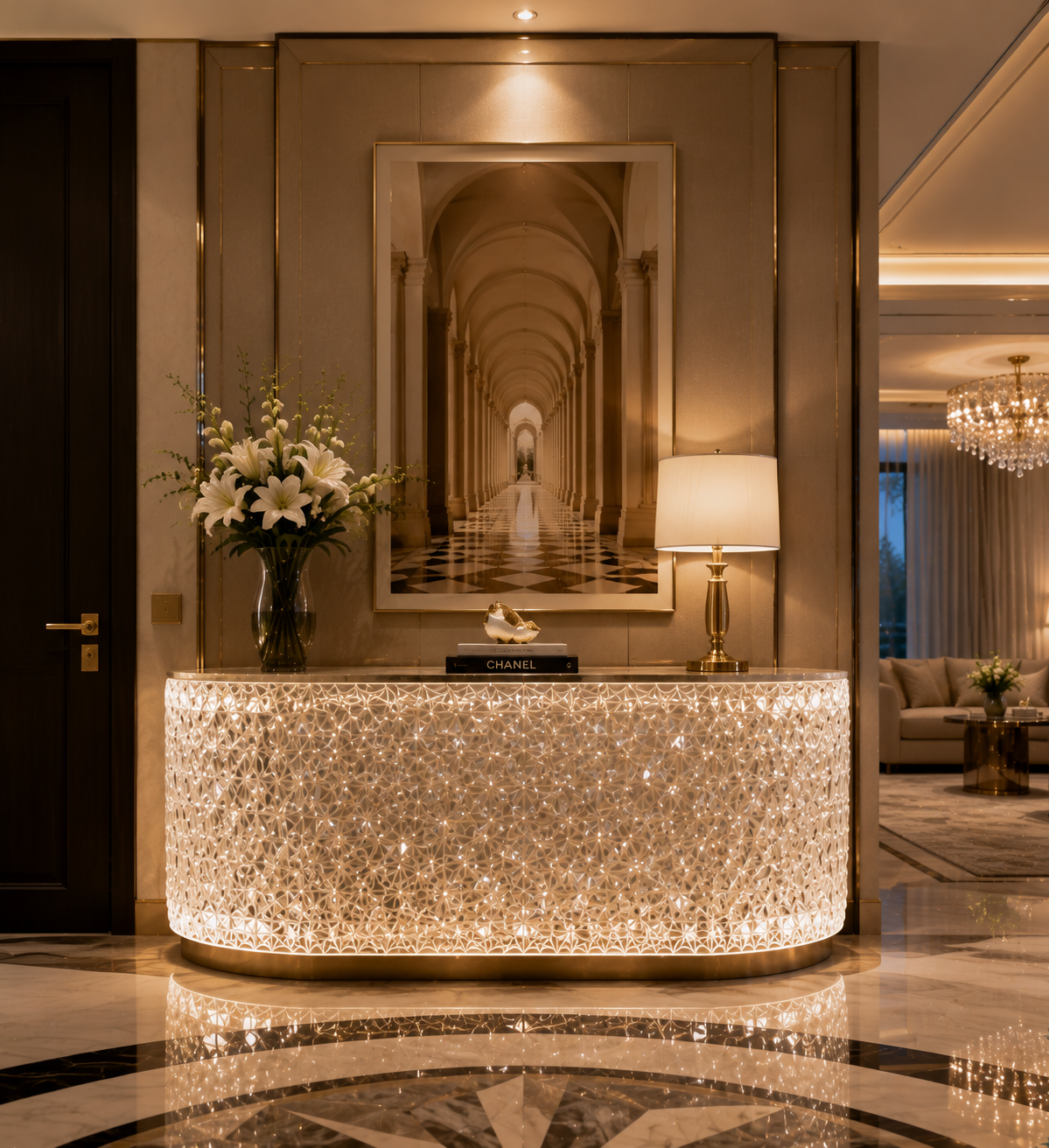
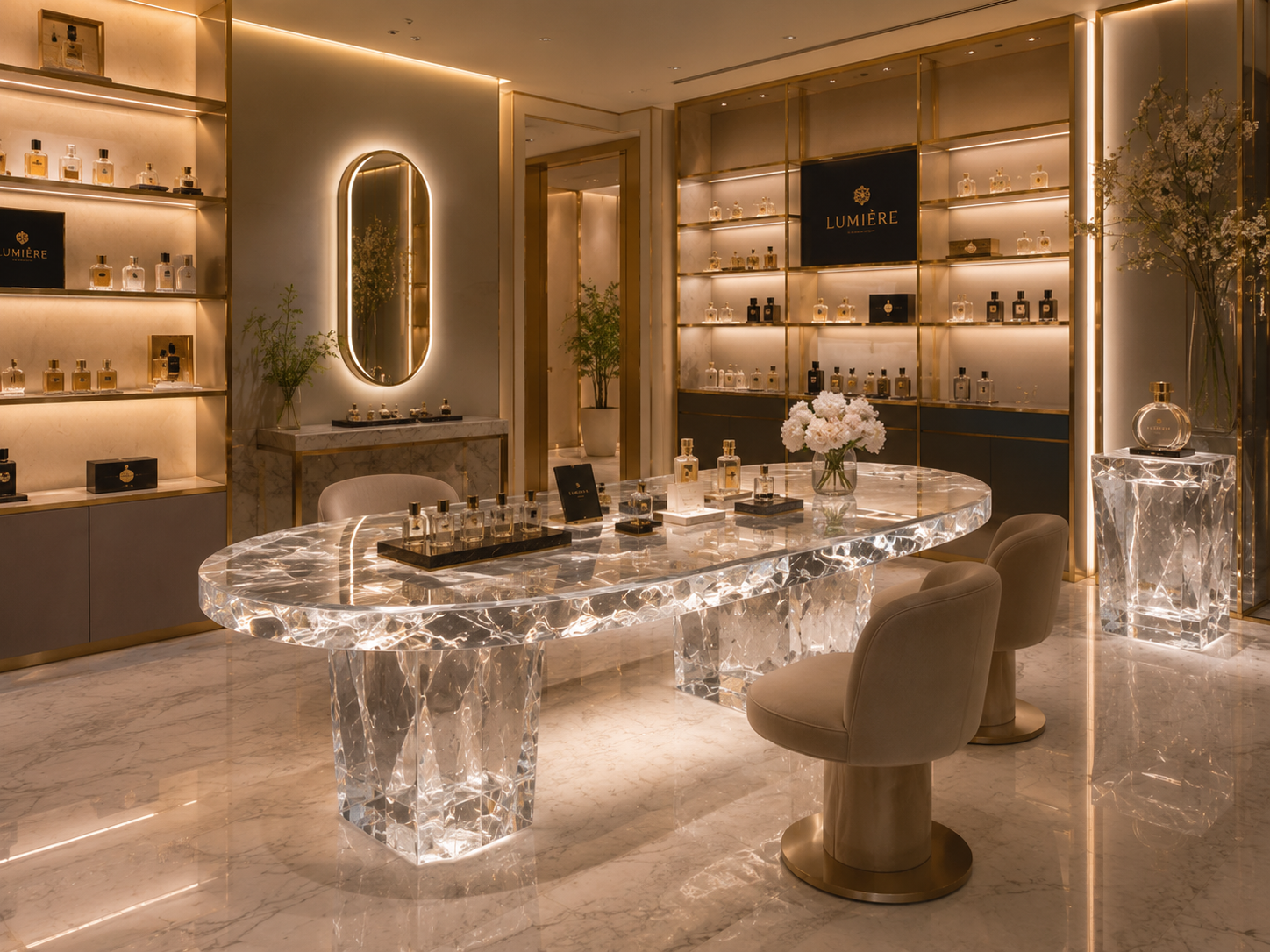
Transparent furniture is one of the most demanding categories in luxury furniture manufacturing. On an opaque cabinet, minor scratches, adhesive marks, uneven polishing, or slight discoloration may remain unnoticed. On a transparent console, resin dining table, synthetic-crystal plinth, or acrylic chair, every imperfection is revealed by reflected and transmitted light.
This explains why two transparent pieces can appear almost identical when new but look completely different after one or two years of use. The difference is not simply the purchase price. It normally comes from raw-material purity, polymer formulation, UV resistance, casting control, curing quality, polishing, structural design, cleaning practices, and the possibility of repair.
In this article, “platinum acrylic” refers to premium optical-grade PMMA selected and fabricated for high-end furniture. It is a commercial product description rather than a universal technical material standard.
1. Transparent Furniture Loses Its Luxury When Light No Longer Travels Cleanly
When people say that transparent furniture has “lost its shine,” they may actually be observing several different forms of deterioration. The surface may have lower gloss, the material may have developed haze, the edges may have become cloudy, or the entire piece may have shifted toward a yellow or grey tone. Fine scratches can also blur reflected images, making an otherwise structurally sound table look old and inexpensive.
These changes can be measured. ASTM D523 evaluates specular gloss at 20°, 60°, and 85°, while ASTM D1003 measures haze and luminous transmittance in transparent plastics. ASTM explains that haze occurs when light is scattered as it passes through a transparent material, creating a smoky appearance or veiling glare. In real furniture applications, thousands of scratches that are almost invisible individually can collectively scatter enough light to reduce clarity.
Low-priced transparent furniture is often designed to deliver an acceptable first impression rather than retain optical performance. A thin polished surface may temporarily conceal machining marks, flow lines, internal stress, bubbles, or material contamination. Once that surface is exposed to regular cleaning and physical contact, the imperfections underneath become easier to see.
Premium transparent furniture is manufactured around the behavior of light throughout the entire object. The raw material must be optically consistent, the faces must be flat, and the edges must be polished to a uniform standard. Internal bubbles, adhesive joints, embedded elements, and connection details must all be controlled because transparent furniture provides no visual place to hide them.
Consider two display plinths positioned beneath strong retail spotlights. One uses optically consistent material with precisely polished edges. The other contains slight internal haze and uneven finishing. The first supports the merchandise by appearing visually quiet. The second produces distracting reflections and cloudy highlights. Both may technically be transparent, but only one continues to communicate premium quality.
2. Low-Cost Materials Often Have Less Protection Against UV, Heat, and Oxidation
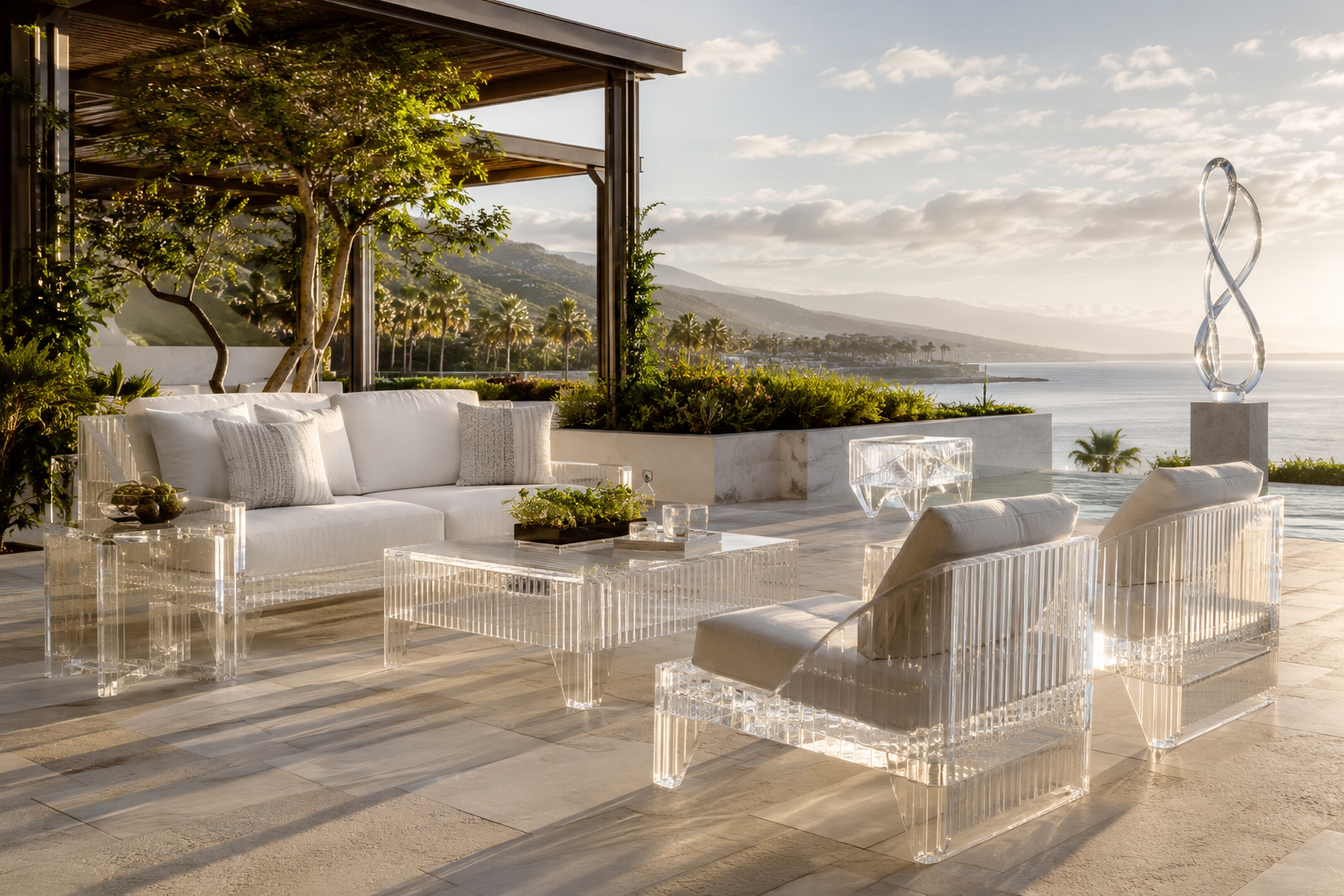
Sunlight is not only a concern for outdoor furniture. Tables and display fixtures placed near hotel windows, retail storefronts, atriums, restaurants, penthouses, and luxury residential glazing can receive substantial ultraviolet radiation and heat.
UV radiation can break or alter polymer chains. Oxygen, humidity, and elevated temperatures can accelerate additional chemical reactions. Over time, these processes may produce yellowing, surface roughness, loss of gloss, microcracking, and reduced mechanical performance.
Research published by the U.S. National Institute of Standards and Technology has demonstrated that the UV degradation of polymer coatings is affected by temperature, humidity, formulation, and material microstructure. In a study of acrylic-urethane coatings, degradation occurred more rapidly under wet conditions, while changes in surface roughness showed a strong relationship with deterioration. A rougher surface is especially damaging to transparent furniture because it scatters light and creates a dull appearance.
Epoxy resin provides another useful example. A 2025 study published in Polymers reported that accelerated UV aging caused color deepening, molecular-chain damage, microcrack development, and reduced performance in the epoxy system tested. A separate peer-reviewed study found that a common amine-cured epoxy experienced irreversible yellowing during hygrothermal aging, even when protected from UV radiation. Researchers connected the discoloration to thermo-oxidative chemical changes within the polymer.
These findings do not mean that all resin furniture will yellow rapidly. They demonstrate why resin chemistry, catalyst ratio, cure schedule, UV stabilizers, casting thickness, temperature exposure, and protective coatings must be carefully controlled.
Premium synthetic crystal, high-end resin, and optical-grade acrylic are generally selected according to defined performance requirements. Manufacturers may use higher-purity raw materials, UV absorbers, light stabilizers, controlled catalysts, appropriate post-curing, and protective surface systems.
Established premium PMMA products can provide high initial optical performance. For example, ACRYLITE technical literature lists 92% light transmission for a specified colorless acrylic sheet and offers a 30-year limited warranty for the referenced glazing product. That warranty cannot automatically be applied to furniture, but it illustrates the documented performance available from reputable PMMA manufacturers.
3. Surface Quality and Cleaning Practices Determine How Long Clarity Survives
Transparent surfaces are highly sensitive to abrasion because every scratch changes the way light is reflected. Dust can act as an abrasive when it is wiped across a dry surface. Paper towels, dirty cloths, scouring pads, rings, watches, handbags, keys, plates, and housekeeping equipment can gradually create dense networks of fine scratches.
Low-cost transparent furniture may deteriorate quickly because its surface is soft, insufficiently cured, unevenly polished, or too thin to be professionally refinished. A piece may also be delivered without clear maintenance instructions, leaving cleaning staff to treat it like ordinary glass.
Premium quality does not mean that a material is completely scratch-proof. Acrylic, synthetic crystal, epoxy resin, polyester resin, and polyurethane resin all have different surface characteristics. The advantage of a high-end furniture system is that its expected performance is known and its limitations are considered during design.
High-contact furniture can be engineered with harder protective coatings, replaceable glass tops, sacrificial panels, thicker surfaces, rounded corners, or removable components. A resin artwork can form the visual body of a reception desk while a replaceable surface handles daily contact. A platinum-acrylic base can create transparency while a separate top protects the main structure.
Cleaning instructions are part of this engineering process. PLEXIGLAS recommends warm water, mild dishwashing detergent, and soft lint-free materials. Its technical guidance warns against dry rubbing, abrasive cleaners, and aggressive solvents such as acetone, which can permanently damage acrylic or initiate crazing that may not be immediately visible.
The cumulative effect is significant. A hotel lobby table cleaned three times a day may undergo more than one thousand cleaning cycles in a year. If housekeeping staff use paper towels and an unsuitable chemical cleaner, the surface can rapidly become scratched and cloudy.
A premium table should therefore arrive with an approved cleaner, designated cloths, written instructions, and a defined refinishing procedure. Its long-term appearance depends not only on the polymer but on the complete relationship between material, surface finish, cleaning frequency, staff training, and repairability.
4. Casting, Curing, and Fabrication Quality Control What Happens Inside the Material
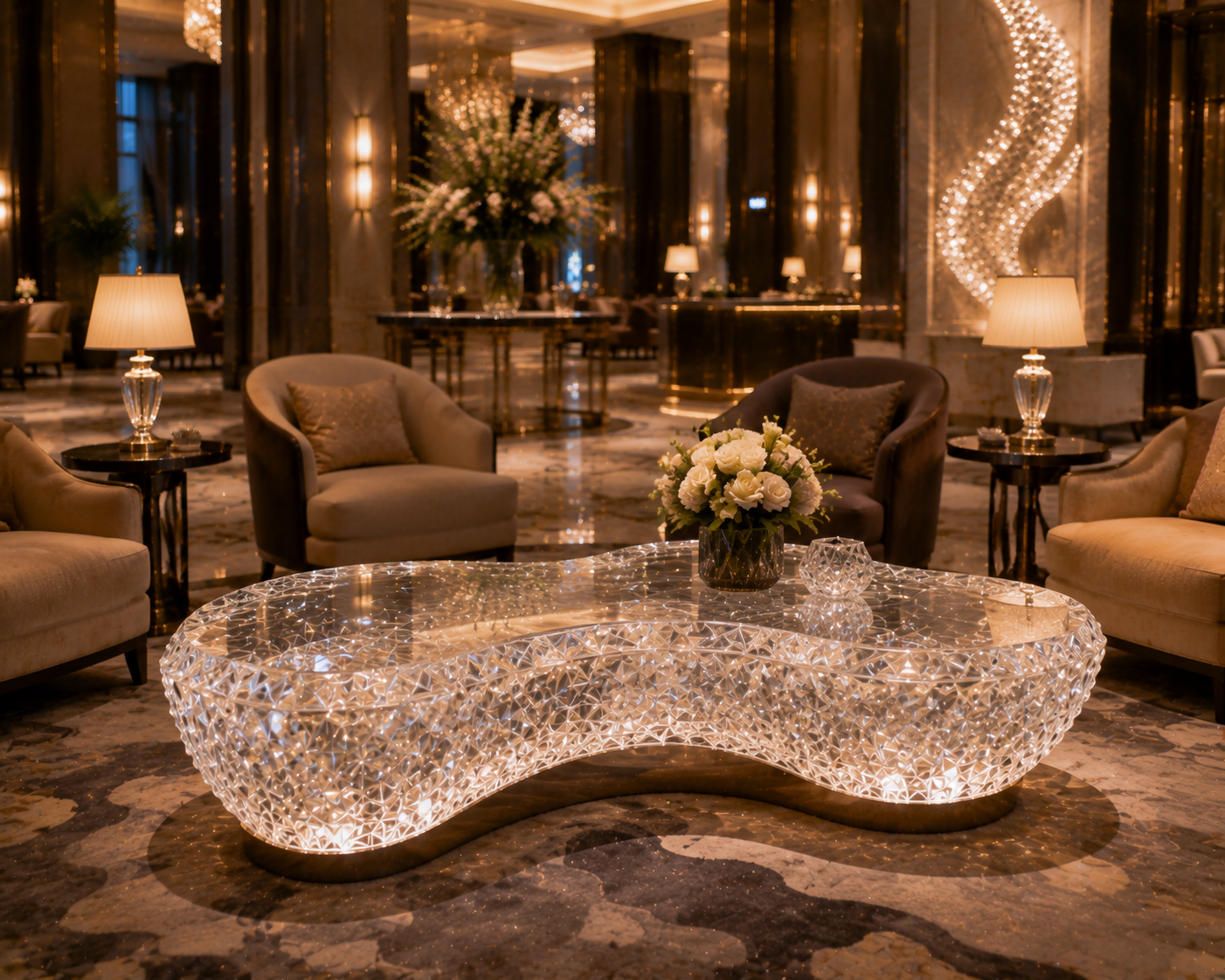
Transparent furniture must remain visually consistent throughout its thickness. Defects that would be hidden inside an opaque material become highly visible in clear resin, synthetic crystal, and acrylic.
To shorten production time, low-cost casting may involve inaccurate mixing, insufficient degassing, excessive pour thickness, uncontrolled reaction heat, premature demolding, or inadequate post-curing. The furniture may initially appear satisfactory, but residual stress, uncured regions, bubbles, shrinkage, or local color variations can become more noticeable later.
Large resin castings are particularly demanding because polymerization generates heat. If the temperature rises too quickly, the center and surface may cure differently. The result can include distortion, internal cracking, inconsistent hardness, excessive shrinkage, or discoloration.
Decorative inclusions introduce additional complexity. Metallic powders, pigments, natural materials, fabrics, recycled particles, and crystal-like fragments can affect heat flow, UV exposure, adhesion, and optical consistency. NIST research on filled polymer coatings has shown that degradation patterns can depend on particle dispersion, with more severe surface deterioration appearing around larger particle clusters in the systems studied.
Professional resin and synthetic-crystal production therefore requires recorded process controls. These may include batch identification, mixing ratios, material temperature, mold preparation, vacuum degassing, pour depth, curing time, post-curing conditions, sanding stages, and polishing compounds.
PMMA furniture involves different risks. Overheating during machining, incorrect polishing, incompatible adhesives, sharp internal corners, or fasteners tightened too aggressively can introduce hidden stress. The piece may leave the workshop looking clear, only to develop crazing near holes, joints, or bonded areas after chemical exposure.
High-end acrylic fabrication controls cutting speed, tool condition, heat generation, bonding chemistry, annealing requirements, edge finishing, and load distribution. Joints are engineered rather than simply glued together.
This is why a professional buyer should not approve transparent furniture solely from digital renderings or small samples. Full-size prototypes should be examined under reflected and transmitted light. Edges, joints, bubbles, inclusions, load-bearing areas, and polishing consistency must all be inspected before mass production.
5. Premium Materials Retain Their Appearance Because the Furniture Is Better Engineered
Many problems described as material failures are actually design failures. A transparent tabletop may become badly scratched because its exposed edge is positioned directly beside customer traffic. A resin console may crack because a long span lacks support. An acrylic component may craze because a drilled hole is too close to the edge. A synthetic-crystal corner may chip because its shape concentrates impact.
Low-cost furniture is frequently optimized to use less material, reduce machining, simplify packaging, and accelerate assembly. These savings may produce thin panels, rigid joints, sharp corners, inadequate support, and very little refinishing allowance.
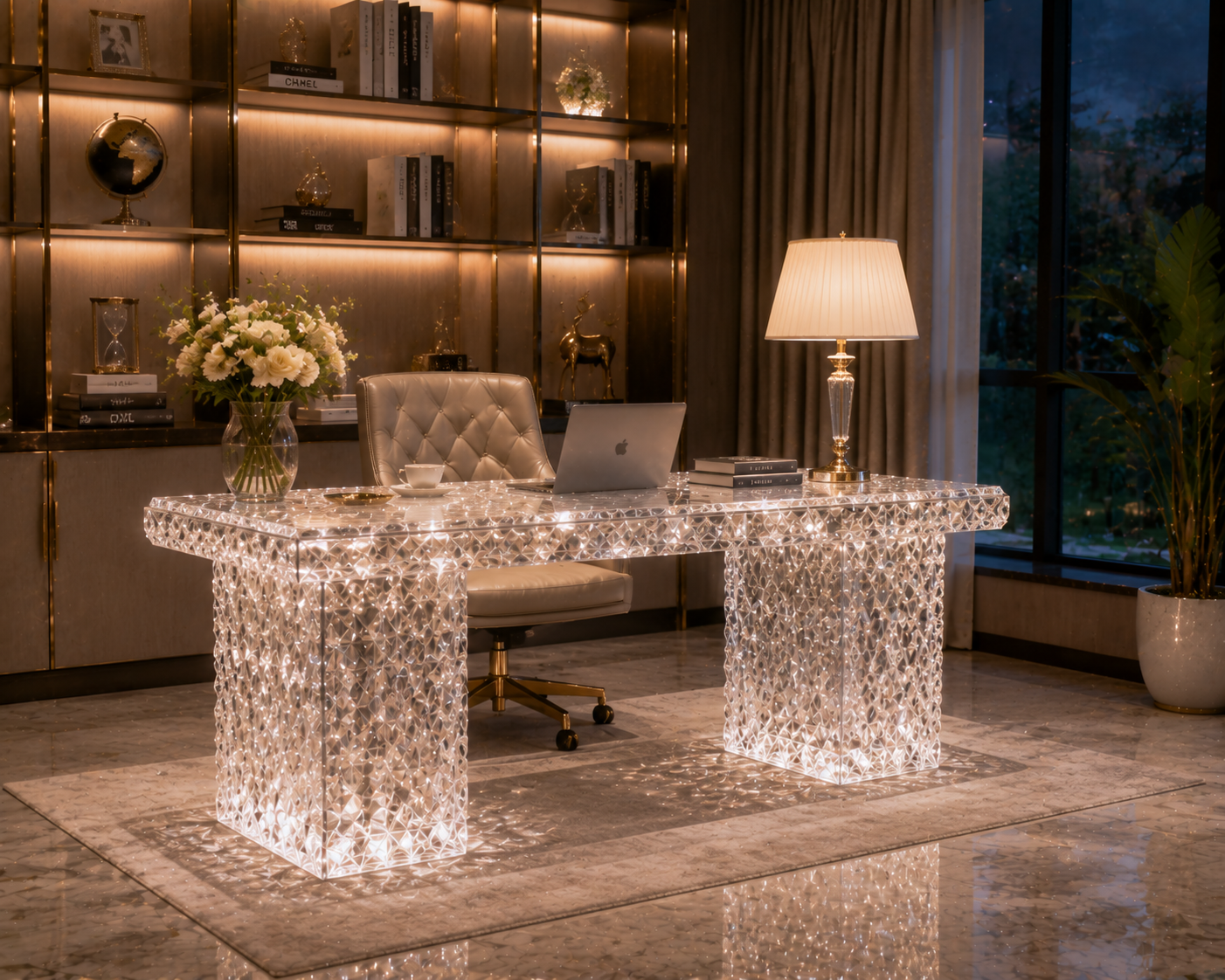
Premium furniture places each material where it performs best. A designer may combine a platinum-acrylic base with a replaceable glass top, use premium resin as a sculptural body below the working surface, or position synthetic-crystal elements on a separate metal frame.
High-contact faces can be thickened, impact-prone corners can be rounded, fasteners can be isolated from the acrylic, and large loads can be transferred through concealed reinforcement. Components that experience the most wear can be made removable.
Repairability is an important part of long-term quality. A thick, well-manufactured acrylic or resin component may allow controlled sanding and repolishing. A thin low-cost panel may distort, expose bubbles, or lose dimensional accuracy during the same process.
Modular construction can also reduce lifecycle cost. A hotel may replace a scratched tabletop without replacing its sculptural base. A retail brand may change a damaged display face without discarding the complete fixture. This approach protects the original investment and reduces operational disruption.
Performance claims should still be examined carefully. ASTM D1435 notes that plastic weathering varies according to UV radiation, temperature, wetness, pollutants, and geographic location. It also warns that short-term exposure results should not be used to predict absolute long-term durability. ASTM G154 similarly states that laboratory UV testing requires appropriate exposure conditions and meaningful correlations.
A responsible supplier should therefore avoid unsupported promises such as “never yellows” or “completely scratch-resistant.” Professional evidence should identify the exact material grade, test method, exposure conditions, measured changes, limitations, and warranty terms.
6. Buyers Should Specify Retained Appearance Instead of Initial Transparency
The best way to prevent premature loss of shine is to purchase measurable long-term appearance rather than accepting a sample that merely looks clear when new.
A commercial specification should identify the material family, manufacturer, grade, casting method, thickness, color tolerance, acceptable haze, surface gloss, edge finish, joint system, cleaning chemicals, traffic level, sunlight exposure, and intended service environment.
ASTM D1003 can establish baseline haze and luminous transmittance, while ASTM D523 can document initial surface gloss. Relevant artificial-weathering procedures can then expose representative samples to UV, heat, and moisture before gloss, haze, color, cracking, and mechanical properties are measured again.
ISO 4892-1:2024 provides general requirements for exposing plastics to laboratory light sources and interpreting artificial-weathering data. These tests do not create a simple universal conversion between laboratory hours and years of service, but they allow buyers to compare suppliers using controlled evidence.
Real maintenance testing is equally important. Samples should be repeatedly cleaned with the chemicals, cloths, and procedures that will actually be used by hotel, restaurant, retail, or office staff. Horizontal surfaces should undergo abrasion, stain, and heat trials. Bonded joints should be examined for haze, bubbles, and stress cracking.
For resin furniture, buyers should request information about curing, UV protection, expected color change, temperature limitations, and repair methods. For platinum-acrylic furniture, they should confirm whether the material is cast or extruded, how the edges are polished, whether annealing is required, and whether scratches can be professionally removed.
The final commercial calculation should be based on the cost per year of acceptable appearance. A low-priced transparent table that becomes cloudy after one operating season may require replacement, disposal, freight, installation, and disruption to the space. A premium synthetic-crystal, high-end resin, or platinum-acrylic piece can justify its higher initial cost when it retains clarity, supports the brand image, and can be repaired instead of discarded.
Transparent furniture remains luxurious only when it continues to manage light cleanly. The long-term difference is not created by a fashionable material name. It comes from optical-grade raw materials, stable chemistry, complete curing, precise polishing, engineered joints, realistic testing, proper maintenance, and repairable construction.
Low-cost transparent furniture is often manufactured for the first photograph. Premium transparent furniture is engineered for years of real service.
READ MORE:
- Come trasformare un arredo distintivo in un elemento riconoscibile del brand
- Dove collocare un elemento artistico per migliorare il percorso del cliente all'interno dello spazio
- Come abbinare mobili in cristallo sintetico, illuminazione e superfici senza creare un ambiente eccessivo
- I 3 aspetti dei materiali più importanti nella riqualificazione degli hotel internazionali
- Come mantenere nel tempo l'eleganza di uno spazio commerciale
- What Designers Really Care About Isn't Just Furniture Price—It's These Four Long-Term Costs
- Synthetic Crystal, Premium Resin, or Platinum Acrylic: How Should Commercial Spaces Choose?
- One Transparent Furniture Project: How to Balance Visual Impact, Transport Safety, and Long-Term Maintenance
- From "Photogenic" to "Built to Last": How High-End Commercial Furniture Is Changing


