Introduction
For a long time, furniture purchasing was mainly based on function.
Consumers asked whether a table was stable, whether a cabinet offered enough storage, whether a chair was comfortable, and whether a product could fit into a particular room. Manufacturers responded by focusing on dimensions, structure, durability, production efficiency, and price.
These factors remain important. Furniture must still perform its basic purpose.
However, the market is changing.
Today, more consumers, designers, architects, and commercial brands are choosing furniture not only because of what it does, but also because of how it makes a space feel. They care about atmosphere, visual identity, emotional impact, personalization, and the relationship between furniture and architecture.
Furniture has become part of a larger lifestyle decision.
A dining table is not merely a surface for meals. It may be the visual center of a home. A reception desk is not only a workplace. It may communicate the character of a hotel or company. A display shelf is not simply a storage structure. It may influence how a luxury product is perceived.
This transformation creates new opportunities for synthetic crystal acrylic furniture.
Synthetic crystal acrylic furniture refers to premium transparent, translucent, colored, or sculptural furniture produced from high-quality acrylic materials. It is designed to achieve clarity, optical depth, polished edges, controlled color, and refined structural performance.
Unlike ordinary transparent plastic furniture, high-end synthetic crystal acrylic furniture is defined by its visual precision and craftsmanship. It may use thick panels, complex curves, custom color gradients, invisible joints, integrated lighting, or combinations with marble, metal, leather, wood, and glass.
Its value does not come only from function.
It comes from the way it changes light, space, perception, and emotion.
This is why synthetic crystal acrylic furniture is increasingly turning furniture from a functional choice into an aesthetic choice.
It allows products to participate in the visual story of a space. It gives designers new ways to create openness, depth, brightness, and sculptural expression. It gives customers the opportunity to choose furniture that reflects personal taste rather than merely satisfying practical needs.
The rise of this material also reflects a broader change in contemporary luxury.
Modern high-end design is often less interested in heavy decoration and more interested in clarity, originality, proportion, and atmosphere. Instead of using furniture to fill space, designers increasingly use furniture to shape experience.
Synthetic crystal acrylic is especially suited to this new approach.
It can appear present and almost invisible at the same time. It can support architecture without blocking it. It can create visual impact without relying on excessive ornament. It can function as an everyday object while also appearing like a piece of contemporary art.
This article examines how synthetic crystal acrylic furniture is redefining the role of furniture and why aesthetic value is becoming just as important as practical performance.
1. The Shift from Utility-Driven Furniture to Experience-Driven Furniture
Traditional furniture markets were built around basic needs.
People bought beds for sleeping, tables for eating, desks for working, cabinets for storage, and chairs for sitting. Product evaluation was straightforward. The furniture needed to be stable, durable, affordable, and suitable for the available space.
In many mass-market categories, this logic still dominates.
However, as living standards improve and interior design becomes more accessible, consumers are paying greater attention to how objects affect their emotional experience.
They no longer ask only, “Does this table work?”
They also ask:
Does it make the room feel more elegant?
Does it reflect my personality?
Does it coordinate with my art, lighting, and architecture?
Will it make the space memorable?
Does it feel original?
Does it communicate quality?
These questions represent a major change.
Furniture is moving from the category of equipment into the category of experience.
This shift is especially visible in high-end residential and commercial markets. In a luxury home, the furniture is expected to support a complete visual environment. In a boutique hotel, each object contributes to the guest experience. In a premium store, furniture helps shape the brand image. In a restaurant or club, furniture becomes part of the atmosphere customers remember.
As a result, the meaning of value has expanded.
A product may be highly functional but still feel visually ordinary. Another product may perform the same basic task while adding beauty, identity, and emotional impact. The second product can command greater attention and often greater commercial value.
Synthetic crystal acrylic furniture responds strongly to this change because it offers qualities that are immediately experiential.
Transparency creates openness.
Polished surfaces create brilliance.
Thick edges create depth.
Curves create movement.
Color creates mood.
Reflections create visual change.
These qualities are not simply technical specifications. They shape how people feel in a space.
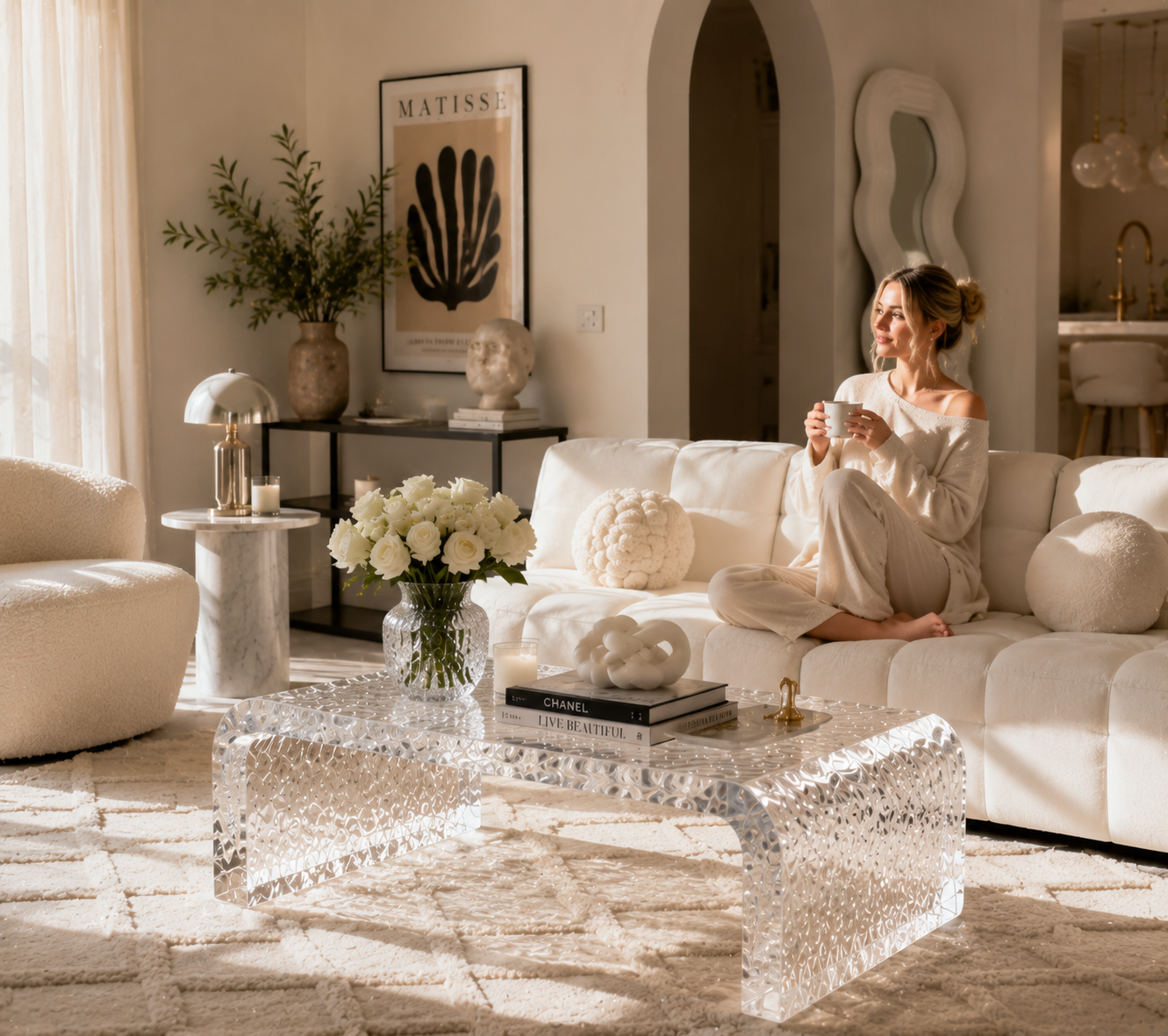
A transparent coffee table, for example, may provide the same practical surface as a wooden table. Yet its effect on the room is completely different. It allows a decorative rug to remain visible. It preserves open sightlines. It reflects nearby light. It can make the seating area feel less crowded.
The table therefore provides both function and atmosphere.
This dual role is increasingly important.
Contemporary consumers often live in environments where space must perform several functions. A living room may also serve as a work area, entertainment space, and social environment. Heavy furniture can make such spaces feel crowded and fixed.
Acrylic furniture can support flexibility because it appears visually lighter.
It allows the room to feel more open even when the product itself is substantial.
Experience-driven furniture also supports emotional ownership.
Consumers are more likely to value an object when it feels connected to their personal taste. A customized acrylic console in a specific color or a sculptural chair designed for a particular room can create a stronger emotional relationship than a generic product.
The customer does not simply own furniture.
The customer owns a design decision.
This is one of the most important reasons why aesthetic choice is becoming central to furniture purchasing.
2. Transparency, Light, and Visual Weight as New Design Advantages
Every piece of furniture occupies physical space, but it also occupies visual space.
A large wooden table may take up the same floor area as a transparent acrylic table, yet the two objects can feel completely different. The wooden table creates a solid visual block. The acrylic table allows the eye to continue through it.
This difference is known as visual weight.
Synthetic crystal acrylic has the ability to reduce visual weight without necessarily reducing physical strength or scale.
This makes it especially valuable in contemporary interiors.
Open-plan homes, city apartments, hotel suites, boutique stores, executive offices, and compact restaurants often need furniture that performs important functions without making the environment feel congested.
Transparent furniture helps achieve this balance.
A clear dining table can create seating for several people while keeping the room visually open. Acrylic bar stools can provide function without forming a heavy line beneath a kitchen island. A transparent console can sit in a hallway without covering decorative wall panels or narrowing the visual space.
This ability to preserve openness is one of the material’s strongest aesthetic advantages.
Light adds another dimension.
Acrylic does not simply allow light to pass through. Depending on thickness, shape, finish, and color, it can reflect, refract, concentrate, and distribute light.
A polished edge may glow under natural sunlight.
A curved surface may bend reflections.
A colored acrylic panel may create soft shadows.
A thick transparent base may appear almost luminous under focused lighting.
These effects make the furniture visually dynamic.
It changes throughout the day.
In morning light, a clear table may appear nearly invisible. In the afternoon, its edges may become bright and sharp. At night, under warm decorative lighting, the same object may feel richer and more sculptural.
This changing character creates emotional depth.
Traditional opaque furniture usually presents a more stable visual appearance. Acrylic furniture interacts continuously with its environment.
It reflects surrounding colors, architecture, artwork, people, and movement.
As a result, it becomes part of the atmosphere rather than remaining visually separate from it.
This is particularly useful in spaces where lighting is carefully designed.
Luxury hotels, restaurants, clubs, retail stores, and galleries often use layered lighting systems to create mood. Acrylic furniture can become an active element within these systems.
A reception desk can incorporate internal lighting.
A bar counter can produce a glowing edge.
A display platform can highlight merchandise without blocking the visual field.
A transparent partition can divide space while preserving brightness.
Transparency also supports visual layering.
Designers often create sophisticated interiors by combining several elements at different depths. A textured rug may sit beneath a clear table. A patterned wall may remain visible behind an acrylic console. Artwork may be seen through transparent shelving.
Instead of hiding these features, the furniture allows them to remain active.
This creates complexity without clutter.
The room can contain many design elements while still feeling controlled.
In aesthetic terms, transparency becomes a form of restraint.
The furniture does not demand attention through mass or decoration. It attracts attention through precision, light, and optical effect.
This is a more subtle form of luxury.
It appeals to clients who prefer sophistication over obvious display.

3. From Standard Product to Sculptural Design Object
A functional product is usually evaluated by what it does.
A sculptural design object is evaluated by both what it does and what it expresses.
Synthetic crystal acrylic furniture can occupy both categories.
Acrylic can be cut, bent, polished, bonded, cast, layered, engraved, tinted, frosted, and combined with other materials. These processes allow designers to create forms that would be difficult or expensive to achieve with wood, stone, or glass.
This flexibility expands the creative role of furniture.
A table does not need to be a simple top supported by four legs. It can use a continuous curved base, a folded transparent structure, interlocking geometric panels, or a sculptural central form.
A chair can appear to be made from one flowing transparent surface.
A cabinet can combine clear and colored layers.
A bench can follow the curve of a wall.
A shelf can appear to float.
These designs turn practical products into visual statements.
Thickness plays an important role.
Thin acrylic may appear delicate, minimal, and almost invisible. Thick acrylic can feel solid, luxurious, and jewel-like. Its edges collect light and create optical depth.
Designers can use this contrast to create different emotional effects.
A thin transparent side table may feel quiet and refined. A thick acrylic dining table may become the center of the room.
Edge treatment is equally important.
Polished edges can appear bright and crystal-like. Frosted edges can create softness. Colored edges can produce a glowing effect. Beveled or faceted edges can make the object resemble cut stone or jewelry.
These details influence whether the product feels ordinary or premium.
Curvature creates another level of expression.
Soft curves can make acrylic furniture feel fluid, elegant, and approachable. Sharp geometry can create a more architectural and futuristic character.
The material can therefore support very different design identities.
Color further expands its possibilities.
Clear acrylic is associated with purity and lightness, but synthetic crystal acrylic furniture does not need to remain colorless.
Smoke gray can create a sophisticated atmosphere.
Amber can add warmth.
Blue can feel calm or technological.
Green can introduce a fresh, artistic tone.
Rose or violet can feel expressive and fashionable.
Fluorescent colors can create a bold contemporary effect.
Gradients and layered tones can produce even greater depth.
Color transforms transparency into emotion.
It allows the product to influence the mood of the space while preserving some visual openness.
Mixed materials also help elevate acrylic furniture into the category of collectible design.
Acrylic and brass combine lightness with warmth.
Acrylic and marble create contrast between transparency and geological weight.
Acrylic and wood balance modernity with natural texture.
Acrylic and stainless steel communicate precision.
Acrylic and leather introduce softness and comfort.
These combinations increase visual richness and allow the furniture to fit into a wider range of interiors.
Craftsmanship is essential throughout this process.
Because acrylic is transparent, construction details remain visible. Poor bonding, uneven polishing, trapped air, misaligned joints, scratches, and structural distortion cannot be easily hidden.
The material exposes the quality of production.
This makes precision a central part of its aesthetic value.
A well-made acrylic object can appear simple, but achieving that simplicity may require advanced cutting, polishing, bonding, heating, shaping, and finishing.
The final result communicates technical confidence.
In this sense, the product becomes a form of functional sculpture.
It serves a practical purpose while demonstrating material mastery.
4. Personalization and the Rise of Individual Aesthetic Expression
Modern consumers increasingly want products that reflect who they are.
They do not want every home, hotel, office, or store to look the same. They want environments with character.
Customization is therefore becoming a major part of aesthetic value.
Synthetic crystal acrylic furniture is highly suitable for personalization because many of its visible features can be adjusted.
Clients can choose:
Dimensions
Thickness
Color
Transparency
Surface finish
Edge treatment
Curvature
Structural form
Material combinations
Engraving
Embedded graphics
Lighting effects
These options allow furniture to be designed around a specific person, space, or brand.
In residential interiors, personalization may begin with room dimensions.
A console can be designed to fit a narrow entrance. A dining table can be proportioned for a particular room. A bedside table can be matched to the height of a custom bed. A transparent desk can be created for a compact study area.
Color can then be developed around the interior palette.
A pale amber table may coordinate with warm stone. A smoky gray cabinet may complement dark metal. A clear acrylic shelf may preserve the focus on an art collection.
The product becomes part of the architecture.
In commercial projects, personalization becomes even more strategic.
A fashion brand may use acrylic in its signature color. A hotel may develop custom furniture that reflects its visual identity. A beauty store may use transparent display structures to support product color. A technology company may choose clear or frosted acrylic to communicate innovation and precision.
Engraving, printing, lighting, and embedded elements can further strengthen brand recognition.
This creates a major shift in how furniture is valued.
Standard furniture is chosen from existing options.
Customized furniture is developed as part of a specific experience.
The second approach creates stronger emotional and commercial value because the product is difficult to replace.
It belongs to the space.
Personalization also supports exclusivity.
Luxury consumers often value rarity. They want products that are not widely available or immediately recognizable as mass-market items.
A custom acrylic table with a unique color gradient, unusual curve, or special material combination can satisfy this desire.
Its value comes not only from material cost but from design relevance.
The object feels personal.
This emotional connection can make aesthetic choices more powerful than functional comparisons.
Two tables may have similar dimensions and structural performance, yet the customized table may feel much more valuable because it reflects the client’s taste.
For manufacturers and brands, this creates an opportunity to move beyond catalogs.
Instead of offering only fixed products, they can provide design consultation, samples, prototypes, digital renderings, and custom engineering.
This transforms the customer relationship.
The company is no longer simply selling furniture.
It is helping the client create an identity.
5. Creating Emotional and Commercial Value in Premium Spaces
Aesthetic value is not limited to personal enjoyment.
It also creates commercial value.
In many high-end environments, the way a space looks directly influences how people evaluate the brand, property, or experience.
Synthetic crystal acrylic furniture can contribute strongly to this perception.
Luxury Residential Spaces
In premium homes, furniture helps communicate the owner’s taste.
A sculptural acrylic dining table can become the center of a living space. A transparent console can support artwork without blocking it. Acrylic shelving can display objects while preserving visual openness.
These pieces often create a feeling of refinement without making the room appear heavy.
This is especially valuable in contemporary residences where clients want luxury to feel calm and modern.
Hotels and Resorts
Hotels compete through experience.
Guests remember the lobby, lighting, room atmosphere, and distinctive design details.
A custom acrylic reception desk can create a memorable first impression. Transparent lounge furniture can make public areas feel more spacious. Colored acrylic tables or illuminated partitions can become recognizable design features.
These elements may also encourage photography and social sharing.
The furniture therefore contributes to both guest experience and marketing.
Retail Environments
In retail, furniture affects how products are perceived.
Luxury goods require display systems that support the merchandise without distracting from it.
Transparent acrylic shelves, stands, and platforms can make products appear to float. Colored acrylic can organize different collections. Custom forms can reflect campaign concepts.
The display furniture becomes part of the brand presentation.
It can increase visual clarity and help products feel more exclusive.
Offices and Corporate Interiors
Workplaces increasingly use design to communicate culture.
Acrylic reception desks, meeting tables, partitions, and display systems can represent openness, innovation, and modern thinking.
In creative, technology, fashion, and luxury industries, this visual language can strengthen corporate identity.
Restaurants, Bars, and Clubs
These spaces depend heavily on atmosphere.
Acrylic works well with decorative lighting and strong color. It can be used in bars, tables, stools, screens, and illuminated installations.
Because the material changes under different lighting conditions, it helps create a more immersive environment.
Distinctive furniture can also become part of the venue’s public image.
Galleries and Exhibitions
In cultural spaces, furniture should often support objects without dominating them.
Transparent acrylic plinths, benches, display cases, and partitions can remain visually restrained while providing necessary function.
At the same time, sculptural acrylic furniture can become part of the exhibition itself.
Across all these environments, aesthetic value supports practical business goals.
It can improve customer perception, strengthen brand memory, encourage social sharing, differentiate the space from competitors, and create a premium atmosphere.
The furniture is therefore not merely an expense.
It becomes an investment in experience.
.png)
6. Building Lasting Aesthetic Value through Quality, Innovation, and Responsible Design
Aesthetic impact alone is not enough.
For synthetic crystal acrylic furniture to maintain long-term value, it must also perform well.
Low-quality material, weak construction, visible scratches, poor color stability, and careless finishing can quickly reduce the product’s visual appeal.
Material quality is therefore essential.
Premium acrylic should offer consistent clarity, controlled thickness, reliable color, and stable performance. The surface should be carefully protected during production, transportation, and installation.
Processing quality is equally important.
Cutting must be accurate.
Edges must be polished evenly.
Joints must be clean and strong.
Curves must be controlled.
The structure must support the expected load.
These technical factors directly affect aesthetic value.
A beautiful design will not feel premium if the craftsmanship is poor.
Maintenance must also be considered.
Acrylic can be sensitive to abrasive cleaning tools and unsuitable chemicals. Clients should receive clear care instructions. Soft cloths and appropriate cleaning products should be used.
Minor surface scratches may sometimes be professionally polished, depending on the finish and depth of damage.
Restoration services can help extend the life of the furniture.
This is important because long-term value depends partly on repairability.
Responsible design is another growing consideration.
Acrylic is a petroleum-based material, so brands should avoid making unrealistic environmental claims. However, they can reduce environmental impact through thoughtful design and production.
Products can be designed for long service life.
Structures can be made modular.
Offcuts can be reused where suitable.
Packaging can be optimized.
Repair and polishing services can extend usability.
Recycled acrylic may be considered when technical and visual requirements allow.
The goal should be responsible use rather than short-term novelty.
Technology will also shape the future of the category.
Digital modeling allows designers to test forms, proportions, and structures before production. CNC cutting improves accuracy. Advanced bending and casting techniques support more complex shapes.
Integrated lighting can turn furniture into a visual installation.
Printing, engraving, and embedded elements can add branding and artistic expression.
Smart technology may create further possibilities.
Acrylic furniture could integrate charging systems, touch controls, digital displays, sensors, or interactive lighting.
These developments will strengthen the connection between function and aesthetics.
The best future products will not choose between beauty and performance.
They will combine both.
From Product Function to Design Identity
The transformation of furniture from functional choice to aesthetic choice represents a deeper change in the market.
Function answers the question: “What does this product do?”
Aesthetics answers the question: “What does this product mean?”
Synthetic crystal acrylic furniture can answer both.
It provides surfaces, seating, storage, display, separation, and support. At the same time, it communicates clarity, innovation, lightness, precision, and individuality.
This combination gives the material a special position.
It can serve daily life while also shaping identity.
For consumers, choosing acrylic furniture may represent a preference for openness and contemporary design.
For architects, it may provide a tool for controlling visual weight and light.
For hotels and retailers, it may create memorable brand experiences.
For manufacturers, it may create a path from product supply to design leadership.
This transformation also changes the basis of competition.
When products compete only by function, price becomes highly important. Customers compare dimensions, thickness, delivery time, and cost.
When products compete through aesthetics, additional forms of value appear.
Design originality matters.
Craftsmanship matters.
Customization matters.
Visual communication matters.
Brand story matters.
Service matters.
This allows companies to move away from pure price competition.
They can create value that is more difficult to copy.
Practical Principles for Designing Aesthetic Acrylic Furniture
Several principles can help ensure that synthetic crystal acrylic furniture becomes a true aesthetic choice.
First, the design should use transparency intentionally.
Clear material should not be chosen simply because it is fashionable. It should improve the relationship between furniture, light, and space.
Second, proportion should be carefully controlled.
Thin sections may appear elegant, but they must remain structurally stable. Thick sections can feel luxurious, but they should not become visually excessive.
Third, edge treatment should support the design concept.
Polished, frosted, beveled, colored, or faceted edges create different visual effects.
Fourth, color should be connected to the environment.
Custom tones should coordinate with architecture, lighting, materials, and brand identity.
Fifth, mixed materials should be balanced.
Acrylic should complement wood, stone, metal, leather, or textiles rather than competing with them.
Sixth, craftsmanship must remain visible through precision.
Clean joints, accurate alignment, and consistent polishing are essential.
Seventh, lighting should be considered early.
Acrylic changes significantly under different lighting conditions. Product development should include tests in natural and artificial light.
Finally, the design should create emotional relevance.
The product should contribute to how the space feels.
This is the final measure of aesthetic success.
Conclusion
Synthetic crystal acrylic furniture is helping redefine why people choose furniture.
The decision is no longer based only on function, durability, size, and price. It is increasingly based on visual identity, emotional connection, personalization, atmosphere, and design experience.
Acrylic is particularly suited to this transformation because it changes the visual behavior of furniture.
It reduces visual weight.
It interacts with light.
It preserves openness.
It creates depth.
It supports color, curves, sculptural form, and customization.
It can appear almost invisible or highly expressive.
These qualities allow furniture to become more than equipment.
It becomes part of the aesthetic structure of a space.
In homes, it reflects personal taste.
In hotels, it creates memorable experiences.
In stores, it supports brand presentation.
In offices, it communicates modernity.
In restaurants and clubs, it strengthens atmosphere.
In galleries, it supports both function and artistic expression.
However, lasting value depends on more than transparency.
High-quality material, refined craftsmanship, thoughtful proportion, responsible production, professional maintenance, and clear design intention are essential.
Without these elements, acrylic may remain a short-term visual effect.
With them, it can become a sophisticated design language.
The future of synthetic crystal acrylic furniture will therefore depend on its ability to combine beauty with usefulness, innovation with durability, and individuality with spatial intelligence.
Its greatest opportunity is not simply to replace traditional materials.
It is to expand the meaning of furniture itself.
A table can become a visual center.
A shelf can become an architectural layer.
A chair can become a sculptural object.
A reception desk can become a brand symbol.
A transparent surface can become an emotional experience.
This is how synthetic crystal acrylic furniture turns a product from a functional choice into an aesthetic choice.
It allows customers to choose not only what works, but also what inspires, represents, and transforms the space around them.
READ MORE:
- Elevating Hotel Interiors Without Increasing the Budget: Three Ways to Combine High-End Materials
- How High-End Transparent Furniture Can Balance Visual Impact, Structural Stability, and Easy Maintenance
- From "Beautiful" to "Built to Last": How Custom Hotel Furniture Can Balance Design Impact and Long-Term Maintenance
- Reducing Maintenance Pressure at Hotel Front Desks and Public Areas Through Smarter Furniture Materials
- How Should Hotels Choose Furniture for High-Frequency Areas? Application Strategies for Synthetic Crystal, Premium Resin, and Platinum Acrylic
- Synthetic Crystal Acrylic Furniture: A New Direction for Differentiated Competition in the Future High-End Furniture Market
- Why Are Designers and High-End Clients Paying More Attention to Synthetic Crystal Acrylic?
- From Material Upgrade to Brand Upgrade: New Opportunities Created by Synthetic Crystal Acrylic Furniture
- Synthetic Crystal Acrylic Furniture: Why It Is Becoming a New Symbol of Value in High-End Spaces


