Introduction
In the furniture industry, material innovation often begins as a technical improvement. A material becomes clearer, stronger, lighter, more stable, easier to process, or more visually attractive. Manufacturers then use these improvements to produce better products.
However, the most successful companies do not stop at the level of material improvement.
They use material innovation as the foundation for brand transformation.
Synthetic crystal acrylic furniture offers a strong example of this opportunity. When acrylic is treated merely as a transparent plastic, it usually competes in a price-sensitive market. Products are compared according to thickness, dimensions, basic design, and manufacturing cost. The supplier may have advanced equipment and experienced technicians, but the market still sees the company mainly as a producer.
When the same material is developed through better design, higher craftsmanship, customized services, stronger visual communication, and clear brand positioning, its commercial meaning changes.
It becomes more than a raw material.
It becomes a design language, a spatial solution, a brand symbol, and a source of emotional value.
This transformation is especially relevant as premium interior markets evolve. Luxury clients, architects, designers, hotels, retailers, and commercial brands are no longer looking only for furniture that performs a basic function. They are looking for objects that support identity, create memorable environments, improve visual experience, and communicate originality.
Synthetic crystal acrylic furniture can respond to these needs because it combines transparency, light interaction, sculptural flexibility, color customization, and architectural adaptability. It can appear refined, futuristic, elegant, minimal, artistic, or highly personalized.
For manufacturers and furniture brands, this creates a new path for growth.
The opportunity is not simply to sell more acrylic tables, chairs, cabinets, or decorative objects. The greater opportunity is to move upward—from material supplier to design partner, from factory to brand, from standardized production to customized value creation, and from product competition to experience competition.
This article examines how synthetic crystal acrylic furniture can support that transition and why material upgrading may become the starting point of a much larger brand upgrade.
1. Material Innovation as the Starting Point of Brand Transformation
Every strong product begins with material performance.
In the case of synthetic crystal acrylic furniture, the quality of the material directly influences how the market evaluates the finished object. Low-grade acrylic may appear cloudy, thin, unstable, or visually similar to ordinary plastic. Premium acrylic, by contrast, can achieve exceptional transparency, depth, smoothness, color accuracy, and light transmission.
These differences create the first level of value.
High-quality synthetic crystal acrylic can produce polished edges that appear luminous. Thick transparent panels can create the visual effect of solid crystal. Carefully controlled surfaces can reflect and refract light with precision. Stable pigments can create elegant colors without reducing clarity.
Material quality also affects structural possibilities.
Improved strength and consistent thickness allow designers to create larger tables, sculptural bases, curved panels, integrated shelving, decorative partitions, and complex architectural forms. Better thermal performance and fabrication control make bending, bonding, cutting, engraving, and polishing more reliable.
These improvements allow products to move beyond simple shapes.
This is important because material innovation becomes commercially meaningful only when it creates new design freedom.
If a manufacturer uses better acrylic only to make the same standard products, the market may notice a small quality difference, but the company’s position remains largely unchanged. It may charge slightly more, but it still competes within the same category.
Brand upgrading begins when technical improvement changes the product concept.
A thicker panel is not merely stronger; it can become a monumental visual element. A clearer surface is not simply more transparent; it can create an atmosphere of purity and precision. A more accurate color process is not only a manufacturing improvement; it allows the brand to develop exclusive color collections.
In this way, technical characteristics can be translated into emotional and symbolic benefits.
For example:
Optical clarity can represent purity and sophistication.
Structural lightness can represent modernity and freedom.
Custom color can represent personality and exclusivity.
Precise bonding can represent craftsmanship and technical confidence.
Sculptural shaping can represent creativity and artistic ambition.
This translation is essential.
Customers rarely build a strong emotional connection with technical specifications alone. They may appreciate material quality, but they choose premium brands because the product communicates a desired lifestyle, identity, or experience.
Therefore, the first opportunity created by synthetic crystal acrylic is not only product improvement. It is the ability to redefine what the company stands for.
A manufacturer can position itself around transparency, light, innovation, customization, or contemporary luxury. It can develop collections with a clear visual direction. It can create a recognizable design philosophy based on the material’s unique properties.
Material upgrading then becomes the foundation of a brand promise.
The company is no longer saying, “We produce acrylic furniture.”
It is saying, “We create light-driven furniture for premium spaces,” or “We transform transparent materials into architectural objects,” or “We design customized crystal-like furniture for modern luxury interiors.”
That difference is the beginning of brand transformation.
2. Turning Product Features into a Distinctive Brand Language
Strong brands are recognizable before customers read the logo.
They are recognized through shape, color, proportion, texture, atmosphere, photography, packaging, retail environment, and communication style. Every visible detail supports a consistent identity.
Synthetic crystal acrylic provides many opportunities to build this kind of brand language.
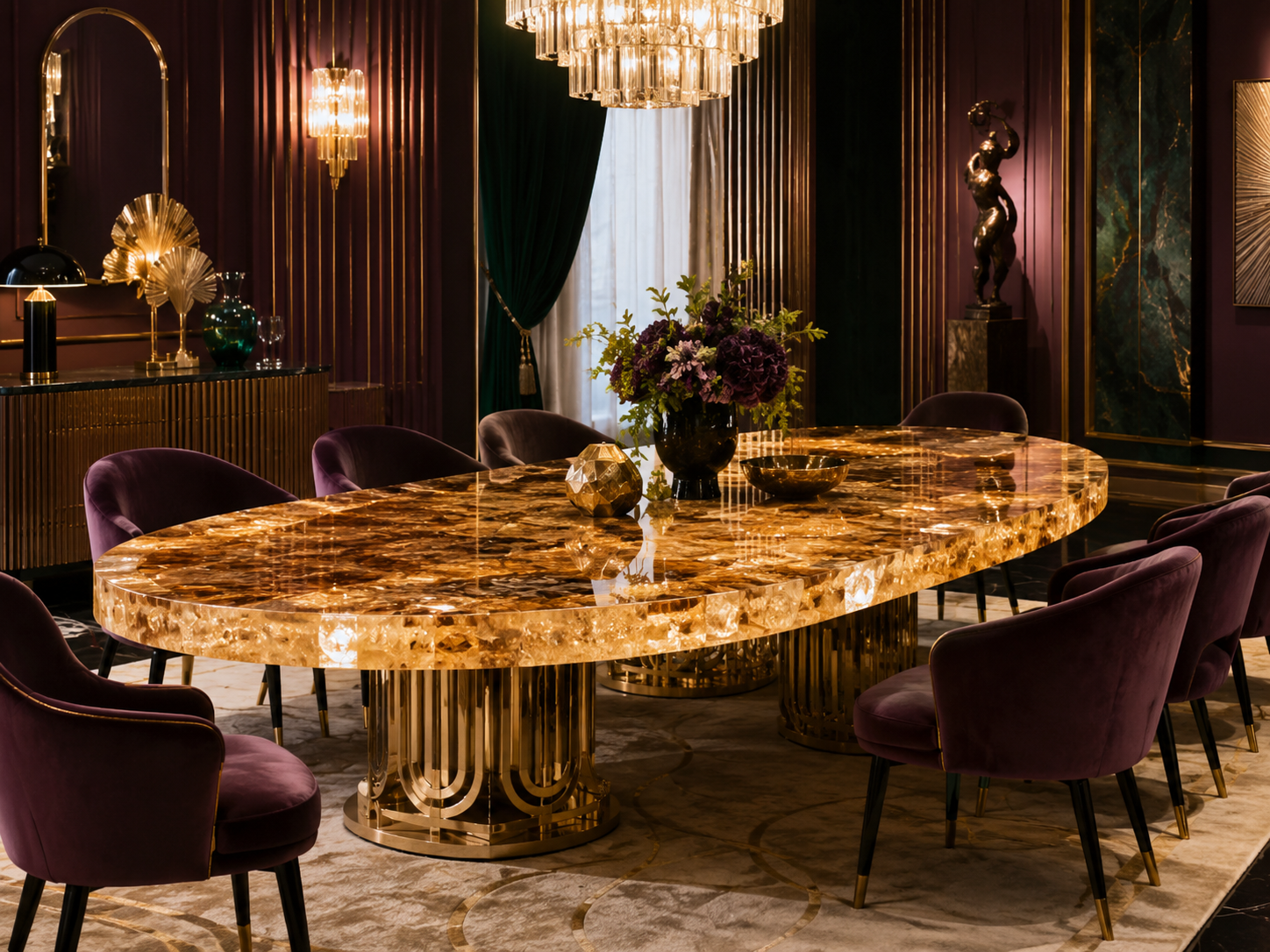
Transparency is the most obvious characteristic, but it is only one element. The material also offers polished edges, internal reflections, layered depth, curved surfaces, soft color gradients, frosted finishes, embedded decorative elements, and dramatic interaction with lighting.
These characteristics can become visual assets.
A brand may focus on thick geometric furniture with jewel-like edges. Another may develop soft curves and pale transparent colors. A third may combine acrylic with brass, marble, stainless steel, leather, or wood. Each approach creates a different identity.
This flexibility is valuable because premium markets reward distinction.
In crowded furniture categories, many products look similar. Wooden tables, upholstered chairs, storage cabinets, and metal shelving systems often follow familiar forms. Acrylic allows brands to create stronger visual differentiation without depending on excessive ornament.
A single transparent console with a distinctive curve can become more recognizable than a complex traditional cabinet.
A brand can also build identity through color.
Clear acrylic communicates purity and minimalism. Smoke gray suggests maturity and architectural sophistication. Amber creates warmth. Blue can feel technological or calm. Rose tones can appear fashionable and expressive. Fluorescent edges can produce a more experimental and youthful image.
Custom color systems can become part of the brand’s intellectual property.
Instead of selling random color options, a company can develop named color collections, seasonal palettes, signature tones, and coordinated material combinations. These systems help designers and clients understand the brand more easily.
Form is equally important.
If every product is designed separately without a common visual logic, the collection may lack identity. A stronger approach is to establish design principles that connect different pieces.
These principles may include:
Repeated edge profiles
Consistent panel thickness
Similar curve radii
Specific joint details
Controlled proportions
Recognizable base structures
Signature color combinations
A defined relationship between transparency and opacity
When these elements appear across tables, chairs, shelves, screens, lighting objects, and accessories, the brand begins to feel coherent.
Photography and presentation must reinforce this identity.
Acrylic furniture is highly sensitive to lighting and background. Poor photography can make premium products appear flat, cloudy, or inexpensive. Strong visual communication requires careful control of reflections, shadows, perspective, and surrounding materials.
Brands should show not only isolated products but also complete spatial experiences.
An acrylic chair should be seen in relation to flooring, architecture, natural light, and surrounding furniture. A transparent dining table should be photographed with a visible rug, decorative objects, and carefully selected lighting. A colored acrylic cabinet should be shown in a setting that supports its tone.
These images help customers understand the product’s role in a space.
Visual storytelling also makes the brand more memorable.
Instead of communicating only product dimensions and prices, a company can present themes such as light, reflection, weightlessness, transformation, and spatial freedom. It can connect the material to art, architecture, fashion, and contemporary culture.
This approach moves communication away from manufacturing language and toward brand language.
The product remains important, but the brand begins to sell a perspective.
.png)
3. Expanding from Furniture Manufacturing to High-Value Design Services
One of the greatest opportunities in synthetic crystal acrylic furniture is the shift from product supply to solution delivery.
Standard furniture production usually follows a simple model. The manufacturer develops a catalog, the customer chooses a product, the factory produces it, and the transaction ends after delivery.
This model can generate volume, but it often limits profit margins and customer loyalty.
Premium projects operate differently.
Architects, interior designers, hotels, retailers, and luxury homeowners may require custom dimensions, unique colors, unusual shapes, structural testing, sample development, installation support, and coordination with other materials.
These needs create opportunities for higher-value services.
A synthetic crystal acrylic company can offer design consultation at the beginning of a project. It can help clients understand which thickness, transparency, finish, and structural solution are suitable for a particular environment.
It can provide material samples, edge samples, color samples, prototypes, and lighting tests.
It can also participate in engineering.
Large acrylic tables, architectural screens, reception desks, display structures, and sculptural installations require more than visual design. They require load calculations, transportation planning, assembly methods, connection details, and installation systems.
A company that can solve these problems becomes more valuable than a factory that only follows drawings.
This creates a major change in market position.
The supplier becomes a technical partner.
Designers are more likely to recommend a partner who understands both creative intent and manufacturing reality. Clients are more willing to pay for a company that reduces risk, improves execution, and supports the project from concept to installation.
Customization also strengthens customer relationships.
When a company develops a unique product for a hotel, store, office, or residence, it becomes part of the project’s identity. The client is less likely to compare the result only by price because the solution is not easily replaceable.
This reduces direct price competition.
After-sales service offers another opportunity.
Acrylic furniture may require guidance on cleaning, scratch prevention, transportation, restoration, and long-term maintenance. Premium brands can provide professional care manuals, maintenance products, repair services, polishing support, and replacement components.
These services increase trust.
They also extend the customer relationship beyond the initial purchase.
A brand may offer project documentation, installation instructions, digital files, technical drawings, and product certificates. For commercial clients, it may provide batch consistency records, quality reports, and packaging standards.
Each service adds value around the physical product.
This is how companies move from selling objects to selling confidence.
The customer is not paying only for acrylic material. The customer is paying for expertise, coordination, reliability, problem-solving, and a successful final result.
For manufacturers, this transition may require new capabilities.
They may need industrial designers, project managers, engineers, visual content specialists, installation teams, and client service systems. These investments increase operating complexity, but they also create barriers that lower-cost competitors cannot easily copy.
Over time, service capability becomes part of the brand itself.
4. Entering New Premium Markets and Application Scenarios
Synthetic crystal acrylic furniture is not limited to one market category.
Its transparency, customization, lightness, and visual impact allow it to enter a wide range of premium spaces. This creates new business opportunities for both manufacturers and design brands.
Luxury Residential Interiors
High-end residential clients increasingly look for furniture that feels personal and visually distinctive.
Acrylic can be used for dining tables, coffee tables, consoles, benches, desks, bedside tables, dressing tables, shelving, decorative screens, and art display structures.
Its transparency is especially valuable in apartments and urban residences where clients want luxury without visual heaviness.
Custom furniture can be designed around room dimensions, lighting conditions, flooring patterns, artworks, and architectural features. This allows the brand to participate in highly personalized projects.
Hotels and Resorts
Hospitality environments need memorable visual features.
Acrylic reception desks, lobby tables, bar counters, room dividers, lounge furniture, decorative installations, and guest-room accessories can help a hotel establish a recognizable identity.
Transparent and illuminated furniture can create dramatic first impressions. Colored acrylic elements can become signature features. Custom objects can support a hotel’s theme, location, or cultural story.
Hotels also offer repeat business opportunities.
A successful supplier may work across multiple properties, renovations, room types, restaurants, and public spaces.
Luxury Retail
Retail brands need display systems that attract attention without overwhelming the product.
Acrylic is highly suitable for fashion, jewelry, beauty, eyewear, accessories, electronics, and lifestyle stores. Transparent stands can make merchandise appear to float. Colored blocks can organize product categories. Custom forms can reflect campaign themes.
Acrylic can also integrate branding through engraving, printing, lighting, and embedded graphics.
For manufacturers, retail projects can provide frequent updates because stores change displays seasonally or launch new collections regularly.
Corporate and Executive Interiors
Premium offices increasingly use design to communicate company values.
Transparent meeting tables, reception desks, partitions, shelving, display units, and executive furniture can communicate openness, innovation, and precision.
Technology companies, creative agencies, luxury brands, design firms, and financial institutions may use acrylic to create a modern and confident atmosphere.
Restaurants, Bars, and Clubs
Entertainment and dining spaces depend strongly on atmosphere.
Acrylic responds well to decorative lighting, color, and movement. It can be used for bars, tables, stools, partitions, display walls, and illuminated installations.
Because these spaces are often photographed and shared online, distinctive acrylic furniture can also support marketing visibility.
Exhibitions, Galleries, and Events
Exhibition environments require flexible, visually controlled structures.
Acrylic plinths, display cases, benches, partitions, signage, and interactive elements can support art, products, and temporary installations.
The material’s transparency allows the displayed object to remain the focus.
Branded Architectural Projects
The largest opportunity may exist where furniture, architecture, and brand experience overlap.
Custom acrylic walls, screens, reception structures, counters, shelving systems, and integrated lighting features can become permanent parts of a building.
In these projects, the company is no longer treated as a furniture supplier. It becomes a specialist material and design partner.
This market position usually supports higher project value and stronger professional recognition.
5. Building Trust through Craftsmanship, Quality Systems, and Brand Storytelling
Premium branding requires more than attractive images.
It requires trust.
Synthetic crystal acrylic furniture can appear simple, but high-quality production is technically demanding. Customers may not immediately understand the differences between material grades, bonding methods, polishing quality, structural design, and color stability.
Brands must therefore educate the market.
They should explain how the material is selected, how panels are processed, how edges are polished, how joints are controlled, and how structural performance is tested.
This information should not be presented as complicated factory language. It should be translated into customer benefits.
For example:
Better raw material means higher clarity and more stable color.
Precision cutting means cleaner geometry.
Professional polishing means brighter, smoother edges.
Controlled bonding means stronger and more elegant joints.
Structural engineering means safer and more durable furniture.
Protective packaging means lower installation risk.
This kind of communication builds confidence.
Quality systems are also essential.
A premium brand should define standards for raw material inspection, dimensions, surface quality, color tolerance, edge finish, bonding, load performance, packaging, and final inspection.
These standards create consistency.
Without consistency, a brand cannot grow safely. One excellent sample is not enough. Customers need to know that future products will meet the same level of quality.
Project documentation can strengthen credibility.
Brands can record development sketches, prototypes, material tests, production stages, installation processes, and completed spaces. These records become valuable content for websites, presentations, social media, exhibitions, and client meetings.
They show that the company’s value is based on real capability.
Craftsmanship stories are especially important.
Acrylic furniture often looks effortless when completed, but the process may involve many stages of technical work. Showing this process helps customers understand why a premium piece costs more than a basic transparent product.
Brand storytelling should also include design intention.
Why was a particular curve selected? How does the piece interact with light? Why was a certain thickness used? How does the object improve the space?
These stories transform products into meaningful design objects.
Client stories add another level of trust.
A hotel project can show how acrylic furniture improved the lobby experience. A retail project can demonstrate how transparent displays increased product visibility. A residential project can explain how custom furniture made a compact room feel larger.
These examples make brand value more concrete.
Transparency about limitations is also important.
A responsible brand should explain proper cleaning, scratch prevention, temperature conditions, structural limits, and maintenance needs. Honest guidance does not weaken luxury positioning. It strengthens professionalism.
Trust grows when the company communicates clearly before and after the sale.
.png)
6. Creating Long-Term Growth through Technology, Sustainability, and Global Positioning
Material and brand upgrading should not be viewed as a one-time project.
It is a long-term process.
Technology will play an increasingly important role in the development of synthetic crystal acrylic furniture.
Digital design tools allow companies to create complex forms, test proportions, study structural performance, and communicate ideas through realistic visualizations. CNC cutting, precision polishing, advanced bending systems, and improved bonding technologies increase production accuracy.
Digital workflows can also improve customization.
Clients may be able to review three-dimensional models, compare colors, adjust dimensions, and understand the final product before manufacturing begins.
This reduces errors and improves the design experience.
Smart furniture may create additional opportunities.
Acrylic tables, display systems, and architectural objects can integrate lighting, charging systems, digital screens, sensors, or interactive controls. Because the material already has a technological appearance, it can support these functions naturally.
Sustainability will also influence future brand value.
Acrylic is not automatically an environmentally friendly material, and responsible brands should avoid unsupported claims. However, they can improve environmental performance through better design and production practices.
This may include:
Designing products for longer use
Offering repair and polishing services
Reducing production waste
Reusing suitable offcuts
Developing modular structures
Improving packaging efficiency
Exploring recycled acrylic where performance allows
Selecting suppliers with stronger environmental controls
Providing end-of-life guidance
The goal should be responsible use rather than superficial marketing.
Long-lasting custom furniture may offer greater value than disposable low-quality products. A brand that supports maintenance and restoration can extend product life and strengthen customer loyalty.
Mixed-material design will create further opportunities.
Acrylic can be combined with wood, metal, stone, leather, glass, ceramics, textiles, and new engineered materials. These combinations expand the emotional range of the product and allow the brand to serve different interior styles.
Global positioning is another major opportunity.
Synthetic crystal acrylic furniture can appeal to international markets because its visual language is contemporary and adaptable. It can work in minimalist European interiors, luxury Middle Eastern residences, modern Asian retail spaces, American hospitality projects, and global exhibition environments.
However, international growth requires more than exporting products.
Brands need clear catalogs, technical documents, professional photography, reliable packaging, international project management, and consistent communication. They may also need local representatives, installation partners, design collaborations, and logistics support.
Participation in design fairs, architecture exhibitions, hotel supply events, and material showcases can improve visibility.
Collaboration with architects and interior designers can be especially powerful. When professionals specify the brand in projects, the company gains credibility and access to higher-value clients.
Intellectual property should also be considered.
Original structures, connection systems, surface treatments, color formulas, product forms, and brand visual elements may be protected through design registration, patents, trademarks, or contractual controls.
This helps the company defend the value it creates.
The long-term goal is to build an ecosystem around the material.
This ecosystem may include product collections, custom project services, technical expertise, design partnerships, care services, digital tools, and global distribution.
At that point, the company is no longer dependent on one product category.
It has created a complete brand platform.
From Manufacturing Logic to Brand Logic
The transition from material upgrade to brand upgrade requires a change in thinking.
Manufacturing logic asks:
How can we produce faster?
How can we reduce cost?
How can we improve yield?
How can we increase output?
These questions remain important.
However, brand logic asks additional questions:
What do customers remember about us?
What makes our products visually recognizable?
What emotional value do we create?
Which problems can we solve better than competitors?
Why should designers recommend us?
Why should clients pay a premium?
What experience surrounds the product?
Companies that combine both forms of thinking are more likely to succeed.
Production capability supports quality and delivery. Brand capability supports differentiation and long-term value.
Synthetic crystal acrylic furniture is particularly suitable for this combination because the material connects technical precision with strong visual expression.
A factory may begin with machinery, processing knowledge, and raw material expertise. From there, it can develop design collections, project services, visual identity, professional content, and international partnerships.
Each step moves the company further away from pure price competition.
Practical Strategies for Brand Upgrading
A company entering this field can begin with several practical actions.
First, it should define a clear market position.
It may focus on luxury residential furniture, hospitality projects, retail displays, custom architectural pieces, or collectible design. Trying to serve every market at once may weaken communication.
Second, it should develop a small but coherent signature collection.
The collection should demonstrate the brand’s material quality, design philosophy, color system, and craftsmanship.
Third, it should invest in samples.
Physical samples of thickness, color, edge finish, bonding, curves, and mixed materials help designers and clients evaluate quality.
Fourth, it should improve visual communication.
Professional photography, project renderings, videos, process documentation, and detailed product pages are essential for acrylic furniture.
Fifth, it should create a structured customization process.
Clients should understand how to submit dimensions, select colors, approve drawings, review samples, and confirm production.
Sixth, it should build professional service standards.
Response time, quotation format, drawing control, packaging, installation, and after-sales support should be consistent.
Seventh, it should collect and present completed project cases.
Real projects prove capability more effectively than general claims.
Finally, it should continue developing design and technology.
Brand upgrading is not achieved through a new logo alone. It must be supported by better products, better systems, and better customer experiences.
Conclusion
Synthetic crystal acrylic furniture creates a rare opportunity because it connects material innovation with brand innovation.
At the material level, it offers clarity, depth, lightness, color flexibility, and sculptural potential. At the product level, it allows furniture to become more expressive, customized, and architecturally integrated.
At the brand level, it provides a distinctive language based on transparency, light, precision, and contemporary luxury.
The most important opportunity is the shift in market position.
A company can move from producing transparent furniture to creating premium spatial experiences. It can move from accepting drawings to participating in design. It can move from supplying products to solving complex project needs.
This transition creates higher value, stronger customer relationships, and greater resistance to price competition.
However, the transformation requires more than improved material.
It requires original design, consistent craftsmanship, professional services, quality systems, visual storytelling, responsible production, and long-term strategic positioning.
The companies that succeed will be those that understand both the technical and emotional possibilities of the material.
They will not simply describe acrylic as clear, strong, or customizable. They will show how it changes the feeling of a room, supports brand identity, interacts with light, creates memorable experiences, and responds to the needs of contemporary architecture.
In the future, synthetic crystal acrylic furniture may become more than a specialized furniture category.
It may become an important bridge between manufacturing, design, technology, art, and premium spatial branding.
That is the real opportunity created by the material.
The upgrade begins with clarity, thickness, color, and craftsmanship.
But it does not end there.
The final goal is not simply a better acrylic product.
It is a stronger brand, a more valuable service system, and a new position in the global high-end design market.
READ MORE:
- Elevating Hotel Interiors Without Increasing the Budget: Three Ways to Combine High-End Materials
- How High-End Transparent Furniture Can Balance Visual Impact, Structural Stability, and Easy Maintenance
- From "Beautiful" to "Built to Last": How Custom Hotel Furniture Can Balance Design Impact and Long-Term Maintenance
- Reducing Maintenance Pressure at Hotel Front Desks and Public Areas Through Smarter Furniture Materials
- How Should Hotels Choose Furniture for High-Frequency Areas? Application Strategies for Synthetic Crystal, Premium Resin, and Platinum Acrylic
- Synthetic Crystal Acrylic Furniture: A New Direction for Differentiated Competition in the Future High-End Furniture Market
- Why Are Designers and High-End Clients Paying More Attention to Synthetic Crystal Acrylic?
- Synthetic Crystal Acrylic Furniture: Turning Products from a Functional Choice into an Aesthetic Choice
- Synthetic Crystal Acrylic Furniture: Why It Is Becoming a New Symbol of Value in High-End Spaces


