Introduction
For generations, luxury furniture was closely associated with weight, rarity, and visible material richness. Solid hardwood, carved stone, polished brass, hand-stitched leather, and natural marble represented permanence and status. Their value was immediately recognizable because their physical presence was substantial. They occupied space with confidence and communicated quality through mass, texture, and traditional craftsmanship.
Today, however, the language of high-end interiors is changing.
Contemporary luxury is no longer defined only by expensive materials or decorative complexity. It is increasingly expressed through proportion, light, originality, personalization, spatial intelligence, and emotional experience. A room can feel luxurious without appearing heavy. A piece of furniture can look precious without being covered in ornament. A transparent object can become the visual center of a space precisely because it seems almost weightless.
This shift has created new opportunities for synthetic crystal acrylic furniture.
Synthetic crystal acrylic generally refers to high-quality transparent or translucent acrylic furniture designed to achieve exceptional clarity, depth, polish, and optical brilliance. The material is often associated with premium-grade polymethyl methacrylate, commonly known as PMMA, although the commercial term may also describe acrylic products engineered to resemble the purity and luminosity of crystal.
Unlike ordinary plastic furniture, high-end synthetic crystal acrylic pieces are defined by their thickness, optical consistency, precision, craftsmanship, and finishing quality. They may be cut from substantial transparent panels, cast into sculptural shapes, polished to glass-like smoothness, tinted in custom colors, combined with metal or stone, or produced as one-of-a-kind architectural objects.
As luxury interiors become cleaner, more flexible, and more experience-driven, synthetic crystal acrylic furniture is moving from the margins of decorative design into the center of premium spatial planning. It is appearing in luxury residences, boutique hotels, designer stores, executive offices, galleries, clubs, restaurants, exhibition environments, and branded commercial spaces.
Its rise is not accidental. The material responds directly to several major changes in contemporary design: the desire for openness, the importance of lighting, the demand for customization, the growing popularity of sculptural furniture, and the search for new forms of visual identity.
Synthetic crystal acrylic furniture is becoming a new value symbol because it does more than provide function. It shapes perception. It transforms light. It reduces visual weight. It creates memorable images. Most importantly, it represents a modern understanding of luxury—one based not only on what an object is made from, but also on what that object allows a space to become.
1. From Transparent Material to Luxury Design Language
Acrylic has existed for decades, but its cultural meaning has changed significantly. It was once viewed primarily as a practical substitute for glass: lighter, more impact-resistant, easier to shape, and suitable for signs, display cases, protective screens, and industrial components. In many low-cost applications, acrylic was treated as a purely functional material.
The development of premium furniture-grade acrylic has changed this perception.
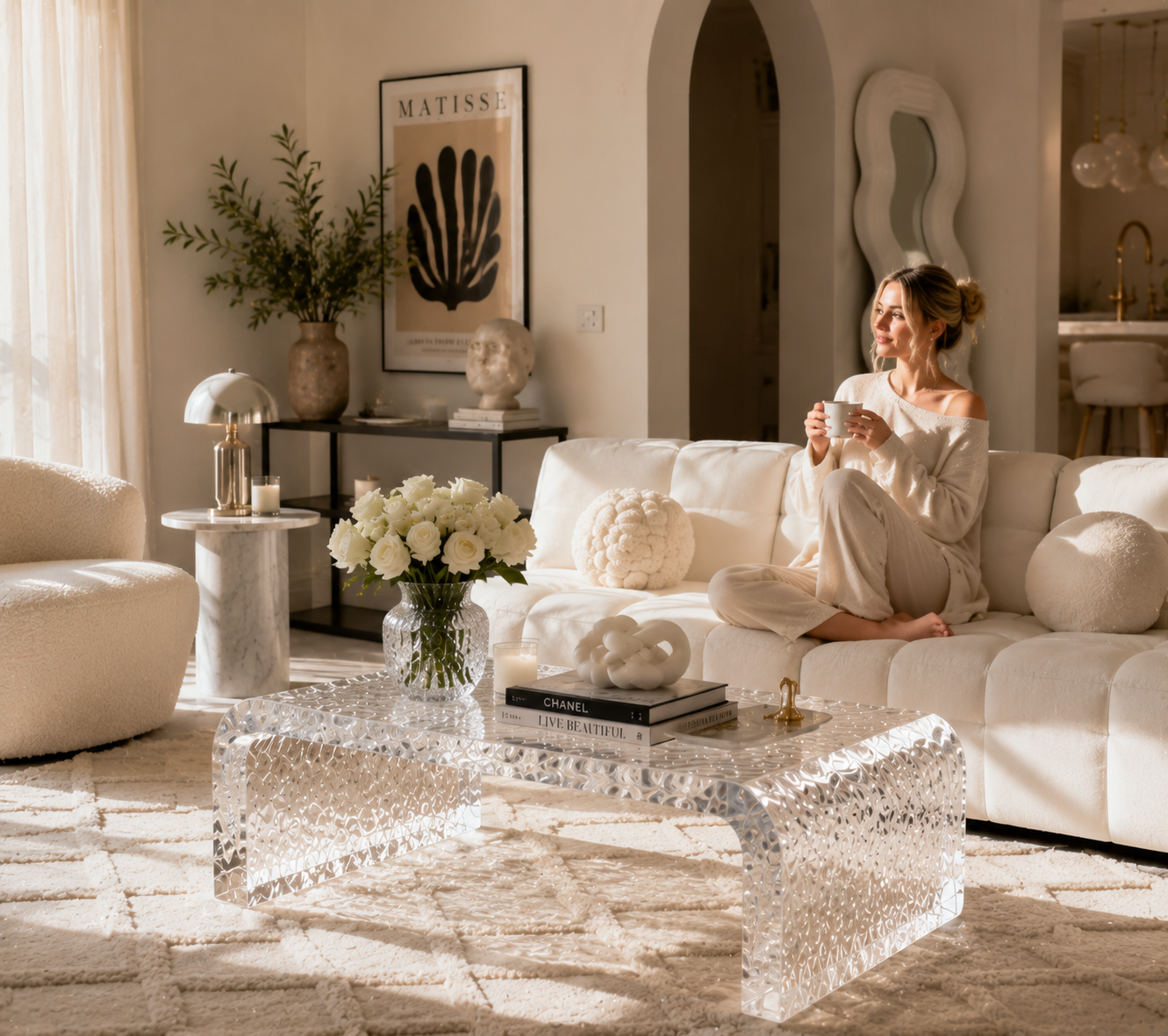
When acrylic is produced with high optical clarity, controlled thickness, accurate color, and professional finishing, it no longer resembles an ordinary plastic product. It gains depth and visual purity. Thick transparent sections can create the impression of solidified light. Polished edges can catch reflections like cut crystal. Curved surfaces can distort the surrounding environment in subtle and artistic ways.
The result is a material with its own luxury identity.
This identity differs from the traditional luxury of wood or stone. Wood communicates nature, age, warmth, and craftsmanship. Marble communicates permanence, uniqueness, and geological rarity. Metal communicates strength, precision, and prestige. Synthetic crystal acrylic communicates clarity, innovation, lightness, modernity, and visual intelligence.
These qualities are especially relevant in contemporary high-end spaces.
Many luxury interiors now emphasize open layouts, large windows, restrained color palettes, carefully selected art, and architectural simplicity. In such environments, visually heavy furniture can interrupt the flow of space. A large dark table or cabinet may dominate the room more than the designer intends. Transparent acrylic furniture provides function without creating the same visual obstruction.
A clear console table can occupy a hallway while preserving the architectural lines behind it. A transparent dining table can create a strong central form without making the room feel crowded. An acrylic chair can provide seating while allowing flooring, rugs, wall finishes, and natural light to remain visible.
This ability to be present without appearing visually dense is one of the material’s most valuable design characteristics.
At the same time, transparency does not mean invisibility. Well-designed acrylic furniture can be highly expressive. Its polished edges, thickness, geometry, reflections, and shadows create a changing visual presence. The piece may appear subtle from one angle and dramatic from another. In daylight, it may nearly disappear. Under focused evening lighting, the same object may glow, refract, and become sculptural.
This duality makes synthetic crystal acrylic especially attractive to designers who want interiors to feel calm but not empty, minimal but not cold, and luxurious without relying on obvious decoration.
The material also carries associations with technology and the future. Its clean surfaces and optical precision suggest advanced manufacturing, digital design, and modern engineering. In high-end offices, fashion stores, technology showrooms, and luxury hospitality environments, these associations help communicate innovation and cultural relevance.
As a result, acrylic furniture is no longer chosen simply because it is transparent. It is chosen because transparency itself has become part of a sophisticated design language.
2. The Optical Power of Light, Transparency, and Space
Light is one of the most important materials in interior design, even though it cannot be touched. It defines surfaces, reveals textures, creates atmosphere, directs attention, and influences how large or small a room feels.
Synthetic crystal acrylic furniture has an exceptional relationship with light.
Unlike opaque furniture, which blocks light and creates solid shadows, clear acrylic allows light to pass through its body. Depending on the thickness, shape, finish, and angle of the material, light may travel directly through it, collect at the edges, create internal reflections, or produce luminous highlights.
This gives acrylic furniture an optical quality that traditional materials cannot easily reproduce.
A thick acrylic table leg, for example, may appear almost invisible in the center while becoming intensely bright along its polished edges. A curved chair may bend reflections across its surface. A tinted acrylic cabinet may cast soft colored shadows onto the floor. A layered acrylic screen may create overlapping tones that change as the viewer moves.
These effects bring movement into otherwise static furniture.
In luxury interiors, where lighting is often carefully planned, synthetic crystal acrylic can become part of the lighting composition. It responds to daylight, chandeliers, spotlights, concealed LEDs, wall washers, decorative lamps, and reflected light from stone or metal surfaces.
A transparent piece placed near a window can amplify the feeling of openness. Positioned beneath a pendant light, it can create a delicate play of reflections. Combined with integrated lighting, it can function almost like an illuminated installation.
The spatial benefits are equally important.
High-end design does not always mean large rooms. Luxury apartments, urban penthouses, boutique hotel suites, private lounges, and premium retail stores may have limited floor area. In these spaces, every object must contribute without creating unnecessary visual pressure.
Transparent acrylic furniture allows the eye to continue through the object rather than stopping at its surface. This can make a room feel less crowded and more continuous. The architecture remains visible. Decorative flooring is not concealed. A statement rug can be seen beneath a table. A sculptural wall can remain uninterrupted behind a console.
This visual continuity creates a sense of additional space, even when the physical dimensions of the room remain unchanged.
The effect is especially useful in interiors that combine multiple functions. A transparent desk in a bedroom can provide a work area without visually turning the room into an office. Acrylic stools around a kitchen island can add seating without creating a line of heavy forms. A clear side table in a lounge can serve practical needs while preserving the composition of the sofa and surrounding artwork.
For designers, this means acrylic can solve functional problems while protecting the overall visual concept.
Transparency also supports layering. In sophisticated interiors, depth is often created by arranging different materials, colors, and forms across the visual field. Because acrylic allows other elements to remain visible through it, it can connect foreground and background rather than separating them.
A clear table placed over a richly textured carpet creates a visual dialogue between the two surfaces. A transparent chair positioned in front of patterned wall panels allows both objects to remain active. A colored acrylic screen can partially transform the view behind it without completely blocking it.
This layering produces complexity without clutter.
The emotional effect of lightness should not be underestimated. Heavy furniture can communicate security, tradition, and permanence, but it can also make a space feel formal or static. Transparent furniture introduces airiness, freedom, and visual movement. It can make an interior feel more relaxed, contemporary, and imaginative.
In premium environments, where atmosphere is often as important as function, this emotional quality adds significant value.
.png)
3. Sculptural Form and Advanced Craftsmanship
One of the greatest misunderstandings about acrylic furniture is the assumption that transparency makes the material simple to produce. In reality, high-quality synthetic crystal acrylic furniture requires considerable technical knowledge and craftsmanship.
The difference between an ordinary acrylic product and a luxury acrylic object can be seen in the details.
Material selection is the first critical factor. Premium furniture requires acrylic with consistent transparency, stable color, controlled thickness, and minimal internal defects. Bubbles, cloudiness, distortion, uneven tinting, or surface marks can reduce the visual quality of the finished piece.
Cutting must also be precise. Poor cutting can create chipped edges, inaccurate angles, stress points, or visible tool marks. In furniture with strong geometric forms, even a small error can disrupt the entire composition.
Polishing is equally important. The edges of high-end acrylic furniture often need to be polished until they achieve a smooth, crystal-like finish. This process may involve several stages of sanding, mechanical polishing, flame polishing, or specialized finishing methods. Each technique requires careful control because excessive heat or pressure can damage the material.
Bonding presents another challenge. Transparent acrylic joints must often appear clean and nearly invisible. Uneven adhesive, trapped air, misalignment, or surface contamination can remain visible through the material. Producing a clear, strong, and visually refined connection requires experience and accuracy.
Complex forms demand even greater expertise.
Acrylic can be heated and bent, but controlling the final curve requires precise temperature management and accurate molds. If the material is heated unevenly, it may develop distortion, internal stress, or inconsistent thickness. Cast forms may require custom tooling and long production cycles. Large pieces must be engineered to support weight while preserving visual elegance.
These processes make luxury acrylic furniture a combination of design, engineering, and hand-finishing.
The material’s sculptural potential is one reason it is becoming increasingly valuable.
Designers are not limited to basic transparent boxes or simple tables. Acrylic can be formed into curved chairs, wave-shaped benches, faceted consoles, layered cabinets, floating shelves, geometric screens, luminous bars, sculptural bases, and complex decorative installations.
Thickness can be used as an expressive element. A thin sheet may feel delicate and almost invisible, while a thick block can feel monumental and jewel-like. Curves can create softness and movement. Sharp angles can communicate precision and architectural strength.
Color expands these possibilities further.
Transparent acrylic can be tinted in smoky gray, amber, bronze, blue, green, rose, champagne, or nearly any custom tone. Fluorescent edges can produce a glowing effect. Frosted finishes can soften transparency and add privacy. Gradient colors can create depth. Embedded fabrics, metallic films, natural materials, printed graphics, or decorative particles can turn the material into a unique visual surface.
These techniques allow acrylic furniture to function as both furniture and art.
In a luxury residence, a sculptural acrylic table may become the centerpiece of a living room. In a hotel lobby, an illuminated acrylic installation may establish the property’s visual identity. In a fashion boutique, custom acrylic display furniture may frame products without competing with them. In an executive office, a precision-made desk may communicate clarity, innovation, and authority.
The value of these pieces comes not only from the raw material but from the difficulty of achieving perfection.
Because acrylic is transparent, mistakes are difficult to hide. The object exposes its own construction. Edges, joints, internal surfaces, and structural decisions remain visible. This honesty demands a high level of execution.
In that sense, premium acrylic craftsmanship represents a modern form of luxury: technical excellence made visible through apparent simplicity.
4. Customization and Architectural Integration
Luxury clients increasingly expect furniture to fit their spaces rather than asking their spaces to fit standard furniture. This is especially true in custom residences, boutique hotels, premium retail stores, branded offices, private clubs, and gallery environments.
Synthetic crystal acrylic is well suited to this demand because it offers a high degree of customization.
Dimensions can be adjusted to match a specific room, wall, display area, or circulation path. Colors can be developed to coordinate with brand identities, artworks, fabrics, stone finishes, or lighting schemes. Transparency can be increased, reduced, frosted, layered, or selectively controlled.
Acrylic can also be combined with other materials.
Clear acrylic and brass create a refined contrast between transparency and warmth. Acrylic and stainless steel produce a sharper, more technological character. Acrylic and marble combine visual lightness with natural weight. Acrylic and wood balance modern clarity with organic texture. Acrylic and leather can create furniture that feels both futuristic and comfortable.
These combinations allow designers to introduce acrylic without making an entire space feel overly synthetic.
The material’s adaptability is particularly valuable in architectural integration.
Acrylic furniture can be designed around columns, windows, steps, display platforms, lighting systems, and existing structural elements. It can be incorporated into wall units, reception desks, bars, shelving systems, room dividers, bathroom vanities, product displays, and decorative partitions.
In many cases, the line between furniture and architecture becomes blurred.
A transparent shelving wall may divide two areas while maintaining visual connection. A large acrylic island may function as a display surface, storage unit, and illuminated feature. A curved acrylic bench may follow the shape of a wall. A custom console may appear to float between architectural panels.
This level of integration increases the perceived value of a space because the furniture looks intentional rather than added later.
Customization also creates exclusivity.
Mass-produced luxury products can be expensive, but they may still be widely available. A custom acrylic piece designed for a specific interior has a different type of value. Its proportions, color, details, and function are connected to one project. It becomes difficult to reproduce outside that context.
For high-end clients, this uniqueness is increasingly important.
Luxury is no longer only about owning something expensive. It is about owning something personal, rare, and relevant to a particular lifestyle. A custom acrylic dining table designed around a client’s room dimensions, lighting conditions, and art collection can feel more exclusive than a conventional table from a famous brand.
Commercial spaces benefit from the same principle.
In luxury retail, furniture must support the brand story. Acrylic displays can be produced in signature colors, engraved with logos, shaped around product collections, or illuminated to create a distinctive atmosphere. Because the material is visually light, it can present products clearly without overwhelming them.
In hospitality, custom acrylic furniture can help create memorable guest experiences. A glowing reception desk, a transparent bar, a colored bedside table, or a sculptural lobby bench can become a recognizable visual feature that guests photograph and share.
In offices, acrylic can communicate openness, precision, and innovation. Custom meeting tables, reception elements, partitions, and display units can reinforce a company’s identity while maintaining a clean professional environment.
This ability to carry both spatial and brand meaning gives synthetic crystal acrylic furniture a strategic role in high-end design.
It is not simply selected as a product. It is developed as part of the total experience.
5. Changing Definitions of Luxury and Value
The rise of synthetic crystal acrylic furniture reflects a broader transformation in the meaning of luxury.
Traditional luxury often depended on visible abundance. Expensive interiors were filled with decorative materials, detailed surfaces, rare objects, and formal furniture. Value was demonstrated through complexity and quantity.
Contemporary luxury is often more selective.
A room may contain fewer objects, but each object is carefully chosen. Materials may appear simple, but their proportions and finishes are highly controlled. Decoration may be limited, but light, texture, and spatial relationships are carefully designed.
In this context, value is created through precision rather than excess.
Synthetic crystal acrylic fits this new definition because its impact depends on design intelligence. The material does not automatically appear luxurious. Poorly designed acrylic can look inexpensive. Thin sections, visible scratches, weak joints, cloudy surfaces, and generic forms can reduce its quality.
For acrylic furniture to succeed in a premium environment, every decision matters: thickness, scale, edge treatment, structural balance, color, placement, lighting, and relationship to surrounding materials.
When these decisions are handled well, the result can feel highly refined.
This refinement often appeals to clients who want luxury without visual heaviness. They may appreciate natural marble and handmade wood, but they also want their spaces to feel current, open, and individual. Acrylic introduces contrast and prevents traditional materials from making the interior feel too formal.
It can also support the growing preference for experiential luxury.
People increasingly evaluate spaces based on how those spaces make them feel. They remember the atmosphere of a hotel lobby, the lighting in a restaurant, the visual surprise of a boutique, or the calm openness of a private residence.
Synthetic crystal acrylic contributes directly to these experiences.
It changes as people move around it. It reacts to changing daylight. It reflects nearby colors. It creates unusual photographic effects. It can appear almost invisible at one moment and intensely luminous at another.
This dynamic quality creates emotional engagement.
In the age of visual media, the ability of a space to create memorable images has also become commercially valuable. Hotels, restaurants, shops, and event venues are frequently photographed and shared online. A distinctive transparent installation or sculptural acrylic piece can become part of a location’s public identity.
This does not mean acrylic is valuable only because it is visually dramatic. Its greatest strength is often the balance between presence and restraint.
Acrylic can create a recognizable statement without filling the room with color or ornament. It can attract attention while allowing other important elements to remain visible. It can support art, architecture, products, and people rather than competing with them.
This quality is especially relevant to sophisticated luxury, where the goal is not simply to impress but to create harmony.
The material also represents a form of cultural confidence. Choosing unconventional furniture suggests that the owner or designer does not depend entirely on familiar status symbols. Instead of selecting value that everyone already recognizes, they participate in defining new value.
A custom synthetic crystal acrylic piece can therefore communicate taste, curiosity, and openness to innovation.
It suggests that luxury can be transparent rather than solid, experimental rather than traditional, and visually light rather than physically dominant.
.png)
6. Long-Term Relevance, Practical Value, and Future Potential
For synthetic crystal acrylic furniture to become a lasting symbol of value, it must offer more than visual novelty. It must also perform well in real environments.
High-quality acrylic has several practical advantages.
It is lighter than glass of comparable size, which can simplify transportation and installation. It has good impact resistance and does not break in the same way as conventional glass. It can be fabricated into complex forms and produced in large transparent sections.
It is also relatively easy to clean when maintained correctly. Dust and fingerprints can usually be removed with suitable soft materials and approved cleaning products. Minor surface scratches may sometimes be polished or professionally restored, depending on their depth and the finish of the piece.
However, acrylic is not maintenance-free.
Its surface can scratch if cleaned with rough cloths, abrasive products, or inappropriate chemicals. Poor-quality material may yellow, distort, or lose clarity over time. Heat exposure, structural stress, and unsuitable installation methods can also affect performance.
These risks make product quality and professional fabrication essential.
In high-end projects, clients should evaluate more than appearance. They should consider material grade, panel thickness, structural design, bonding quality, edge finishing, expected load, installation environment, and maintenance requirements.
Responsible suppliers should provide clear information about usage, cleaning, restoration, and long-term care.
Environmental questions must also be addressed honestly.
Acrylic is a petroleum-based material and should not automatically be described as environmentally sustainable. Its production has environmental impacts, and large low-quality pieces that are quickly discarded can contribute to waste.
Nevertheless, the environmental value of a furniture product depends partly on how it is designed, used, maintained, and managed at the end of its life.
A well-made custom piece with a long service life may offer greater value than a lower-cost product that is replaced frequently. Repairable and polishable surfaces can extend usability. Modular construction can make parts easier to replace. Offcuts may be reused in accessories or decorative components. Some production systems also incorporate recycled acrylic, although clarity, color, and technical requirements must be carefully controlled.
The future of premium acrylic furniture will likely involve stronger attention to traceability, efficient fabrication, material recovery, and responsible product design.
Technological innovation will also expand the material’s creative potential.
Digital modeling allows designers to develop complex shapes and accurately study structure before production. CNC cutting improves precision. Advanced casting and molding methods can create new forms. Integrated lighting can turn furniture into responsive visual objects. Printing, engraving, lamination, and embedded elements can add graphic or artistic content.
Smart technology may further transform acrylic furniture.
Transparent desks and display units could integrate charging systems, lighting controls, digital interfaces, or interactive surfaces. Hospitality furniture could respond to guest preferences. Retail displays could combine transparent structures with embedded media. Exhibition furniture could become part of an immersive environment.
Mixed-material innovation is another important direction.
Rather than replacing traditional luxury materials, acrylic is likely to be used alongside them. Designers may combine it with recycled metal, engineered stone, hand-finished timber, leather, textiles, glass, ceramics, or bio-based materials.
These combinations can create more balanced and emotionally rich interiors.
The future value of synthetic crystal acrylic furniture will therefore depend on its ability to evolve beyond novelty. The strongest designs will not use transparency simply as an effect. They will use it to solve spatial problems, improve visual continuity, interact with light, support customization, and create meaningful experiences.
Applications in High-End Spaces
The growing importance of synthetic crystal acrylic can already be seen across several premium design sectors.
Luxury Residential Interiors
In private homes, acrylic furniture is particularly effective in living rooms, dining areas, dressing rooms, studies, bedrooms, entrance halls, and entertainment spaces.
A clear dining table can make a formal room feel more open. A sculptural console can create a strong entrance without blocking decorative wall finishes. Transparent bedside tables can reduce visual density in compact bedrooms. Acrylic shelving can display books and collectibles while maintaining a clean architectural appearance.
Custom color and thickness allow pieces to be coordinated with the client’s art, lighting, and material palette.
Boutique Hotels and Resorts
Hotels need furniture that is functional, durable, memorable, and connected to the property’s identity. Acrylic can meet these needs when it is carefully specified.
A custom reception desk can create a luminous first impression. Transparent lounge furniture can preserve open sightlines in a lobby. Colored acrylic tables can introduce a signature tone into guest rooms. Illuminated bar fronts and decorative partitions can create atmosphere in restaurants and nightlife areas.
These elements can become recognizable features that distinguish one property from another.
Premium Retail Stores
Luxury retail environments must display products clearly while supporting the brand’s aesthetic. Acrylic is especially effective because it can frame products without creating excessive visual competition.
Transparent shelves can make merchandise appear to float. Colored display blocks can organize collections. Custom forms can reflect the geometry of a product or campaign. Engraving and printing can incorporate logos and graphics.
The material’s ability to change quickly in color, scale, and form also makes it useful for seasonal installations and limited-edition displays.
Executive Offices and Corporate Interiors
In premium workplaces, acrylic furniture can express modernity, transparency, and precision. Reception desks, conference tables, partitions, display cabinets, and executive accessories can be designed to create a clean and progressive atmosphere.
Because acrylic is visually light, it can support open-plan environments without making them feel overly crowded. Frosted or tinted versions can provide partial privacy while preserving brightness.
Restaurants, Clubs, and Entertainment Spaces
Hospitality and entertainment spaces often rely on lighting and visual atmosphere. Acrylic responds strongly to these conditions.
Transparent or colored tables can reflect ambient light. Bar furniture can integrate LEDs. Sculptural seating can create distinctive photo opportunities. Decorative screens can divide areas while maintaining visual energy.
In these environments, the material becomes part of the performance of the space.
Galleries and Exhibition Environments
Acrylic has long been used in museum and display applications, but custom furniture extends its role. Transparent plinths, benches, tables, cases, and partitions can support exhibits while remaining visually restrained.
The material can help create a neutral framework for art, or it can become an expressive part of the exhibition itself.
What Determines the Value of Synthetic Crystal Acrylic Furniture?
Not all acrylic furniture belongs in the luxury category. Its value depends on several connected factors.
The first is material quality. Clarity, thickness, color stability, and surface consistency strongly influence the final result.
The second is design originality. A generic form made from transparent material may still look ordinary. High-end pieces usually demonstrate thoughtful proportion, distinctive geometry, or strong integration with the surrounding environment.
The third is craftsmanship. Polished edges, accurate joints, stable structure, clean bonding, and controlled curves separate professional work from low-cost production.
The fourth is customization. A piece designed for a specific client or location carries more value than a standard product with limited relevance to the space.
The fifth is installation. Even an excellent object can lose impact if positioned poorly, lit incorrectly, or combined with unsuitable materials.
The sixth is service. Design consultation, sampling, engineering, delivery, installation, maintenance guidance, and restoration support all contribute to the total value of a premium product.
For clients and designers, evaluating these factors is more useful than comparing acrylic furniture only by price.
Conclusion
Synthetic crystal acrylic furniture is becoming a new symbol of value in high-end spaces because it reflects the priorities of contemporary luxury.
It is visually light but technically demanding. It is transparent but expressive. It can appear minimal while requiring exceptional precision. It supports function while also shaping atmosphere, perception, and identity.
Its greatest advantage is not simply that it resembles crystal. Its value lies in the way it interacts with space.
It allows architecture to remain visible. It lets light move through furniture. It creates depth without visual congestion. It supports custom forms, brand expression, and artistic experimentation. It can connect traditional materials with a more modern design language.
Most importantly, synthetic crystal acrylic represents a shift from material display to spatial experience.
In the past, luxury was often measured by how much visual and physical weight an object carried. In many of today’s most sophisticated interiors, value is measured differently. It is found in clarity, proportion, originality, personalization, craftsmanship, and emotional impact.
A transparent object can now carry significant meaning.
When produced with high-quality material, advanced engineering, skilled finishing, and thoughtful design, synthetic crystal acrylic furniture is not a temporary decorative trend. It becomes a functional sculpture, an architectural tool, and a statement about the future of luxury.
For high-end residences, hotels, retail spaces, offices, restaurants, and cultural environments, it offers a rare combination of elegance and innovation. It can disappear into a room or define it. It can support other materials or become the central attraction. It can communicate purity, confidence, technology, creativity, and exclusivity.
That flexibility is precisely why it is becoming so valuable.
Synthetic crystal acrylic furniture does not replace wood, marble, metal, or glass. Instead, it expands the vocabulary of premium design. It gives designers and clients a new way to express luxury—one that is lighter, clearer, more adaptable, and more closely connected to the experience of space itself.
READ MORE:
- Elevating Hotel Interiors Without Increasing the Budget: Three Ways to Combine High-End Materials
- How High-End Transparent Furniture Can Balance Visual Impact, Structural Stability, and Easy Maintenance
- From "Beautiful" to "Built to Last": How Custom Hotel Furniture Can Balance Design Impact and Long-Term Maintenance
- Reducing Maintenance Pressure at Hotel Front Desks and Public Areas Through Smarter Furniture Materials
- How Should Hotels Choose Furniture for High-Frequency Areas? Application Strategies for Synthetic Crystal, Premium Resin, and Platinum Acrylic
- Synthetic Crystal Acrylic Furniture: A New Direction for Differentiated Competition in the Future High-End Furniture Market
- Why Are Designers and High-End Clients Paying More Attention to Synthetic Crystal Acrylic?
- Synthetic Crystal Acrylic Furniture: Turning Products from a Functional Choice into an Aesthetic Choice
- From Material Upgrade to Brand Upgrade: New Opportunities Created by Synthetic Crystal Acrylic Furniture


