Introduction
The high-end furniture industry is entering a period of significant change.
For decades, luxury furniture brands built their value around familiar materials and recognizable forms. Solid wood represented heritage and craftsmanship. Marble communicated rarity and permanence. Leather suggested comfort and status. Brass, stainless steel, and other metals added precision and decorative richness.
These materials remain important, but they no longer guarantee meaningful differentiation.
The global furniture market has become more visually connected. Designers, manufacturers, and consumers can quickly see new products, collections, interiors, and trends from around the world. Successful designs are studied and reproduced rapidly. Similar colors, shapes, materials, and decorative styles appear across different markets.
As a result, many premium products are beginning to look increasingly alike.
A brand may use better wood, finer leather, or more expensive stone, but the basic product language may still resemble that of competitors. When this happens, customers may find it difficult to understand why one product deserves a significantly higher price.
At the same time, high-end clients are changing.
They are no longer satisfied with furniture that is simply expensive, durable, or beautifully made. They want products that feel personal. They want spaces that communicate identity. They want materials that create emotional impact, visual memory, and a sense of contemporary relevance.
This shift creates a new challenge for premium furniture companies.
They must compete not only through quality, but also through distinction.
Synthetic crystal acrylic furniture offers a promising response to this challenge.
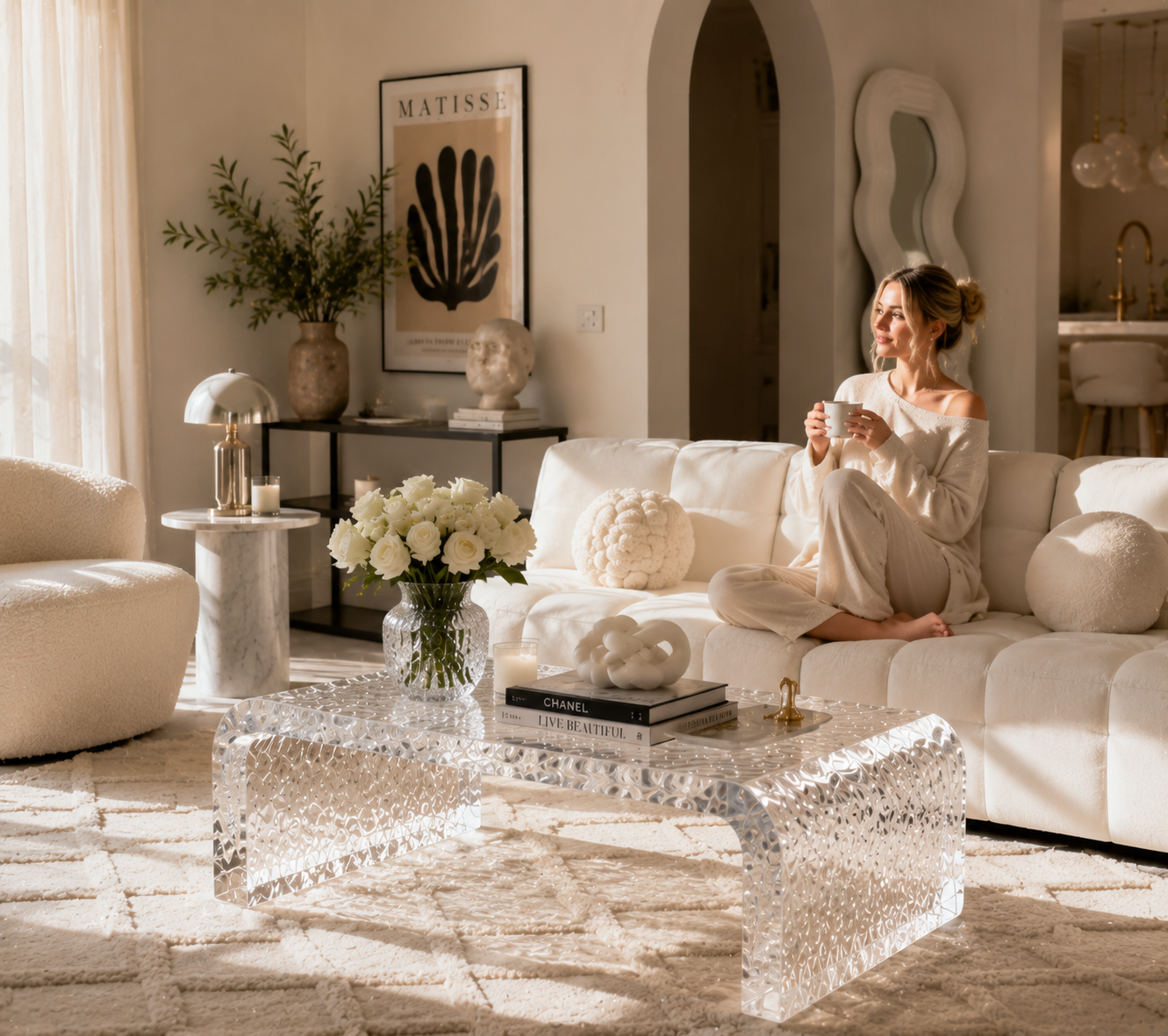
Synthetic crystal acrylic generally refers to premium transparent, translucent, tinted, frosted, or sculptural acrylic furniture designed to achieve exceptional clarity, depth, polish, and optical brilliance. It is different from ordinary low-cost plastic furniture because its value depends on carefully selected materials, substantial thickness, precise cutting, advanced bonding, refined polishing, structural engineering, and sophisticated design.
When used intelligently, synthetic crystal acrylic can create furniture that appears light, architectural, artistic, and technologically advanced.
It can interact with natural and artificial light. It can preserve visual openness. It can take on complex curves and geometric forms. It can be produced in customized colors and combined with metal, stone, wood, leather, glass, and lighting systems.
These characteristics give it the potential to become more than a material.
It can become a strategic tool for product differentiation, brand building, spatial customization, and market expansion.
The future competitive advantage of acrylic furniture will not come from transparency alone. It will come from the ability of brands to transform material qualities into distinctive design, emotional experience, technical expertise, and long-term customer value.
1. Why Traditional Luxury Furniture Is Entering a New Competitive Stage
The luxury furniture industry has traditionally relied on three major competitive factors: material quality, craftsmanship, and brand reputation.
A company could distinguish itself by using rare timber, natural marble, premium leather, hand-finished metal, or complex decorative techniques. Skilled artisanship and historical brand heritage could further increase the perceived value of the product.
These factors still matter, but the market environment has become more complicated.
Manufacturing capabilities have improved across many regions. High-quality cutting, polishing, carving, upholstery, finishing, and metalworking are no longer limited to a small number of companies.
Digital manufacturing has also increased consistency.
Computer-controlled equipment can reproduce shapes and details with great accuracy. International supply chains make premium materials more widely available. Online design platforms allow manufacturers to observe new products quickly.
This reduces the time during which a product remains unique.
When one brand introduces a successful curved sofa, marble table, or metal cabinet, similar forms may soon appear in other collections. The original product may still be better made, but its visual distinction becomes weaker.
Traditional luxury symbols are also changing in meaning.
A large piece of dark wood furniture may once have represented wealth and stability. Today, some clients may view it as visually heavy. Highly decorative furniture may once have suggested craftsmanship, but contemporary consumers may prefer cleaner forms.
Younger luxury buyers are often more interested in individuality than formality.
They may choose a product because it reflects their personality, complements their art collection, photographs well, or creates an unusual atmosphere. They may value design originality more than historical convention.
This changes how high-end brands must compete.
The question is no longer simply, “How can we make a better version of a familiar product?”
The more important question is, “How can we create a product experience that competitors cannot easily reproduce?”
Differentiation can come from several sources:
A distinctive material language
Original structural forms
Customization capabilities
Superior project services
Strong emotional storytelling
Advanced integration with architecture and technology
Exclusive color and finish systems
Synthetic crystal acrylic supports all of these possibilities.
It allows furniture companies to move beyond the visual language of conventional luxury. Instead of relying only on weight, ornament, and material rarity, brands can compete through clarity, lightness, optical effect, and sculptural precision.
This does not mean traditional materials will disappear.
The most successful future interiors will likely combine established and emerging materials. Wood can provide warmth, stone can communicate permanence, metal can offer strength, and acrylic can introduce lightness and visual movement.
The opportunity lies in creating a new balance.
Acrylic can make traditional materials feel more contemporary. A transparent chair beside a wooden desk creates contrast. An acrylic table base beneath a stone top reduces visual heaviness. A clear display cabinet with brass details combines modernity with refinement.
These combinations help brands update their product identity without abandoning their existing strengths.
2. Synthetic Crystal Acrylic as a Distinctive Material Language
A material becomes strategically valuable when customers can recognize the visual and emotional qualities it represents.
Synthetic crystal acrylic has a strong potential to develop this kind of identity.
Its most obvious characteristic is transparency. However, premium acrylic offers more than the simple ability to see through a surface.
Thickness creates optical depth.
Polished edges collect light and produce a luminous effect. Curved panels distort reflections. Tinted surfaces add color while preserving visual openness. Layered sheets create complex depth and overlapping tones.
These effects give acrylic a dynamic presence.
A wooden or stone object usually has a stable visual character. Acrylic changes according to its environment. It reacts to daylight, artificial lighting, nearby colors, movement, and viewing angle.
During the day, a clear table may almost disappear into the room.
At night, focused lighting may transform its edges into bright lines. A colored acrylic cabinet may appear soft in natural light and dramatic beneath decorative lighting.
This changing quality creates visual interest without requiring excessive ornament.
It also allows designers to use light as part of the furniture itself.
Acrylic can be illuminated from below, from the side, or from within. Light can travel through polished edges or diffuse through frosted surfaces. A reception desk, bar counter, display unit, or decorative partition can become an atmospheric feature.
This interaction between material and light is one of the strongest sources of differentiation.
Acrylic also changes the visual weight of furniture.
Two tables may have identical dimensions, but the transparent table will usually feel lighter because the eye can continue through it. This makes the material valuable in compact luxury residences, hotel suites, retail environments, and open-plan spaces.
The furniture can provide function without visually reducing the room.
This creates a clear practical advantage.
It also creates an emotional advantage.
Transparent furniture can make a space feel more open, calm, and flexible. It can preserve the visibility of decorative flooring, carpets, artwork, architectural walls, and surrounding furniture.
Instead of interrupting the design, acrylic can support it.
For premium furniture brands, these qualities can become part of a recognizable identity.
A company may develop collections based on substantial crystal-like thickness. Another may specialize in soft transparent curves. A third may use smoky colors and architectural geometry. Another may combine acrylic with metal, stone, or handmade materials.
Consistency is important.
A brand should not use acrylic as an isolated novelty. It should create a design system around the material.
This system may include:
Signature edge details
Consistent panel thickness
Exclusive color palettes
Repeated structural forms
Specific mixed-material combinations
Distinctive lighting effects
Controlled proportions
Recognizable polishing techniques
When these elements appear across tables, chairs, consoles, cabinets, screens, and accessories, the brand begins to establish a unique visual language.
That language is difficult to build through generic products.
It requires original design and technical control.
.png)
3. From Standardized Furniture to Personalized Spatial Solutions
One of the limitations of traditional furniture competition is the dependence on standardized products.
A brand develops a collection, produces fixed sizes and colors, and asks customers to choose from available options. This approach supports manufacturing efficiency, but it can weaken exclusivity.
High-end clients increasingly expect something more personal.
They want furniture that responds to the dimensions, lighting, architecture, and identity of a specific space.
Synthetic crystal acrylic is highly suitable for this transition.
The material can be customized in size, thickness, shape, color, transparency, surface finish, edge treatment, and structural form. It can also be engraved, printed, layered, illuminated, or combined with other materials.
This allows furniture companies to move from selling isolated objects to delivering spatial solutions.
In a luxury residence, a dining table can be developed around the size of the room, the position of the windows, the flooring, and the client’s art collection.
In a hotel lobby, a reception desk can be designed to reflect the architecture and brand identity of the property.
In a fashion store, display furniture can be matched to seasonal collections, campaign colors, and product categories.
In an executive office, acrylic partitions, tables, and display structures can communicate openness, precision, and technological confidence.
These projects create higher value because the final result is not easily replaceable.
A standard product can be compared directly with similar products from other suppliers. A custom solution is evaluated according to design relevance, technical quality, and project success.
This reduces price competition.
It also strengthens the relationship between the furniture company and the client.
To capture this opportunity, manufacturers must develop more than production skills.
They need design consultation, engineering, sampling, project management, transportation planning, installation, and maintenance support.
Material samples are especially important.
Clients and designers may need to compare thicknesses, colors, levels of transparency, edge finishes, and mixed-material combinations. A professional sample system can make the design process more reliable.
Digital visualization is also valuable.
Three-dimensional models and realistic renderings can help clients understand how a transparent or tinted object will behave in a particular room. Lighting simulations can demonstrate how edges and surfaces may change throughout the day.
Prototyping may be required for complex projects.
A brand that can develop and test prototypes offers greater confidence than a supplier that only produces from finished drawings.
This transition changes the company’s role.
It is no longer simply a furniture manufacturer.
It becomes a design and material partner.
That position creates a stronger competitive barrier because it depends on experience, communication, technical knowledge, and service systems that are difficult to copy quickly.
4. From Functional Product to Emotional and Experiential Value
Furniture has always served practical purposes.
Tables support objects. Chairs provide seating. Cabinets organize storage. Screens divide space.
In the future high-end market, function will remain necessary, but it will no longer be enough.
Premium customers increasingly evaluate furniture according to the experience it creates.
They ask how the product changes the mood of a room, how it reflects personal taste, how guests respond to it, and how it contributes to the identity of a space.
Synthetic crystal acrylic is well suited to this experience-driven market.
Its optical qualities attract attention.
Its transparency creates surprise.
Its interaction with light generates movement.
Its sculptural forms can produce strong visual memory.
These qualities are valuable in both residential and commercial environments.
Luxury Residential Interiors
In private homes, acrylic furniture can help clients express individuality.
A thick transparent dining table may become the visual center of the residence. A softly tinted console may coordinate with artwork or decorative stone. Clear shelving may display objects without creating a heavy background.
These pieces can make an interior feel more personal and less predictable.
They also support emotional ownership.
A custom object designed for a specific room often has greater meaning than a standard product selected from a catalog.
Hotels and Resorts
Hospitality businesses compete through memorable experiences.
Guests may not remember every practical detail of a hotel, but they often remember the lobby, lighting, atmosphere, and distinctive design features.
An illuminated acrylic reception desk can establish a powerful first impression. Transparent lounge furniture can preserve openness in busy public areas. Colored screens and sculptural tables can create recognizable visual moments.
These features can also support marketing.
Distinctive interiors are frequently photographed and shared. A memorable acrylic installation may become part of the hotel’s public image.
Premium Retail
Luxury retail environments must present products while communicating brand identity.
Transparent shelves, platforms, and display blocks allow merchandise to remain visually dominant. Colored acrylic can organize collections or reinforce campaign themes.
Custom engraving, printing, and lighting can integrate logos and graphics.
Because acrylic is visually light, it can create strong display effects without overwhelming the products.
Restaurants, Bars, and Clubs
Entertainment spaces rely on atmosphere and social energy.
Acrylic works particularly well in environments with controlled lighting. Transparent and colored surfaces can reflect movement, create luminous edges, and support dramatic nighttime experiences.
A bar counter, table, screen, or seating element may become part of the venue’s identity.
Offices and Branded Workplaces
Corporate interiors increasingly communicate culture.
Acrylic furniture can suggest openness, creativity, innovation, and precision. It may be used in reception areas, meeting rooms, executive offices, display zones, and collaborative spaces.
For technology, fashion, media, luxury, and creative companies, this visual language can strengthen brand positioning.
Galleries and Exhibitions
In galleries, acrylic can support art without blocking it.
Transparent display cases, plinths, benches, and partitions provide function while maintaining visual restraint. More expressive acrylic objects can also become part of the exhibition itself.
Across these applications, the commercial value of acrylic furniture is connected to its ability to create recognition.
A memorable environment can improve customer perception, strengthen brand identity, encourage social sharing, and differentiate a business from competitors.
The furniture becomes more than an object.
It becomes part of the experience economy.
5. How Craftsmanship, Technology, and Service Build Competitive Barriers
Synthetic crystal acrylic may appear visually simple, but premium production is technically demanding.
This creates both a challenge and an opportunity.
Companies that treat acrylic as an ordinary plastic material may produce furniture that looks inexpensive. Thin panels, cloudy surfaces, visible joints, weak structures, scratches, and inaccurate edges can quickly damage the perceived value of the product.
Luxury acrylic requires a different standard.
The first requirement is material quality.
Premium furniture needs acrylic with consistent clarity, stable color, controlled thickness, and minimal internal defects. Low-quality material may yellow, distort, or display uneven transparency.
The second requirement is precision cutting.
Geometric forms must be accurate. Curves must be controlled. Large panels must be processed without introducing stress or deformation.
The third requirement is edge finishing.
Polished edges are central to the crystal-like effect. Uneven polishing, visible tool marks, or rough transitions can reduce visual quality.
The fourth requirement is bonding.
Transparent joints reveal mistakes easily. Adhesive marks, trapped air, dust, and misalignment may remain visible through the material.
Clean bonding requires controlled conditions and skilled technicians.
The fifth requirement is structural engineering.
Acrylic furniture must support real loads. Tables, benches, shelves, and architectural elements require careful analysis of thickness, span, connection methods, and long-term stress.
The sixth requirement is transportation and installation.
Large acrylic components may be heavy and sensitive to surface damage. Protective films, custom packaging, lifting systems, site coordination, and professional assembly are essential.
These technical demands create competitive barriers.
A company that develops strong expertise in material selection, processing, engineering, and installation becomes difficult to replace.
Technology can strengthen this advantage.
Three-dimensional design software allows teams to study form and structure before production. CNC equipment improves cutting accuracy. Digital templates support complex curves and repeated components.
Lighting simulations help designers understand optical effects.
Advanced engraving, printing, lamination, and embedded decoration create new product possibilities.
Smart systems may also be integrated.
Acrylic furniture can incorporate LED lighting, wireless charging, touch controls, sensors, screens, and interactive elements. These features connect furniture with technology and expand the premium product category.
Service is equally important.
High-end customers expect clear communication, technical drawings, reliable schedules, quality inspection, professional installation, care guidance, and after-sales support.
Maintenance services can become part of the brand offer.
Acrylic surfaces require correct cleaning. Minor scratches may sometimes be polished. Damaged components may be replaceable if the product is designed intelligently.
Providing these services increases customer confidence and extends the product’s useful life.
The strongest companies will combine design, manufacturing, engineering, and service.
They will not compete only through production price.
They will compete through complete project capability.
.png)
6. Future Growth through Branding, Sustainability, and Global Design Collaboration
Acrylic furniture will not achieve long-term differentiation through novelty alone.
As the material becomes more popular, more manufacturers will enter the market. Basic transparent tables, chairs, and accessories will become easier to find.
Brands must therefore build value beyond the material itself.
Original design is essential.
Companies should develop signature collections with recognizable forms, colors, edge details, and material combinations. These collections can establish a clear identity and reduce dependence on custom production alone.
Intellectual property may also become more important.
Original structures, connection systems, surface treatments, color formulas, and product forms may be protected through design registrations, patents, trademarks, or contractual agreements.
Brand storytelling should explain more than appearance.
Customers should understand the design intention, production process, material quality, and spatial value of the product.
Professional photography, project documentation, videos, samples, and completed case studies can make these qualities visible.
Sustainability must also be addressed responsibly.
Acrylic is a petroleum-based material and should not automatically be described as environmentally friendly. However, brands can improve its environmental performance through thoughtful design and production.
Products can be designed for long service life.
Modular structures can allow components to be replaced. Repair and polishing services can extend usability. Efficient cutting plans can reduce waste. Suitable offcuts may be reused for smaller products or decorative components.
Recycled acrylic may be considered where performance and visual requirements allow.
Packaging can be optimized to reduce unnecessary material.
The goal should be responsible use rather than unsupported environmental claims.
Global collaboration will create further opportunities.
Synthetic crystal acrylic can appeal to international markets because its visual language is adaptable. It can work in minimalist European interiors, luxury Middle Eastern residences, modern Asian retail environments, North American hospitality projects, and international exhibitions.
Partnerships with architects, interior designers, artists, fashion brands, technology companies, and lighting specialists can expand its creative potential.
A furniture company may collaborate with an artist on a limited collection.
It may work with a hotel group on custom public-space furniture.
It may develop illuminated retail systems for a luxury brand.
It may cooperate with a technology company on interactive furniture.
These collaborations create cultural relevance and market visibility.
They also help the material move beyond a single furniture category.
In the future, acrylic may appear in furniture, lighting, architectural partitions, art installations, display systems, smart interiors, and immersive environments.
The boundaries between these categories will become less important.
The strongest brands will position themselves not only as furniture producers, but as creators of transparent spatial experiences.
The Main Competitive Opportunities
Synthetic crystal acrylic creates several important opportunities for future high-end furniture companies.
The first is visual differentiation.
The material offers a distinctive combination of transparency, depth, light interaction, and sculptural flexibility.
The second is customization.
Brands can develop products around specific dimensions, colors, spaces, and identities.
The third is service differentiation.
Design consultation, engineering, sampling, installation, maintenance, and restoration can increase value.
The fourth is market expansion.
Acrylic furniture can serve residences, hotels, retail, restaurants, offices, galleries, and branded commercial spaces.
The fifth is technological integration.
Lighting, sensors, charging, digital displays, and interactive systems can create new categories.
The sixth is brand storytelling.
Transparency, light, innovation, and contemporary luxury provide a strong conceptual foundation for communication.
These advantages become more powerful when they are combined.
A beautiful material without craftsmanship will not create premium value.
Advanced manufacturing without original design will not create brand distinction.
Customization without reliable service will not create long-term trust.
The competitive opportunity lies in building a complete system.
Strategic Recommendations for Furniture Brands
Furniture companies interested in this direction should begin with clear positioning.
They should decide whether they want to focus on luxury residential furniture, hospitality projects, retail display systems, collectible design, or architectural customization.
A focused position makes it easier to develop products and communication.
The next step is to create a coherent signature collection.
The collection should demonstrate material quality, design philosophy, technical capability, and visual identity. It should include enough variation to show the potential of the material without becoming inconsistent.
Professional samples should be developed.
Clients and designers need to experience thickness, transparency, color, edge quality, and surface finish directly.
Project processes should be standardized.
Quotation, drawing approval, sampling, production, inspection, packaging, transportation, installation, and maintenance should follow clear procedures.
High-quality visual content is also essential.
Acrylic is difficult to photograph because reflections and transparency require careful control. Professional images and videos can significantly influence market perception.
Completed projects should be documented in detail.
Case studies can show how the furniture solved spatial problems, supported brand identity, or created a memorable experience.
Finally, continuous design research is necessary.
As the market grows, generic acrylic products will become common. Long-term differentiation will depend on original structures, exclusive finishes, new material combinations, technical innovation, and strong creative partnerships.
Conclusion
The future high-end furniture market will not be defined only by better materials or more expensive products.
It will be defined by meaningful differentiation.
Clients want furniture that feels personal, visually distinctive, technologically relevant, and connected to the identity of a space.
Synthetic crystal acrylic offers a strong platform for this new competition.
Its transparency reduces visual weight. Its polished edges create light and depth. Its colors and finishes support customization. Its shaping potential allows furniture to become sculptural. Its compatibility with lighting, technology, and other materials expands its application.
For designers, it provides creative freedom.
For clients, it provides exclusivity.
For brands, it provides a new language of contemporary luxury.
However, the material alone is not enough.
True competitive value depends on design originality, material quality, craftsmanship, structural engineering, service systems, responsible production, and brand communication.
Companies that use acrylic only to reproduce familiar products may gain temporary attention.
Companies that develop a complete design and service ecosystem can create a lasting market position.
The greatest opportunity is to move beyond selling transparent furniture.
The goal is to create products that transform light, improve space, express identity, and deliver memorable experiences.
In this sense, synthetic crystal acrylic furniture represents more than a material trend.
It represents a new competitive direction.
It allows the high-end furniture industry to move from material display to spatial intelligence, from standardized products to personalized solutions, and from traditional luxury symbols to contemporary emotional value.
That transition may become one of the most important sources of differentiation in the future premium furniture market.
READ MORE:
- Elevating Hotel Interiors Without Increasing the Budget: Three Ways to Combine High-End Materials
- How High-End Transparent Furniture Can Balance Visual Impact, Structural Stability, and Easy Maintenance
- From "Beautiful" to "Built to Last": How Custom Hotel Furniture Can Balance Design Impact and Long-Term Maintenance
- Reducing Maintenance Pressure at Hotel Front Desks and Public Areas Through Smarter Furniture Materials
- How Should Hotels Choose Furniture for High-Frequency Areas? Application Strategies for Synthetic Crystal, Premium Resin, and Platinum Acrylic
- Why Are Designers and High-End Clients Paying More Attention to Synthetic Crystal Acrylic?
- Synthetic Crystal Acrylic Furniture: Turning Products from a Functional Choice into an Aesthetic Choice
- From Material Upgrade to Brand Upgrade: New Opportunities Created by Synthetic Crystal Acrylic Furniture
- Synthetic Crystal Acrylic Furniture: Why It Is Becoming a New Symbol of Value in High-End Spaces


