.png)
1. Begin With Optical Performance, but Define It Through Measurable Material Quality
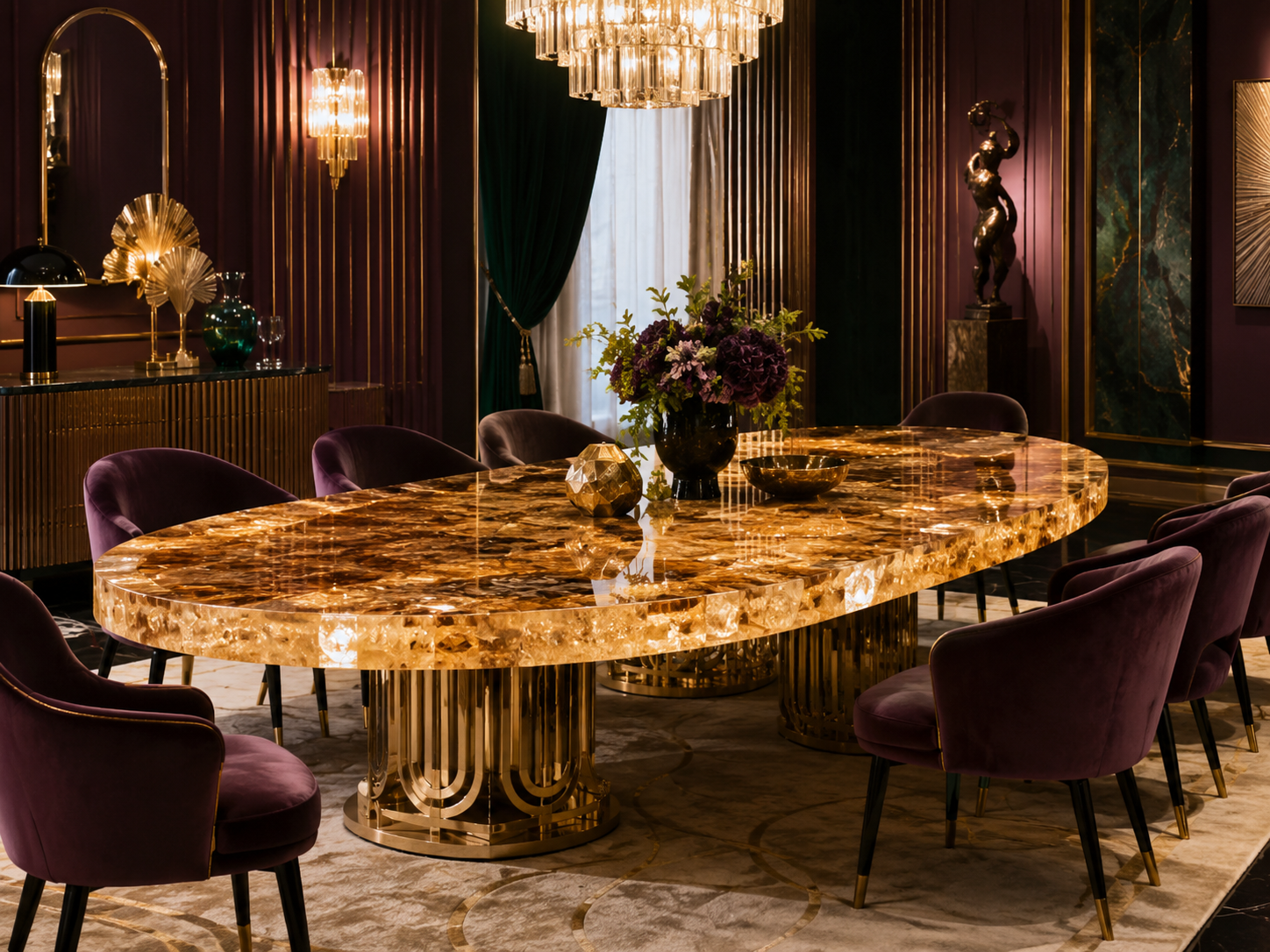
The appeal of high-end transparent furniture comes from its ability to occupy physical space without visually overwhelming it. A transparent console can create architectural presence while keeping a hallway open; a clear dining table can become the focal point of a room without blocking sightlines; and a sculptural resin coffee table can capture and refract light like a functional artwork. However, this visual effect depends on much more than whether a material simply appears clear.
For furniture made from synthetic crystal, premium cast resin, or platinum-grade acrylic, optical quality should be evaluated through light transmission, color consistency, haze, internal bubbles, inclusions, edge clarity, and long-term resistance to yellowing. PLEXIGLAS states that colorless PMMA can achieve light transmission of up to 92%, depending on the grade and product configuration. Its published warranty information also notes that, under specified conditions, the reduction in light transmission after 30 years can be limited to approximately 2% to 15%. These figures show why high-quality acrylic is frequently selected when designers want a cleaner and brighter visual result than ordinary transparent plastics can provide.
For international buyers, terms such as “synthetic crystal” and “platinum acrylic” should be supported by technical specifications rather than treated as standardized material grades. A professional supplier should explain what the label means in measurable terms: the resin system used, casting method, light-transmission target, acceptable bubble size, color-difference tolerance, polishing level, ultraviolet-stability test, and inspection conditions. This prevents a visually attractive sample from becoming a disappointing production order.
The same principle applies to cast resin. Thick transparent resin furniture can create depth, suspended decorative effects, flowing forms, and colors that are difficult to produce with sheet acrylic. Yet thick casting also introduces practical challenges, including heat buildup during curing, internal stress, shrinkage, bubbles, uneven color, and visible casting lines. For example, a 150-millimeter-thick resin coffee-table base should not be approved solely from photographs. It should be inspected under both direct and side lighting, because small bubbles and internal flow marks that disappear in frontal images may become obvious when light enters through a polished edge.
The correct material choice therefore begins with the desired visual effect. Acrylic is often suitable for precise geometry, clear panels, polished edges, bent components, and repeatable production. Cast resin is particularly effective for monolithic forms, embedded objects, artistic textures, gradients, and large sculptural volumes. The strongest transparent-furniture collections use each material where its optical and manufacturing characteristics create genuine value rather than attempting to use one material for every design.
2. Treat Structural Stability as an Engineering Requirement, Not a Visual Compromise
The central challenge in transparent-furniture design is that customers want the structure to appear almost invisible while expecting it to perform like conventional furniture. Removing visible supports may improve the appearance, but it also increases bending, joint stress, vibration, and the risk of instability. The design process must therefore begin with realistic loads and user behavior rather than with appearance alone.
BIFMA, the organization responsible for widely used commercial-furniture standards, emphasizes that furniture performance must address safety, durability, structural strength, and stability. The ANSI/BIFMA X5.5 standard for desks and tables includes evaluations relating to stability, leg strength, top retention, and the structural performance of table products used in offices, institutions, retail environments, restaurants, and educational spaces.
These principles are directly relevant to transparent dining tables, desks, consoles, display plinths, and side tables. A large acrylic tabletop may look rigid in a showroom but deflect noticeably when a user leans on the center or places weight near an unsupported edge. A clear resin console may stand securely on a flat factory floor yet rock after installation on stone tiles with minor level differences. A sculptural base may support vertical weight while remaining vulnerable to lateral forces caused by someone pushing the furniture or sitting on an edge.
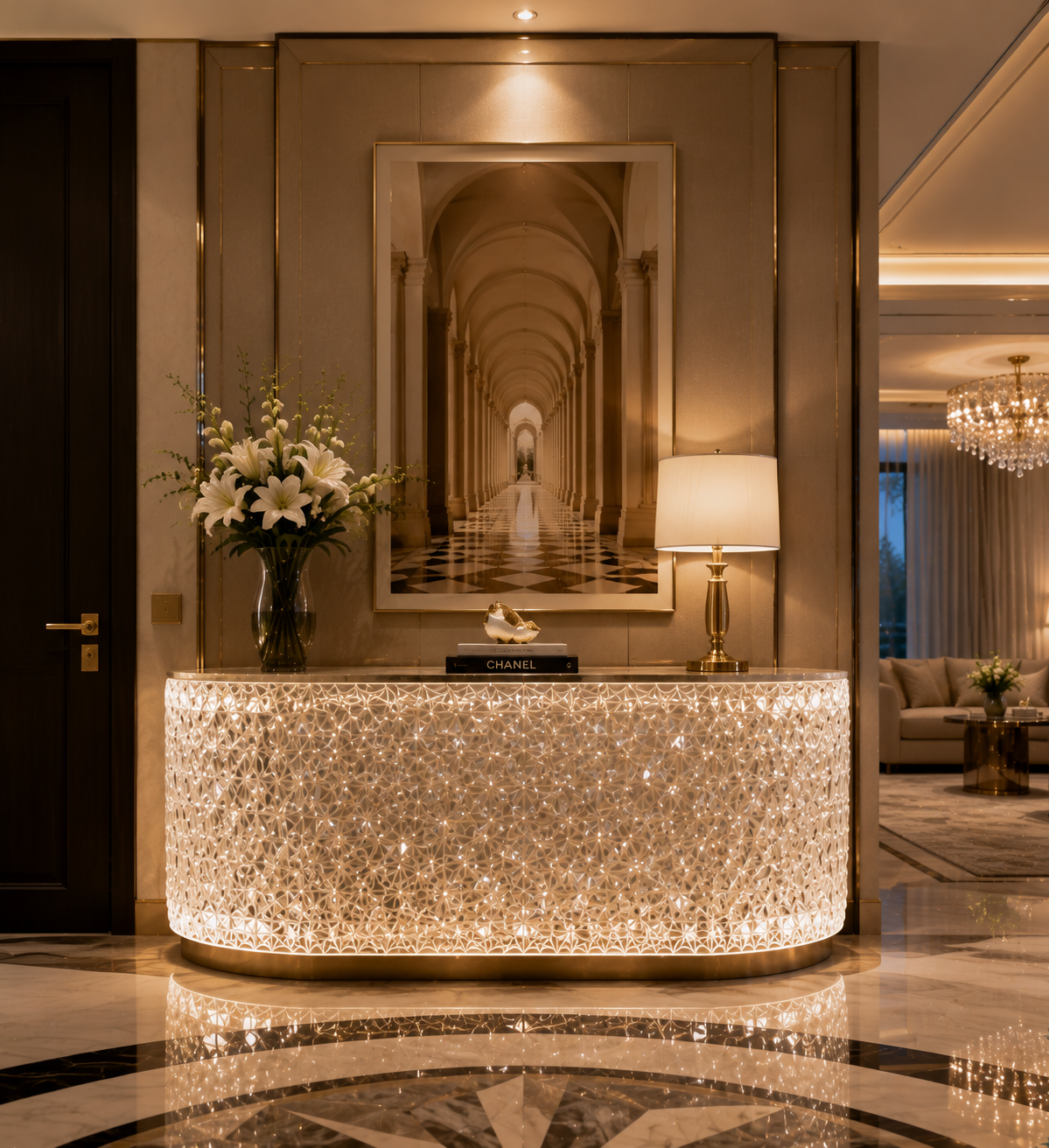
The solution is not necessarily to make every component visibly thicker. Stability can be improved through intelligent load paths, wider support geometry, concealed reinforcement, laminated construction, mechanically locked joints, and carefully positioned contact points. A transparent console, for instance, may incorporate a recessed stainless-steel spine inside its rear edge. From the front, the product maintains a clean, floating appearance, while the concealed metal component controls bending and protects the joint between the top and legs.
Furniture with drawers, doors, or a tall center of gravity requires additional attention. The U.S. Consumer Product Safety Commission’s furniture-stability requirements for clothing-storage units consider realistic conditions such as placement on carpet, loaded drawers, multiple open drawers, and forces associated with a child interacting with the unit. Although not every transparent furniture product falls within that regulation, the testing philosophy is valuable: stability must be evaluated under foreseeable use, not only under ideal showroom conditions.
For premium projects, structural decisions should be documented before production. Drawings should identify material thickness, reinforcement location, joint type, allowable load, floor-contact geometry, and installation requirements. Prototype testing should include vertical loading, edge loading, lateral force, repeated use, and transportation simulation. A luxury transparent table earns its premium position not because it looks delicate, but because it achieves that delicacy without behaving like a fragile object.
3. Design Joints and Dimensions Around the Real Behavior of Acrylic and Resin
Many failures in transparent furniture occur not in the main material but at joints, drilled holes, bonded corners, threaded inserts, and connections between dissimilar materials. These areas concentrate stress and are also where manufacturing tolerances, temperature changes, and installation errors become most visible.
Acrylic expands and contracts considerably more than glass or metal. Technical information published for ACRYLITE sheet states that the material may expand and contract approximately three to eight times as much as glass or metals. As a practical example, the manufacturer reports that a 48-inch panel exposed to a temperature difference of 100°F may change in dimension by approximately 3/16 of an inch.
This behavior matters when a transparent tabletop is fixed to a stainless-steel frame, when an acrylic panel is enclosed inside a rigid metal channel, or when a large console is shipped from a humid Asian factory to an air-conditioned hotel in the Middle East, Europe, or North America. If the design prevents movement completely, stress may accumulate around fasteners and edges, producing crazing, cracking, distortion, or joint failure.
Oversized clearance holes, flexible bushings, slotted metal connections, controlled adhesive gaps, and movement allowances can reduce these risks. Bolts should not be tightened directly against an unprotected acrylic surface. Load-spreading washers, compatible gaskets, sleeves, and controlled torque are essential, particularly when the component will experience vibration during shipping. Sharp internal corners should also be avoided because they create stress-concentration points. A generous radius is usually more durable and often appears more refined after polishing.
Adhesive selection must be treated with equal care. A bond that looks clear immediately after assembly may develop bubbles, whitening, separation, or fine cracks after thermal cycling. The adhesive must be compatible with the exact acrylic or resin formulation, provide sufficient working time, cure without excessive shrinkage, and tolerate the anticipated temperature range. Adhesive tests should use production material rather than an unrelated sample sheet, because coatings, pigments, additives, and surface treatments can change bonding performance.
Large resin castings present another dimensional issue: internal curing stress. A thick synthetic-crystal base may appear stable after demolding but gradually distort if the curing schedule, post-curing process, or material thickness is not properly controlled. Machining away a large amount of material from only one side may release stress unevenly and change the component’s geometry. For this reason, final machining and polishing should be planned as part of the casting process rather than treated as cosmetic finishing steps.
A practical example is a transparent dining table with a thick resin base and an acrylic top. The base, top, metal inserts, and floor glides all respond differently to temperature and load. A reliable design does not force these components to behave as one rigid material. Instead, it creates controlled interfaces that transfer weight securely while allowing small dimensional changes to occur without visible damage.
4. Protect the Surface Without Destroying the Material’s Depth and Brilliance
In conventional furniture, small scratches may blend into wood grain, stone texture, or a matte finish. On high-gloss transparent furniture, the same scratch can catch the light and become immediately visible. Surface engineering is therefore a central part of both product development and customer expectation management.
ASTM D7027 provides a laboratory method for evaluating and comparing the scratch resistance of polymeric coatings and plastics. The standard notes that polymer behavior is affected by temperature and conditioning, and it distinguishes between immediate scratch damage and residual damage after material recovery. It recommends allowing 24 hours when evaluating residual scratch depth in materials that show viscoelastic recovery.
For manufacturers, this means that claims such as “scratch-proof” should be avoided unless supported by a clearly defined test. A more credible specification describes the surface system, test method, load, stylus geometry, appearance criteria, and permitted residual mark. It is also useful to compare polished, coated, matte, and textured samples under the same conditions.
High-gloss acrylic delivers exceptional brilliance and depth but reveals fingerprints, dust, wiping marks, and fine scratches more readily. A hard-coated surface can improve resistance to everyday abrasion, although the coating must maintain adhesion, clarity, repairability, and edge consistency. Frosted or satin finishes conceal minor marks more effectively, but they produce a softer optical effect and may show polished spots if repeatedly rubbed in one area. Cast resin surfaces can also be formulated and finished in different ways, but the final system must be tested for stain resistance, chemical compatibility, color stability, and repair behavior.
Ultraviolet exposure must be considered even for indoor furniture. Getty Conservation Institute research identifies yellowing, loss of transparency, crazing, cracking, warping, and surface changes among the common signs of deterioration found in plastics. ASTM D4459 uses window-glass-filtered xenon-arc exposure to evaluate the stability of plastics intended for indoor applications, while ISO 4892-2 specifies xenon-arc exposure methods for studying changes caused by light, heat, humidity, and moisture.
A transparent resin table intended for a sunlit hotel lobby should therefore be tested differently from a side table intended for a private bedroom. The supplier should establish a target end-use environment and test representative samples, including pigments, adhesives, clear coats, embedded materials, and printed components. A premium product is not simply clear when it leaves the factory; it is designed to preserve its intended appearance throughout a realistic service life.

5. Make Maintenance Part of the Product Design and Customer Experience
Easy maintenance cannot be added after the furniture has already been designed. It depends on surface selection, access to joints, replaceable components, cleaner compatibility, edge details, and the information supplied to the user.
The Canadian Conservation Institute notes that acrylic is often preferred in museum applications because of its transparency, toughness, workability, and maintainability. However, it also warns that many household cleaners contain abrasives that can scratch acrylic, while some solvent-containing products can cause crazing. The institute further explains that acrylic can develop static electricity during cleaning and use, causing dust to accumulate on the surface.
These observations are highly relevant to luxury homes, boutiques, hotels, galleries, and restaurants, where transparent furniture may be cleaned every day by staff who are unfamiliar with the material. A beautiful acrylic display plinth can lose its premium appearance quickly if it is repeatedly wiped with paper towels and ordinary glass cleaner.
A practical care system should specify a clean microfiber cloth, a compatible antistatic acrylic cleaner, gentle pressure, and separate cloths for wet cleaning and final drying. Dry wiping should be minimized because trapped dust can act as an abrasive. Cleaners containing ammonia, acetone, strong alcohol concentrations, aromatic solvents, or abrasive particles should not be used unless the material supplier has confirmed compatibility with the exact product.
Furniture geometry also affects maintenance. Narrow gaps that collect dust but cannot accommodate a cloth should be eliminated. Transparent feet and floor glides should be removable, because damaged glides may cause rocking or floor scratches. Metal connectors should be accessible for inspection without requiring the bonded acrylic structure to be disassembled. In hospitality applications, high-contact protective components can be designed as replaceable parts rather than permanent elements.
Repairability should be defined realistically. Very light surface marks may sometimes be polished, but aggressive polishing can create optical distortion or an uneven glossy area. The Canadian Conservation Institute notes that removing even shallow scratches can be labor-intensive and recommends comparing the cost of restoration with replacement.
For premium furniture, the maintenance package should include a care card, approved-cleaner list, stain-response instructions, replacement-part information, and guidance on sunlight, heat, and heavy objects. Clear maintenance instructions do more than reduce complaints. They reassure architects, distributors, hospitality buyers, and homeowners that the visual quality they are purchasing can be preserved without specialist intervention every time the product is cleaned.
6. Prove Luxury Through Testing, Documentation, and Long-Term Serviceability
In transparent furniture, quality is unusually visible. Bubbles, polishing waves, glue lines, dust inclusions, joint misalignment, scratches, and color differences cannot be concealed beneath veneer or paint. This makes production control and documentation essential parts of the luxury proposition.
Every product should have an agreed inspection standard covering viewing distance, lighting conditions, allowable inclusions, edge quality, dimensional tolerance, color variation, surface marks, joint alignment, and protective packaging. The approved sample should represent achievable production quality rather than an exceptional prototype made under conditions that cannot be repeated.
Performance testing should match the intended application. Dining tables and desks should be evaluated for stability, leg strength, edge loading, top retention, and repeated use. Tall cabinets and display units require tip-over assessment. Transparent surfaces should be tested for scratching, staining, cleaning chemicals, thermal cycling, ultraviolet exposure, and color change. Shipping tests should reproduce vibration, drop events, compression, temperature changes, and the stress created by rigid packaging around components that expand differently.
Indoor-air quality is also becoming part of premium furniture procurement, especially in healthcare, education, hospitality, and environmentally certified buildings. UL Solutions states that GREENGUARD certification establishes chemical-emission limits for product categories including furniture. GREENGUARD Gold applies lower emission limits, addresses more than 360 VOCs, and includes additional requirements intended for sensitive environments such as schools and healthcare facilities.
For manufacturers of synthetic-crystal and resin furniture, this means that adhesives, coatings, pigments, cleaners, and casting systems should be considered together rather than evaluating only the main transparent body. A low-emission material can still be compromised by an unsuitable coating or bonding system. Batch records and supplier declarations also become important when products are specified for international projects.
Long-term serviceability completes the balance between appearance, stability, and maintenance. Replaceable floor glides, detachable metal accessories, documented adhesive systems, retained color references, and spare-component policies can extend the useful life of a product. Packaging should protect the furniture during the first delivery and be suitable for possible relocation, because high-end furniture is often moved between residences, galleries, showrooms, or hospitality spaces.
Ultimately, the best transparent furniture does not force a choice between visual drama and practical performance. It uses optical-grade materials where clarity matters, engineered reinforcement where loads demand it, controlled interfaces where materials move differently, tested surfaces where daily contact occurs, and clear maintenance systems where long-term appearance depends on user behavior. When these decisions are integrated from the beginning, synthetic crystal, premium resin, and high-grade acrylic can deliver furniture that looks almost weightless while remaining structurally dependable, commercially credible, and straightforward to maintain.

READ MORE:
- Elevating Hotel Interiors Without Increasing the Budget: Three Ways to Combine High-End Materials
- From "Beautiful" to "Built to Last": How Custom Hotel Furniture Can Balance Design Impact and Long-Term Maintenance
- Reducing Maintenance Pressure at Hotel Front Desks and Public Areas Through Smarter Furniture Materials
- How Should Hotels Choose Furniture for High-Frequency Areas? Application Strategies for Synthetic Crystal, Premium Resin, and Platinum Acrylic
- Synthetic Crystal Acrylic Furniture: A New Direction for Differentiated Competition in the Future High-End Furniture Market
- Why Are Designers and High-End Clients Paying More Attention to Synthetic Crystal Acrylic?
- Synthetic Crystal Acrylic Furniture: Turning Products from a Functional Choice into an Aesthetic Choice
- From Material Upgrade to Brand Upgrade: New Opportunities Created by Synthetic Crystal Acrylic Furniture
- Synthetic Crystal Acrylic Furniture: Why It Is Becoming a New Symbol of Value in High-End Spaces


