.png)
A hotel does not feel luxurious simply because expensive materials have been used everywhere. Guests experience quality through proportion, light, texture, craftsmanship, visual consistency and the way furniture interacts with the surrounding space. A carefully positioned transparent console can create a stronger impression than an entire wall of costly stone. A sculptural table with a luminous synthetic-crystal detail may communicate more exclusivity than filling a lobby with conventional “luxury” furniture.
This distinction is increasingly important for hotel owners. CBRE’s global hotel outlook noted that operating expenses were expected to grow faster than revenue in several markets, putting pressure on margins and profitability. In that environment, design teams must improve the perceived value of a property without allowing furniture, fixtures and equipment budgets to expand uncontrollably.
Synthetic crystal, high-end resin and premium optical-grade acrylic—often marketed in the furniture sector as platinum acrylic—provide a practical solution. Used selectively and combined intelligently, these materials can introduce depth, transparency, colour, light and customised detailing while keeping the overall specification commercially realistic.
1. Begin with Visual Hierarchy Rather Than Material Quantity
The first principle is to stop treating premium materials as finishes that must cover an entire room. Their greatest value comes from controlling attention. In a well-designed hotel space, the eye should move toward a limited number of focal points: the reception desk, a central lobby table, a concierge console, a bar counter, a feature screen or an artwork-like furniture piece.
This approach allows a designer to concentrate synthetic crystal, resin and platinum acrylic where guests are most likely to notice, photograph and touch them. Standard materials can still be used for large background surfaces, including painted walls, timber veneer, upholstered panels, engineered stone and powder-coated metal. The premium materials then create contrast against those quieter foundations.
Research published in Current Psychology found that the visual aesthetics of a luxury hotel front desk can influence consumers’ willingness to pay a price premium. Significantly, the study showed that visual impact does not depend entirely on elaborate thematic decoration. A coherent, visually refined non-thematic design can also produce a strong response.
In practical terms, a hotel does not need a reception counter made entirely from synthetic crystal. A more economical solution might use a conventional internal structure, durable commercial panels and a carefully illuminated synthetic-crystal front insert. The guest sees brilliance, depth and craftsmanship, while the expensive material represents only a controlled percentage of the total construction.
The same logic applies to furniture. Instead of specifying ten ordinary side tables and ten expensive decorative tables, a project may achieve greater impact by using eight restrained tables and two sculptural statement pieces. The statement pieces can combine transparent legs, a resin surface and a synthetic-crystal detail, establishing the visual language for the entire lobby.
Luxury is therefore created through editing. When every object attempts to look expensive, the space becomes visually noisy. When one high-value material is surrounded by calmer textures, its quality becomes more visible. This is the foundation for improving a hotel’s perceived level without automatically increasing its budget.
2. Use Synthetic Crystal as the Jewellery of the Interior
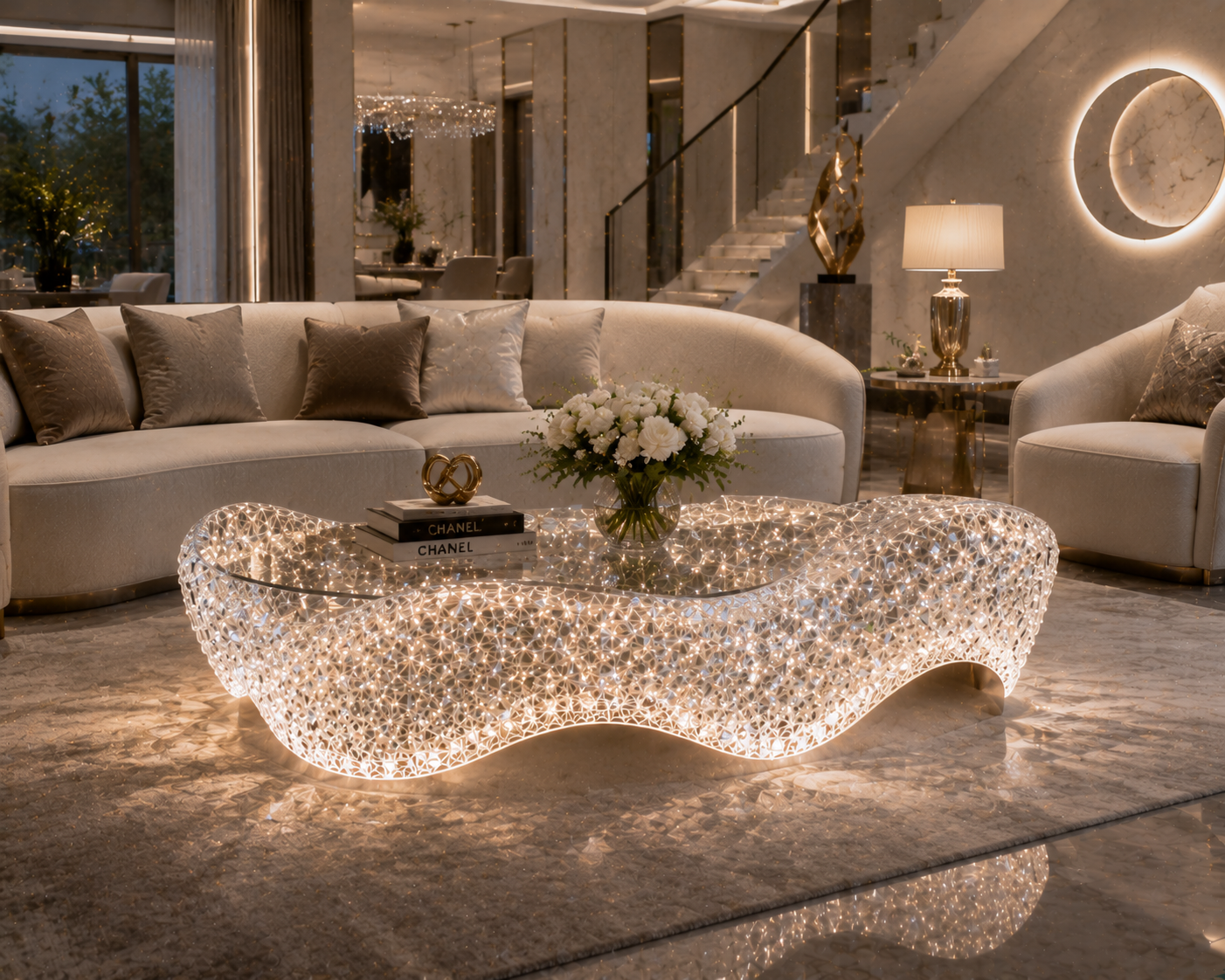
Synthetic crystal is most effective when treated as an accent rather than a construction material. Like jewellery in fashion, it should be used to sharpen the composition, reflect light and provide a memorable detail. Its purpose is not to occupy the most square metres; its purpose is to attract the most attention per square metre.
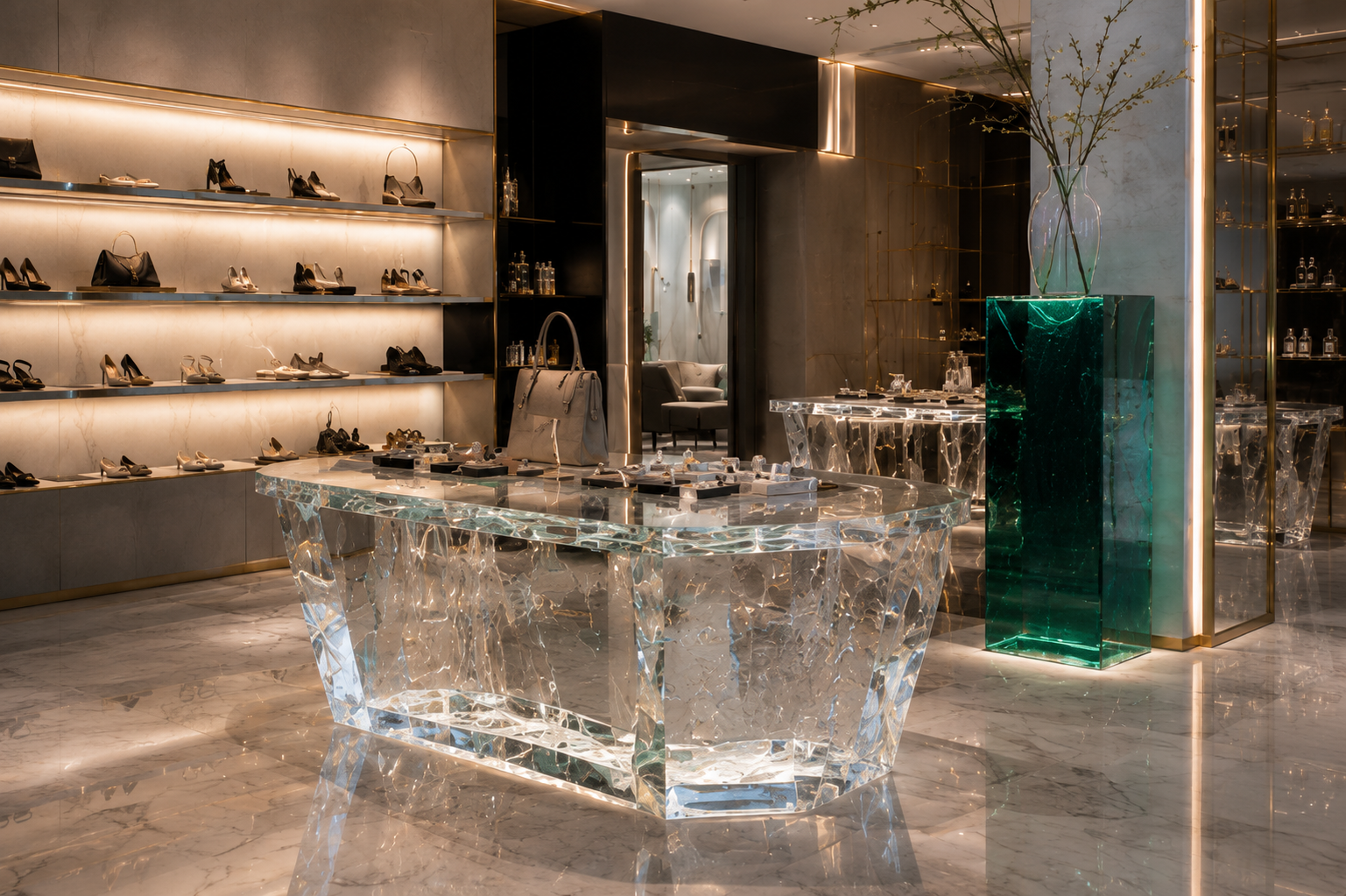
In a hotel lobby, synthetic crystal can be introduced through reception-desk panels, table bases, decorative furniture inlays, sculptural screens, lighting elements or small architectural objects. When positioned near controlled lighting, the material gains visual depth and produces changing reflections as guests move through the space. This sense of movement helps a static piece of furniture feel more experiential.
A practical lobby combination would use a synthetic-crystal feature on the front of the concierge desk, warm timber or champagne-coloured metal around the structure, and discreet resin detailing at the edges. The timber provides familiarity, the metal adds precision and the synthetic crystal creates the visual signature. Because the crystal is concentrated in the guest-facing area, there is no need to apply it to concealed sides, internal surfaces or low-visibility zones.
In guestrooms, synthetic crystal should be used more quietly. A small insert in a minibar cabinet, bedside table, vanity or decorative mirror can connect the room to the lobby’s design language without making the environment overly theatrical. A hotel should not repeat the lobby statement at the same scale in every room. Instead, it should repeat a simplified material cue.
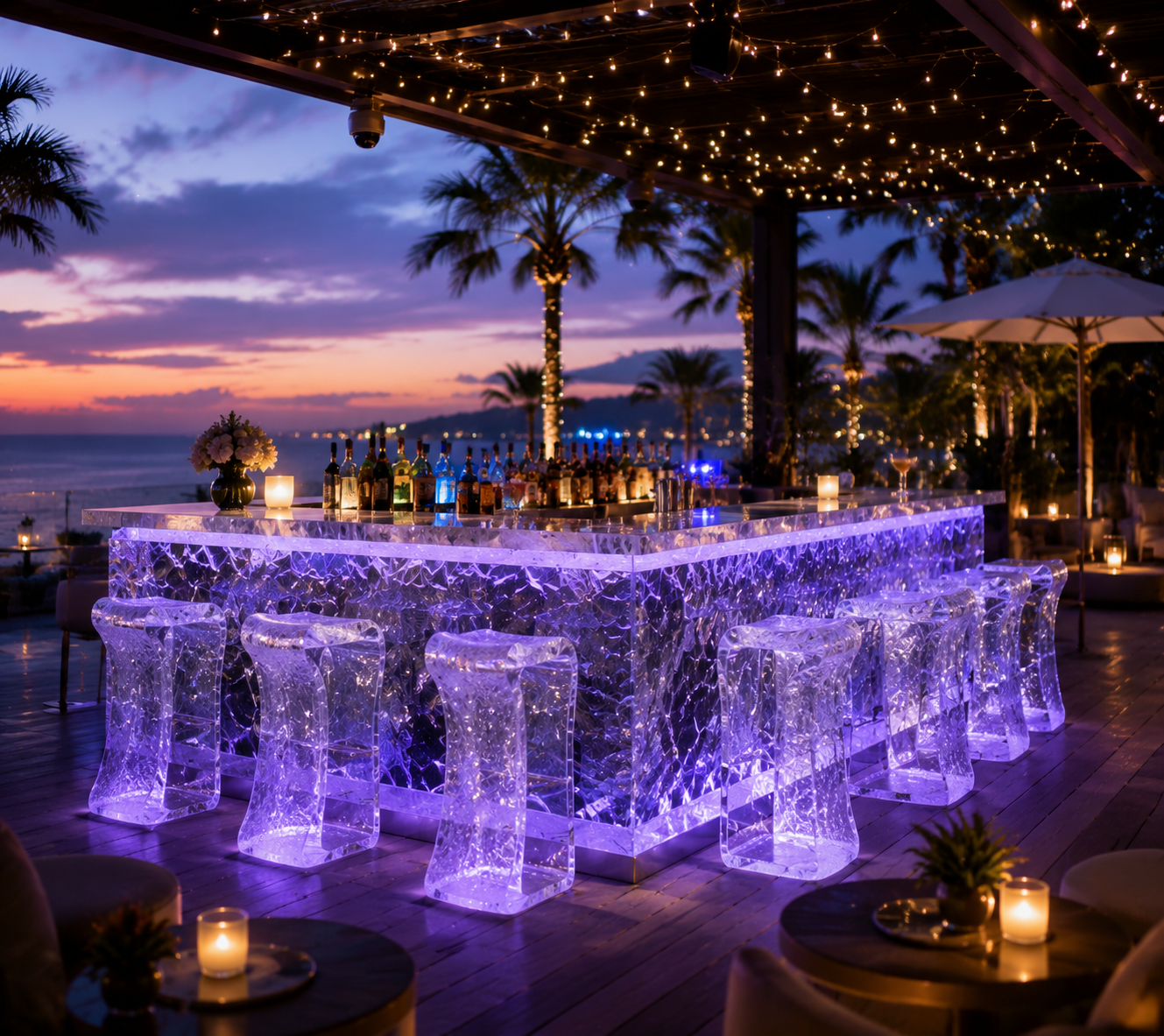
For restaurants and bars, darker or tinted synthetic crystal can be particularly effective. Combined with bronze metal, smoked glass, dark timber or richly coloured resin, it can create an evening atmosphere without depending on expensive natural stone slabs. Backlighting should be restrained and integrated into the furniture. Excessively bright illumination can make a premium material appear commercial or decorative rather than sophisticated.
The budget advantage comes from precision. Synthetic crystal should be specified only where its transparency, refraction or depth can actually be seen. Using it on a poorly lit surface, beneath clutter or in a low-visibility corner wastes both the material and the budget. Every application should answer a simple question: what will this detail contribute that paint, laminate, glass or metal cannot?
3. Use High-End Resin to Add Texture, Colour and Local Identity
High-end resin offers a different form of luxury. Synthetic crystal attracts attention through brilliance, while resin creates value through depth, tactility, colour and customisation. It can be clear, translucent, opaque, matte, polished, layered or combined with decorative inclusions. This makes it especially useful for hotels that need a distinctive identity rather than a generic international style.
Resin furniture can reference a destination without relying on literal decoration. A coastal hotel might use soft mineral colours, suspended organic forms or wave-like layers. An urban business hotel could use smoke-grey resin with metallic particles and precise geometric edges. A resort near a forest or mountain region might combine resin with timber textures, botanical impressions or locally inspired colour gradients.
The key is restraint. The more expressive the resin, the simpler the surrounding furniture should become. A resin tabletop with visible depth may only require a minimal metal base. A sculptural resin console can be placed against a plain plaster wall instead of competing with patterned stone, decorative wallpaper and multiple artwork pieces.
Resin is also useful when a designer wants visual continuity across different furniture categories. The same customised colour or texture can appear in a lobby table, reception insert, restaurant divider and guestroom accessory. These elements do not need to be identical. Their shared colour and material character are enough to create a recognisable brand language.
From a sustainability perspective, selective material use is also more defensible than unnecessary replacement or over-specification. The World Green Building Council reports that buildings account for 39 percent of global energy-related carbon emissions, with 11 percent associated with materials and construction. Its guidance emphasises reducing upfront carbon and considering the whole lifecycle of buildings and renovations.
For hotel projects, this supports a design strategy in which existing sound furniture structures may be retained while visible surfaces or feature components are upgraded. A conventional table base, for example, may receive a new resin top rather than being completely replaced. A reception desk can be refreshed with resin and synthetic-crystal panels while keeping its internal carcass.
However, resin must always be selected according to its intended use. A decorative resin suitable for a low-contact console may not be appropriate for a heavily used restaurant table. The specification should address heat exposure, staining, yellowing, scratch resistance, cleaning products, fire requirements and repair procedures. “High-end resin” is not a single technical category; performance depends on the formulation, manufacturing process, finishing system and quality control.
4. Use Platinum Acrylic to Create Space, Lightness and Optical Precision
In this context, platinum acrylic should be understood as premium optical-grade PMMA selected for furniture requiring exceptional clarity, polished edges and a refined finish. The term is frequently used commercially, but it is not a universal technical classification. Hotel buyers should therefore request material-grade information, test data, thickness tolerances, colour consistency and finishing standards rather than relying on the name alone.
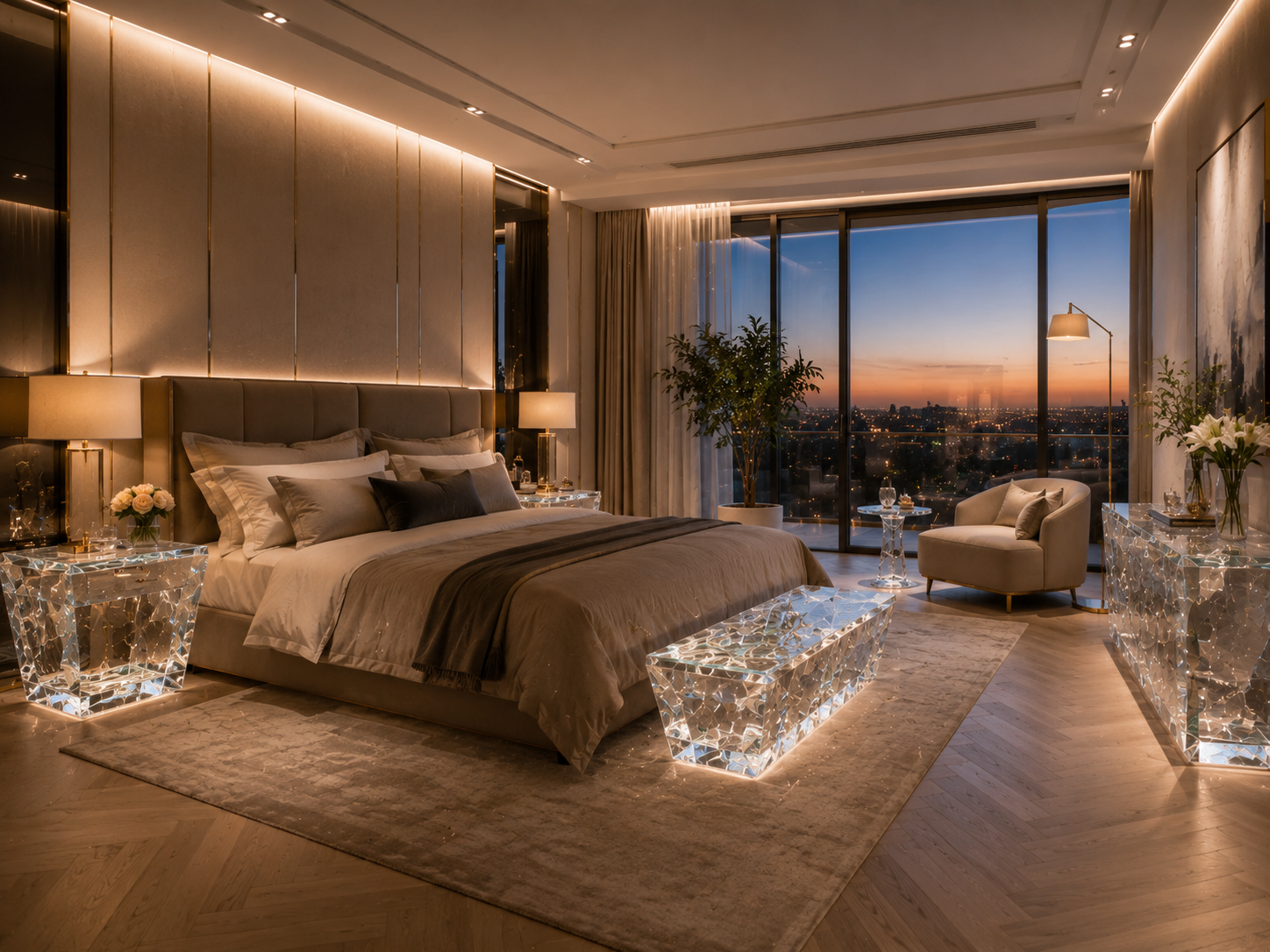
The main design advantage of premium acrylic is visual lightness. A solid timber or stone table base occupies the room visually even when its physical footprint is small. A transparent acrylic base allows flooring, rugs and architectural lines to remain visible, making the same room appear less crowded.
This is especially valuable in compact hotel lobbies, guestrooms, executive lounges and corridors. A platinum-acrylic console can provide a functional surface without creating a heavy visual barrier. Acrylic legs can make a marble, resin or synthetic-crystal tabletop appear to float. A transparent screen can establish separation while preserving sightlines and daylight.
A technical sheet for one optical-grade PLEXIGLAS PMMA product reports 92 percent light transmission at a thickness of three millimetres, a density of 1.19 grams per cubic centimetre and haze below one percent. The manufacturer also identifies machining, forming, joining and surface finishing as available processing methods. These values apply to that particular grade rather than every acrylic product, but they illustrate why verified optical PMMA can be useful in light-driven furniture design.
Acrylic should normally be paired with a contrasting material. When every component is transparent, the furniture can lose visual definition. A clearer composition is created by combining platinum-acrylic legs with a coloured resin top, an acrylic frame with synthetic-crystal inlays, or a transparent console with metal connectors in brass, black or stainless-steel finishes.
Edge quality is critical. Poor polishing, visible adhesive, cloudy joints, inconsistent thickness or rough machining will immediately weaken the luxury impression. In transparent furniture, construction cannot be concealed. The fabrication itself becomes part of the design.
Maintenance must also be planned carefully. ASTM maintains a specific test method for evaluating stress crazing in acrylic plastics exposed to liquid or semi-liquid compounds under bending stress. This confirms the importance of checking cleaning-agent compatibility rather than assuming that every commercial chemical is safe for acrylic furniture. Hotel operators should receive approved cleaning instructions, suitable cloth recommendations and clear restrictions on solvents or abrasive products.
5. Combine the Three Materials by Function, Not by Formula
The three materials should not be added to every furniture piece in equal proportions. Their roles are different. Synthetic crystal creates brilliance and an emotional focal point. High-end resin delivers colour, texture and storytelling. Platinum acrylic provides transparency, structure and visual lightness. The most successful combinations assign each material a specific job.
In a lobby, a central table could use a resin top with a subtle mineral texture, platinum-acrylic legs and a small synthetic-crystal core visible through the transparent structure. The resin establishes colour, the acrylic keeps the object visually open, and the crystal creates a memorable detail. Surrounding side tables could repeat only the resin colour or acrylic profile, reducing cost while maintaining consistency.
At reception, the internal counter can remain conventional and durable. A synthetic-crystal guest-facing panel may become the main focal element, while resin is used at the countertop or branding area. Acrylic should be applied only where transparency supports the composition, such as a floating shelf, decorative canopy or side display.
In a restaurant or bar, resin is usually the most functional lead material because it can carry colour and atmosphere across tabletops, host stands and partitions. Synthetic crystal can appear at the bar front or in feature tables, while acrylic is reserved for dividers, display furniture or bases that should not block the room.
Guestrooms require a calmer balance. A resin bedside tabletop or minibar insert can provide tactile identity, while a transparent acrylic luggage bench, console or small table makes the room feel more spacious. Synthetic crystal should appear as a restrained signature detail rather than the dominant surface.
Furniture that can be moved or adapted also supports a more personal guest experience. Cornell researchers recently examined hotel-room psychological ownership through several experiments and an analysis of 14,689 TripAdvisor reviews. Guests who demonstrated a stronger sense of ownership reported higher satisfaction, and allowing guests to control or rearrange elements of the room was associated with greater loyalty.
This finding has a practical implication for material selection. Transparent acrylic and carefully engineered resin furniture can be designed in compact, movable formats, giving guests or staff greater flexibility without adding visual clutter. Lightweight appearance should not be confused with inadequate structural performance, however. Furniture must still meet the loading, stability, fire-safety and contract-use requirements of the target market.
6. Protect the Budget Through Lifecycle Specification and Manufacturing Control
The purchase price of a hotel furniture item is only one part of its cost. Cleaning, repair, refinishing, replacement, freight, installation, room downtime and disposal can all affect the final financial result. A visually impressive item that becomes cloudy, scratched, unstable or difficult to repair may prove more expensive than a slightly higher-quality product with controlled long-term performance.
The U.S. Environmental Protection Agency defines lifecycle cost as the total cost of an item throughout its life, including planning, design, acquisition, operation, maintenance and disposal, less residual value. Its lifecycle model also includes renewal and decommissioning costs rather than focusing only on the original purchase price.
Hotel buyers should therefore evaluate synthetic crystal, resin and platinum-acrylic furniture through a lifecycle lens. Samples should be reviewed under the actual lighting conditions of the property. High-contact surfaces should be tested with the hotel’s cleaning products. Edges, joints, metal connections and load-bearing areas should be inspected before mass production.
Mock-ups are particularly important because transparent and translucent materials respond dramatically to light. A resin sample that looks sophisticated in a factory may appear too dark in a guestroom. A synthetic-crystal panel may require a different LED colour temperature. Acrylic edges may reveal fabrication defects that were not visible in drawings.
Budget control is strongest when the project uses a repeatable modular system. One acrylic-leg profile, for example, can support several table sizes. One customised resin colour can be used across multiple furniture categories. A synthetic-crystal detail can be produced in a standard dimension and repeated selectively throughout the property. This reduces tooling complexity, simplifies quality control and creates visual consistency.
The final specification should identify material grade, approved colour range, surface finish, acceptable tolerances, edge treatment, joint method, metal finish, cleaning procedure, replacement components and packaging requirements. “Transparent acrylic,” “luxury resin” and “synthetic crystal” are not detailed enough for contract procurement.
Elevating a hotel does not require replacing every conventional material with an expensive one. It requires understanding where guests form impressions and directing the budget toward those moments. Synthetic crystal should create the highlight, resin should carry the story, and platinum acrylic should bring clarity and lightness. When each material performs a defined role, a hotel can look more distinctive, more spacious and more premium without simply spending more.
READ MORE:
- How High-End Transparent Furniture Can Balance Visual Impact, Structural Stability, and Easy Maintenance
- From "Beautiful" to "Built to Last": How Custom Hotel Furniture Can Balance Design Impact and Long-Term Maintenance
- Reducing Maintenance Pressure at Hotel Front Desks and Public Areas Through Smarter Furniture Materials
- How Should Hotels Choose Furniture for High-Frequency Areas? Application Strategies for Synthetic Crystal, Premium Resin, and Platinum Acrylic
- Synthetic Crystal Acrylic Furniture: A New Direction for Differentiated Competition in the Future High-End Furniture Market
- Why Are Designers and High-End Clients Paying More Attention to Synthetic Crystal Acrylic?
- Synthetic Crystal Acrylic Furniture: Turning Products from a Functional Choice into an Aesthetic Choice
- From Material Upgrade to Brand Upgrade: New Opportunities Created by Synthetic Crystal Acrylic Furniture
- Synthetic Crystal Acrylic Furniture: Why It Is Becoming a New Symbol of Value in High-End Spaces


