
.png)
1. Treating Public-Area Furniture as an Operational Asset
Furniture in a hotel lobby is often selected primarily for its appearance. Designers consider color, shape, brand identity and visual impact, while the operational consequences of the material may receive less attention. Yet front desks, concierge counters, lobby tables, lounge seating, decorative consoles and communal work surfaces are among the most intensively used assets in a hotel.
Unlike furniture inside a private guestroom, public-area furniture is continuously exposed to luggage, beverage spills, fingerprints, cleaning chemicals, accidental impacts and repeated contact from guests. A reception counter may be touched thousands of times during its service life. A lobby table may be moved, cleaned and used by different groups throughout the day. When the material is difficult to clean, easily scratched or vulnerable to moisture, the consequences are not limited to appearance. Employees must spend more time cleaning it, engineering teams receive more repair requests, and management may need to replace the furniture earlier than planned.
This relationship between physical condition and guest experience is supported by hospitality research. The 2026 North America Hotel Guest Satisfaction Index Study from J.D. Power surveyed 44,787 hotel guests and found that overall satisfaction increased across all dimensions of the hotel stay. Satisfaction with hotel facilities rose by 14 points on a 1,000-point scale, with J.D. Power specifically identifying maintenance and upkeep as contributors to the improvement.
The finding is important because guests rarely separate furniture condition from the overall condition of the property. A chipped reception desk, cloudy tabletop or heavily scratched lobby feature may suggest inadequate maintenance even when the rest of the hotel is well managed. Conversely, furniture that remains polished, clean and structurally stable reinforces the impression that the hotel is professionally operated.
Hotels should therefore evaluate furniture as a long-term operating asset. Synthetic crystal, premium resin and high-grade acrylic furniture can support this approach when the products are correctly formulated, fabricated and tested. Their potential value lies not only in creating a luxurious appearance, but also in reducing joints, controlling surface consistency and creating forms that are easier for staff to inspect and maintain. The purchasing decision should consider how many labor hours, repairs and disruptions the material may generate throughout its usable life.
2. Designing Surfaces Around Real Hotel Cleaning Conditions
Hotel furniture is not cleaned under laboratory conditions. Front-office and housekeeping employees work within limited time windows, often using standardized cleaning products across multiple surfaces. Furniture materials must therefore tolerate the actual chemicals, tools and cleaning frequency used by the property.
The U.S. Centers for Disease Control and Prevention advises facilities to clean high-touch surfaces regularly and to use cleaning products that are appropriate for each surface. Its examples of frequently touched surfaces include counters, tables, desks, handles and other items commonly found in public environments. The CDC also emphasizes that dirt should be removed before sanitizing or disinfecting because surface contamination may reduce the effectiveness of the treatment.
For hotels, this means a furniture surface should not be described simply as “easy to clean.” The supplier should clarify which chemicals can be used, which concentrations are acceptable, how long a cleaner may remain on the surface and whether repeated exposure affects gloss, color or transparency. This is particularly important for clear synthetic crystal, resin and acrylic furniture because any loss of optical quality may be immediately visible under lobby lighting.
ASTM D543 provides standardized practices for evaluating the resistance of plastics to chemical reagents. The standard allows manufacturers to report changes in appearance, dimensions, weight, color, strength and other properties after chemical exposure. ASTM also warns that test conditions should resemble the intended end use, including the actual reagent, concentration, temperature, stress and duration of contact.
A useful hotel-specific test should therefore reproduce the property’s cleaning routine rather than rely on a generic chemical-resistance statement. Sample panels can be repeatedly exposed to the hotel’s glass cleaner, detergent, alcohol-based product or approved disinfectant. The hotel can then inspect the samples for whitening, crazing, discoloration, loss of gloss, surface softening or adhesive failure.
Material optimization should also address furniture geometry. Continuous surfaces, rounded internal corners and carefully finished edges can reduce the places where dust and residue accumulate. Decorative grooves, complex joints and unsealed connections may look attractive in a showroom but require additional cleaning time in daily operation. In many projects, simplifying the construction of a reception desk or lobby table can produce a greater operational benefit than introducing an additional decorative treatment.
The objective is not to eliminate cleaning. It is to make cleaning more predictable, faster and less damaging to the furniture. When employees can use a documented procedure without worrying about harming the surface, maintenance pressure becomes easier to control.
3. Converting Material Quality into Measurable Performance
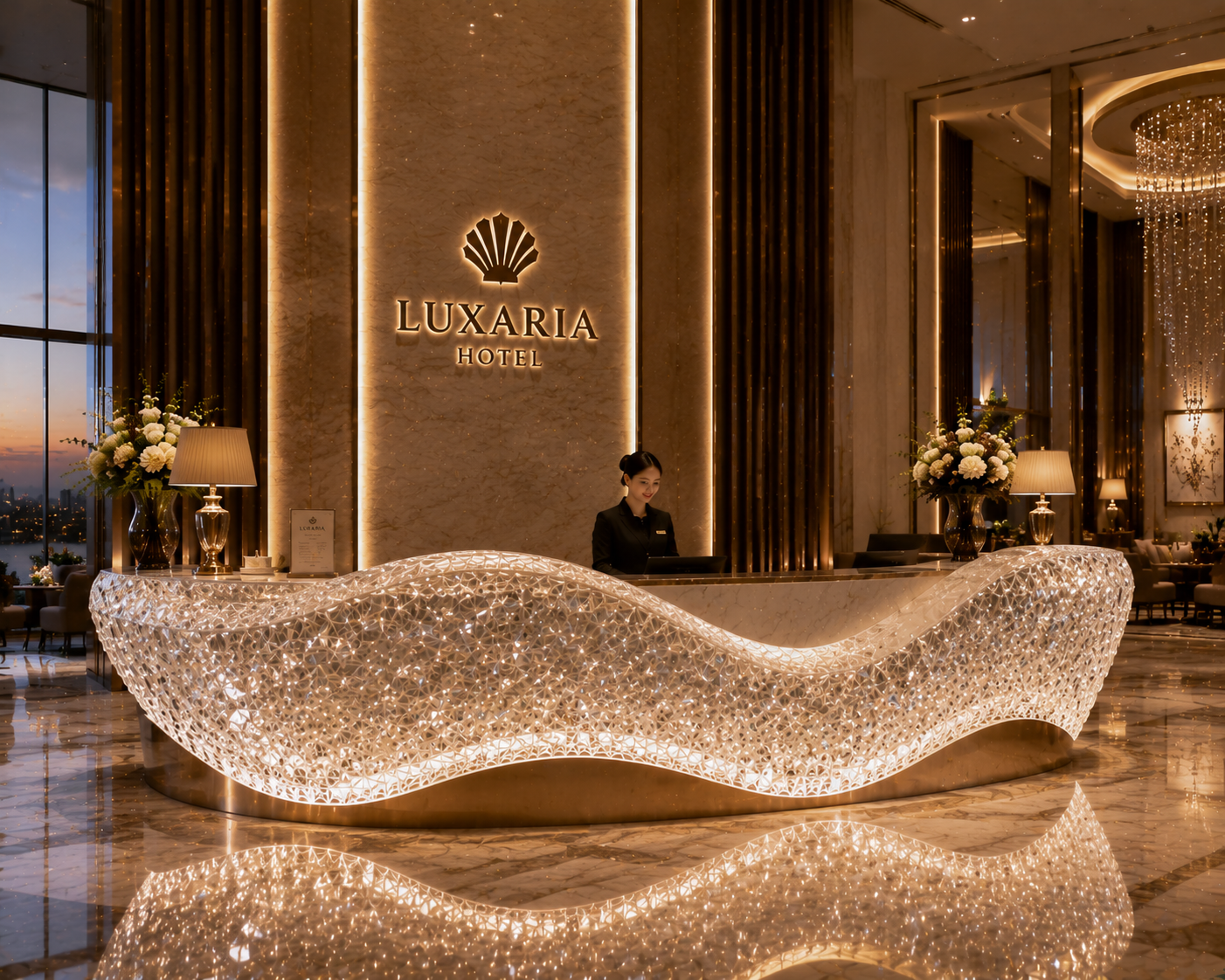
Terms such as “luxury resin,” “premium acrylic” and “synthetic crystal” communicate a market position, but they do not provide enough information for a hotel procurement team. High-traffic furniture should be supported by measurable performance criteria because two products with a similar appearance may behave very differently after repeated use.
The specification should begin with the risks associated with the furniture’s location. A front desk requires resistance to repeated hand contact, luggage impact, writing pressure, spills and cleaning chemicals. A lobby side table may need stronger edge-impact resistance. A transparent decorative console positioned near a window may require greater resistance to ultraviolet exposure and color change. A public seating product must also meet structural and safety requirements appropriate to its intended use.
BIFMA, the trade association for business and institutional furniture manufacturers, maintains standards covering furniture used in public environments. ANSI/BIFMA X5.4-2020, reaffirmed in 2025, applies to public and lounge seating found in reception, waiting, restaurant and gathering spaces. The standard addresses the safety, durability and structural adequacy of this type of furniture. BIFMA also identifies standards for desks and tables, as well as BIFMA X8.1, which addresses furniture-surface durability during cleaning, sanitizing and disinfecting.
These standards illustrate an important purchasing principle: material performance must be evaluated as part of a complete furniture system. A strong acrylic panel will not prevent failure if the joint design is weak. A chemically resistant resin surface will not solve the problem if metal inserts loosen under repeated movement. Likewise, a visually impressive synthetic crystal element may still create maintenance problems if its edges chip easily or cannot be repaired on site.
Hotels should request evidence covering the complete product, including the material formulation, thickness, internal reinforcement, connection method, edge treatment and maximum recommended load. Relevant verification may include chemical-resistance testing, structural-load testing, impact testing, accelerated light exposure, surface-abrasion testing and project-specific fire-performance documentation.
Suppliers should also disclose the limitations of the material. Acrylic and resin products should not be presented as universally scratch-proof or resistant to every cleaning chemical. Performance depends on formulation, surface finish, fabrication quality and operating conditions. Honest documentation allows the hotel to match each material to the correct application.
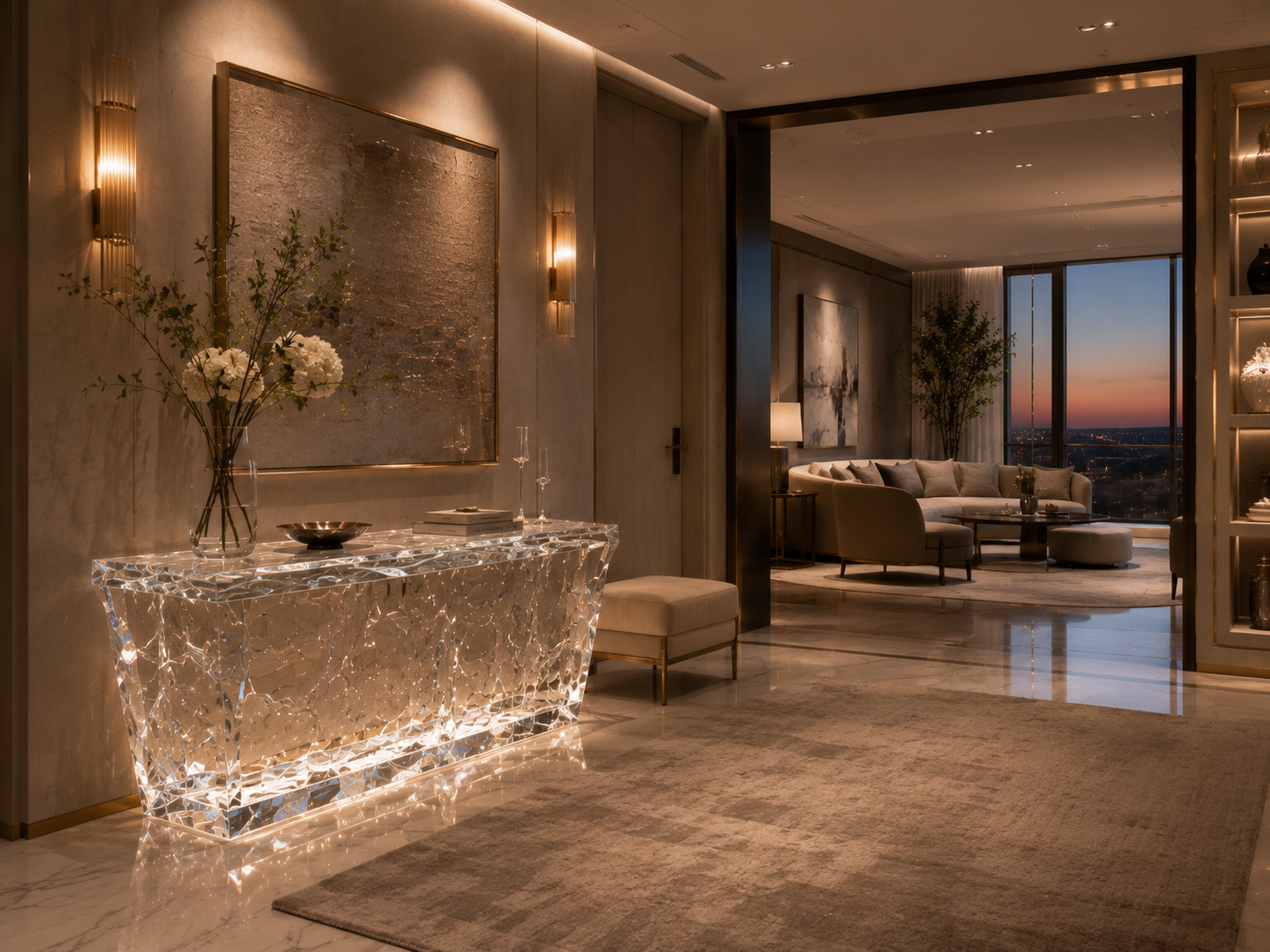
For example, a highly polished transparent surface may be ideal for a low-contact sculptural console but require additional protection when used as a luggage-facing reception counter. The same visual language can be maintained by combining a synthetic crystal feature with a replaceable or more abrasion-resistant work surface. This type of material zoning preserves the luxury appearance while directing the strongest performance to the areas that receive the most wear.
4. Maintaining Visual Quality Without Repeated Replacement
In a hotel lobby, visual deterioration can become an operational problem long before the furniture is structurally unusable. Fine scratches, damaged corners, yellowing, cloudy patches and inconsistent gloss are highly visible under architectural lighting. When several pieces begin to age differently, the space may appear poorly maintained even when every item is still functional.
This is especially relevant to premium hotels because guests interpret environmental details as evidence of value. J.D. Power’s 2025 hotel satisfaction study, based on responses from 39,219 branded-hotel guests, reported that investments in guestroom décor and furnishings contributed to improved satisfaction. The study identified the condition of furnishings and décor as an investment-sensitive area that affected the guest’s perception of the stay. Although the study discusses the broader hotel environment, the same principle is applicable to the lobby, where furniture shapes the guest’s first and final impressions.
Material optimization should therefore focus on visual longevity, not simply physical survival. Hotels need to consider how quickly fingerprints appear, whether minor scratches can be polished, whether damaged components can be removed independently and whether replacement pieces will match the original color.
Synthetic crystal and high-end resin can be molded into distinctive forms that would be difficult to achieve with conventional materials. Premium acrylic can provide clarity, depth and a contemporary luxury character. However, these advantages create a higher expectation of surface perfection. The maintenance plan should be established before installation and should identify approved cleaning cloths, polishing procedures, prohibited chemicals and repair methods.
Furniture design can reduce the visual impact of wear. Patterns, internal textures, controlled translucency and softly radiused edges may conceal minor marks more effectively than completely flat, mirror-like surfaces. Replaceable protective panels can be incorporated into reception counters, while detachable tops or modular bases can allow the hotel to renew the most exposed component without discarding the complete item.
Color consistency is another important issue. The hotel should approve production samples under the actual lighting conditions of the project. Replacement-component tolerances should be documented, particularly for tinted transparent furniture. Batch records and retained reference samples can help the supplier reproduce the original appearance several years later.
By planning for visual maintenance from the beginning, hotels can protect their brand image while avoiding unnecessary replacement. The goal is furniture that continues to look intentionally designed rather than merely old but usable.
5. Calculating Lifecycle Cost Instead of Purchase Price
A lower purchase price does not always create a lower-cost hotel project. The true cost of public-area furniture includes cleaning labor, repair materials, specialist visits, operational disruption, replacement freight, installation and disposal. In some cases, the furniture may also require the temporary closure of part of the lobby, creating inconvenience during peak operating periods.
Lifecycle assessment provides a more suitable framework for evaluating these costs. ISO 14040 defines the principles and structure of lifecycle assessment, including the examination of materials, production, use, maintenance and end-of-life considerations. Although ISO 14040 focuses on environmental assessment, its lifecycle perspective is also useful for commercial decision-making because it prevents procurement teams from concentrating only on the initial transaction.
The European Commission’s Green Public Procurement research on furniture reviewed lifecycle studies and environmental product declarations. It concluded that approximately 80% to 90% of furniture’s environmental impacts can be associated with its materials and components. The research also emphasized that durability and reparability are critical for extending the useful life of furniture and preventing premature disposal.
Hotels can apply the same reasoning by comparing furniture alternatives over a defined service period. A premium acrylic reception feature may have a higher initial price but create a lower lifecycle cost if exposed panels can be replaced independently, minor damage can be repaired, and the furniture remains visually acceptable for a longer period. A cheaper product may become more expensive when damaged laminates, swollen panels or nonreplaceable components force complete replacement.
A lifecycle-oriented quotation should include expected service conditions, warranty coverage, spare-part availability, repair options and cleaning requirements. It should also identify which components are permanent and which are designed as sacrificial or replaceable elements. This information gives the hotel a clearer basis for comparing suppliers.
The U.S. Environmental Protection Agency describes sustainable materials management as the productive use and reuse of materials across their full lifecycle. The EPA notes that products can be redesigned with more durable materials and made easier to disassemble, maintain and return at the end of use.
For synthetic crystal, resin and acrylic furniture, sustainability claims should therefore be supported by longevity, repairability and responsible end-of-life planning. Durability should not be used as an unsupported marketing slogan. The supplier should demonstrate how the furniture can remain in service longer, how damaged sections can be addressed and how material waste can be reduced.
6. Building a Material-Led Maintenance Strategy
The most effective furniture-material strategy is developed jointly by the designer, manufacturer, hotel operator, housekeeping team and engineering department. Each participant understands a different part of the furniture’s lifecycle. Designers control the visual concept. Manufacturers understand material behavior and fabrication. Housekeeping employees know how surfaces are cleaned. Engineers understand common failure points. Operators understand guest traffic and acceptable downtime.
Before production, the hotel should provide information about expected traffic, cleaning products, cleaning frequency, sunlight exposure, luggage contact and the operational role of each item. The manufacturer can then recommend the appropriate synthetic crystal, resin or acrylic formulation, thickness, finish, reinforcement and connection method.
A full-size mock-up is particularly valuable for reception counters and signature lobby pieces. Staff can test the working height, inspect visibility of fingerprints, simulate spills, move luggage against the lower panels and perform repeated cleaning. Problems discovered during the mock-up stage are far less expensive to correct than problems discovered after installation.
After delivery, the supplier should provide a practical maintenance manual written for hotel employees rather than only for technical specialists. The manual should explain daily cleaning, periodic care, prohibited products, stain-response procedures, polishing methods and the correct way to move the furniture. Training should be provided to the employees who actually perform the work.
Maintenance records can then be used to improve future specifications. Hotels can monitor which pieces generate repair calls, which surfaces take the longest to clean and where visible wear first appears. That information allows asset managers to make evidence-based decisions during renovation cycles.
The central principle is straightforward: an optimized furniture material should reduce uncertainty. It should give employees a clear cleaning process, give engineers fewer preventable failures and give management a longer, more predictable replacement cycle.
Synthetic crystal, high-end resin and premium acrylic furniture can play an important role in this strategy. Their value is strongest when visual creativity is combined with documented chemical resistance, structural performance, thoughtful detailing and repair planning. When these elements are considered together, furniture becomes more than a decorative object. It becomes a controlled operational asset that protects the hotel’s appearance while reducing maintenance pressure at the front desk and throughout its public areas.
READ MORE:
- Elevating Hotel Interiors Without Increasing the Budget: Three Ways to Combine High-End Materials
- How High-End Transparent Furniture Can Balance Visual Impact, Structural Stability, and Easy Maintenance
- From "Beautiful" to "Built to Last": How Custom Hotel Furniture Can Balance Design Impact and Long-Term Maintenance
- How Should Hotels Choose Furniture for High-Frequency Areas? Application Strategies for Synthetic Crystal, Premium Resin, and Platinum Acrylic
- Synthetic Crystal Acrylic Furniture: A New Direction for Differentiated Competition in the Future High-End Furniture Market
- Why Are Designers and High-End Clients Paying More Attention to Synthetic Crystal Acrylic?
- Synthetic Crystal Acrylic Furniture: Turning Products from a Functional Choice into an Aesthetic Choice
- From Material Upgrade to Brand Upgrade: New Opportunities Created by Synthetic Crystal Acrylic Furniture
- Synthetic Crystal Acrylic Furniture: Why It Is Becoming a New Symbol of Value in High-End Spaces


