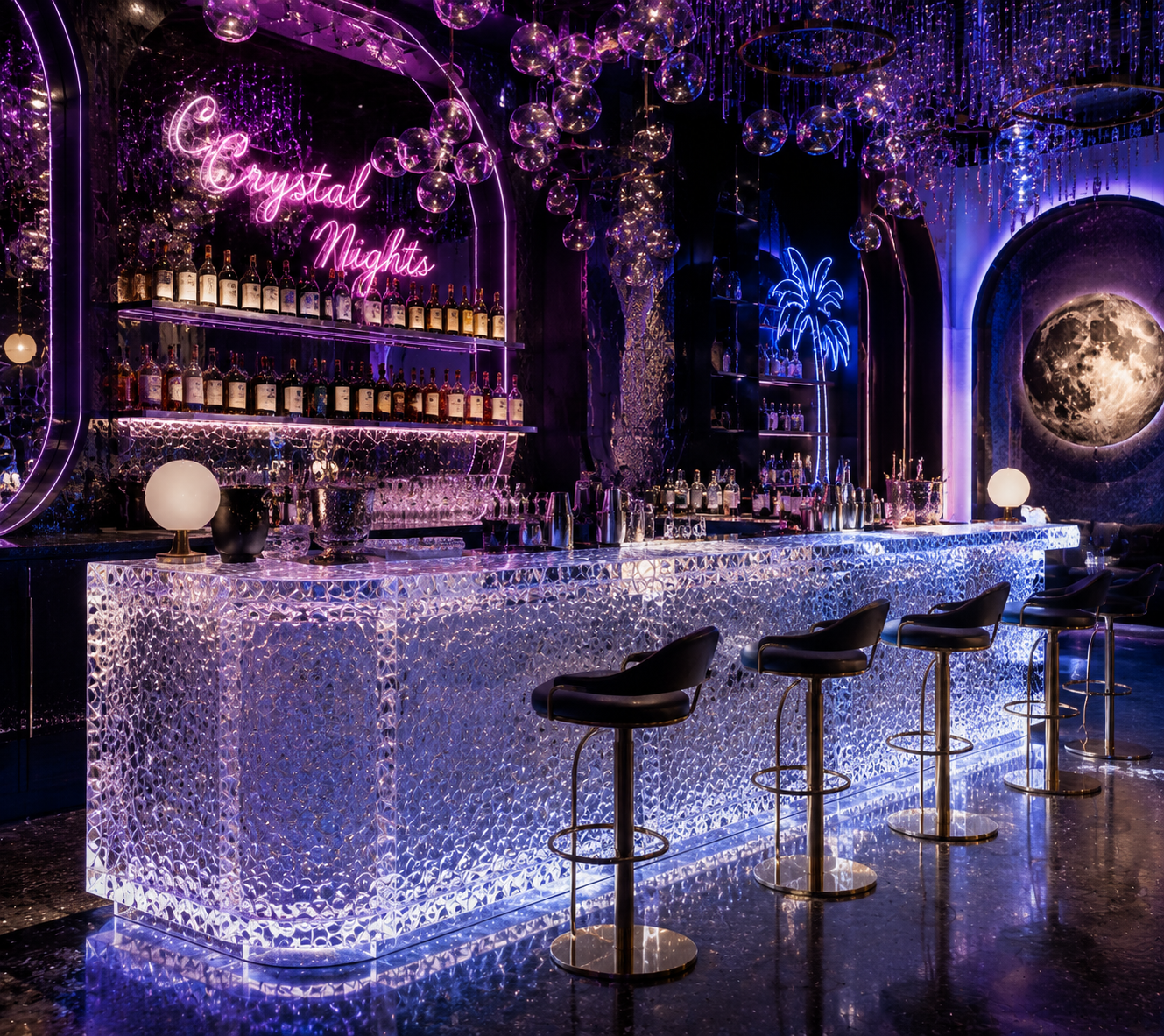
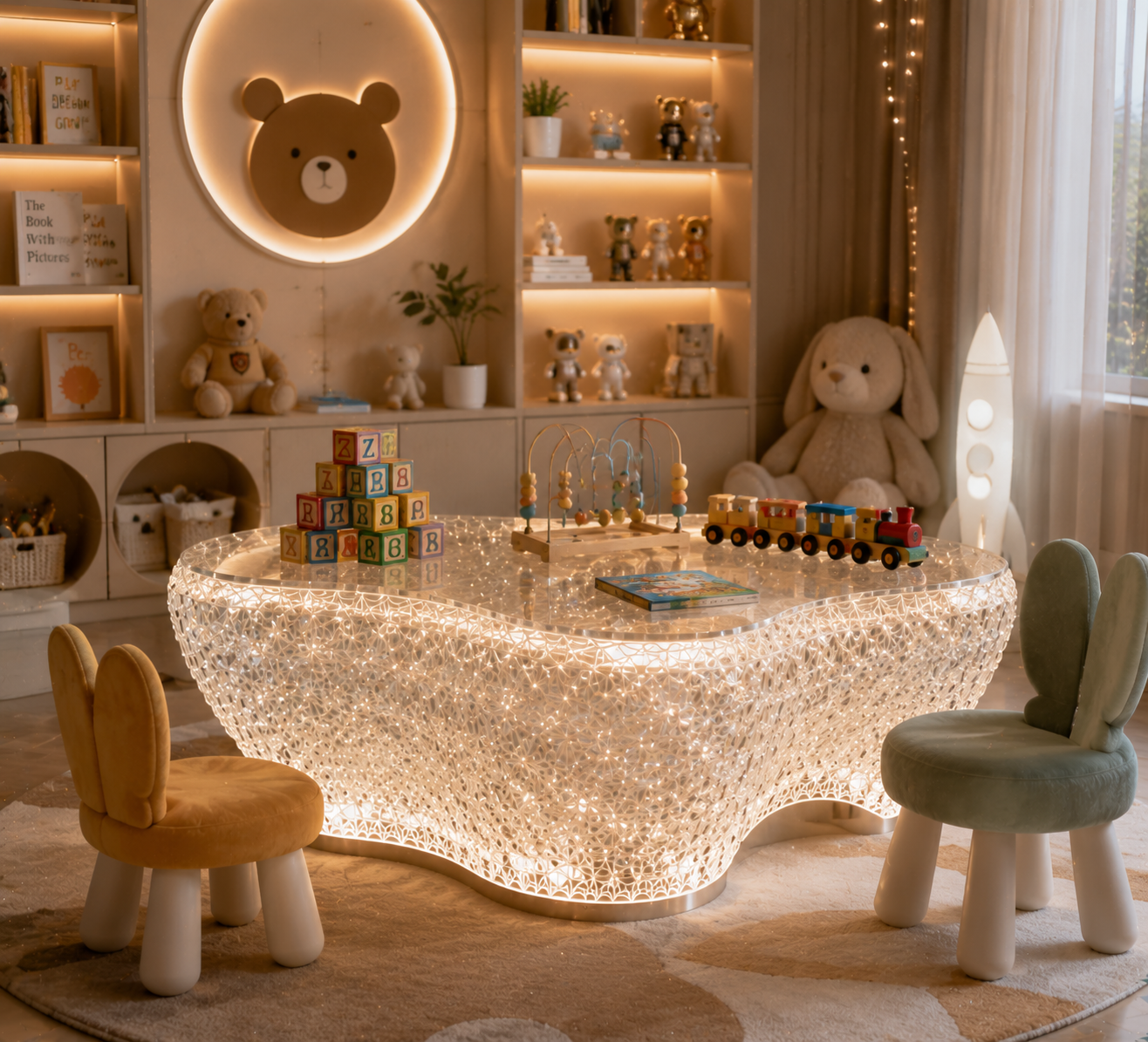
In hotel design, furniture is expected to perform two very different jobs. It must create an immediate emotional response when a guest enters the lobby, suite, restaurant, or spa, but it must also survive years of luggage impacts, beverage spills, sunlight, frequent cleaning, and continuous guest turnover. A piece that photographs beautifully on opening day but becomes scratched, cloudy, loose, or difficult to clean within a year is not successful hotel furniture. It is simply a short-lived visual installation.
This challenge is especially relevant to custom furniture made from synthetic crystal, premium resin, and platinum-grade acrylic. These materials can produce exceptional optical depth, sculptural forms, translucent colours, embedded decorative effects, and seamless surfaces that conventional wood or metal furniture cannot easily achieve. However, their long-term performance depends on formulation, engineering, fabrication, installation, and maintenance—not appearance alone.
For the purpose of this article, “platinum-grade acrylic” refers to premium cast PMMA selected for high optical clarity, colour stability, fabrication quality, and polishability. It is a commercial description rather than a universal technical standard, so hotel owners and designers should always verify the actual material grade, manufacturer data, test results, and warranty.
1. Begin With the Operating Environment, Not the Rendering
The most common mistake in custom hotel furniture is beginning with a beautiful rendering and treating durability as an engineering problem to be solved later. In reality, maintenance requirements should influence the design from the first concept sketch.
A lobby table, for example, may be exposed to coffee, alcohol, hand sanitiser, perfume, luggage wheels, metal handbag hardware, direct sunlight, and several cleaning cycles every day. A sculptural table in a private suite experiences a very different level of contact. Although both pieces may look identical in a rendering, they should not automatically use the same surface specification, edge detail, structural support, or maintenance programme.
The Whole Building Design Guide defines life-cycle cost analysis as a method that considers acquisition, operation, maintenance, repair, replacement, and disposal costs rather than judging an option only by its initial price. It also recommends conducting this analysis early enough for the results to influence design decisions. Although the guidance is written for buildings and building systems, the same principle applies directly to hotel furniture.
Before a material or finish is selected, the project team should therefore identify how frequently the furniture will be touched, what objects will be placed on it, which cleaning chemicals will be used, whether it will receive direct sunlight, and how quickly damaged components must be repaired or replaced.
Consider a transparent acrylic console positioned behind a reception desk. Its apparent simplicity may be central to the interior concept, but a completely exposed base will show every shoe mark and vacuum impact. By slightly recessing the base, strengthening vulnerable corners, and making the lower protective component replaceable, the manufacturer can preserve the floating visual effect while reducing visible damage. The guest sees the same elegant form; the operations team receives a much more practical product.
Design quality in hospitality should therefore be measured not only by how closely the finished piece matches the rendering, but by how successfully it maintains that appearance under real operating conditions.
2. Match Each Material to the Failure It Is Most Likely to Face
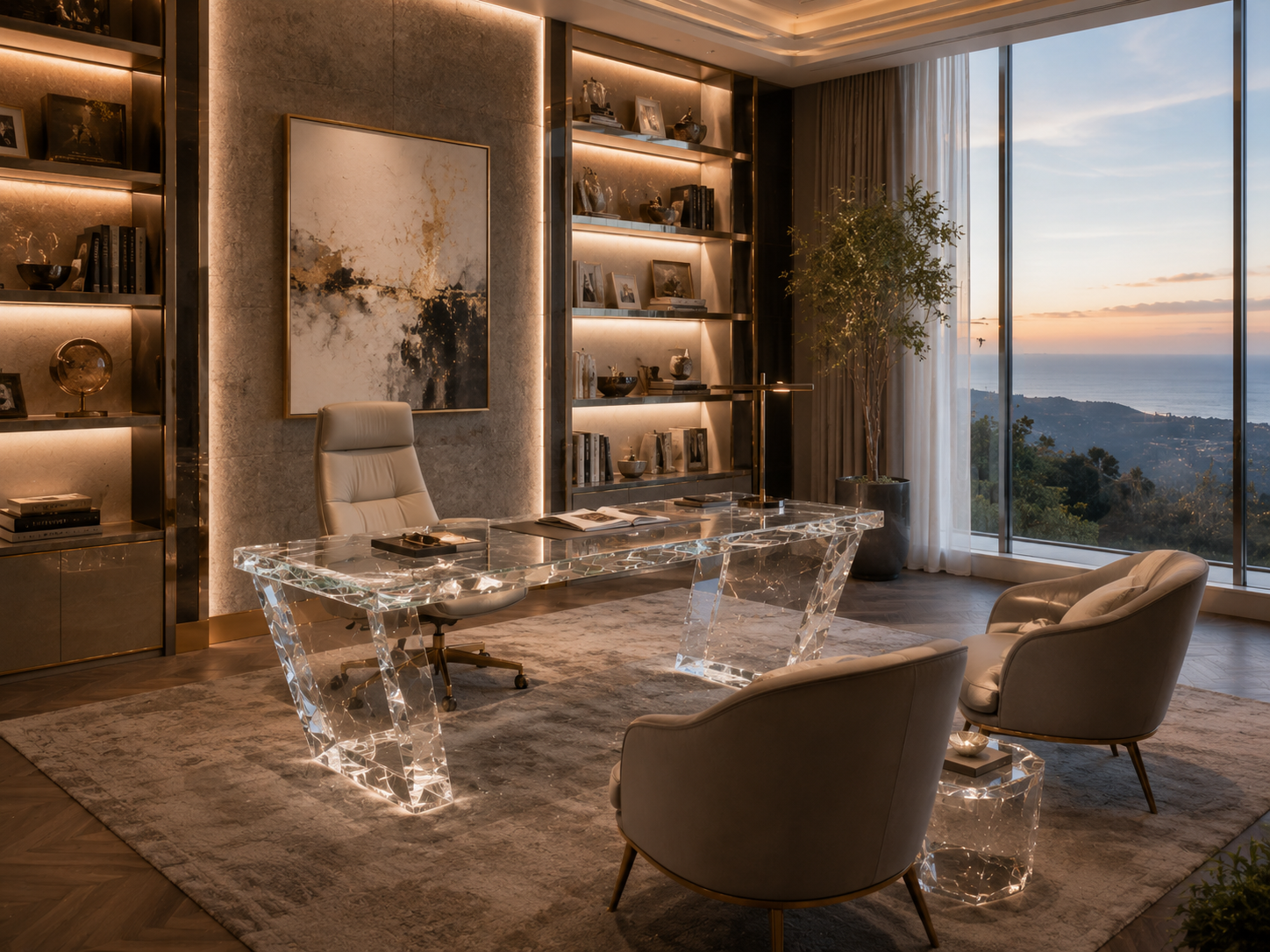
Synthetic crystal, premium resin, and acrylic should not be treated as interchangeable transparent materials. Each offers a different combination of optical performance, weight, fabrication freedom, repairability, chemical resistance, and sensitivity to surface damage.
Premium cast acrylic is particularly effective when a design requires transparency, visual lightness, polished edges, precise machining, or curved forms. Certain clear PLEXIGLAS products, for example, offer light transmission of up to 92 percent, while the manufacturer states that many of its clear transparent products can retain up to 90 percent light transmission after 30 years under the conditions of its product warranty. These figures are product-specific rather than guarantees for every acrylic formulation, but they demonstrate what properly selected PMMA can achieve.
Acrylic’s strength is optical clarity, yet its most visible risk is surface scratching. It can also develop stress cracks or cloudiness when exposed to incompatible solvents, poorly designed joints, excessive fabrication stress, or unsuitable cleaning products. It is therefore well suited to vertical panels, illuminated bases, occasional tables, decorative screens, or protected surfaces, but heavily used horizontal tops may require additional protection or a planned polishing strategy.
Premium resin provides greater freedom for monolithic forms, stone-like appearances, embedded textures, layered colours, and organic curves. Its chemical, heat, and scratch resistance, however, depends heavily on the resin chemistry, additives, pigments, curing conditions, and final coating. Epoxy manufacturers note that highly cross-linked formulations can offer strong chemical and mechanical resistance, but this performance is formulation-specific. A generic statement that “resin is chemical-resistant” is not sufficient for hotel procurement.
Synthetic crystal can create exceptional depth, refraction, suspended inclusions, and jewel-like focal points. For large cast pieces, the manufacturer must control bubbles, colour variation, shrinkage, internal stress, curing temperature, and UV exposure. In many projects, its best use is as a controlled decorative volume, feature leg, illuminated insert, or protected tabletop element rather than an unprotected work surface.
The Conrad Maldives Rangali Island’s underwater residence, THE MURAKA, demonstrates how acrylic can support an extraordinary hospitality experience. Its acrylic tunnel and curved transparent structure are fundamental to the visual concept because the material is matched to a specific optical and environmental function. The lesson for furniture designers is not that acrylic should be used everywhere, but that a material becomes powerful when its performance characteristics directly support the intended experience.
3. Protect the Design Through Engineering, Detailing, and Prototyping
Many maintenance problems blamed on materials are actually caused by poor detailing. A high-quality acrylic sheet can still fail visually if sharp corners are repeatedly struck by luggage. A premium resin table can still crack if the internal frame does not accommodate movement. A beautiful synthetic-crystal component can still become unsafe if its weight is concentrated on an inadequately reinforced connection.
Successful custom furniture protects vulnerable areas without weakening the design language. Corners can be softened with carefully controlled radii. Metal accessories can be recessed so that their edges do not scratch adjacent transparent surfaces. Structural frames can be concealed inside opaque or coloured sections. Bases can be set back from cleaning equipment, while replaceable glides can prevent direct floor contact. Frequently damaged tops, trays, plinths, or edge guards can be designed as separate components rather than permanently bonded parts.
The structural design must also consider how transparent materials reveal construction. Fasteners, adhesive lines, internal supports, cable routes, and uneven joints that would remain hidden inside conventional casegoods may become visible through clear acrylic or translucent resin. This means engineering and aesthetics cannot be separated. The structure itself must be organised as part of the visual composition.
Commercial furniture standards provide a useful benchmark for this process. BIFMA develops standards addressing furniture safety, performance, durability, casegoods, seating, tables, and storage systems. Even when a hotel product does not fall precisely within a particular BIFMA category, the underlying approach—testing completed furniture under repeated loads and realistic use conditions—is preferable to relying only on raw-material data.
Safety testing must also address the complete assembly. UL Solutions notes that furniture and plastic components may need to be evaluated for ignition, flame spread, heat release, strength, and compliance with recognised ASTM, ISO, NFPA, ANSI, or regional standards. A resin or acrylic supplier’s material certificate does not automatically prove that the finished table, headboard, partition, or illuminated furniture assembly meets the project’s safety requirements.
For high-value custom projects, the most reliable approach is to manufacture a full-size prototype or model-room sample. It should be reviewed under the hotel’s actual lighting, handled by housekeeping staff, tested with the intended cleaning products, loaded with realistic objects, and examined from guest sightlines. A prototype is not merely an approval sample; it is an opportunity to discover maintenance problems before they are multiplied across hundreds of rooms.
4. Design the Maintenance System Before the Furniture Leaves the Factory
A material cannot remain beautiful if the people responsible for maintaining it do not know how to care for it. This is particularly important for acrylic and transparent resin surfaces because well-intentioned cleaning with an unsuitable chemical can create more damage than the original stain.
Official PLEXIGLAS care guidance recommends lukewarm water, mild dishwashing detergent, and a soft, lint-free cloth for routine indoor cleaning. It warns against rubbing the surface completely dry because static charge can attract dust and contribute to scratching. The manufacturer also explains that stressed acrylic surfaces can be sanded and polished to remove scratches and restore gloss when appropriate methods are used. ACRYLITE similarly states that fine scratches can be hand-polished, while deeper scratches may require wet sanding and professional buffing.
These recommendations reveal an important advantage: premium acrylic is not necessarily disposable when scratched. In many cases, its appearance can be restored. However, repairability provides value only when the hotel has the correct instructions, materials, trained personnel, and access to professional support.
Every custom furniture package should therefore be delivered with a material-specific maintenance manual. It should identify approved daily cleaners, prohibited chemicals, suitable cloths, stain-response procedures, scratch-repair limitations, load restrictions, and procedures for replacing damaged parts. Small care labels can be placed discreetly beneath furniture, while colour-coded cleaning kits can help housekeeping teams avoid mixing products intended for glass, stone, wood, metal, acrylic, and resin.
The manufacturer should also test the hotel’s actual cleaning chemicals on production samples. A material may perform well with mild detergent but react differently to concentrated disinfectant, alcohol-based products, alkaline degreasers, or citrus solvents. Testing should reproduce repeated exposure rather than a single wipe because cumulative cleaning damage may only appear after dozens or hundreds of cycles.
Imagine a high-gloss transparent bedside table that develops haze after six months. The immediate assumption may be poor material quality, but investigation could reveal that housekeeping has been cleaning it with a standard glass cleaner intended for mirrors. The design was visually successful and the material may have been correctly manufactured, yet the project still failed because the maintenance system was never integrated into procurement.
In hotel furniture, after-sales documentation is therefore part of the product itself.
5. Purchase Verified Performance, Not Just an Attractive Finish Sample
A small finish sample can confirm colour and transparency, but it cannot demonstrate structural stability, long-term UV resistance, joint quality, repairability, chemical compatibility, or consistency across a large production run. Hotel buyers should turn the design concept into measurable acceptance criteria before issuing a final order.
The specification should identify the exact material type and grade, colour tolerance, thickness tolerance, optical requirements, UV-stability expectations, allowable bubble or inclusion levels, edge finish, adhesive system, internal reinforcement, load capacity, cleaning-chemical resistance, and expected repair procedure. It should also define how each requirement will be verified through samples, reports, inspections, or testing.
Indoor environmental quality is another important consideration. The EPA’s Indoor AirPlus guidance prioritises low-emission materials and references chamber-based testing methods for evaluating VOC emissions from interior products and finishes. WELL guidance also addresses furniture and furnishings, requiring qualifying projects to document low-emitting products using recognised standards and test methods. For resin furniture, buyers should assess not only the cured material but also coatings, adhesives, pigments, backing panels, and components added during assembly.
The European Commission’s Green Public Procurement criteria for furniture recommend durable, fit-for-use products that comply with relevant standards, can be repaired and disassembled, have spare parts available, and are supported by an appropriate warranty. The criteria specifically identify premature disposal and difficulty obtaining replacement parts as important sources of furniture waste.
Production scale makes these controls especially important. Industry reporting on the Mandarin Oriental Mayfair project described more than 2,000 bespoke items for 50 rooms and suites, plus over 140 pieces for its spa, restaurants, lounge, and front-of-house areas. At that scale, a slight colour variation, polishing inconsistency, unstable joint, or packaging weakness can become a major operational and financial problem.
Approval should therefore cover the complete production process: master samples, shop drawings, full-size prototypes, batch control, pre-shipment inspection, protective packaging, installation methods, spare components, maintenance kits, and warranty response. A good supplier does not simply reproduce the appearance of a sample. It demonstrates that the same quality can be repeated, transported, installed, cleaned, repaired, and supported throughout the furniture’s intended service life.
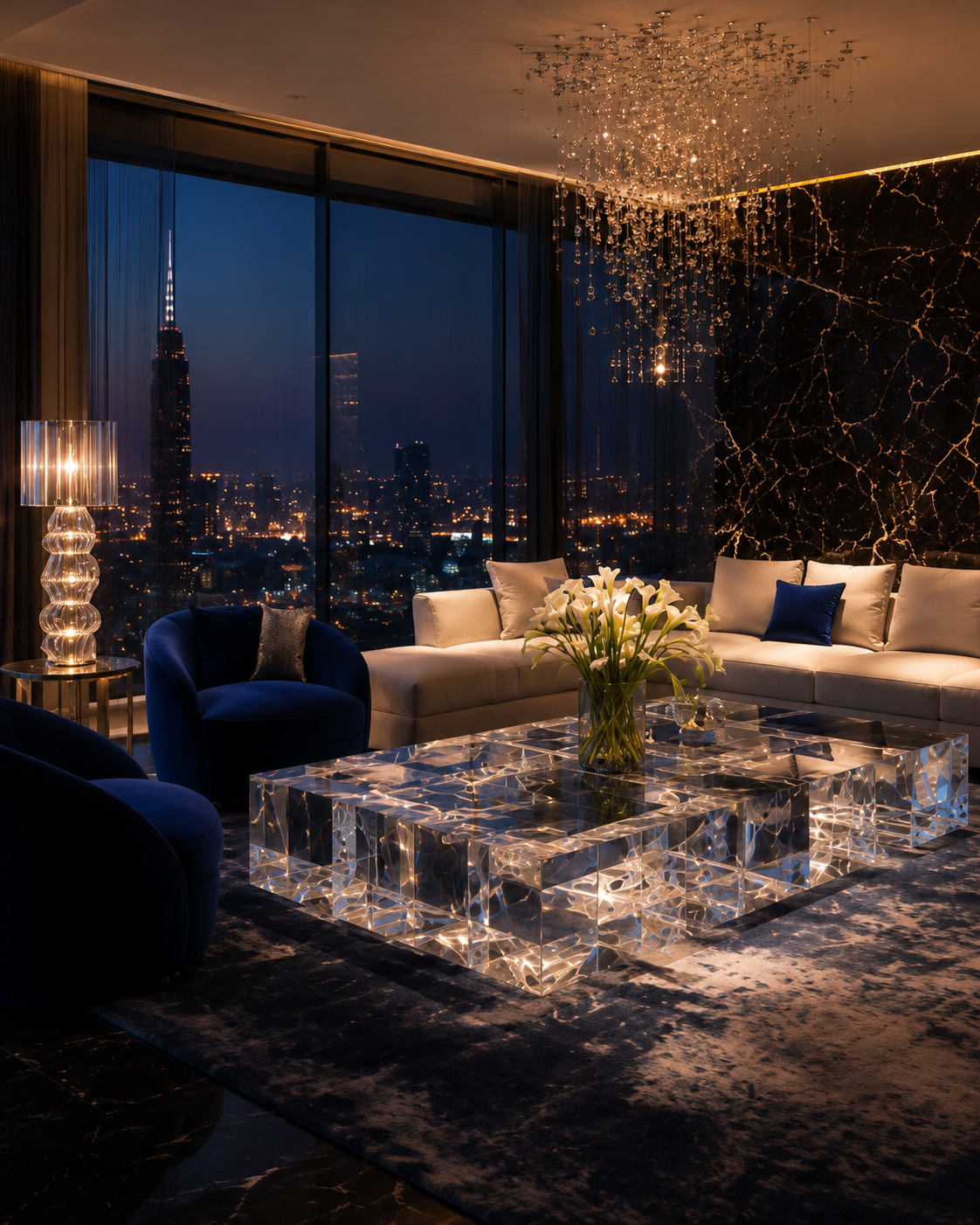
6. Turn Durability Into a Luxury Experience and a Stronger Return on Investment
Durability is sometimes treated as a technical concern that limits creativity. In reality, well-engineered durability protects the luxury experience. Guests may never know the thickness of an acrylic panel or the curing method used for a resin base, but they immediately notice cloudy surfaces, chipped corners, unstable tables, visible repairs, or mismatched replacement pieces.
Furniture that maintains its clarity, colour, geometry, and finish helps a hotel preserve visual consistency across physical spaces, professional photography, social-media content, and guest expectations. It also reduces emergency replacement, room downtime, maintenance labour, shipping costs, and the need to reproduce discontinued custom finishes.
The correct commercial comparison is therefore not “standard furniture versus expensive custom furniture.” It is the total cost of achieving and preserving the intended design over a defined period. A higher-quality transparent table that can be professionally repolished, fitted with a replaceable top, or repaired on site may be more economical than a cheaper product that requires complete replacement after visible damage.
Repairable construction also supports sustainability goals. The European Commission’s furniture criteria connect durability, warranties, disassembly, repair, and spare-parts availability with reduced premature waste. For hotel operators, this means sustainability can be built into the commercial model rather than added as a marketing statement after installation.
The most effective strategy is to create a furniture performance matrix for every project area. Public spaces, restaurants, bars, guestrooms, bathrooms, spas, and outdoor zones should each receive material and engineering specifications based on their distinct exposure levels. Synthetic crystal can provide exceptional decorative depth in controlled feature applications. Premium resin can deliver seamless sculptural forms and customised colour effects when its formulation is tested against real service conditions. Platinum-grade acrylic can create luminous, visually weightless furniture when edge protection, cleaning compatibility, stress control, and future polishing are considered from the beginning.
The transition from “beautiful” to “built to last” does not require sacrificing design ambition. It requires expanding the definition of good design. The most successful custom hotel furniture is visually memorable on the first day, operationally practical during daily service, repairable when normal wear occurs, and still consistent with the hotel’s brand years after opening.
When material selection, engineering, testing, manufacturing, maintenance, and after-sales support are treated as one integrated system, synthetic crystal, high-end resin, and premium acrylic become more than decorative alternatives. They become strategic materials capable of delivering both distinctive hospitality design and dependable long-term value.
READ MORE:
- Elevating Hotel Interiors Without Increasing the Budget: Three Ways to Combine High-End Materials
- How High-End Transparent Furniture Can Balance Visual Impact, Structural Stability, and Easy Maintenance
- Reducing Maintenance Pressure at Hotel Front Desks and Public Areas Through Smarter Furniture Materials
- How Should Hotels Choose Furniture for High-Frequency Areas? Application Strategies for Synthetic Crystal, Premium Resin, and Platinum Acrylic
- Synthetic Crystal Acrylic Furniture: A New Direction for Differentiated Competition in the Future High-End Furniture Market
- Why Are Designers and High-End Clients Paying More Attention to Synthetic Crystal Acrylic?
- Synthetic Crystal Acrylic Furniture: Turning Products from a Functional Choice into an Aesthetic Choice
- From Material Upgrade to Brand Upgrade: New Opportunities Created by Synthetic Crystal Acrylic Furniture
- Synthetic Crystal Acrylic Furniture: Why It Is Becoming a New Symbol of Value in High-End Spaces


