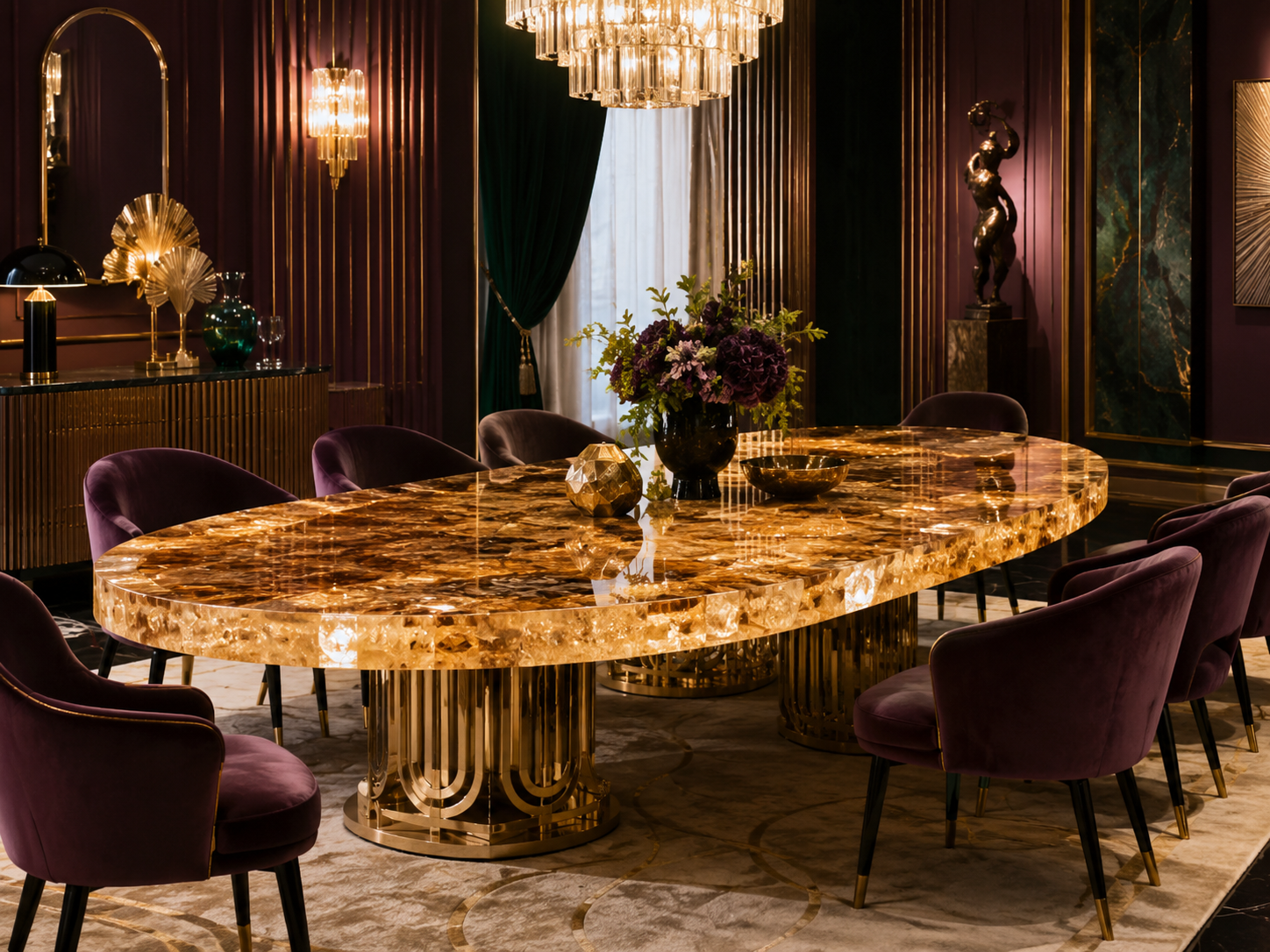
Introduction: The New Meaning of Luxury Furniture
Luxury furniture was once primarily associated with rare wood, natural stone, hand-carved decoration, precious metal, and traditional craftsmanship. These materials still retain considerable value, but the expectations of high-end customers are changing. Today, luxury is not defined by historical materials alone. It is increasingly defined by design intelligence, material performance, manufacturing precision, visual originality, and the ability of a product to retain its beauty over time.
This change has created new opportunities for synthetic crystal acrylic furniture.
Premium acrylic furniture can appear light, transparent, contemporary, and almost invisible within a space. It can create the impression that a tabletop is floating, that a chair is formed from light, or that a display structure has no visual boundaries. Its transparency allows surrounding architecture, artwork, textiles, flooring, and lighting to remain visible. For interior designers, this quality makes acrylic furniture an effective tool for controlling visual weight.
However, high-end customers are becoming more selective. They understand that not all transparent furniture has the same quality. A product may look attractive in a photograph but reveal cloudy surfaces, visible joints, unstable structures, sharp edges, internal stress marks, bubbles, scratches, or yellowing after continued use.
For this reason, material value has become a central purchasing consideration.
Material value refers to more than the cost of raw acrylic. It includes the optical quality of the sheet, the purity of the material, thickness accuracy, structural properties, resistance to aging, processing difficulty, craftsmanship, safety, customization potential, maintenance performance, and usable lifespan. In premium furniture, the material and the manufacturing process cannot be separated. Excellent raw material requires excellent processing, while sophisticated craftsmanship cannot fully compensate for inferior material.
The growing interest in material value reflects a more mature understanding of luxury. High-end clients are not simply asking whether a piece looks expensive. They are asking why it deserves to be considered valuable.
1. Luxury Is Shifting from Surface Appearance to Material Credibility
The luxury market is moving away from purely decorative consumption. High-end customers are more informed, more design-conscious, and more willing to investigate how a product is made. They often compare materials, request samples, ask about production methods, examine edge quality, and evaluate how a product will perform in a real environment.
This behavior is especially visible in custom residential projects, luxury hotels, designer boutiques, premium offices, private clubs, galleries, and branded commercial spaces. In these environments, furniture must support a complete design concept. A visually impressive piece that deteriorates quickly can damage the perceived quality of the entire project.
Material credibility has therefore become essential.
For acrylic furniture, credibility begins with the grade and consistency of the material. Premium cast acrylic typically offers greater optical clarity, better thickness control, improved processing possibilities, and a more refined surface than low-grade alternatives. When viewed from the front, many transparent materials may initially appear similar. The difference becomes more visible at the edges, around curved areas, near bonded joints, and under strong lighting.
High-quality acrylic can produce a clear, luminous edge after precision polishing. Inferior material may appear slightly grey, blue, cloudy, or uneven. It may contain impurities, surface ripples, internal marks, or inconsistencies that become obvious in a premium interior.
High-end customers also pay attention to touch. Luxury furniture is experienced physically, not only visually. The edge should feel smooth and carefully finished. The structure should remain stable when used. A chair should not flex unexpectedly. A console should not vibrate under light pressure. A tabletop should communicate solidity even when its appearance is delicate.
These details influence the emotional response to a product.
When a customer touches a polished acrylic surface and observes a flawless transition between planes, the furniture feels intentional and controlled. When edges are rough or joints are visible, the piece may feel temporary or mass-produced. The material may be expensive, but the product does not communicate value.
Material credibility also affects trust between designers, suppliers, contractors, and clients. A high-end project may involve significant budgets, strict schedules, and exact specifications. Designers need confidence that the final furniture will match approved samples and drawings. Clients need confidence that the product will remain visually consistent after installation.
As a result, premium buyers increasingly request information about material thickness, production tolerances, maximum loading, bonding techniques, polishing standards, packaging, installation, maintenance, and warranty conditions. These are not merely technical questions. They are part of the luxury purchasing decision.
The modern luxury customer is attracted by beauty, but convinced by evidence.
2. Crystal-Like Transparency Creates a Distinctive Spatial Experience
The most recognizable quality of acrylic furniture is transparency. Yet transparency is not simply the absence of color. In a high-end interior, it becomes an active design element.
Transparent furniture reduces visual obstruction. A solid cabinet, table, or chair occupies physical space and visual space at the same time. Acrylic furniture still performs a physical function, but its visual presence can be significantly lighter. This makes it especially valuable in compact luxury apartments, open-plan residences, hotel suites, galleries, boutiques, reception areas, and spaces containing decorative flooring or architectural details that should remain visible.
A crystal-clear acrylic console placed against a feature wall does not compete heavily with the wall finish. A transparent coffee table allows a patterned rug to remain visually dominant. Acrylic dining chairs can provide seating without making a dining area appear crowded. Display plinths can support products while minimizing distraction.
This ability to preserve visual continuity has strong material value.
The difference between premium acrylic and ordinary transparent plastic becomes particularly important under natural and artificial light. High-grade acrylic can transmit light with exceptional clarity, creating clean reflections and luminous edges. When polished correctly, thicker sections can produce a jewel-like appearance. Curved surfaces can bend light gently, while beveled edges can create controlled highlights.
Designers can use these optical effects deliberately.
Acrylic furniture may appear almost invisible in soft daylight and become more expressive under directional evening lighting. Integrated lighting can illuminate edges, engraved patterns, internal objects, or colored layers. Frosted and transparent areas can be combined to produce depth and contrast. Tinted acrylic can introduce color without the heaviness of painted wood or stone.
This versatility explains why acrylic is used in both minimalist and highly decorative interiors. In minimalist spaces, it supports simplicity and openness. In glamorous spaces, it provides brilliance, reflection, and theatricality. In retail environments, it directs attention toward products. In art-focused interiors, it can function as a neutral support for sculpture or collectible objects.
High-end clients increasingly recognize that optical quality is a measurable aspect of material performance. They look for clarity across broad surfaces, consistency through thick edges, smoothness around bends, and clean reflections without visual distortion.
Low-quality acrylic may technically be transparent, but it may not provide the same spatial effect. Minor haze, waviness, internal stress, poor polishing, or visible adhesive can interrupt the illusion of purity. These imperfections are particularly noticeable because transparent furniture has little ability to hide manufacturing errors.
A wooden product can conceal internal joints beneath veneer, paint, or upholstery. A transparent acrylic product reveals almost everything. Every cut, bond, curve, and edge remains exposed.
This transparency creates both opportunity and risk. It allows skilled manufacturers to display exceptional craftsmanship, but it also exposes shortcuts immediately.
For high-end clients, crystal-like clarity is not a superficial decoration. It is evidence of material selection, engineering control, and manufacturing precision. The clearer the design appears, the more disciplined the production process must be.
.png)
3. Material Quality Determines Durability, Safety, and Daily Performance
Acrylic furniture is often selected for its visual lightness, but it must still perform as functional furniture. A dining table must support weight. A chair must withstand repeated use. A console must remain level. A shelf must resist deflection. A display structure must protect valuable objects. A hospitality installation must tolerate frequent cleaning and contact.
Material quality directly influences these functions.
Thickness is one of the most visible factors, but thickness alone does not guarantee performance. The design must consider span, load distribution, support position, joint construction, bending radius, material orientation, and the behavior of acrylic under long-term stress. A thick but poorly designed panel may still bend or crack. A thinner component with intelligent structural support may perform reliably.
Premium manufacturers evaluate acrylic furniture as an engineered product. They do not simply cut transparent sheets into attractive shapes.
Structural calculations and physical testing may be necessary for large tables, benches, shelving systems, suspended elements, or commercial installations. The manufacturer must understand where stress will accumulate and how the material responds to temperature changes, impact, and continuous loading.
Annealing can also be important. Cutting, drilling, polishing, bending, and bonding may introduce internal stress. If this stress is not controlled, cracking may occur later, especially around holes, corners, or bonded areas. Proper production procedures reduce this risk and improve long-term stability.
Safety is equally important.
Acrylic is often preferred over glass in environments where impact resistance and reduced breakage risk matter. It is lighter than glass and does not break in the same way. However, this does not mean every acrylic design is automatically safe. Furniture still requires appropriate edge finishing, stable geometry, reliable joints, suitable thickness, and correct installation.
High-end clients are particularly sensitive to these issues because their spaces may contain children, guests, hotel users, retail customers, or valuable merchandise. A visually elegant product must not create hidden risks.
Surface behavior is another major consideration. Acrylic can scratch if cleaned incorrectly or exposed to abrasive objects. Premium customers increasingly ask how easily a surface can be maintained, repaired, or repolished. The answer depends on the material grade, finish, application, and maintenance instructions.
Acrylic has an advantage in that certain minor surface marks can often be reduced through professional polishing. This can extend the visual life of the furniture. By comparison, damage to some coated, laminated, or printed surfaces may be difficult to repair without replacing the entire component.
Resistance to yellowing is also frequently discussed. High-quality acrylic formulated for appropriate interior or exterior conditions can maintain clarity for a long period, while lower-grade transparent plastics may change color or become brittle more quickly. Actual performance depends on material formulation, UV exposure, environmental conditions, cleaning chemicals, and manufacturing quality.
This is why sophisticated buyers avoid evaluating acrylic furniture by appearance alone. Two products with similar photographs can have very different long-term outcomes.
The higher-priced product may use carefully selected cast acrylic, greater material thickness, stress-controlled processing, precision bonding, stronger packaging, and stricter inspection. The lower-priced version may reduce costs through thinner panels, inconsistent raw material, limited polishing, simpler joints, or inadequate quality control.
Material value becomes visible over time. At the moment of purchase, both pieces may appear transparent. After repeated use, cleaning, transport, sunlight exposure, and environmental changes, their differences become much clearer.
4. Advanced Craftsmanship Converts Acrylic into a Luxury Product
Raw acrylic sheet is not automatically a luxury material. Its final value depends on how it is transformed.
Cutting is the first critical stage. Accurate cutting determines dimensional consistency and affects later assembly. Poor cutting can create chipped edges, heat damage, uneven lines, or inaccurate angles. In custom furniture, even small deviations may prevent parts from aligning correctly.
After cutting, edges require careful finishing. Depending on the intended appearance, manufacturers may use machine polishing, flame polishing, diamond polishing, hand polishing, or a combination of methods. Each technique creates a different result and must be selected according to material thickness, geometry, production quantity, and quality expectations.
For premium furniture, the goal is not simply to make the edge smooth. The edge should appear optically clear, consistent, and free from distracting marks. On thick acrylic, a well-polished edge can become one of the most visually valuable parts of the product.
Bonding is even more demanding.
Transparent furniture exposes the joint. Excess adhesive, bubbles, misalignment, dust, fingerprints, or uneven bonding lines can reduce the quality of the entire piece. Successful bonding requires clean surfaces, controlled application, precise fixtures, suitable adhesive chemistry, experienced technicians, and sufficient curing time.
High-end clients often prefer joints that appear nearly invisible. Achieving this effect involves much more than applying glue. The components must fit accurately before bonding. The workspace must remain clean. The adhesive must flow consistently. Internal stress must be managed. The assembly must stay correctly positioned throughout curing.
Bending and forming create additional complexity. Acrylic can be heated and shaped into curves, but temperature control is essential. Uneven heating can cause distortion, bubbles, surface marks, or inconsistent curves. The bending process must account for sheet thickness, bend radius, heating time, cooling method, and final structural requirements.
Large sculptural pieces may require specialized molds, ovens, jigs, and repeated prototyping. A simple-looking curved chair or waterfall console may represent many hours of engineering and manual refinement.
Drilling and hardware installation also demand precision. Holes must be positioned accurately and designed to reduce stress concentration. Metal fittings should not place uncontrolled pressure on acrylic surfaces. Protective components, washers, inserts, and carefully specified tolerances may be necessary.
Final inspection completes the transformation. Premium furniture should be checked for dimensions, stability, surface quality, edge clarity, joint consistency, scratches, dust, protective film condition, and packaging readiness.
Packaging itself is part of craftsmanship.
Transparent acrylic surfaces can be damaged during transportation if protection is insufficient. Custom foam, soft wrapping, corner protection, rigid crates, handling labels, and clear unpacking instructions may be required. For international projects, packaging must also account for vibration, stacking, humidity, repeated handling, and customs inspection.
These processes explain why premium acrylic furniture cannot be evaluated by raw material price alone. The raw sheet may represent only one part of the total value. Skilled labor, specialized equipment, prototyping, engineering, quality control, and packaging all contribute to the finished result.
High-end customers increasingly understand this relationship. They are willing to pay more when craftsmanship is visible in every detail and when the supplier can explain how quality is achieved.
Luxury is not created by complexity for its own sake. It is created when complex work produces an effortless result.
5. Customization and Material Innovation Support Exclusive Interiors
Exclusivity is one of the strongest drivers of high-end furniture purchasing. Premium clients often want pieces that respond to a particular room, architectural detail, brand identity, artwork collection, or lifestyle requirement.
Acrylic is highly suitable for customization because it can be cut, polished, bent, bonded, engraved, printed, frosted, tinted, illuminated, laminated, and combined with other materials.
A custom acrylic table may be designed to match the exact dimensions of a seating arrangement. A transparent console may fit around an architectural column. A display pedestal may be proportioned for a specific sculpture. A boutique fixture may integrate brand colors, lighting, product storage, and security features. A hotel installation may require repeated units with consistent quality across multiple locations.
Material innovation expands these possibilities.
Clear acrylic can be combined with tinted layers, metallic details, wood, stone, glass, fabric, leather, or integrated LED systems. Embedded objects, decorative films, mesh, pigments, printed patterns, and textured surfaces can create highly distinctive effects.
For luxury residential interiors, customization allows furniture to complement rather than compete with valuable surroundings. The acrylic may be nearly invisible, allowing artwork and architecture to dominate. Alternatively, a colored or sculptural acrylic piece may become the focal point of the room.
For commercial clients, material customization supports brand communication. A beauty retailer may use soft tinted acrylic to create a clean, luminous atmosphere. A jewelry brand may choose crystal-clear display structures that maximize product visibility. A technology company may prefer precise transparent forms that suggest innovation. A hospitality group may use illuminated acrylic details to create memorable guest experiences.
High-end clients also value dimensional flexibility. Standard furniture is designed for average spaces. Luxury interiors are rarely average. They may include unusual ceiling heights, curved walls, narrow circulation routes, oversized rooms, or highly specific furniture layouts.
Custom acrylic production can respond to these conditions, but it requires close communication among designers, engineers, project managers, and manufacturers. Drawings must clarify dimensions, tolerances, material thickness, finishes, loading, joints, hardware, lighting, installation, and packaging.
Samples and prototypes can be especially important. Transparency, tint, edge polish, and lighting effects may look different in physical form than on a digital screen. A small material sample allows clients to evaluate clarity and color, while a prototype can confirm proportions, stability, and assembly details.
This collaborative process adds to material value. The customer is not purchasing only an object. The customer is purchasing design development, technical interpretation, material expertise, and manufacturing capability.
The more complex the customization, the more important the supplier’s experience becomes.
A manufacturer must know when an idea is technically feasible, when structural reinforcement is necessary, when a bend radius should be adjusted, when material thickness should increase, and when a different joining method will create a better result. The best suppliers do not simply follow drawings. They help improve them.
This is particularly valuable in high-end projects, where a small technical decision can significantly influence visual quality, safety, delivery time, and installation success.
.png)
6. Material Value Strengthens Brand Image and Long-Term Investment Value
High-end clients increasingly evaluate furniture as a long-term investment rather than a short-term decorative purchase. This does not mean every item must last forever, but it should provide appropriate value throughout its intended lifecycle.
Material value contributes to this investment in several ways.
First, premium acrylic furniture can remain visually relevant because transparency is adaptable. Clear furniture works with many colors, textures, and decorative styles. A transparent table can remain suitable even when surrounding rugs, sofas, artwork, or wall finishes change. This flexibility can extend the useful design life of the piece.
Second, high-quality construction reduces replacement risk. Furniture that remains stable, clear, and repairable may offer better long-term value than a lower-cost product that quickly scratches, deforms, discolors, or fails at the joints.
Third, distinctive material quality strengthens brand perception. In luxury hotels, boutiques, showrooms, and offices, furniture communicates the standards of the organization. Customers may not know the technical grade of the acrylic, but they notice clarity, precision, stability, and finish. These qualities influence their overall impression of the space.
A premium retail display can make products appear more valuable. A carefully made reception desk can communicate professionalism. A transparent conference table can create a modern, open atmosphere. A sculptural acrylic installation can become a recognizable visual signature.
Material value therefore supports commercial value.
Sustainability is also becoming part of the discussion. High-end customers are asking more questions about product lifespan, material efficiency, repair options, responsible manufacturing, packaging, and end-of-life considerations. Acrylic is a synthetic material, so its environmental value must be evaluated honestly and practically.
A durable product that remains in use for many years may have a different lifecycle impact from a low-quality product that is replaced frequently. Efficient cutting plans can reduce manufacturing waste. Careful design can allow components to be repaired or replaced. Protective packaging can reduce shipping damage and unnecessary remanufacturing. Some acrylic materials may also enter specialized recycling systems, depending on local infrastructure and material type.
The most credible sustainability strategy is not based on vague claims. It is based on measurable improvements in durability, production efficiency, maintenance, repairability, and responsible material handling.
Emotional longevity matters as well.
High-end customers keep objects that continue to feel meaningful. A custom acrylic table designed for a particular home, a display case created for a private collection, or a sculptural chair associated with a memorable project may retain value beyond basic function.
This emotional connection is strengthened by originality and craftsmanship. A generic transparent product can be replaced easily. A distinctive piece with exceptional proportions, precise detailing, and a clear design story is more likely to be preserved.
For this reason, high-end clients increasingly ask about the story behind the material. They want to know how the product was developed, why a particular thickness was chosen, how the joints were created, what makes the surface special, and how the piece should be maintained.
These questions transform furniture from a commodity into a considered design object.
Conclusion: Material Value Is Becoming the New Standard of Acrylic Luxury
The rising interest in synthetic crystal acrylic furniture is not driven by transparency alone. It reflects a broader transformation in the luxury furniture market.
High-end customers are becoming more knowledgeable and more demanding. They expect beauty, but they also expect evidence of quality. They want furniture that looks refined from every angle, performs reliably, supports customization, complements sophisticated interiors, and retains its visual value over time.
Premium acrylic responds to these expectations through optical clarity, structural versatility, lightness, design flexibility, and compatibility with advanced manufacturing. Yet the success of the final product depends on the complete chain of value: raw material selection, engineering, cutting, polishing, bending, bonding, assembly, inspection, packaging, installation, and maintenance.
This is why the phrase “material value” has become so important.
Material value explains why two transparent tables can have dramatically different prices. It explains why a flawless joint matters, why edge clarity matters, why thickness consistency matters, and why professional manufacturers invest in specialized equipment and skilled technicians.
For high-end clients, the best acrylic furniture does not feel like a substitute for glass, wood, or crystal. It establishes its own material identity.
It can be visually quiet or highly expressive. It can disappear into a room or become its central sculpture. It can support art, products, lighting, hospitality experiences, brand stories, and private lifestyles. Most importantly, it can combine contemporary aesthetics with credible technical performance.
As luxury moves away from surface decoration and toward informed appreciation, premium acrylic furniture will increasingly be judged by what lies behind its appearance: purity, precision, engineering, craftsmanship, and longevity.
In that context, material is no longer merely the substance from which furniture is made.
Material itself becomes part of the design, part of the experience, and part of the value.
READ MORE:
- Future Furniture Design Trends: How Synthetic Crystal Acrylic Connects Aesthetics with Commercial Value
- Synthetic Crystal Acrylic Furniture: Why Is It Becoming a Highlight Choice in Designer Projects?
- Synthetic Crystal Acrylic Furniture: Creating High-End Market Differentiation Through Unique Transparency
- From Spatial Decoration to Visual Focal Point: The Changing Role of Synthetic Crystal Acrylic Furniture
- Elevare il valore percepito di un mobile senza accumulare materiali costosi: la vera chiave è la combinazione materica
- Dal render alla realtà: i 5 errori più comuni nella scelta dei materiali per mobili di alta gamma
- COME PUÒ UN PROGETTO DI ARREDAMENTO DI ALTA GAMMA CONCILIARE TRASPARENZA, DURATA E QUALITÀ DEL RISULTATO FINALE?
- Natural Stone, Glass, or Synthetic Crystal? How to Choose the Right Material for Every Space
- Arredamento di alta gamma: estetica e durata devono davvero escludersi?


