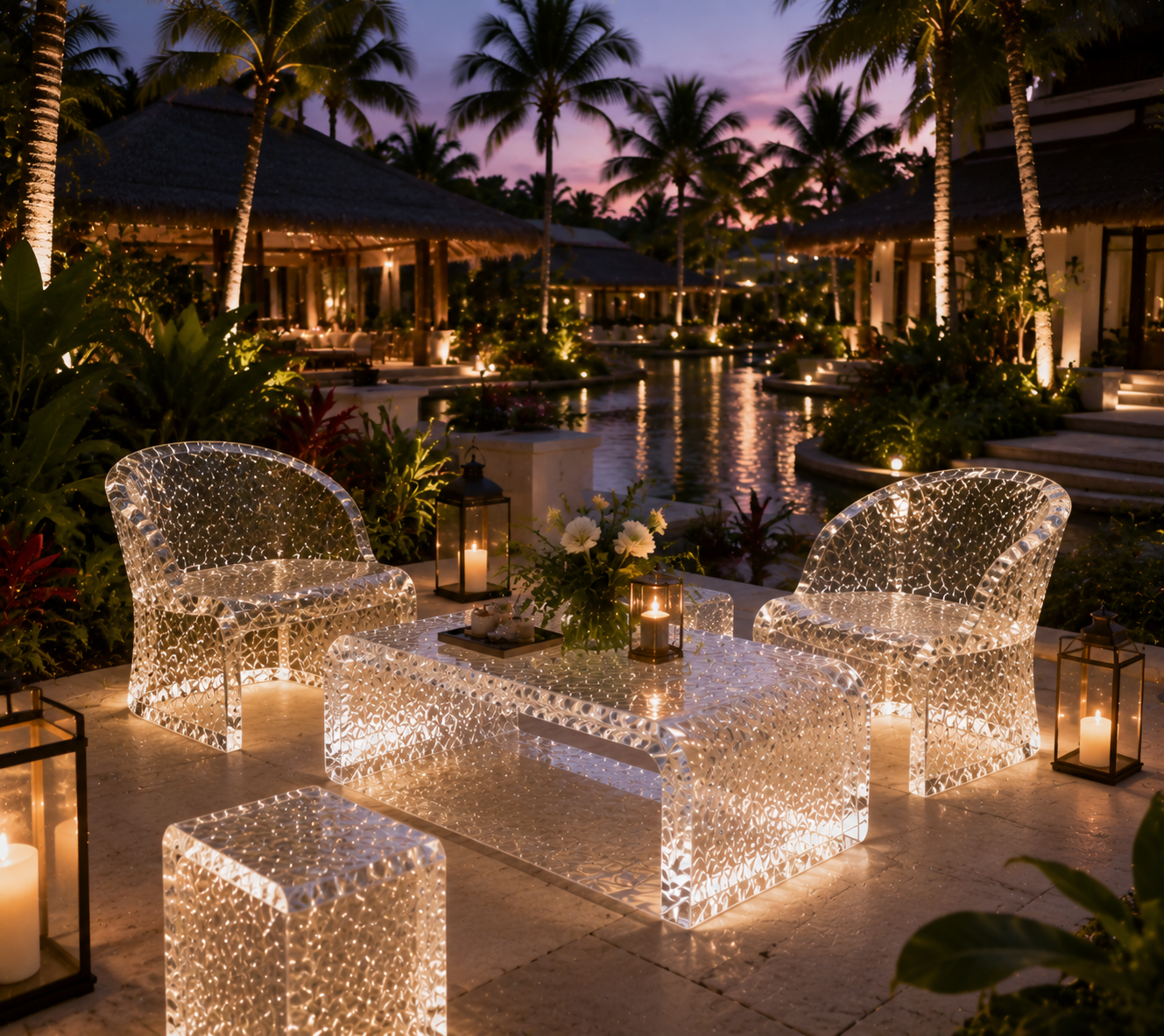
Introduction: A Material That No Longer Wants to Disappear
For many years, transparent acrylic furniture was praised for its ability to disappear.
Interior designers used clear acrylic chairs, tables, consoles, and display stands when they wanted to preserve visual openness. Because the material allowed light, color, flooring, walls, and surrounding furniture to remain visible, it was considered an ideal solution for small rooms, crowded layouts, or interiors with strong decorative features.
Its role was supportive rather than dominant.
A clear acrylic coffee table could provide a practical surface without blocking a patterned rug. Transparent dining chairs could offer seating without making the room appear heavy. An acrylic console could stand against a decorative wall while allowing the wall treatment to remain visible. In galleries and boutiques, transparent pedestals could support art or products without competing for attention.
This quality remains valuable, but it no longer represents the full identity of acrylic furniture.
Today, synthetic crystal acrylic is increasingly moving from the background to the center of the room. Designers are using thicker materials, stronger proportions, intense colors, sculptural curves, layered structures, integrated lighting, embedded objects, and highly polished surfaces to create furniture that immediately attracts attention.
Instead of asking how acrylic furniture can become visually invisible, designers are now asking how it can become unforgettable.
This shift reflects several larger changes in interior design. Contemporary clients want spaces that feel individual rather than generic. Luxury is becoming more experimental. Furniture is expected to communicate identity, provide memorable visual moments, and perform as part of a complete spatial narrative.
At the same time, acrylic manufacturing has become more sophisticated. Advanced cutting, bending, bonding, polishing, printing, laminating, and lighting technologies have expanded the creative possibilities of the material. Shapes that were once difficult or expensive to produce are becoming more practical. Designers can now treat acrylic not only as a transparent sheet, but as a flexible medium for creating optical and sculptural effects.
As a result, synthetic crystal acrylic furniture is entering a new stage of development.
It is no longer only a practical solution for visual openness. It is becoming a design language, a brand tool, a collectible object, and a focal point capable of defining the emotional character of a space.
1. From Invisible Support to Intentional Presence
The original popularity of transparent acrylic furniture was closely connected to its visual lightness.
Traditional furniture materials such as solid wood, stone, metal, and upholstery create physical and visual mass. Their surfaces block sightlines and establish strong boundaries within a room. Acrylic behaves differently. Its transparency allows the eye to continue through the object, reducing the sense of obstruction.
This made acrylic furniture especially useful in compact apartments, narrow rooms, small hotel suites, exhibition spaces, and interiors where designers wanted to preserve openness.
However, visual lightness does not always mean visual absence.
Even a transparent object can create a strong presence through shape, scale, reflection, edge brightness, and placement. As designers began to understand these qualities more deeply, acrylic furniture gradually evolved from a neutral support element into an intentional part of the composition.
One of the most important changes has been the use of greater thickness.
Thin acrylic panels may appear almost invisible from a distance. Thick acrylic, by contrast, creates luminous edges, stronger reflections, and a greater sense of material substance. When the edges are polished correctly, light travels through the material and produces a crystal-like glow. The furniture may remain transparent, but it no longer feels visually weak.
A thick acrylic console, for example, can become a bold architectural object even when it is completely clear. Its mass is revealed through refraction and edge highlights rather than through opacity. The result is a piece that feels both present and weightless.
Scale also changes the role of the material.
A small transparent side table may quietly support a seating area. An oversized acrylic dining table can define the entire room. A tall acrylic shelving structure can divide space while preserving light. A large sculptural bench can become an installation rather than a simple piece of furniture.
Placement further strengthens visual importance.
When acrylic furniture is positioned under focused lighting, in front of a textured wall, beside natural stone, or within a dramatic architectural frame, it begins to interact with its surroundings. Reflections move across the surface. Edges capture light. Colors from nearby objects appear within the material. The furniture becomes responsive rather than static.
This responsive quality allows acrylic to occupy an unusual position between object and atmosphere.
Solid furniture is generally perceived through its surface. Transparent acrylic is perceived through its surface, its interior, its edges, and the environment visible through it. Its appearance changes according to viewing angle, light direction, background color, and surrounding materials.
For this reason, acrylic furniture can create a visual presence that is subtle but complex.
High-end clients increasingly appreciate this complexity. They do not necessarily want every focal point to be large, colorful, or heavily decorated. A clear acrylic piece can command attention through precision, purity, and optical depth.
The shift from invisible support to intentional presence therefore does not require acrylic to abandon transparency. It requires designers to use transparency more consciously.
2. Transparency Is Becoming an Expressive Design Language
Transparency was once treated as a single visual condition: the furniture was either clear or not clear.
Contemporary design has expanded this idea considerably.
Acrylic can now be crystal clear, softly tinted, deeply colored, frosted, mirrored, fluorescent, translucent, layered, textured, printed, or internally illuminated. Each treatment creates a different emotional and spatial effect.
Clear acrylic communicates openness, precision, modernity, and visual calm. Smoked acrylic can feel more sophisticated and architectural. Amber, rose, blue, green, or violet acrylic can introduce color without the visual heaviness of painted wood or solid stone. Frosted surfaces can soften reflections and provide privacy while retaining light transmission.
These variations allow transparency to function as an expressive design language.
Color is one of the most powerful tools in this transformation.
A colored acrylic chair does more than provide seating. It projects a colored shadow, reflects surrounding light, and changes appearance according to the background. In daylight, it may appear soft and transparent. Under artificial lighting, its edges may become more intense. Against a white wall, the color feels pure. Against dark stone or timber, it may feel richer and more dramatic.
Layering creates another level of expression.
Multiple acrylic sheets can be laminated or assembled with slight spacing between them. The resulting piece can produce depth, overlapping color, internal reflection, and a sense of movement. A table made from layered transparent panels may appear different from every angle. The structure can seem almost flat from one viewpoint and visually dense from another.
Edge treatment also influences character.
A perfectly polished edge produces a clean, crystal-like effect. A beveled edge catches more light and can make the furniture feel jewel-like. A frosted edge creates a softer appearance. Colored edges can define geometry and make transparent surfaces easier to perceive.
Designers are also using optical distortion intentionally.
Curved acrylic can bend and stretch the view of objects behind it. Thick sections can magnify nearby details. Faceted surfaces can divide reflections. These effects give the furniture a dynamic quality, particularly in spaces where people move around it.
Lighting expands the possibilities even further.
LED systems can be integrated into acrylic bases, edges, shelves, or internal channels. Light can travel through the material and illuminate polished edges, engraved patterns, logos, textures, or embedded details. A transparent bar counter can glow at night. A display pedestal can highlight merchandise. A reception desk can shift color according to an event or brand campaign.
In these applications, acrylic furniture becomes part of the lighting design.
This is a major change from its earlier decorative role. The furniture is no longer simply placed within a completed interior. It actively shapes the atmosphere of the room.
For luxury projects, this expressive potential is especially valuable. High-end clients often want spaces that change from day to night or create different moods for different functions. Acrylic can appear quiet under natural light and theatrical under controlled illumination.
The material can therefore support both subtle and dramatic design strategies.
The most successful results are not achieved by adding visual effects without purpose. They come from understanding how transparency, color, light, thickness, and form work together.
When these elements are carefully coordinated, synthetic crystal acrylic furniture becomes more than a transparent object. It becomes a medium through which the interior communicates.
.png)
3. Sculptural Forms Are Transforming Furniture into Spatial Art
The changing role of acrylic furniture is strongly connected to advances in fabrication.
Early acrylic furniture often relied on simple geometric forms because they were easier to cut, bend, and assemble. Waterfall tables, straight consoles, basic shelving, and rectangular display boxes became familiar products.
These forms remain popular, but modern manufacturing allows far greater freedom.
Computer-controlled cutting can produce complex profiles with high accuracy. Heat-forming equipment can create smooth curves. Large ovens and custom molds can shape thicker sheets. Precision bonding can connect components with minimal visible joints. Advanced polishing methods can produce clear edges across complex geometries.
These capabilities allow designers to treat acrylic as a sculptural material.
A chair can be formed from a continuous flowing surface. A table base can resemble folded crystal, frozen water, or an abstract architectural structure. Shelving can twist through space. A bench can combine transparent and colored volumes. A reception desk can appear to float above an illuminated base.
As these forms become more ambitious, the boundary between furniture and art becomes less clear.
A functional object may also operate as a sculpture. It can organize circulation, frame a view, reflect light, or establish a visual rhythm. In a large room, a sculptural acrylic piece can provide the central moment around which other elements are arranged.
This is particularly relevant in luxury interiors, where clients often seek one or two distinctive pieces rather than filling the room with many decorative objects.
Acrylic furniture can satisfy this desire because it is capable of strong visual impact without necessarily appearing heavy. A large solid stone sculpture may dominate the space physically. A large acrylic sculpture can create similar visual importance while allowing light and architecture to remain visible.
The material is therefore well suited to contemporary ideas of spatial art.
Its ability to combine presence and transparency allows designers to create forms that are dramatic yet integrated.
Sculptural acrylic furniture also encourages movement. Because reflections and transparency change with the viewing angle, the object invites people to walk around it. A shape that appears simple from the front may reveal multiple layers from the side. Curved sections may distort the background. Polished edges may appear brighter as the viewer moves.
This changing perception gives the furniture a cinematic quality.
The piece is not experienced in a single image. It unfolds through time and movement.
For designers, this makes acrylic especially valuable in entrances, hotel lobbies, galleries, boutiques, executive offices, and large residential living spaces. These environments often need a memorable visual anchor.
However, sculptural ambition increases technical demands.
Complex curves require careful control of heat and cooling. Thick sections require longer processing times. Large bonded structures need accurate fixtures. Unsupported spans may require engineering analysis. The final piece must remain stable, safe, and practical despite its artistic appearance.
Surface quality becomes even more important because complex forms reflect light in multiple directions. Minor scratches, distortion, adhesive marks, or uneven polishing can become highly visible.
The transformation of acrylic furniture into spatial art therefore depends on a close relationship between design and manufacturing.
A successful piece must balance imagination with material knowledge. It must appear effortless while being technically controlled.
When this balance is achieved, acrylic furniture can become one of the most distinctive elements in a contemporary interior.
4. Acrylic Furniture Is Reshaping Luxury Interior Composition
A focal point is not simply the most colorful or expensive object in a room. It is the element that organizes attention.
It may be the first object people notice when entering. It may establish the visual direction of the space. It may connect multiple materials or provide contrast against the architecture.
Synthetic crystal acrylic furniture is increasingly being used for this purpose.
In luxury residential interiors, designers often work with visually rich materials such as marble, natural wood, metal, leather, silk, textured plaster, and decorative stone. These materials create depth and warmth, but they can also make a room feel heavy if used without balance.
Acrylic provides contrast.
A transparent dining table can reduce the visual mass of a room containing upholstered chairs and a large chandelier. An acrylic console can sit in front of a dramatic wall without covering it. A colored acrylic side table can introduce a precise point of brightness within a neutral composition.
This contrast helps create hierarchy.
The eye notices the difference between solid and transparent, matte and reflective, natural and synthetic, heavy and light. Acrylic furniture can therefore make surrounding materials appear more expressive.
Beside stone, acrylic may look luminous. Beside timber, it may look futuristic. Beside metal, it may appear softer. Beside fabric, it may create visual sharpness.
In hospitality design, acrylic furniture can contribute to memorable guest experiences.
A hotel lobby may use an illuminated acrylic reception desk as its central feature. A lounge may include sculptural transparent tables that reflect decorative lighting. A rooftop bar may use tinted acrylic furniture to create a stronger nighttime identity.
Because acrylic can respond dramatically to lighting, it is especially effective in spaces that need to change mood throughout the day.
Retail interiors use the material differently.
The focal point may need to support products rather than compete with them. Clear acrylic display structures allow merchandise to remain visible while still creating a premium presentation. Colored acrylic can define different product zones. Custom forms can repeat brand geometry or direct customers through the space.
In jewelry, cosmetics, fashion, technology, and collectible retail, acrylic can create a clean and controlled environment around the product.
Galleries and museums value its visual neutrality, but they are also beginning to use it more expressively. A transparent bench may provide seating without interrupting a gallery view. A colored pedestal may establish a visual dialogue with the artwork. A custom display case may become part of the exhibition design rather than a purely protective object.
Premium offices are another important application.
Transparent conference tables, acrylic partitions, display shelving, and reception furniture can communicate openness and innovation. A sculptural acrylic piece in an executive entrance can provide a contemporary identity without relying on conventional corporate decoration.
Across all these environments, the key change is compositional.
Acrylic furniture is no longer selected only after the main interior decisions have been made. It is increasingly considered during the early design stage because it can influence lighting, circulation, color balance, visual hierarchy, and brand identity.
The furniture becomes part of the architecture of attention.
5. Customization Is Turning Individual Pieces into Brand Symbols
The movement from decoration to focal point is closely connected to customization.
Standard transparent furniture can support a wide range of interiors, but it rarely creates a unique identity. High-end clients increasingly want pieces that belong specifically to their project.
Acrylic offers many customization possibilities.
Dimensions can be adjusted to fit unusual rooms. Shapes can respond to architectural curves or brand symbols. Colors can match a visual identity. Logos can be engraved, printed, embedded, or illuminated. Internal objects, metal mesh, decorative films, natural materials, and artistic elements can be incorporated into the structure.
These options allow a single piece of furniture to become a signature.
In a private residence, a custom acrylic dining table may be designed around the proportions of the room and the client’s art collection. Its color may relate to a painting, while its base may repeat an architectural detail.
In a hotel, a reception desk may use layered acrylic panels and integrated lighting to create a recognizable arrival experience. The same visual language can then be repeated in bar counters, room accessories, and display units.
In a boutique, custom acrylic fixtures may use the brand’s color palette and geometry. Even without a visible logo, customers may immediately associate the design with the brand.
This level of recognition creates commercial value.
A distinctive interior is easier to photograph, remember, and share. In an environment shaped by social media and digital marketing, a visually memorable furniture piece can become part of a brand’s public image.
Guests may photograph a dramatic acrylic chair. Customers may share an illuminated display table. Designers may use a sculptural installation as the central image of a project.
The furniture then operates beyond its physical function. It becomes content, communication, and identity.
Customization also allows acrylic furniture to respond to practical requirements.
A display unit may need concealed storage. A table may need integrated charging. A reception desk may require cable management and equipment access. A hotel piece may need replaceable components. A retail fixture may need adjustable shelves or security features.
When these functions are integrated carefully, the final object can remain visually pure.
This is one of the strengths of transparent furniture design. Technical elements cannot simply be hidden behind opaque surfaces, so the designer and manufacturer must organize them with greater discipline.
The result can be more refined because every detail must be considered.
Custom projects also encourage deeper collaboration among clients, designers, architects, engineers, lighting specialists, and manufacturers. Material samples, color tests, prototypes, drawings, and mockups may be necessary to confirm the final effect.
This collaborative process increases the value of the finished piece.
The customer is not purchasing only a table, chair, or cabinet. The customer is purchasing a unique solution developed for a specific place and identity.
As acrylic furniture becomes more customized, it also becomes more difficult to replace with an ordinary product. Its value comes from the relationship between material, form, context, and story.
That relationship is what allows an individual object to become a brand symbol.
.png)
6. The New Focal Point Must Combine Beauty with Material Credibility
As long as acrylic furniture remains in the background, minor imperfections may receive limited attention.
Once it becomes the visual focal point, every detail matters.
A central acrylic table is viewed from multiple angles. A reception desk is touched by guests throughout the day. A sculptural chair may be photographed under strong lighting. A retail display is examined at close distance.
Transparency exposes the quality of construction.
Visible adhesive, bubbles, scratches, cloudy edges, inaccurate joints, uneven surfaces, internal stress marks, and poor polishing can immediately reduce the perceived value of the piece.
For this reason, the changing role of acrylic furniture creates higher expectations for material credibility.
Optical clarity is one of the first considerations. Premium acrylic should appear consistent across the surface and through the edges. Thick sections should remain visually clean. Color should be controlled. Curves should not contain unexpected distortion unless distortion is part of the design.
Structural stability is equally important.
A dramatic table must still remain level. A chair must support repeated use. A shelving system must control deflection. A display structure must protect valuable products or artwork. Large custom pieces may require engineering, prototypes, load testing, and careful installation.
Craftsmanship becomes part of the visual message.
Precision cutting creates accurate geometry. Proper polishing produces luminous edges. Controlled bonding minimizes visible joints. Correct bending avoids bubbles and surface damage. Annealing can reduce internal stress. Careful drilling and hardware installation help prevent cracking.
Packaging and installation also influence the final quality.
A flawless acrylic piece can be damaged during transport if it is not protected correctly. Large surfaces require soft wrapping, foam protection, reinforced crates, and clear handling instructions. Installation teams must avoid scratches, uncontrolled pressure, and contact with unsuitable chemicals.
Maintenance information should be provided to the client.
Acrylic surfaces require appropriate cleaning materials and methods. Abrasive cloths and aggressive chemicals can damage the finish. Minor marks may sometimes be polished, but prevention is preferable.
High-end clients increasingly evaluate these practical details because a focal point must maintain its appearance over time.
Material value therefore includes both initial beauty and long-term performance.
A lower-cost acrylic piece may create a strong first impression, but if it quickly scratches, becomes unstable, or develops visible joint problems, it weakens the entire interior. A premium piece is designed to preserve clarity, function, and emotional impact.
Sustainability also enters the discussion.
Clients are asking about lifespan, repairability, manufacturing waste, packaging, recycling possibilities, and responsible production. Acrylic is a synthetic material, so credible sustainability claims should focus on measurable practices rather than general marketing language.
Durable design can reduce replacement. Efficient cutting can reduce waste. Repairable components can extend service life. Professional packaging can prevent damage. Responsible manufacturing can improve material utilization.
These factors contribute to the long-term credibility of the product.
The new acrylic focal point must therefore succeed on several levels at once. It must be visually memorable, structurally reliable, technically refined, maintainable, and appropriate for its environment.
Beauty attracts attention. Material credibility justifies it.
Conclusion: Acrylic Furniture Is Becoming Part of the Identity of Space
The evolution of synthetic crystal acrylic furniture reflects a broader change in contemporary interior design.
Clients no longer want furniture only to fill a room or perform a function. They want selected pieces to communicate personality, create emotion, support a brand story, and make the interior memorable.
Acrylic is particularly suited to this new expectation because it can operate in opposite ways.
It can disappear or dominate. It can appear minimal or theatrical. It can support other materials or become the central object. It can feel quiet in daylight and luminous at night. It can remain completely clear or introduce intense color.
This flexibility explains why its role is changing.
The material that was once chosen primarily to reduce visual weight is now being used to establish visual identity.
Advances in manufacturing have made this transformation possible. Better materials, thicker sections, precision cutting, sophisticated bonding, complex forming, custom coloration, and integrated lighting allow designers to explore acrylic with greater confidence.
At the same time, high-end customers have become more informed. They recognize that premium acrylic furniture depends on far more than transparency. Material purity, optical clarity, structural engineering, edge quality, joint precision, surface finishing, packaging, and maintenance all influence the final value.
As acrylic furniture moves into the center of attention, these qualities become impossible to ignore.
The most successful pieces do not rely on novelty alone. They create a meaningful relationship with the architecture, lighting, surrounding materials, and identity of the client. They attract attention without feeling disconnected from the space.
In luxury homes, they can become collectible objects. In hotels, they can define the guest experience. In boutiques, they can strengthen brand recognition. In galleries, they can shape the presentation of art. In offices, they can communicate innovation and openness.
The changing role of synthetic crystal acrylic furniture can therefore be summarized in one important shift:
It is no longer simply decorating the space.
It is helping the space express who it is.
READ MORE:
- Future Furniture Design Trends: How Synthetic Crystal Acrylic Connects Aesthetics with Commercial Value
- Synthetic Crystal Acrylic Furniture: Why Is It Becoming a Highlight Choice in Designer Projects?
- Synthetic Crystal Acrylic Furniture: Creating High-End Market Differentiation Through Unique Transparency
- Synthetic Crystal Acrylic Furniture: Why Are High-End Clients Increasingly Focused on Material Value?
- Elevare il valore percepito di un mobile senza accumulare materiali costosi: la vera chiave è la combinazione materica
- Dal render alla realtà: i 5 errori più comuni nella scelta dei materiali per mobili di alta gamma
- COME PUÒ UN PROGETTO DI ARREDAMENTO DI ALTA GAMMA CONCILIARE TRASPARENZA, DURATA E QUALITÀ DEL RISULTATO FINALE?
- Natural Stone, Glass, or Synthetic Crystal? How to Choose the Right Material for Every Space
- Arredamento di alta gamma: estetica e durata devono davvero escludersi?


