
Synthetic crystal furniture can create an effect that few other materials can achieve.
It can make a large table feel visually light, allow architectural finishes to remain visible, introduce a sense of precision into a soft interior, and bring a jewel-like quality to hospitality, retail, and residential spaces. When properly designed and manufactured, synthetic crystal furniture can appear sculptural, refined, and unmistakably premium.
However, specifying it successfully requires more than selecting an attractive product image.
For designers, retailers, hospitality buyers, procurement teams, and project managers, the real challenge is determining whether a piece will perform as convincingly in the finished space as it does in a showroom or digital rendering. Transparent materials reveal details that opaque furniture can conceal. Surface quality, joint construction, edge finishing, thickness, internal clarity, hardware, packaging, and maintenance all become part of the visible result.
This means synthetic crystal furniture should not be evaluated only as a style choice. It should be assessed as a technical, functional, and commercial product.
A successful specification depends on asking the right questions before production begins.
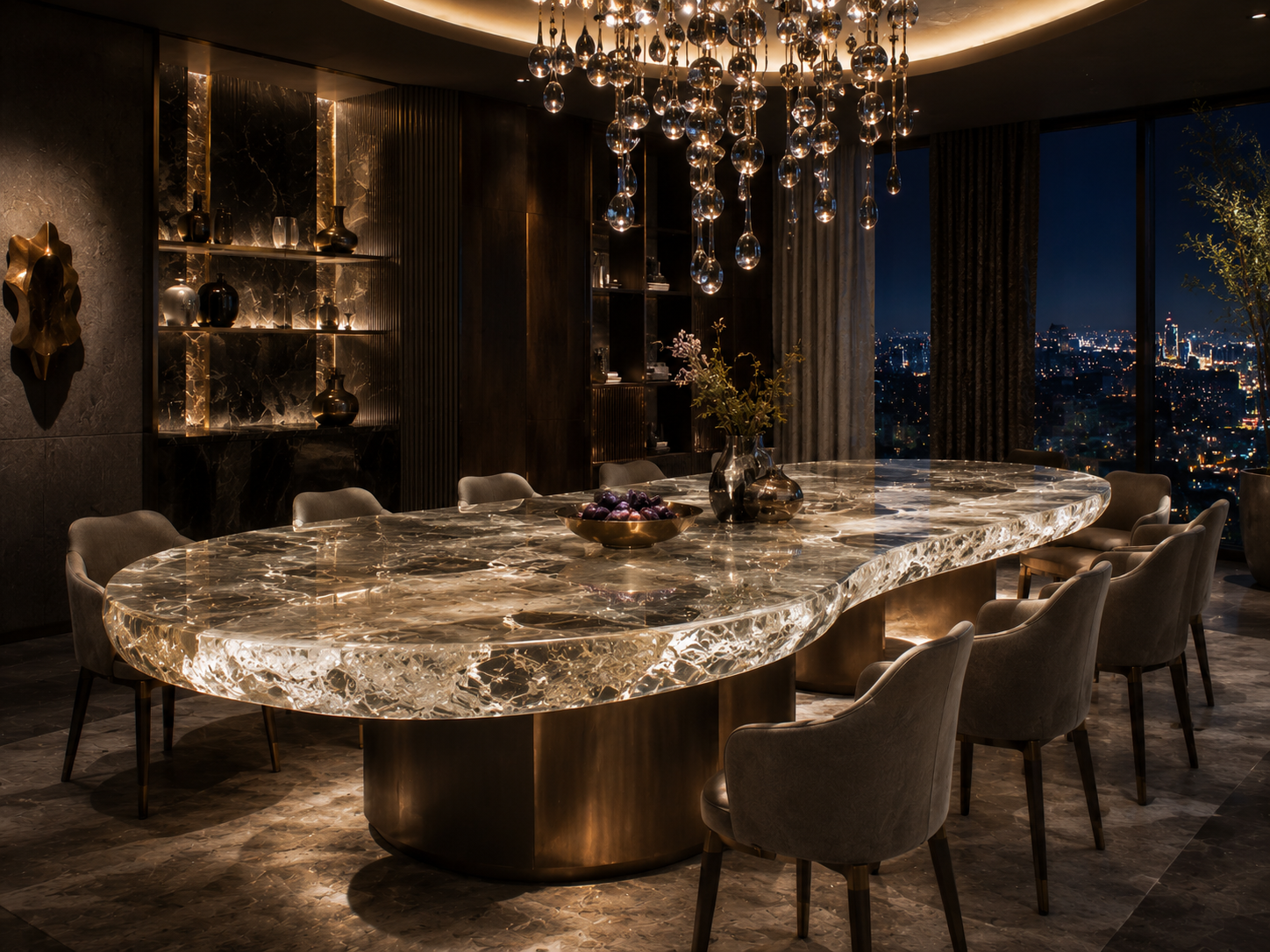
Start With the Material, Not the Photograph
The first thing buyers should verify is the exact material being used.
“Clear,” “crystal,” “transparent,” and “acrylic-style” are often used loosely in furniture marketing. These terms may describe an appearance, but they do not always explain the actual material composition, production method, optical characteristics, or expected performance.
For professional projects, buyers should request a clear material declaration from the supplier.
The manufacturer should be able to explain what is meant by synthetic crystal, how the material is produced, which properties make it suitable for furniture, and how it differs from lower-grade transparent plastics. This conversation is important because products that appear similar in photographs may behave very differently in real environments.
Material quality affects optical clarity, edge appearance, color consistency, surface hardness, structural stability, polish quality, and long-term visual performance.
A high-end synthetic crystal piece should not simply be transparent. It should have visual depth, controlled clarity, and a clean appearance across both large surfaces and thick edges.
Buyers should also ask whether the same grade of material is used throughout the piece. In some products, different components may be made from materials with slightly different optical characteristics. Even small variations in tint or clarity can become obvious once the parts are assembled.
Consistency matters especially in large tables, display fixtures, consoles, benches, and hospitality installations where multiple pieces will be viewed together.
Verify Optical Clarity Under Real Lighting
Digital photography can make almost any transparent material look impressive.
Bright backgrounds, controlled studio lighting, image retouching, and carefully selected viewing angles can reduce the visibility of tint, haze, surface marks, joint lines, or internal distortion. For this reason, buyers should never rely entirely on catalog images.
Whenever possible, request physical samples or close-up videos captured under several lighting conditions.
The sample should be viewed in daylight, warm artificial light, and cooler commercial lighting. This is especially important for hospitality and retail projects, where lighting design strongly affects how transparent furniture is perceived.
A material that looks colorless under one light source may reveal a blue, gray, green, or yellow cast under another. Thicker sections can also appear darker than thin ones, so buyers should inspect samples that represent the actual thickness intended for production.
Optical clarity should be judged across the face of the material, not only at the edges.
Look for haze, waviness, visual distortion, bubbles, inclusions, inconsistent density, and unexpected reflections. Some of these effects may be acceptable within agreed tolerances, but they should be understood before an order is approved.
High-quality synthetic crystal furniture should interact with light in a deliberate way. It should feel deep and luminous rather than flat, cloudy, or packaging-like.
Confirm the Thickness of Every Structural Component
Thickness is one of the most important elements in both the appearance and performance of synthetic crystal furniture.
A thick component can create strong edge reflections, a sense of permanence, and a sculptural visual weight. A thinner component may look more delicate and minimal. Neither approach is automatically superior, but the thickness must be appropriate for the size, function, and structure of the piece.
Buyers should request detailed specifications for tabletops, legs, bases, supports, shelves, and connecting elements.
A single overall dimension is not enough.
For example, a dining table may appear visually substantial in a rendering, but the actual top thickness may be too light for the intended scale. Conversely, an unnecessarily thick top may create excessive weight, complicate shipping, and make the piece feel visually heavy.
The same issue applies to bases and legs. Their proportions must support both the physical load and the visual language of the design.
For hospitality projects, where furniture may experience heavier use than in a private residence, structural thickness should be reviewed in relation to expected traffic, cleaning routines, movement, and daily operational demands.
The supplier should explain how the selected thickness contributes to stability and how the construction has been tested or validated.
Review the Engineering, Not Just the Silhouette
Transparent furniture often appears simple because its structure is visually reduced.
A table may consist of a clear top and two clear bases. A console may look like a single folded form. A display stand may appear to float. Yet behind this simplicity, the engineering may be complex.
Buyers should verify how loads are transferred through the piece.
Ask how the tabletop is supported, how the joints are formed, how the components are connected, and how movement is controlled. For large-format furniture, the supplier should be able to discuss stability, deflection, load distribution, and the effect of repeated use.
This is particularly important for dining tables, retail display fixtures, hotel consoles, benches, reception furniture, and shelving.
A product may look stable in a photograph but respond differently when used at full scale. Long spans, narrow supports, uneven flooring, heavy decorative objects, or repeated lateral pressure can all affect performance.
Professional buyers should request drawings that show construction details, not only exterior dimensions.
These drawings should identify contact points, fasteners, adhesive zones, internal supports, metal reinforcements, or any other structural components. When those elements remain visible through the material, their position and finish become part of the design.
Engineering should not be treated as separate from aesthetics. In transparent furniture, engineering is visible aesthetics.
Inspect Joint Quality and Connection Methods
Joints are among the clearest indicators of manufacturing quality.
Because synthetic crystal is transparent, the method used to connect components can rarely be completely hidden. Adhesive lines, mechanical fixings, hardware, alignment errors, and surface transitions may all remain visible.
Buyers should ask the supplier to explain how joints are produced and what the finished connection will look like.
Some designs aim for a nearly seamless appearance. Others use visible metal fasteners or architectural connections as intentional details. Both can be successful, but the result must be controlled and consistent.
Cloudy bonding areas, trapped bubbles, uneven adhesive distribution, misaligned panels, and visible residue can make an expensive piece appear poorly made.
For repeat orders or multi-location retail and hospitality programs, consistency is especially important. One acceptable prototype does not guarantee that every production unit will match it.
Buyers should establish approval standards for joint clarity, alignment, gap tolerance, adhesive visibility, and hardware placement.
Close-up inspection photographs should be part of the approval process, particularly when the goods are being manufactured remotely.
Examine Edge Finishing From Multiple Angles
Edges determine how transparent furniture captures light.
A properly finished edge can appear luminous, crisp, smooth, and jewel-like. A poorly finished edge may look cloudy, rough, uneven, or scratched. Since edges are often more visually concentrated than broad surfaces, small imperfections can become highly noticeable.
Buyers should verify whether edges are machine-finished, hand-polished, beveled, rounded, faceted, or shaped to a custom profile.
The chosen edge treatment should support the design concept.
A sharp geometric edge may suit a contemporary retail fixture, while a softened radius may be more appropriate for a hotel suite or residential interior. Safety, circulation, and cleaning requirements should also influence the decision.
Request close-up samples of the proposed edge profile at the correct material thickness.
An edge treatment that looks refined on a thin sample may appear very different on a thick dining table or monolithic base.
It is also important to inspect corner transitions. Corners should not feel abrupt, inconsistent, or visibly overworked. The polishing should continue smoothly around the entire form.
In high-end synthetic crystal furniture, the edge is not a minor finishing detail. It is one of the main visual features.
Establish Acceptable Surface Standards
Clear surfaces reveal everything.
Fingerprints, dust, fine scratches, polishing marks, residue, and handling damage can be more visible on transparent furniture than on wood, stone, lacquer, or upholstery. Buyers should therefore define surface expectations before production and delivery.
The supplier should be able to describe the polishing process and the inspection criteria used before packing.
Ask what level of minor surface variation is considered normal, how scratches are classified, and what remedies are available if a delivered item does not meet the agreed standard.
For high-end retail and hospitality projects, surface quality should be reviewed at normal viewing distance and under direct light.
Some imperfections may only become visible when the piece is illuminated from the side or placed near a window. This is why factory inspection images should include multiple angles rather than only front-facing photographs.
Protective films may be used during production and shipping, but buyers should understand when and how those films are removed. Improper removal can leave residue or create damage if the furniture has been stored for an extended period.
A clear surface should arrive ready to install, not ready for repair.
Check Dimensional Accuracy and Site Conditions
Transparent furniture often appears visually lighter than its actual physical dimensions.
A large synthetic crystal table may seem almost weightless in a rendering, yet it still occupies substantial floor space and may be extremely heavy. Buyers should review exact dimensions, tolerances, weight, access routes, and installation conditions before confirming an order.
For hospitality and retail projects, site coordination is essential.
Measure doorways, elevators, staircases, corridors, loading docks, and turning areas. Confirm whether the piece can be delivered fully assembled or whether it must be assembled on site.
If components are being bonded or connected during installation, verify who is responsible for that work and what experience they have with synthetic crystal furniture.
Floor conditions also matter. Uneven floors can affect stability and create stress at contact points. Buyers should ask whether adjustable feet, protective pads, or leveling systems are included.
The relationship between the furniture and surrounding architecture should be checked carefully.
A console designed to align with wall panels, a display table positioned beneath a pendant, or a dining table centered on a rug may require very precise dimensions. Even a small discrepancy can reduce the sense of integration.
For custom work, approved shop drawings should be treated as contract documents.
Evaluate Weight, Handling, and Installation Requirements
Visual transparency can create a false impression of physical lightness.
Large synthetic crystal furniture may be heavy and difficult to move. Buyers should request the net weight, packed weight, center of gravity, recommended lifting method, and number of people required for installation.
Hospitality and retail teams should also consider future movement.
Will the piece remain permanently in one location, or will staff need to reposition it for events, merchandising changes, cleaning, or maintenance? A design that is suitable for a private residence may not be practical for a hotel ballroom, restaurant, or frequently refreshed showroom.
Ask whether lifting points are designated and whether the piece can be safely moved without pressure being applied to vulnerable edges or joints.
Installation instructions should be clear and specific.
Generic advice is not sufficient for large or custom furniture. The supplier should explain how the product should be unpacked, lifted, positioned, leveled, cleaned, and inspected.
For international projects, the buyer should verify whether local installation teams will receive technical guidance. A premium piece can be damaged within minutes if handled incorrectly.
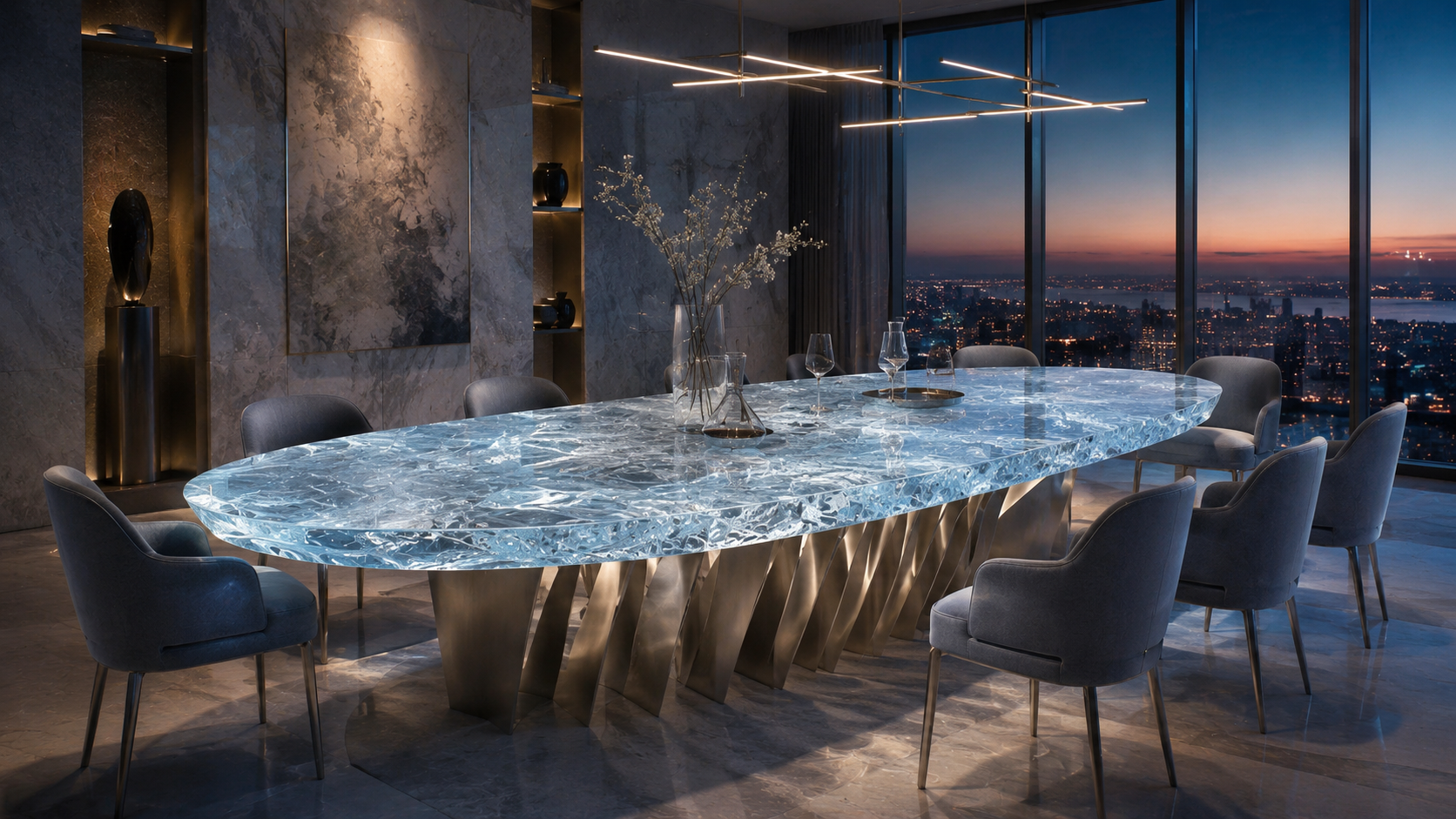
Confirm Compatibility With the Intended Use
A beautiful design may not be suitable for every application.
Before specifying synthetic crystal furniture, buyers should define how the piece will actually be used.
A residential side table, a hotel lobby console, a retail display plinth, and a restaurant dining table face very different demands. The level of contact, movement, cleaning, exposure, and potential impact varies significantly.
For hospitality use, buyers should consider how housekeeping teams will clean the surface, whether luggage may strike the furniture, whether guests may place hot or sharp objects on it, and whether the piece sits within a high-traffic path.
For retail use, consider product loading, visual merchandising, frequent repositioning, customer interaction, and the possibility of metal fixtures or display objects scratching the surface.
For designers specifying residential pieces, consider lifestyle, children, pets, entertaining habits, and the types of objects likely to be placed on the furniture.
The manufacturer should be informed of the real use case before finalizing the design.
A responsible supplier may recommend changes to thickness, edge profile, base dimensions, protective details, or construction method based on the application.
Good specification begins with honest information about use.
Request Clear Cleaning and Maintenance Guidance
Synthetic crystal furniture needs a maintenance plan.
Because clear surfaces show dust and fingerprints easily, the furniture may be cleaned frequently, especially in hospitality and retail environments. The wrong cleaning products or tools can damage the finish over time.
Buyers should request written cleaning instructions before purchase.
The guidance should identify suitable cloths, approved cleaning solutions, prohibited chemicals, and recommended methods for removing fingerprints, dust, and light marks.
Housekeeping and visual merchandising teams should receive this information before the furniture is installed.
Aggressive chemicals, abrasive pads, rough paper products, or unsuitable sprays may create haze, scratches, or surface changes. Even when damage is gradual, it can reduce the clarity and luxurious appearance that justified the original specification.
Ask whether minor scratches can be professionally polished and whether the supplier offers restoration guidance or after-sales support.
For multi-site projects, standardized care instructions are particularly valuable. They help maintain a consistent appearance across hotels, stores, restaurants, or branded environments.
Maintenance should not be an afterthought. It is part of the product’s long-term performance.
Understand UV Exposure and Environmental Conditions
Buyers should discuss the environment in which the furniture will be placed.
Direct sunlight, strong ultraviolet exposure, high temperatures, humidity, chemical cleaners, and nearby heat sources may affect materials differently over time. The supplier should explain the recommended conditions for the specific synthetic crystal product being offered.
This is especially important for spaces near large windows, sunrooms, storefronts, hotel terraces, spa environments, or areas with intense lighting.
Buyers should not assume that a product suitable for an indoor residential room is automatically appropriate for every commercial application.
Ask whether the material is intended for indoor use only and whether prolonged sunlight exposure may influence color, clarity, or surface performance.
If a project has unusual environmental conditions, communicate them early.
A qualified manufacturer should be willing to review the application and recommend whether the product is suitable, requires modification, or should be placed differently.
Long-term appearance depends on matching the material to the environment.
Verify Packaging Standards Before Shipping
Transparent furniture can be vulnerable during transport.
Edges, corners, polished surfaces, joints, and large flat planes all require careful protection. A product that leaves the factory in excellent condition can arrive scratched, chipped, stressed, or contaminated if the packaging is inadequate.
Buyers should ask for a description of the packaging system.
This may include protective film, soft wrapping, foam, corner guards, internal bracing, custom crates, moisture protection, and handling labels. The packaging should prevent movement inside the crate and avoid direct contact between abrasive materials and polished surfaces.
For export shipments, buyers should confirm whether the crate is suitable for international transport and repeated handling.
The packed dimensions and weight should also be reviewed because they affect freight cost, access, unloading, and storage.
Request packing photographs before dispatch.
These images provide evidence of the condition of the furniture and the way it was protected. They can also help the receiving team understand how to open the crate safely.
Unpacking instructions should be included. Incorrect crate removal can cause damage even when the product has survived the journey.
Luxury furniture deserves packaging that reflects its value.
Define Quality-Control Documentation
For custom or high-value orders, verbal assurances are not enough.
Buyers should establish a documented quality-control process.
This may include approval of material samples, finish samples, shop drawings, hardware samples, prototype photographs, production updates, pre-shipment inspection images, packaging photographs, and final measurement checks.
The exact process will depend on the scale of the order.
A single residential console may require fewer stages than a multi-property hotel program or global retail rollout. However, every project benefits from clearly defined approvals.
The buyer should specify which details require written confirmation before production continues.
These may include dimensions, material thickness, edge profile, joint method, hardware finish, load requirements, logo placement, packaging, and installation method.
For repeat orders, an approved reference unit can be extremely useful.
The reference should establish the expected standard for clarity, color, polishing, dimensions, joints, and overall appearance. Future units can then be assessed against it.
Quality control is most effective when expectations are measurable.
Assess the Supplier’s Customization Capability
Many high-end projects require more than a standard catalog product.
Designers may need a custom length, unusual base geometry, specific edge profile, integrated metal detail, branded element, or precise alignment with architectural features. Retailers may need coordinated fixture families. Hospitality buyers may require multiple sizes for guest rooms, suites, public areas, and food-and-beverage spaces.
Buyers should evaluate whether the supplier can genuinely support customization.
Ask how custom designs are developed, what information is required, whether technical drawings are provided, and how structural feasibility is reviewed.
A manufacturer should not simply agree to every request without technical discussion.
Professional customization involves interpreting the design intent, identifying risks, refining proportions, and recommending practical solutions. The best supplier relationships are collaborative.
It is also important to clarify the difference between dimensional customization and full product development.
Changing the length of an existing table may be straightforward. Creating a completely new structural form may require engineering, prototyping, tooling, or additional production time.
These requirements should be identified before pricing and scheduling are finalized.
Review Samples as Part of the Design Process
A material sample is not merely a sales tool. It is part of the design process.
For significant projects, buyers should request samples that reflect the proposed thickness, polish, edge treatment, color, and any mixed-material details.
A small, thin sample may confirm basic clarity, but it may not accurately represent the appearance of a thick table base or large structural panel.
Whenever possible, evaluate a corner sample, joint sample, or partial mock-up.
This allows the design team to understand how surfaces meet, how edges collect light, and how hardware appears through the material.
Samples should also be placed beside the actual interior finishes.
Synthetic crystal may interact differently with dark wood, pale stone, brushed metal, colored upholstery, patterned rugs, or warm lighting. Seeing these materials together can reveal whether the furniture creates the intended balance.
For retail and hospitality projects, samples can be reviewed by design, procurement, operations, and maintenance teams.
Each group may notice different issues, and early feedback can prevent later problems.
Confirm Lead Times and Production Capacity
Custom synthetic crystal furniture may involve multiple production stages, including material preparation, cutting, forming, machining, bonding, polishing, hardware integration, inspection, and specialized packing.
Buyers should request a realistic production schedule rather than relying on a general estimate.
The schedule should identify when drawings will be approved, when samples will be reviewed, when production begins, when quality inspection occurs, and when the goods are ready to ship.
For larger orders, verify the supplier’s production capacity.
Ask whether all units will be produced in one batch, whether color and material consistency can be maintained, and whether the manufacturer has experience managing similar volumes.
Hospitality opening dates and retail launch schedules can be unforgiving. A furniture delay may affect photography, merchandising, staff training, or final handover.
Lead times should also account for shipping, customs clearance, local delivery, and installation.
A transparent production timeline helps buyers coordinate the entire project more effectively.
Clarify Warranty and After-Sales Support
Before placing an order, buyers should understand what happens after delivery.
Ask what warranty is offered, what it covers, how damage or defects are assessed, and what documentation is required for a claim.
The buyer should distinguish between manufacturing defects, transport damage, installation damage, misuse, and normal wear.
Clear procedures protect both parties.
For custom furniture, replacement may not be immediate, so the supplier should explain whether components can be repaired, refinished, or reproduced.
After-sales support is especially important for hospitality groups and retailers that may reorder the same design in the future.
Ask whether production records, drawings, material specifications, and finish references will be retained. This information can improve consistency when additional pieces are needed months or years later.
A high-end supplier relationship should extend beyond the initial shipment.
Consider Brand Alignment and Commercial Presentation
For retailers and hospitality buyers, furniture is not only functional. It communicates brand position.
Synthetic crystal furniture can signal modernity, exclusivity, precision, and visual sophistication. However, those associations depend on execution.
A poorly finished transparent table can weaken the perceived quality of the entire environment. A carefully designed piece can elevate surrounding products, materials, and architecture.
Retailers should consider how the furniture will support merchandise rather than compete with it.
Hospitality buyers should consider whether the furniture aligns with the property’s guest experience, service model, and maintenance capabilities.
Designers should evaluate whether the material contributes meaningfully to the concept or has been selected only because it appears fashionable.
The strongest specifications connect material choice to a clear design purpose.
Synthetic crystal may be used to reduce visual weight, preserve sightlines, reflect lighting, reveal a rug or floor finish, create contrast with natural materials, or establish a memorable focal point.
When the reason is clear, the result feels intentional.
Compare Total Value, Not Only Unit Price
Pricing for synthetic crystal furniture can vary widely.
Buyers should compare more than the quoted unit cost.
A lower-priced piece may use thinner material, simpler construction, less polishing, weaker packaging, limited quality control, or minimal after-sales support. These differences may not be visible in a quotation, but they can affect the final project.
Total value includes design accuracy, material quality, structural reliability, surface finish, packaging, logistics support, installation guidance, warranty, and long-term appearance.
For commercial projects, replacement risk also has a cost.
A delayed or damaged table can disrupt a hotel opening. An inconsistent retail fixture can weaken brand presentation. A scratched or unstable piece can create operational problems that exceed the original price difference.
Buyers should evaluate the supplier’s ability to deliver the required result, not simply the lowest number.
Luxury furniture is expensive when it fails, regardless of how inexpensive it was to purchase.
The Most Important Question Is Whether the Supplier Understands the Project
Specifications, drawings, samples, and inspections are essential, but supplier understanding remains one of the most important factors.
A capable synthetic crystal furniture manufacturer should ask questions.
They should want to know where the piece will be used, how it will be handled, what weight it will support, how the space is lit, what access conditions exist, whether the furniture will be moved, and what visual standard the project requires.
A supplier who focuses only on dimensions and price may overlook critical issues.
By contrast, a supplier who understands the project can recommend better proportions, more suitable thicknesses, safer edge profiles, stronger packaging, and more practical installation methods.
This collaboration is particularly valuable for designers and buyers working with synthetic crystal for the first time.
The goal is not simply to manufacture an object. The goal is to create a piece that performs correctly within a real environment.
Final Thoughts
Synthetic crystal furniture can transform an interior when the material, design, manufacturing, and project context are aligned.
Its transparency creates visual lightness, but its quality depends on precision. Every edge, joint, reflection, dimension, and surface becomes part of the experience.
For designers, retailers, and hospitality buyers, successful specification begins with verification.
Confirm the material. Review the optical clarity. Check the thickness. Understand the engineering. Inspect the joints and edges. Define surface standards. Coordinate dimensions, access, installation, cleaning, packaging, quality control, warranties, and after-sales support.
Most importantly, choose a supplier who understands that transparent furniture leaves nowhere for compromise to hide.
When every visible detail has been resolved before production begins, synthetic crystal furniture does more than fill a space—it becomes the detail people remember long after they leave it, and the next question is whether your current specification is strong enough to create that kind of memory.
READ MORE:
- Beyond the Purchase Price: How to Evaluate the Real Value of a High-End Synthetic Crystal Furniture Piece
- How to Use Transparent Furniture Without Making an Interior Feel Cold, Empty, or Overly Modern
- Will It Scratch, Yellow, or Lose Its Clarity? A Practical Guide to the Long-Term Performance of Synthetic Crystal Furniture
- Why Some Crystal-Clear Furniture Looks Luxurious—and Some Simply Looks Like Plastic
- How Premium Resin and Platinum Acrylic Elevate Brand Perception in High-End Furniture
- Synthetic Crystal, Resin, or Acrylic Furniture: Which Material Is Right for Each Commercial Space?
- Lighting and Transparent Furniture: How to Make an Interior Feel Brighter, Deeper, and More Refined
- Does Spatial Quality Really Affect How Long Customers Stay?
- How Can Commercial Spaces Increase Average Transaction Value Through Material Upgrades? Start with the Quality of the Furniture


