
Transparent furniture has a strange kind of power.
It can make a room feel larger, lighter, calmer, and more sophisticated. It can create the impression that a table is floating, that a chair occupies almost no visual space, or that a console has been carved from frozen light. In the right setting, crystal-clear furniture feels architectural, artistic, and undeniably luxurious.
Yet not every transparent piece creates that effect.
Some clear furniture looks refined from across the room but disappointing up close. Some loses its brilliance under natural light. Some appears slightly cloudy, overly glossy, poorly proportioned, or unmistakably plastic. Two pieces may look similar in an online photograph, but once placed inside a real interior, the difference can be immediate.
Why does one transparent table feel like a collectible design object while another feels like a temporary accessory?
The answer is not transparency alone.
Luxury comes from the way transparency is controlled. It depends on the material, the thickness, the clarity, the polishing, the internal structure, the proportions, the edges, the joints, and even the way the object interacts with its surroundings. When these elements are carefully resolved, clear furniture becomes more than invisible furniture. It becomes a source of light, depth, and visual tension.
For designers, architects, collectors, and homeowners, understanding these differences is essential. A crystal-clear object may appear minimal, but achieving true visual simplicity requires extraordinary precision.
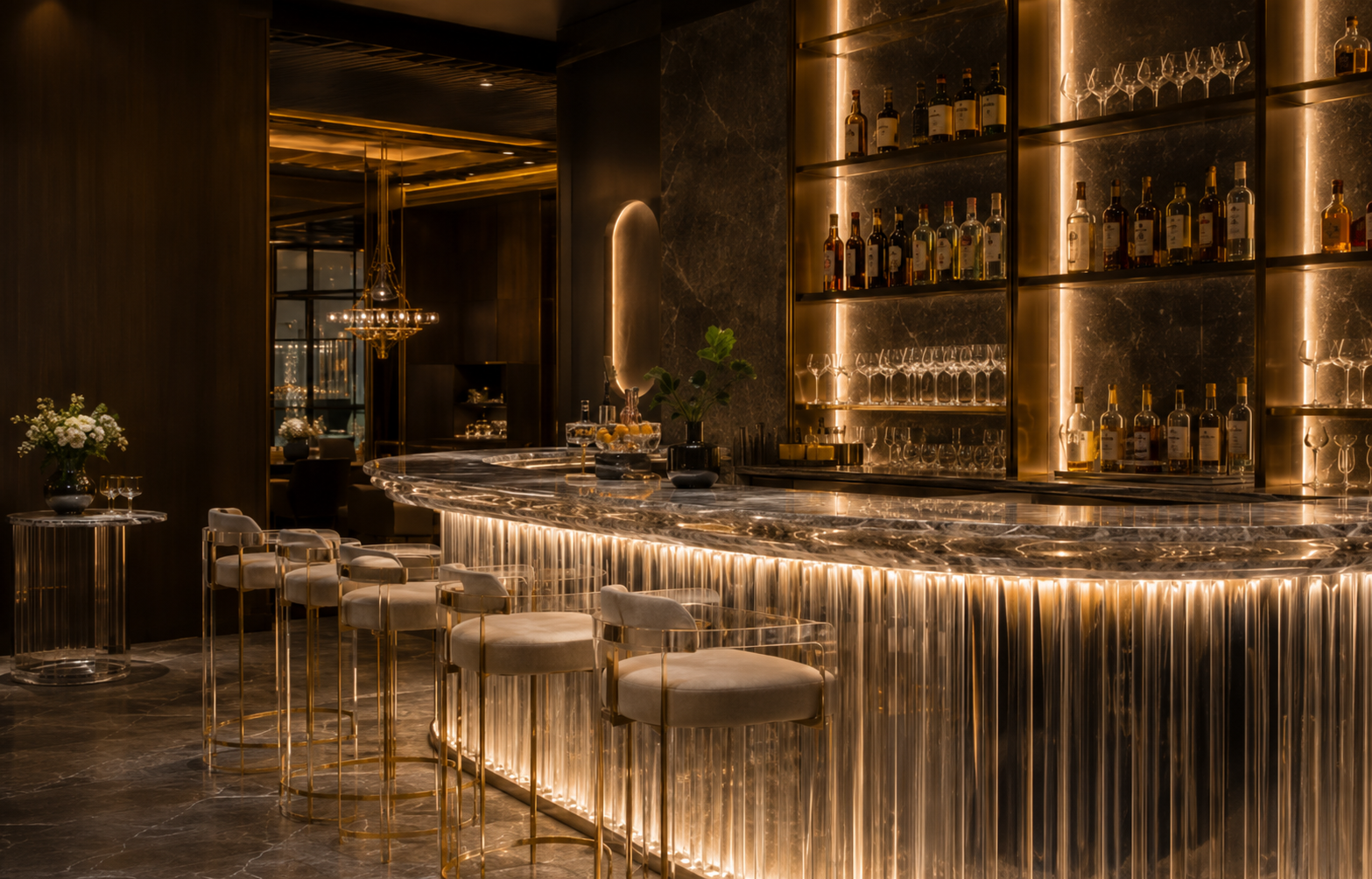
Transparency Is Not the Same as Luxury
Clear furniture is often described as “light,” “modern,” or “minimal,” but these words do not explain why some pieces feel premium.
Transparency reduces visual weight, but luxury requires more than visual absence. A transparent object still has a presence. It reflects light, frames views, reveals edges, exposes construction, and creates shadows. Because there is nowhere for imperfections to hide, every decision becomes visible.
In opaque furniture, paint, veneer, fabric, or surface texture can conceal structural transitions. Transparent furniture offers no such protection. A weak connection, an uneven edge, an awkward joint, or inconsistent thickness can be seen immediately.
This is one reason inexpensive transparent furniture often looks more ordinary than expected. The material may be clear, but the design is not refined enough to benefit from that clarity. Instead of appearing invisible, the piece reveals every compromise in its construction.
Luxury transparent furniture does the opposite. It uses clarity to display precision.
The viewer sees clean geometry, substantial material, smooth transitions, and balanced proportions. Rather than exposing weakness, transparency becomes evidence of craftsmanship.
Material Quality Changes Everything
The most important difference between luxury transparent furniture and furniture that merely looks plastic is the quality of the material itself.
Low-grade transparent plastics may have a slight blue, gray, yellow, or green cast. These color shifts can be difficult to notice in product photography, especially when images are heavily edited. In a bright interior, however, the tint becomes more obvious, particularly along thick edges and corners.
High-quality synthetic crystal is selected for greater optical clarity and a cleaner visual appearance. When properly produced and polished, it allows light to travel through the object with less visual distortion. The result is not simply a transparent surface, but a deeper, more dimensional quality.
This depth matters.
A luxurious transparent table should not feel like a thin sheet of clear material. It should feel substantial, almost geological. Its edges should collect light. Its surfaces should create subtle reflections. Its thickness should produce a sense of permanence.
The object may be visually light, but it should not feel materially weak.
Synthetic crystal is especially suited to furniture that requires both clarity and sculptural presence. It can be shaped into bold forms, generous volumes, and precise architectural profiles while maintaining the clean aesthetic that makes transparent furniture so appealing.
The best pieces do not imitate glass or natural crystal. They use the unique possibilities of synthetic crystal to create a distinct design language of their own.
Optical Clarity Is More Than “Being See-Through”
A material can be transparent without being optically refined.
True optical quality is affected by several factors, including surface smoothness, internal consistency, edge finishing, thickness, and the way light bends as it passes through the object. When any of these elements are poorly controlled, the furniture can appear hazy, distorted, or flat.
Luxury transparent furniture creates a sense of visual depth.
Look at the edge of a well-made synthetic crystal console or side table. The edge should not simply disappear. It should capture and redirect light. Depending on the angle, it may appear brighter, denser, or almost luminous. This is one of the qualities that separates a premium transparent object from a basic plastic one.
Cheap clear furniture often looks visually shallow. Its surfaces may be transparent, but the material does not create rich internal reflections. It may feel like packaging material enlarged into furniture scale.
High-end synthetic crystal furniture behaves differently. It creates layers of transparency. Light moves through it, reflects within it, and changes as the viewer moves around the object. This shifting effect gives the piece a dynamic presence.
It never looks exactly the same from every angle.
That visual movement is one of the reasons transparent furniture can feel so sophisticated. It responds to architecture, daylight, artificial lighting, flooring, artwork, and surrounding materials. It becomes part of the atmosphere rather than simply occupying space.
Thickness Communicates Value
Material thickness has a powerful psychological effect.
Thin transparent furniture can look delicate and elegant, but if the proportions are not carefully designed, it may also feel flimsy or disposable. Luxury furniture usually creates confidence through visual balance. The object should appear stable, intentional, and structurally convincing.
In synthetic crystal furniture, thickness is not only a technical requirement. It is a design tool.
A thick tabletop creates a stronger edge effect. A substantial base produces greater visual depth. A solid leg can appear almost weightless from one angle and dramatically luminous from another. These contrasts are difficult to achieve with thin, mass-produced transparent materials.
However, thicker does not automatically mean better.
Poorly proportioned transparent furniture can become bulky, visually heavy, or awkward. The goal is not maximum mass. The goal is controlled substance.
A luxurious piece balances solidity and transparency. It feels strong without blocking the room. It creates presence without creating clutter. It looks valuable without becoming visually aggressive.
This balance requires careful proportioning. The relationship between the tabletop and the base, the width of the legs, the height of the piece, and the negative space around each component all contribute to the final impression.
The most successful designs appear simple because every proportion has already been resolved.
Edges Reveal the True Level of Craftsmanship
When evaluating clear furniture, always look at the edges.
Edges are where material quality and craftsmanship become easiest to identify. A poorly finished edge may look cloudy, rough, wavy, or uneven. It may reveal machining marks or create inconsistent reflections. These details immediately reduce the perceived quality of the entire piece.
In high-end synthetic crystal furniture, edge finishing is a critical stage.
The edge should feel smooth and visually continuous. Corners should be precise but not crude. Curves should flow naturally. Polished surfaces should transition cleanly without distracting irregularities.
Because transparent materials amplify light, even a small imperfection can become visually prominent. A minor scratch on an opaque cabinet may go unnoticed, but the same defect on a clear console can interrupt the entire composition.
This is why luxury transparent furniture requires patience. The object must be examined from multiple angles and under different lighting conditions. A surface that appears perfect in one environment may reveal inconsistencies in another.
High-quality polishing transforms the material from industrial to jewel-like. It creates the sense that the furniture has been finished rather than merely manufactured.
That distinction is central to luxury.
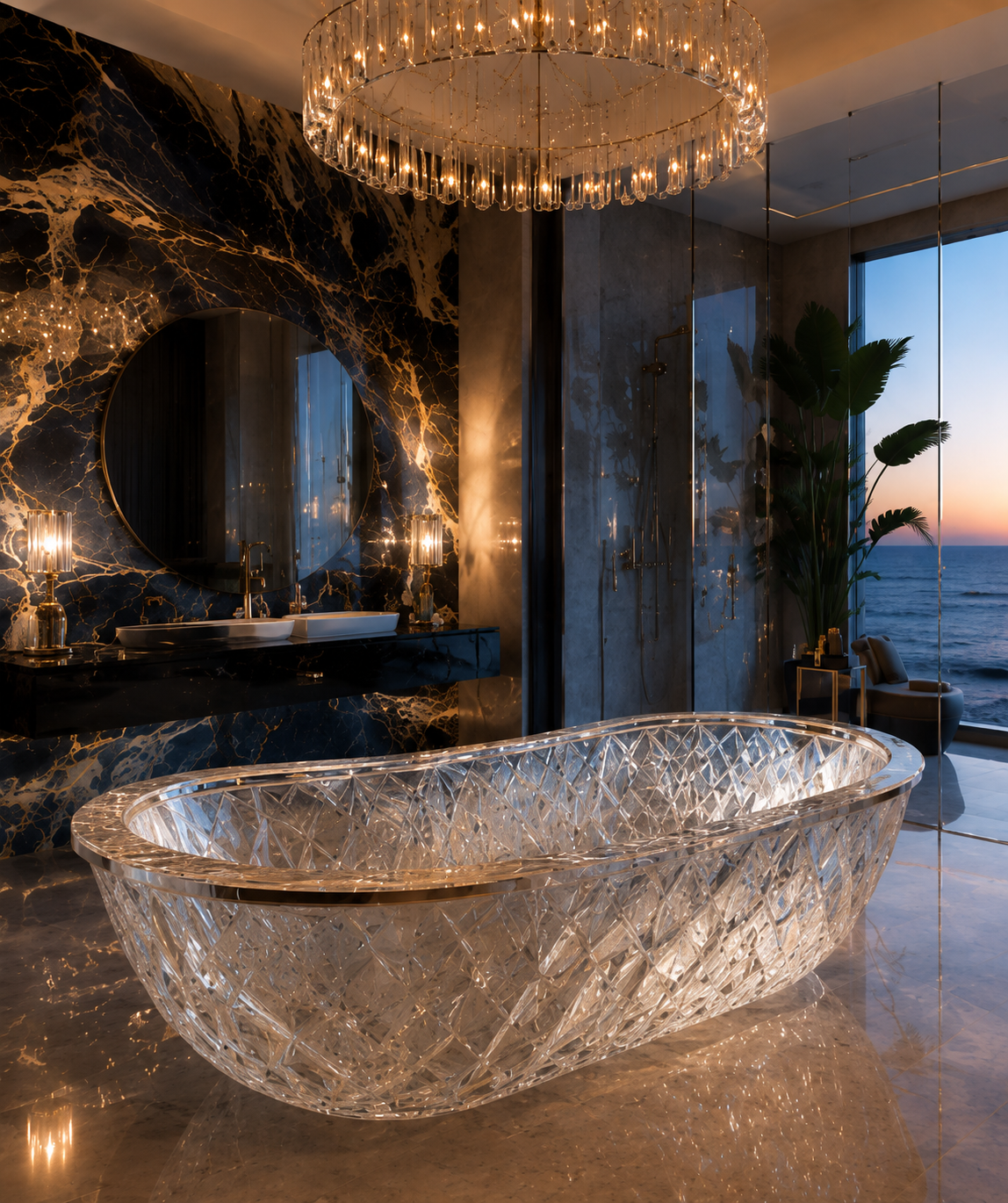
Joints Should Feel Deliberate, Not Hidden
Transparent furniture makes construction visible.
This can be a challenge, but it can also be an advantage. In a well-designed piece, the joints become part of the visual identity. They show how the object is assembled and how its weight is supported.
In lower-quality furniture, joints often look accidental. Adhesive lines may be visible. Connections may appear cloudy, uneven, or misaligned. Hardware may interrupt the transparency without contributing to the design.
Luxury synthetic crystal furniture treats every connection as an architectural detail.
Some designs aim for nearly seamless construction, allowing components to appear as one continuous volume. Others intentionally emphasize the joint, using precise geometry to make the assembly part of the aesthetic.
Neither approach is inherently better. What matters is clarity of intention.
A joint should never look like a problem that has been covered up. It should look resolved.
This principle applies to hardware as well. If metal elements are used, their finish, scale, and position must be carefully considered. Brass, stainless steel, or dark metal can create beautiful contrast against synthetic crystal, but only when the relationship feels purposeful.
Transparent furniture leaves no room for random decisions.
Proportion Is More Important Than Decoration
One of the greatest strengths of crystal-clear furniture is its ability to feel visually quiet.
Because the material itself already creates reflection, depth, and light effects, excessive decoration is rarely necessary. Luxury usually comes from proportion rather than ornament.
A well-designed synthetic crystal dining table may consist of only a few elements: a top, two bases, and carefully calculated spacing. Yet the relationship between those elements determines whether the table feels elegant or ordinary.
The same is true for a console, coffee table, bench, or side table.
When proportions are refined, the piece looks calm. Nothing feels too thick, too narrow, too tall, or too compressed. The object seems inevitable, as though it could not have been designed any other way.
When proportions are weak, transparency makes the problem more visible. The furniture may feel unstable, awkward, or visually cheap even when the material itself is clear.
This is why copying the outline of a luxury design does not reproduce its quality. The character of a premium piece often lies in subtle measurements: the radius of a corner, the distance between supports, the relationship between top thickness and leg width, or the exact amount of overhang.
These details may be small, but they shape the entire experience.
Luxury Is Experienced Through Light
Transparent furniture is highly sensitive to lighting.
In a dark showroom, a clear table may almost disappear. In direct sunlight, it may cast sharp reflections and refracted patterns. Under warm evening light, it may glow softly around the edges. Against a textured wall, it can frame the surface behind it. On polished stone, it may create a layered reflection that makes the entire room feel richer.
This ability to change is part of its luxury.
A high-end synthetic crystal piece does not rely on a single viewing condition. It should remain compelling throughout the day. Morning light, afternoon sun, and evening illumination should reveal different aspects of the form.
Lighting also exposes quality.
Poor surfaces may produce dull or uneven reflections. Internal inconsistencies may become more noticeable. Cheap materials may appear washed out or strangely tinted.
By contrast, well-finished synthetic crystal responds beautifully to controlled lighting. Designers can use spotlights, concealed LEDs, pendants, or natural daylight to activate the furniture and create visual drama.
The piece becomes not only an object in the room, but a participant in the room’s lighting composition.
This is particularly valuable in luxury hospitality, retail, residential, and gallery environments, where atmosphere is as important as function.
Clear Furniture Needs the Right Environment
Even exceptional furniture can lose its effect when placed in the wrong setting.
Transparent furniture works best when the surrounding environment gives it something meaningful to interact with. A synthetic crystal console placed against natural stone will reveal the texture behind it. A clear dining table above a sculptural rug will allow the pattern to remain visible. A transparent side table beside a velvet sofa will create contrast between softness and precision.
Material contrast is especially important.
Synthetic crystal pairs beautifully with marble, travertine, wood, metal, leather, boucle, linen, lacquer, and textured plaster. These materials provide warmth, depth, and tactile richness, while the transparent piece introduces lightness and visual clarity.
A room filled only with shiny, reflective surfaces can feel cold or commercial. Luxury interiors usually balance transparency with texture.
The clear furniture should have space around it. Crowding it with too many accessories reduces its impact. The beauty of the piece often comes from the negative space it preserves.
In this sense, synthetic crystal furniture is not simply another furnishing category. It is a spatial tool.
It can help a compact room feel more open. It can prevent a large table from dominating the architecture. It can introduce a sculptural focal point without adding visual heaviness. It can also connect different materials and colors by allowing them to remain visible through the object.
Why Some Pieces Look Like Plastic
The word “plastic” is often used negatively in design, but the problem is not the category of material itself. Many advanced synthetic materials are capable of exceptional performance and beauty.
The real issue is whether the object communicates depth, precision, and permanence.
Clear furniture tends to look cheap when several problems occur at once: the material appears thin, the edges are poorly polished, the form is generic, the joints are obvious, the proportions are weak, or the surface reflects light in a flat and artificial way.
Color is another factor. A noticeable tint can immediately make a clear object feel less refined. Scratches, bubbles, distortion, and inconsistent finishing can also reduce the sense of quality.
Design context matters as well. Even a well-made transparent piece can appear ordinary when photographed or styled poorly. Harsh lighting, cluttered accessories, low-quality surroundings, or excessive decoration can prevent the material from expressing its best qualities.
Luxury is rarely created by one feature. It is the result of many details working together.
A synthetic crystal table feels premium when the material, design, construction, finishing, and environment all support the same message.
Synthetic Crystal Is a Design Material, Not a Substitute
One of the most important shifts in contemporary furniture design is the recognition that synthetic crystal should not be treated as an imitation material.
It is not valuable because it resembles glass. It is valuable because it offers designers a distinct combination of clarity, formability, visual weight, and modern character.
When designers approach it as a substitute, the result often feels derivative. The furniture attempts to copy the appearance of another material without exploring its own possibilities.
When synthetic crystal is treated as a primary design medium, new opportunities appear.
Designers can create bold monolithic bases, layered geometric forms, sculptural curves, oversized transparent volumes, and precise architectural silhouettes. They can play with thickness, internal reflection, negative space, and contrast. They can combine synthetic crystal with metal, stone, or wood in ways that would be difficult to achieve with more fragile or visually heavy materials.
This approach produces furniture that feels contemporary rather than imitative.
The best synthetic crystal furniture does not ask, “How can we make this look like glass?”
It asks, “What can this material do that other materials cannot?”
Customization Elevates the Final Result
Luxury furniture is often defined by the degree to which it belongs to a specific space.
Standard transparent furniture can be attractive, but custom synthetic crystal furniture offers greater control over scale, proportion, function, and visual impact.
A dining table can be designed around the architecture of the room. A console can align precisely with wall panels or artwork. A coffee table can be proportioned to a particular sofa arrangement. A display plinth can be engineered around the dimensions of a collectible object.
Customization also allows designers to respond to lighting conditions and circulation patterns.
In a narrow interior, a transparent base can reduce visual obstruction. In a grand lobby, thicker material and larger dimensions can create stronger presence. In a luxury retail environment, synthetic crystal fixtures can highlight products without competing with them.
The result feels integrated rather than added later.
This level of consideration is one of the clearest signs of high-end design. The furniture does not simply fit physically. It fits conceptually.
How to Evaluate Crystal-Clear Furniture Before Buying
Photographs can be misleading, especially when evaluating transparent objects. Reflections, editing, background color, and lighting can conceal important details.
When selecting synthetic crystal furniture, examine close-up images of the edges, corners, surfaces, and joints. Look for visual consistency. Consider whether the thickness feels appropriate for the scale of the piece. Pay attention to the relationship between the clear material and any metal or stone components.
Ask how the piece is finished and assembled. Review the dimensions carefully. Transparent furniture may look smaller online because it occupies less visual space, but its physical footprint still matters.
It is also useful to consider how the furniture will interact with your interior.
What will be visible through it? What surface will sit beneath it? Will natural light strike the piece directly? Will it be placed near a window, textured wall, artwork, or reflective floor? What materials surround it?
The more intentional the placement, the more luxurious the final effect will be.
A premium transparent piece should look beautiful on its own, but it should become even more compelling when placed in the right environment.
Caring for the Luxury Appearance
Clear furniture requires thoughtful care because its surfaces reveal dust, fingerprints, and scratches more readily than many opaque materials.
Regular gentle cleaning helps preserve its clarity. Soft, non-abrasive cloths are preferable, and harsh cleaning tools should be avoided. Decorative objects placed on the surface should have smooth bases or protective pads, particularly if they are made of metal, stone, or ceramic.
Placement also matters. The furniture should be used in a way that respects its finish and construction. High-end transparent furniture is functional, but it is also a design object.
Over time, proper care protects more than the surface. It preserves the way the piece handles light.
A scratched or neglected surface can lose its visual depth. A well-maintained synthetic crystal surface continues to reflect, transmit, and shape light as intended.
That luminous quality is central to the experience of the furniture.
The Real Meaning of Luxury in Transparent Design
Luxury is not simply about price, rarity, or visual drama.
In transparent furniture, luxury is the feeling that nothing has been left unresolved.
The material is clear without appearing weak. The edges are polished without looking artificial. The form is simple without feeling generic. The structure is visible without becoming distracting. The proportions are substantial without being heavy.
Every element supports the same idea.
This is why high-end synthetic crystal furniture has such a strong presence. It combines visual lightness with material confidence. It can disappear into a space and still become the object everyone remembers.
The finest pieces do not demand attention through decoration. They earn attention through precision.
They allow architecture, light, artwork, and surrounding materials to remain visible, yet they add a new layer of depth to the room. They feel futuristic without becoming cold, glamorous without becoming excessive, and sculptural without sacrificing function.
That balance is difficult to achieve, which is exactly why it feels luxurious.
When choosing crystal-clear furniture, do not ask only whether it is transparent. Ask whether it has depth, proportion, clarity, craftsmanship, and a reason to exist in the space.
Because once you learn to see the difference between something that is merely clear and something that is truly refined, you may never look at transparent furniture the same way again.
READ MORE:
- Beyond the Purchase Price: How to Evaluate the Real Value of a High-End Synthetic Crystal Furniture Piece
- How to Use Transparent Furniture Without Making an Interior Feel Cold, Empty, or Overly Modern
- Will It Scratch, Yellow, or Lose Its Clarity? A Practical Guide to the Long-Term Performance of Synthetic Crystal Furniture
- What Designers, Retailers, and Hospitality Buyers Should Verify Before Specifying Synthetic Crystal Furniture
- How Premium Resin and Platinum Acrylic Elevate Brand Perception in High-End Furniture
- Synthetic Crystal, Resin, or Acrylic Furniture: Which Material Is Right for Each Commercial Space?
- Lighting and Transparent Furniture: How to Make an Interior Feel Brighter, Deeper, and More Refined
- Does Spatial Quality Really Affect How Long Customers Stay?
- How Can Commercial Spaces Increase Average Transaction Value Through Material Upgrades? Start with the Quality of the Furniture


