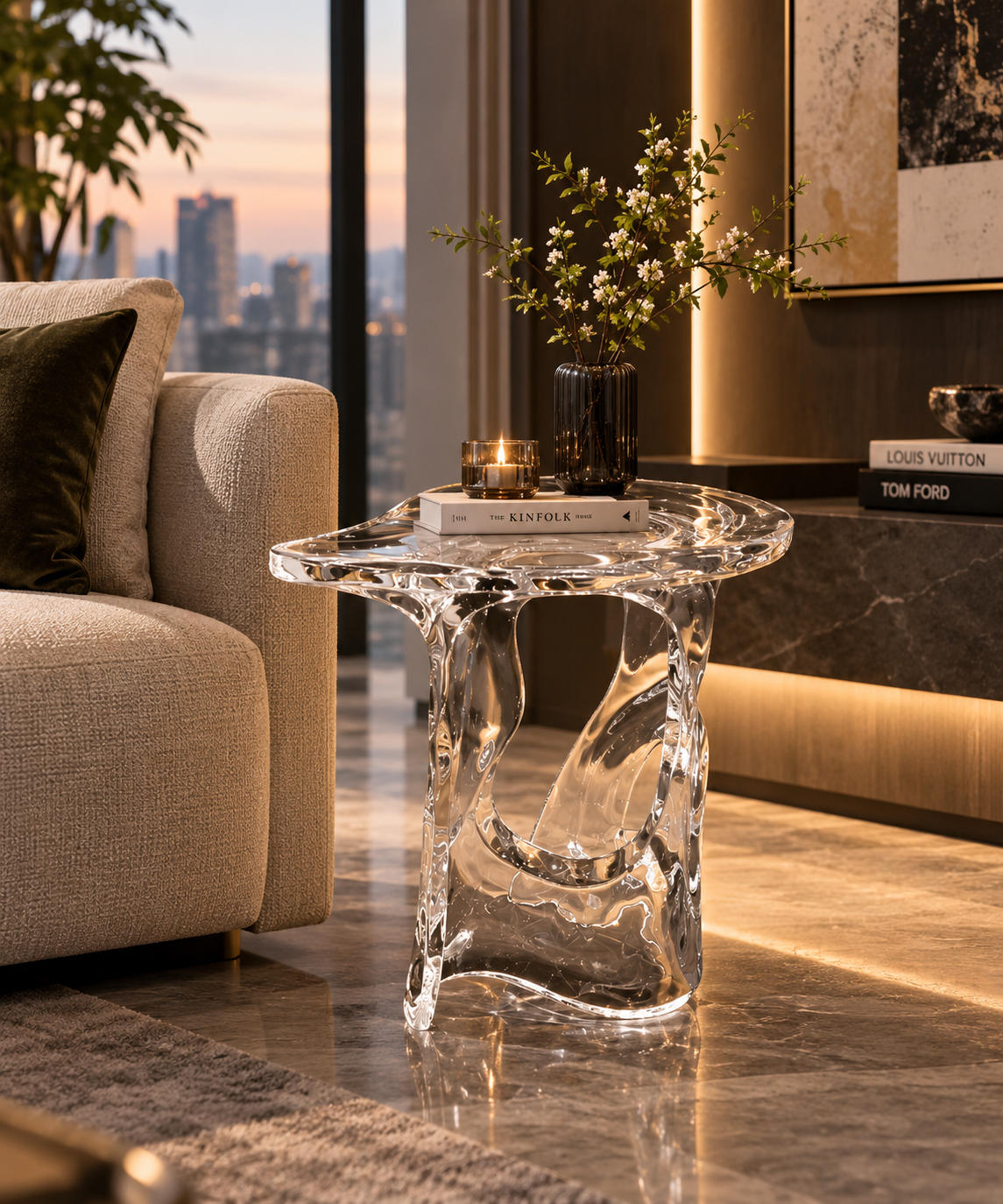
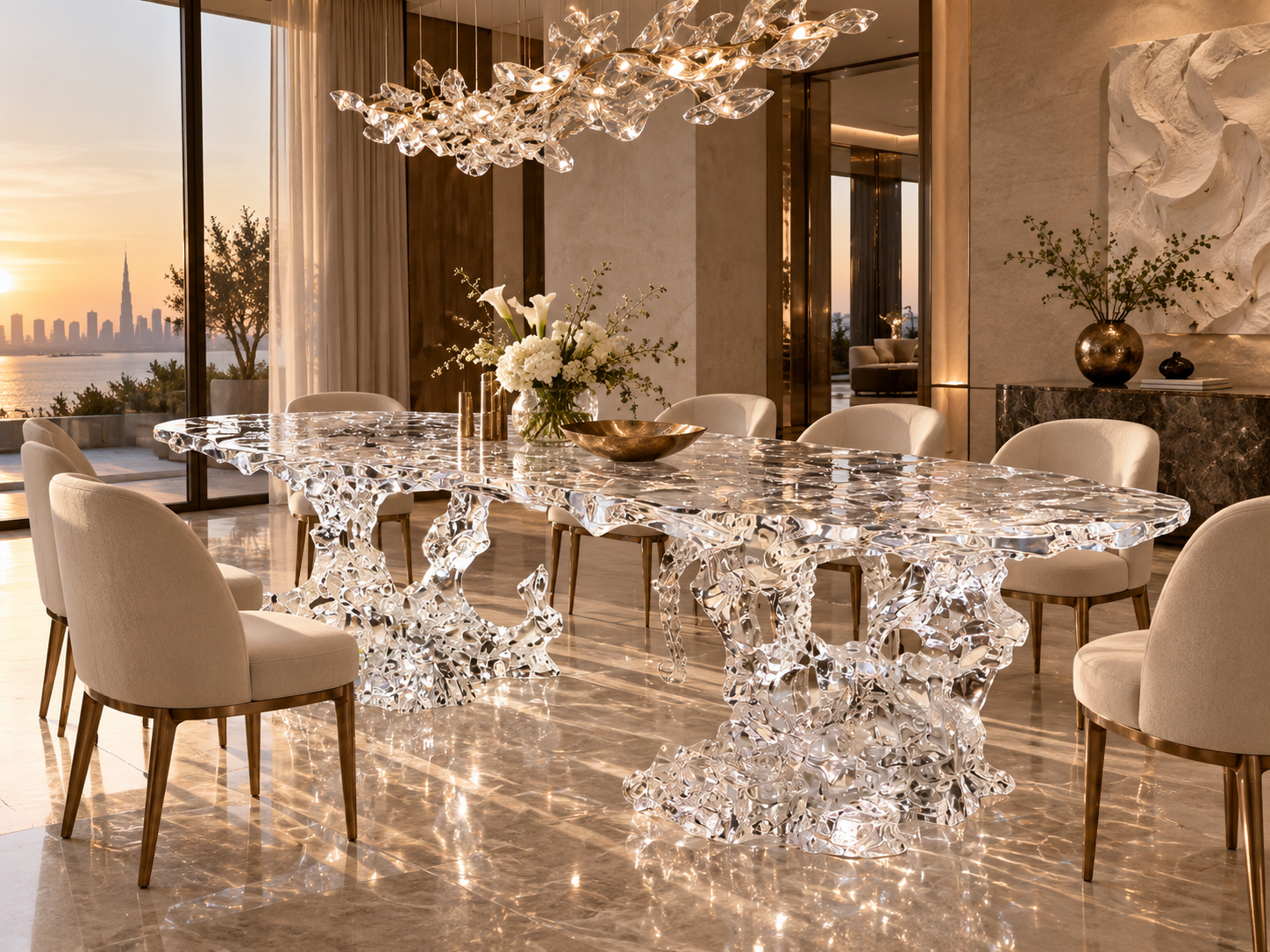
For much of the past decade, interior material trends were dominated by tactile, earthy surfaces: travertine, lime plaster, oak, brushed metal, muted stone, and matte finishes. These materials are not disappearing in 2026. What is changing is the way designers are combining them with a second category of material—one that does not simply occupy space, but actively responds to light.
Transparent glass, translucent resin, crystal-like surfaces, polished acrylic, reflective metal, lacquer, colored glass, and layered semi-transparent materials are becoming increasingly visible across furniture fairs, hospitality interiors, retail concepts, and collectible design.
The change is significant because it suggests a shift from material as finish to material as experience.
The 2026 edition of Salone del Mobile.Milano provides useful context. The fair recorded 316,342 visitors from 167 countries, up 4.5% from 2025, with international trade visitors representing 68% of attendance. With 1,900 brands from 32 countries, the event remains one of the clearest global indicators of where furniture, material, and spatial design are heading.
Across Milan Design Week this year, several recurring ideas stood out: sculptural furniture, glossy lacquer, expressive glass, transparency, material layering, and installations in which lighting was inseparable from the object itself. Wallpaper* noted that glass emerged as one of Milan Design Week 2026's most expressive materials, with designers using layered transparency, color, distortion, and reflection to create atmospheric environments rather than simple decorative objects.
For designers specifying hotels, villas, restaurants, retail stores, clubs, and other premium interiors, the implication is clear. Materials are increasingly being selected not only for how they look when viewed in isolation, but for what happens when light reaches them.
1. Designers Are Moving From Static Surfaces Toward Materials That Change Throughout the Day
One reason light-responsive materials feel particularly relevant in 2026 is that contemporary interiors are expected to provide more than one visual experience.
A hotel lobby looks different at 9 a.m. and 9 p.m. A villa living room may be dominated by daylight in the afternoon but transformed by warm architectural lighting in the evening. A luxury store has to attract customers from outside, present merchandise accurately inside, and still create an atmosphere distinctive enough to reinforce the brand.
Opaque materials are often relatively stable under these changing conditions. A limestone wall remains recognizably limestone. Timber changes subtly. A translucent, reflective, or refractive material can behave much more dynamically.
ArchDaily highlighted this quality in April 2026 in its examination of translucency in public space. The publication described how semi-transparent materials filter light, create changing degrees of visual permeability, and blur conventional boundaries between solid and void or open and enclosed space. Layered materials can produce gradients of depth rather than a single flat surface.
That is exactly why high-end resin, synthetic crystal, textured glass, and premium acrylic are becoming useful design tools.
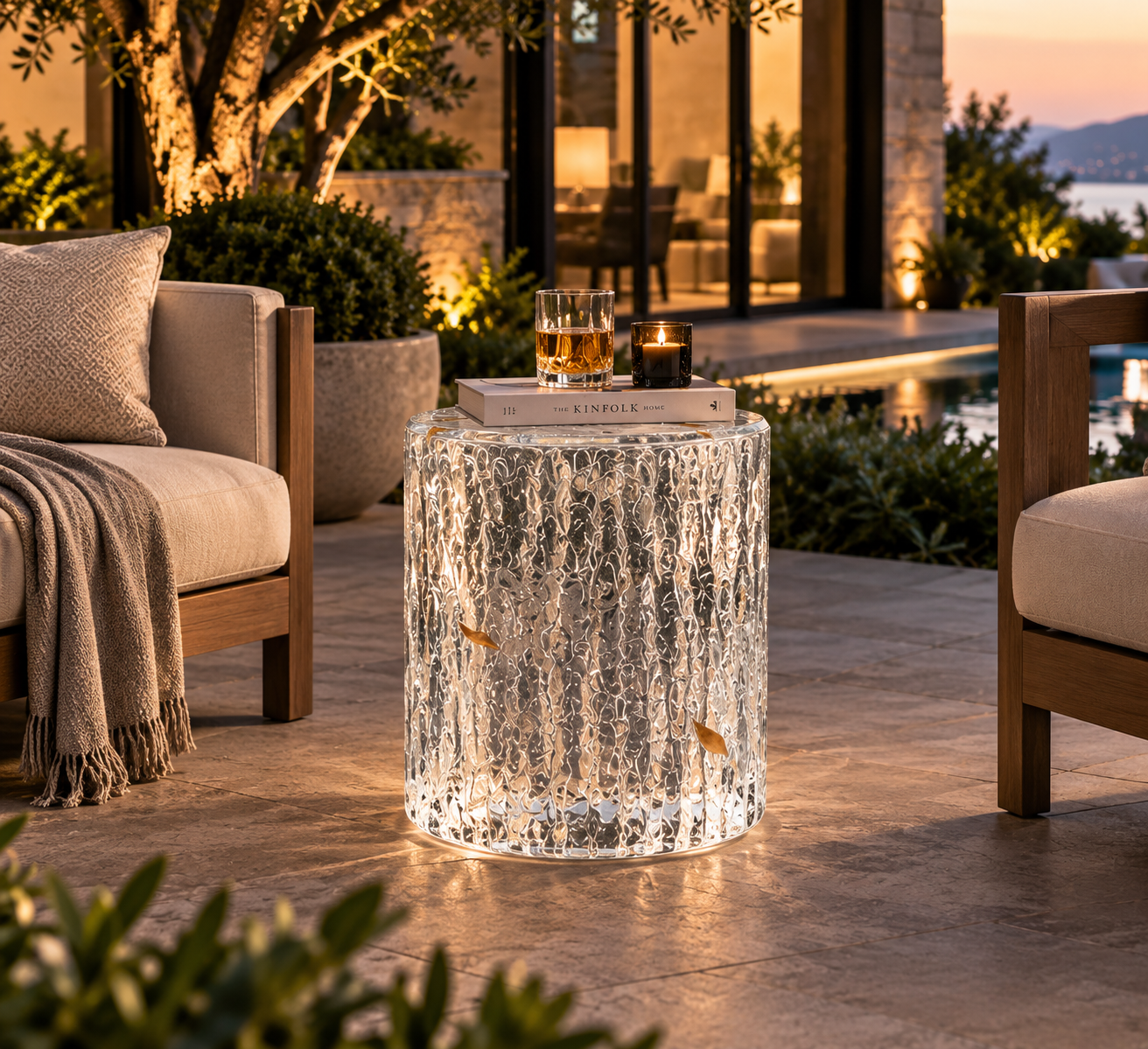
A translucent amber resin panel may appear relatively solid from one angle, then glow when backlit. A synthetic-crystal table base can remain subtle in diffuse daylight but create concentrated highlights under a directional spotlight. A transparent platinum acrylic console may visually disappear against a window during the day, while polished edges become strongly defined at night.
The object therefore has more than one identity.
Even mirrors are being reconsidered in similar terms. The Financial Times reported in September 2026 that designers are moving beyond using mirrors simply to make rooms appear larger and are instead treating reflective surfaces as architectural materials capable of introducing atmosphere, depth, tension, and changing relationships with surrounding spaces.
This broader interest in reflection, transparency, and changing perception explains why designers are looking beyond a palette composed entirely of matte stone and timber.
The new luxury interior does not necessarily need more decoration. It needs materials capable of revealing something different as the environment changes.
2. Light Is Becoming Part of the Material, Rather Than Something Added Afterward
Perhaps the strongest evidence of this shift can be found in how leading designers are working with resin and glass.
At Salone del Mobile 2026, Sabine Marcelis presented Plume, an installation centered on a 3.4-meter-high polished cast-resin fountain. The Salone's official description explains how colored translucent resin filters and transforms light, causing the form to appear to glow internally and change according to the viewer's position. Three accompanying resin wall works use carved spherical forms to concentrate and bend light through lens-like effects.
The important point is not simply that Marcelis used resin.
The material, color, light, internal geometry, and viewer were conceived as one system.
This thinking can translate directly into commercial furniture.
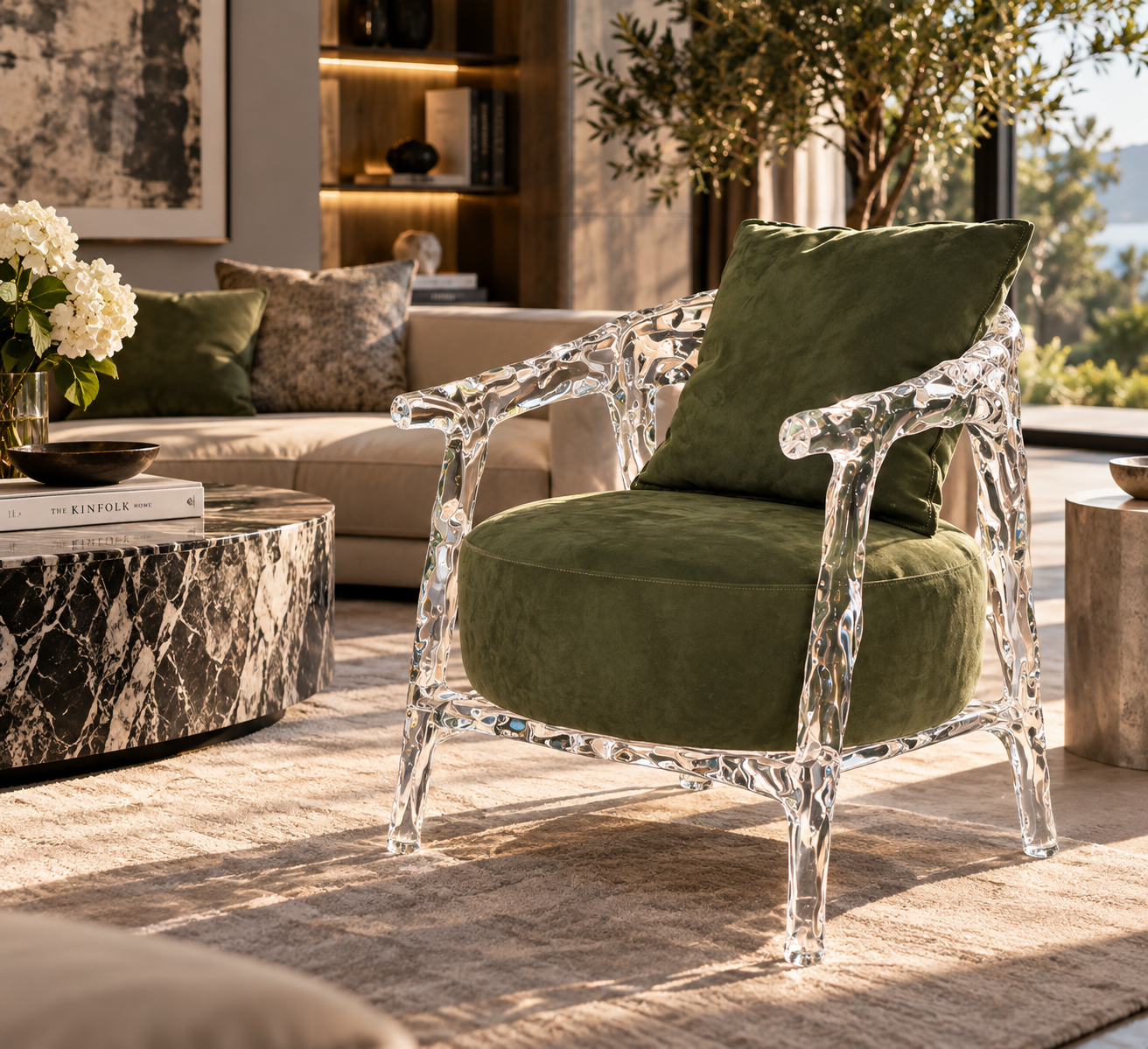
A high-end resin coffee table can use differences in transparency and pigmentation to create depth without any applied decoration. A synthetic-crystal console can use faceted elements to redistribute nearby light. Premium platinum acrylic can form transparent legs, thick table bases, pedestals, or display structures that carry light through their volume.
Technical properties make this increasingly practical. PLEXIGLAS reports visible-light transmission of up to 92% for its clear transparent PMMA products. The figure applies specifically to its own product range rather than all acrylic, but it demonstrates the level of optical performance possible from a properly specified premium acrylic material.
Interior Design offered another 2026 example with the Lamina sconce by Studio Guilty for Transnatural. The fixture uses layers of translucent recycled acrylic combined with tunable LEDs; as viewers move around it or adjust color temperature and intensity, the visual appearance of the layers changes. The components were also designed for disassembly and recycling.
For furniture designers, this suggests a valuable direction.
Instead of thinking of a table as one object and the lighting scheme as another, both can be developed together. The table edge can conduct light. Resin can diffuse it. Synthetic crystal can refract or reflect it. Acrylic can provide visually light structure.
The result is furniture that is not simply illuminated.
It participates in the lighting design.
3. Hotels and Commercial Spaces Need Materials That Create Memory, Not Just Expensive Backgrounds
The rise of light-responsive materials is also connected to a change in what commercial clients expect from interiors.
A luxury hotel, restaurant, flagship store, or private club is no longer judged only by whether it uses expensive materials. It is judged by whether the space creates a recognizable experience.
Hospitality design in 2026 is increasingly focused on emotion, atmosphere, and individuality. Shaw Contract's 2026 hospitality trend research emphasizes that guests want environments that feel authentic and memorable, while “quiet luxury” favors edited, intentional design rather than spectacle everywhere. The same report points to lighting, materials, acoustics, and spatial flow as increasingly integrated aspects of wellness and guest experience.
This creates a strong role for materials with high visual return.
A hotel does not need an entire lobby made from synthetic crystal. A single custom crystal-and-resin console at the entrance may be more effective.
A luxury boutique does not need transparent material on every wall. One platinum acrylic display table with polished edges and controlled illumination may be enough to distinguish the central product presentation.
A villa does not require illuminated resin furniture in every room. A single translucent dining-table base positioned beneath a sculptural pendant may create the memorable moment.
Professional lighting guidance reinforces this approach.
The Illuminating Engineering Society explains that hospitality lighting should establish visual hierarchy using contrast, shadows, varying light levels, and carefully illuminated destinations. Lighting is not simply about uniform brightness; it helps attract guests toward reception, restaurants, lounges, corridors, and other important areas.
This makes synthetic crystal and other light-responsive materials particularly useful at high-attention points.
Crystal can amplify a focused beam. Resin can turn concealed lighting into a soft glow. Acrylic can make a substantial furniture piece feel almost weightless while allowing illuminated architectural surfaces behind it to remain visible.
The commercial value is therefore not “sparkle.”
It is the ability to create a memorable focal point with relatively little material.
4. Sculptural Tables and Transparent Furniture Are Blurring the Boundary Between Product and Installation
Another major 2026 signal is the increased attention being given to furniture as sculpture.
Wallpaper* identified sculptural tables as one of the recurring trends at Salone del Mobile 2026, noting a broader movement toward furniture pieces that make strong visual statements rather than simply performing a functional role.
At the same time, glass is being used more architecturally.
Wallpaper*'s review of glass at Milan Design Week described projects in which overlapping, colored, and reflective glass moved beyond individual decorative objects to become spatial devices. Gallotti & Radice's 2026 presentation, for example, included low tables, consoles, and other pieces using fused glass, gradients, extra-light glass, metallic effects, and translucent coloration.
This creates a favorable environment for synthetic crystal, premium resin, and platinum acrylic furniture because these materials sit naturally between furniture and installation.
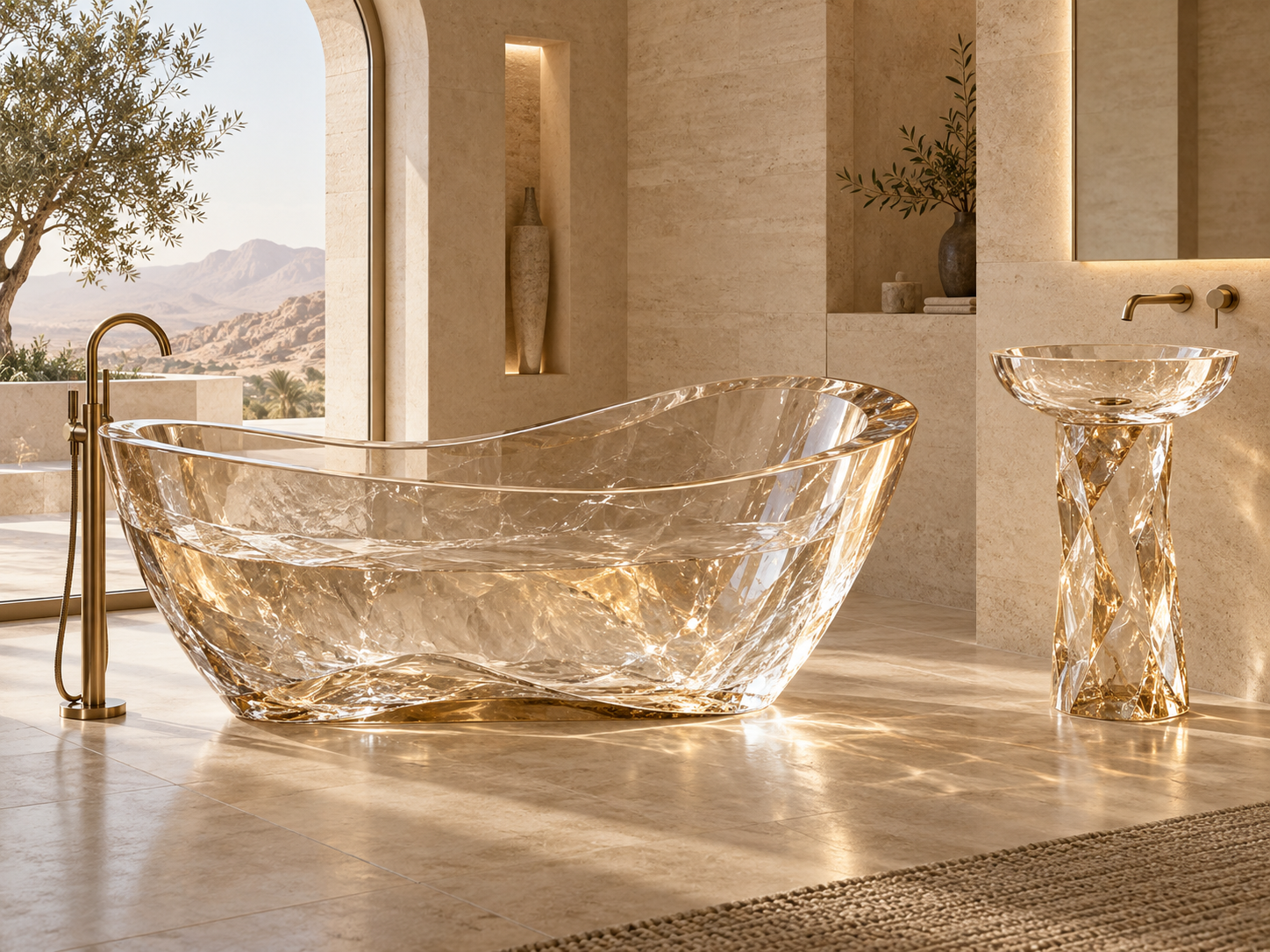
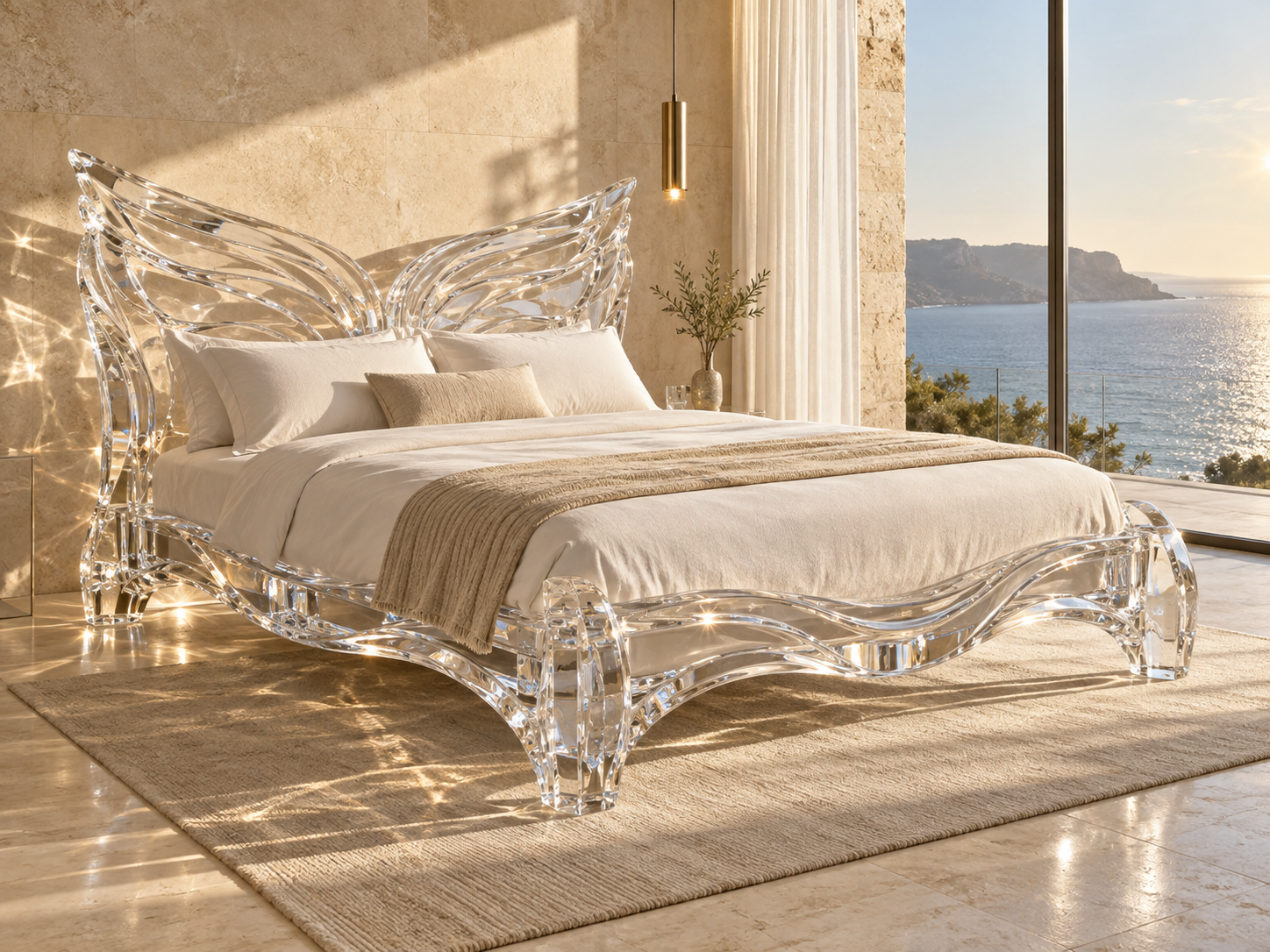
A thick clear acrylic table base can read like a volume of frozen light rather than a conventional support.
A colored resin console can behave almost like a monolithic sculpture.
A synthetic-crystal coffee table can create reflections that extend beyond the physical boundary of the furniture itself.
And combinations can be even more effective. Designers might specify a stone tabletop supported by a transparent acrylic base, embedding synthetic-crystal details inside the structure. Another project might pair smoky translucent resin with metal reinforcement, or place crystal-like inclusions within a colored casting.
The visual interest comes from the dialogue between density and transparency.
This is an important change from the traditional luxury formula, where furniture often communicated value through obvious material weight: thick marble, heavy bronze, dark timber, or elaborate upholstery.
Contemporary transparent furniture can communicate craftsmanship without occupying the room so aggressively.
That makes it particularly attractive in boutique hotels, penthouses, villas, luxury retail, and restaurants where designers want strong statement pieces while preserving sightlines and spatial openness.
In 2026, a successful table is increasingly capable of doing three jobs simultaneously: supporting objects, organizing space, and functioning as an optical experience.
5. Sustainability Is Pushing Designers Toward More Intelligent Material Use, Not Simply More Material
There is another reason expressive materials are being used more strategically.
Designers are facing increasing pressure to consider how much material they specify, how long it lasts, whether it can be repaired or separated, and what happens at the end of its useful life.
World Green Building Council estimates that buildings account for approximately 39% of global energy-related carbon emissions, with about 11% associated with materials and construction. The figure covers the built environment broadly, not furniture alone, but it illustrates why material decisions increasingly carry environmental as well as aesthetic implications.
This does not automatically make resin, acrylic, or synthetic crystal “sustainable.” Material chemistry, recycled content, manufacturing energy, durability, transport, repairability, and end-of-life pathways all matter, and vague environmental claims should be treated cautiously.
What is changing is the design strategy.
Instead of covering hundreds of square meters with visually intensive materials, designers can concentrate more technically sophisticated materials in smaller areas where they achieve greater impact.
One translucent resin reception desk can establish the character of a lobby. One crystal installation can define an entrance. One premium acrylic table can create a focal point within an otherwise restrained room.
Durability is also critical.
For example, PLEXIGLAS states that virtually all of its clear transparent sheet products are warranted against visible yellowing for 30 years and can retain high light transmission over that period, depending on grade and region. Again, this is a manufacturer-specific performance claim and should not be generalized to every acrylic product, but it demonstrates why specifiers need to distinguish between generic clear plastic and verified architectural-grade materials.
The same applies to high-end resin furniture.
Designers should ask about UV stability, heat resistance, color change, surface repair, fire performance where required, cleaning, and documented long-term behavior.
For synthetic-crystal furniture, attachment methods, replacement of individual elements, edge treatment, optical consistency, and cleaning access can be equally important.
The 2026 trend is therefore not simply toward visually dramatic materials.
It is toward more deliberate material performance.
6. The Next Step Is Controlled Light, Not Maximum Shine
The strongest light-responsive interiors are not necessarily the brightest or glossiest.
In fact, as reflective, transparent, and translucent materials become more common, designers need greater control.
WELL's lighting guidance explains that color quality depends on the interaction between a light source, the reflectance or absorption characteristics of an object, and human vision. Poor color quality can diminish the appearance of illuminated surfaces and reduce visual comfort.
Glare is equally important. WELL notes that excessive brightness and excessive brightness contrast can cause visual discomfort and fatigue, including glare generated by reflections from glossy surfaces.
For designers working with synthetic crystal, polished resin, mirror, glass, lacquer, or platinum acrylic, this means more reflection is not automatically better.
A crystal table should not produce uncomfortable glare at seated eye level.
A glossy resin reception desk should not reflect every downlight as a distracting hotspot.
A clear acrylic console should be modeled or mocked up with the actual lighting conditions rather than evaluated only under factory lights.
The best approach is selective activation.
Perhaps only the polished edges of an acrylic table catch the light. Perhaps most of a resin console remains softly translucent while one embedded crystal section produces concentrated reflections. Perhaps a landscape of matte plaster, timber, and fabric creates a quiet background against which a single transparent object becomes luminous.
This is where the 2026 material trend becomes more sophisticated than a fashion for “shiny surfaces.”
At its best, it represents a shift toward responsive materiality: materials whose appearance depends on the architecture, lighting, viewer, time of day, and surrounding colors.
That is also why the direction is relevant to synthetic-crystal, high-end resin, and platinum acrylic furniture.
These materials offer something conventional opaque furniture cannot easily provide. Their appearance is not fixed at the factory. It continues to be designed by the room around them.
For hotels, that can mean a lobby centerpiece that changes from daylight clarity to nighttime drama.
For luxury villas, it can mean furniture that feels visually light without looking inexpensive.
For retail, it can mean transparent or colored display furniture that reinforces both merchandise and brand identity.
For restaurants and clubs, it can mean surfaces that respond to lower, warmer evening lighting and become more atmospheric after dark.
The most important 2026 trend, therefore, is not crystal, acrylic, resin, glass, or lacquer individually.
It is the growing realization that material and light should no longer be designed separately.
As designers move away from interiors that depend entirely on expensive stone and metal to communicate luxury, light-responsive materials provide another vocabulary—one based on transparency, refraction, color, depth, movement, and controlled reflection.
Used carelessly, they can become decorative noise.
Used precisely, even a small amount can transform how an entire space is perceived.
And that may be the most important material lesson of 2026: the future of premium interiors is not simply about what a material is made from.
It is about what that material does when the light arrives.
READ MORE:
- Perché sempre più designer scelgono i mobili trasparenti negli interni contemporanei?
- Il cliente dice che il progetto “non è abbastanza speciale”? Parti dai materiali e dalla luce
- Oltre rattan e metallo: quali materiali scegliere per creare spazi outdoor davvero distintivi?
- Tavolini trasparenti, side table e mobili decorativi: come abbinarli senza far sembrare l’ambiente “economico”?
- Vuoi dare agli interni un aspetto più sofisticato? 5 idee di abbinamento con mobili in materiali trasparenti
- Courtyards, Pools, and Landscape Walls: Creative Applications of Synthetic Crystal in Outdoor Spaces
- How to Make an Entire Space Look More Expensive with Small-Area Decorative Materials
- Lighting + Synthetic Crystal: Why This Combination Is Increasingly Suited to Hotels, Villas, and Commercial Spaces
- Beyond Marble and Metal: What Other Materials Can Designers Use to Create a Striking Interior Focal Point?


