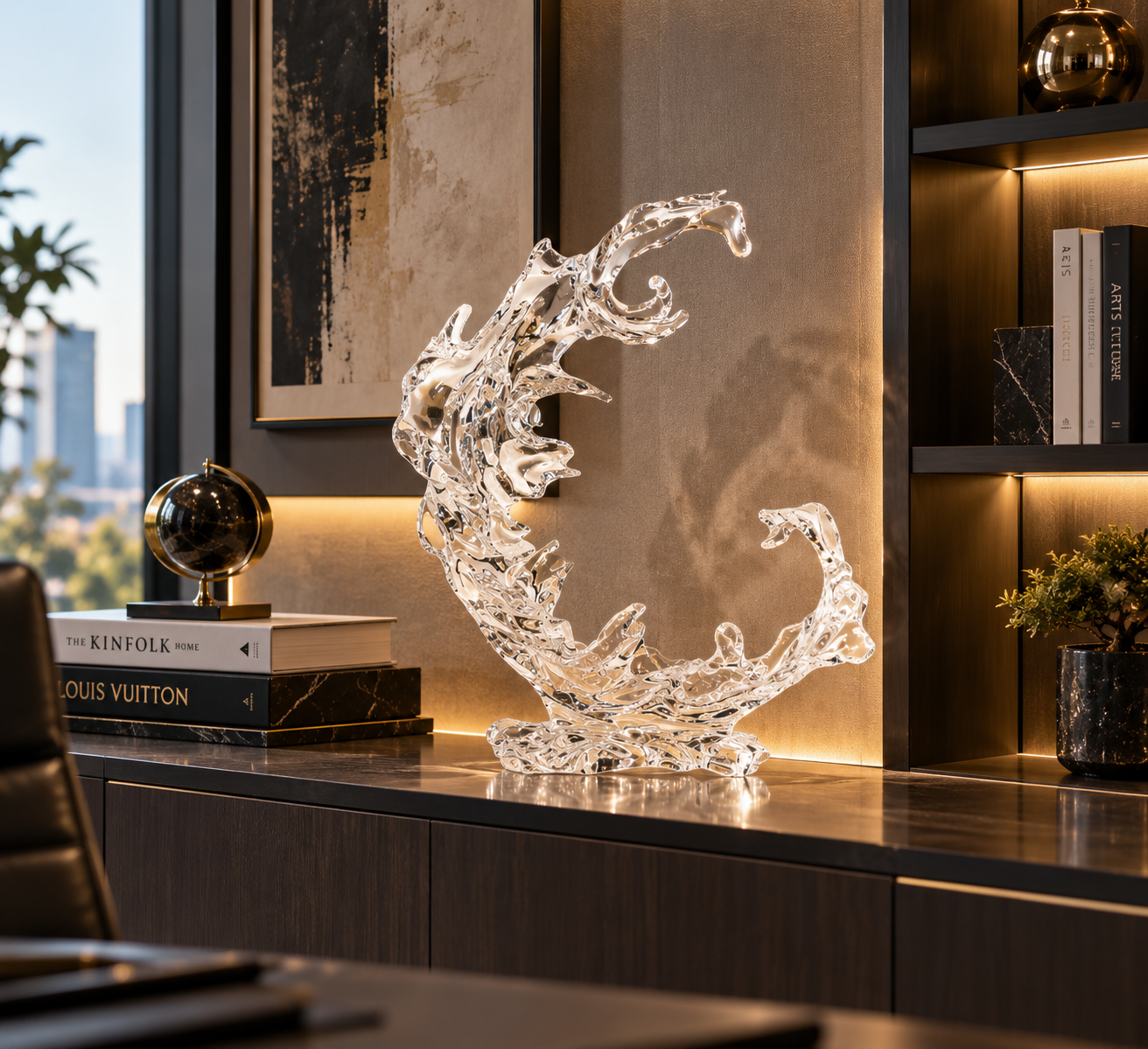

Making an interior look luxurious does not necessarily require covering every wall in marble, specifying brass everywhere, or filling a room with expensive furniture.
In many successful hospitality, residential, and retail interiors, the opposite approach works better: keep most of the architectural background relatively restrained, then invest in a limited number of materials and objects that attract attention exactly where the designer wants it.
This is essentially a question of visual return on material.
A small synthetic-crystal feature behind a reception desk may influence the perception of an entire lobby. A translucent resin console can give an otherwise neutral entrance an unmistakably bespoke quality. One sculptural platinum acrylic coffee table may make a living room feel more sophisticated without increasing the amount of stone, timber, or metal used throughout the architecture.
Professional lighting practice supports the same principle. The Illuminating Engineering Society notes that hospitality lighting is not simply about uniform illumination. Contrast, shadows, changing light levels, and carefully illuminated destinations can establish visual hierarchy and create drama.
For designers working with limited budgets—or simply trying to avoid excessive decoration—the question therefore should not be, “How can we use more premium material?”
A better question is: Where can a small amount of the right material create the greatest perception of value?
1. Put Premium Materials Where the Eye Naturally Stops
The first rule of creating luxury with a small amount of material is concentration.
If the expensive material is distributed evenly throughout a room, it becomes part of the background. When it is concentrated at one important location, it becomes a focal point.
Hotel design offers a particularly clear example.
When SFA Design renovated the Renaissance Esmeralda Resort & Spa in California, Interior Design reported that one of the major challenges was creating focus and intimacy within its enormous seven-story atrium. Rather than filling every surface with elaborate finishes, the designers introduced a dramatic chandelier composed of approximately 280 crystal and metal pieces suspended at different heights. According to the designer, the installation helped provide both visual interest and a sense of scale.
That is an important lesson for smaller projects as well.
A villa entrance does not need crystal on every wall. A custom synthetic-crystal console positioned directly on the arrival axis may be enough. A hotel lobby does not necessarily need premium resin throughout the floor and walls. A translucent resin reception desk can concentrate attention at the most important customer touchpoint.
The same logic applies to restaurants and retail stores. Materials with high visual impact should be placed where people naturally pause: reception, the end of a corridor, behind a bar, beneath a feature light, beside a staircase, in a display window, or at the center of a seating composition.
Gensler uses this approach in hospitality projects as well. At the Vdara Club Lounge in Las Vegas, decorative lighting fixtures were deliberately used as visual focal points within different zones rather than treating every surface as equally important.
For synthetic crystal, high-end resin, and platinum acrylic furniture, this creates a significant advantage. These materials do not need to occupy many square meters to be noticed.
One 1.5-meter console in the right location may have more visual influence than 100 square meters of an expensive but visually repetitive finish.
Luxury begins with hierarchy.
2. Use Transparent and Light-Responsive Materials for Disproportionate Visual Impact
Some materials have a higher visual impact relative to their physical size because they interact with their surroundings.
Synthetic crystal, transparent resin, glass, mirror, and premium acrylic belong to this category.
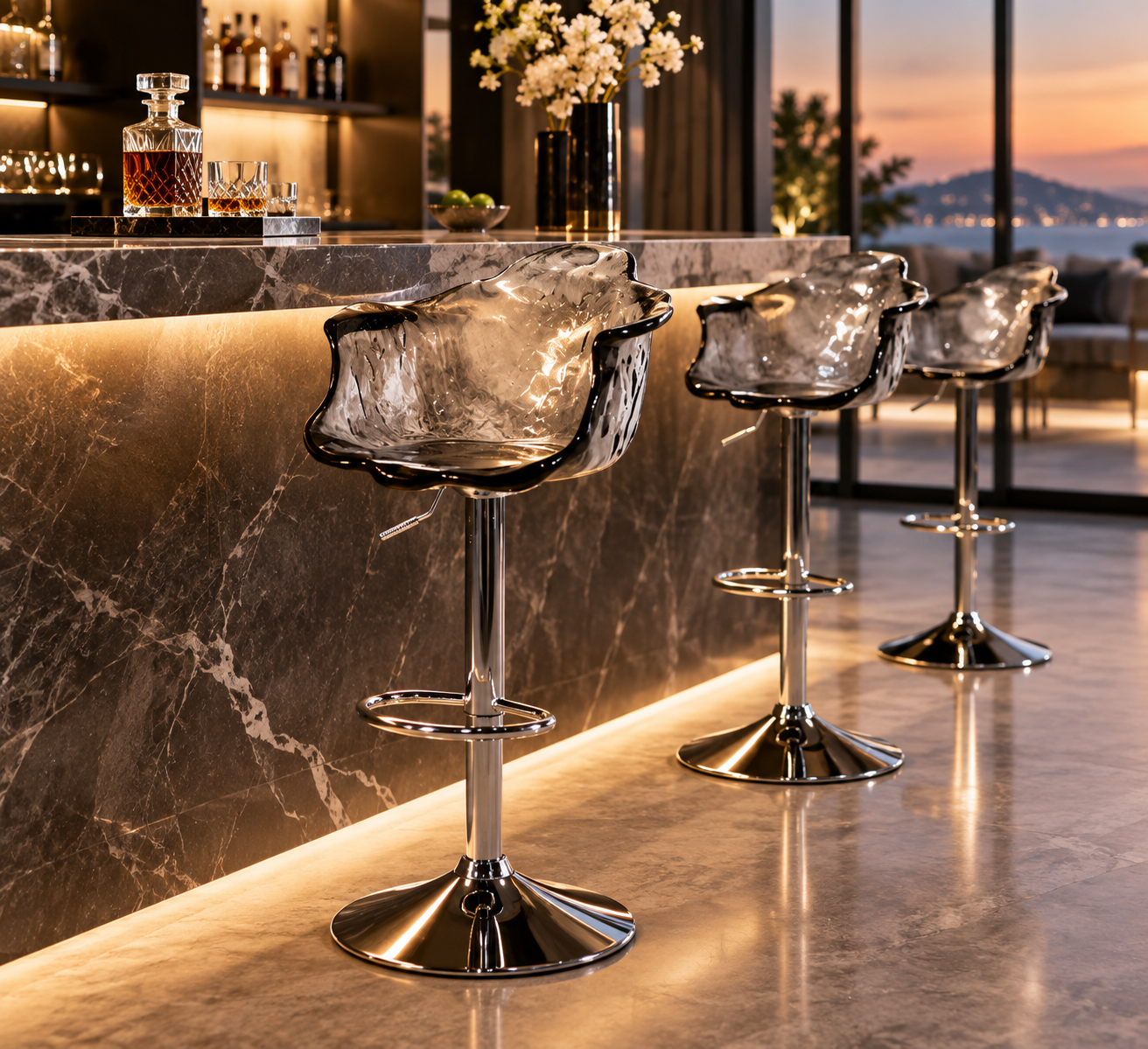
A timber panel occupies exactly the area that it covers. A synthetic-crystal element can visually affect a much larger area because it catches light, reflects nearby colors, produces highlights, and changes as the viewer moves.
Premium acrylic behaves similarly through transparency.
Technical information from PLEXIGLAS states that certain clear transparent PMMA products can achieve visible-light transmission of up to 92%. This allows a substantial acrylic furniture piece to maintain relatively low visual weight because the architecture behind it remains visible.
This is particularly useful in luxury apartments, villas, boutique hotels, and retail interiors where space itself is valuable.
Consider two coffee tables of the same dimensions. A dark stone table becomes a strong solid mass in the center of the room. A thick platinum acrylic coffee table can still demonstrate craftsmanship and material quality, but visually it allows the rug, flooring, and surrounding furniture to continue through the composition.
The result can feel simultaneously substantial and light.
Design history provides an influential example. Shiro Kuramata's 1988 Miss Blanche Chair, held in MoMA's collection, used synthetic flowers embedded inside transparent acrylic resin. Rather than applying ornament onto the chair's surface, Kuramata suspended the decorative elements within the material, making them appear to float. MoMA describes the piece as an icon of postmodern design and notes the painstaking fabrication involved in positioning each flower while the resin hardened.
The same principle can be translated into contemporary custom furniture.
Synthetic crystal fragments can be embedded or suspended within premium resin. Crystal-like forms can appear inside a transparent platinum acrylic table base. Colored resin can gradually shift from clear to amber, smoke, emerald, or another project-specific tone.
A relatively small furniture object can consequently provide several layers of visual information: transparency, color, reflection, internal detail, shadow, and changing light.
That complexity is one reason a carefully designed transparent object can make a room feel more bespoke without physically occupying more of it.
3. Create Contrast Instead of Making Every Material “Luxury”
A common mistake in high-end interiors is allowing every surface to compete.
Polished marble meets polished brass, which meets mirrored glass, which sits beside highly figured timber, decorative wall panels, patterned textiles, and sculptural lighting. Each material may be expensive individually, yet together they can make the room feel visually noisy rather than luxurious.
Premium materials need quieter materials around them.
An interesting example can be seen in Atelier TAO+C's 96-square-meter MOMIC watch store in Hangzhou. ArchDaily describes a restrained composition of dark green, pale green, and white marble blocks interrupted by orange acrylic and blue metal accents. Those relatively small areas of contrasting color gave the store an expressive identity and helped attract attention from the beginning of the customer's journey.
The principle is highly relevant when specifying synthetic crystal and resin.
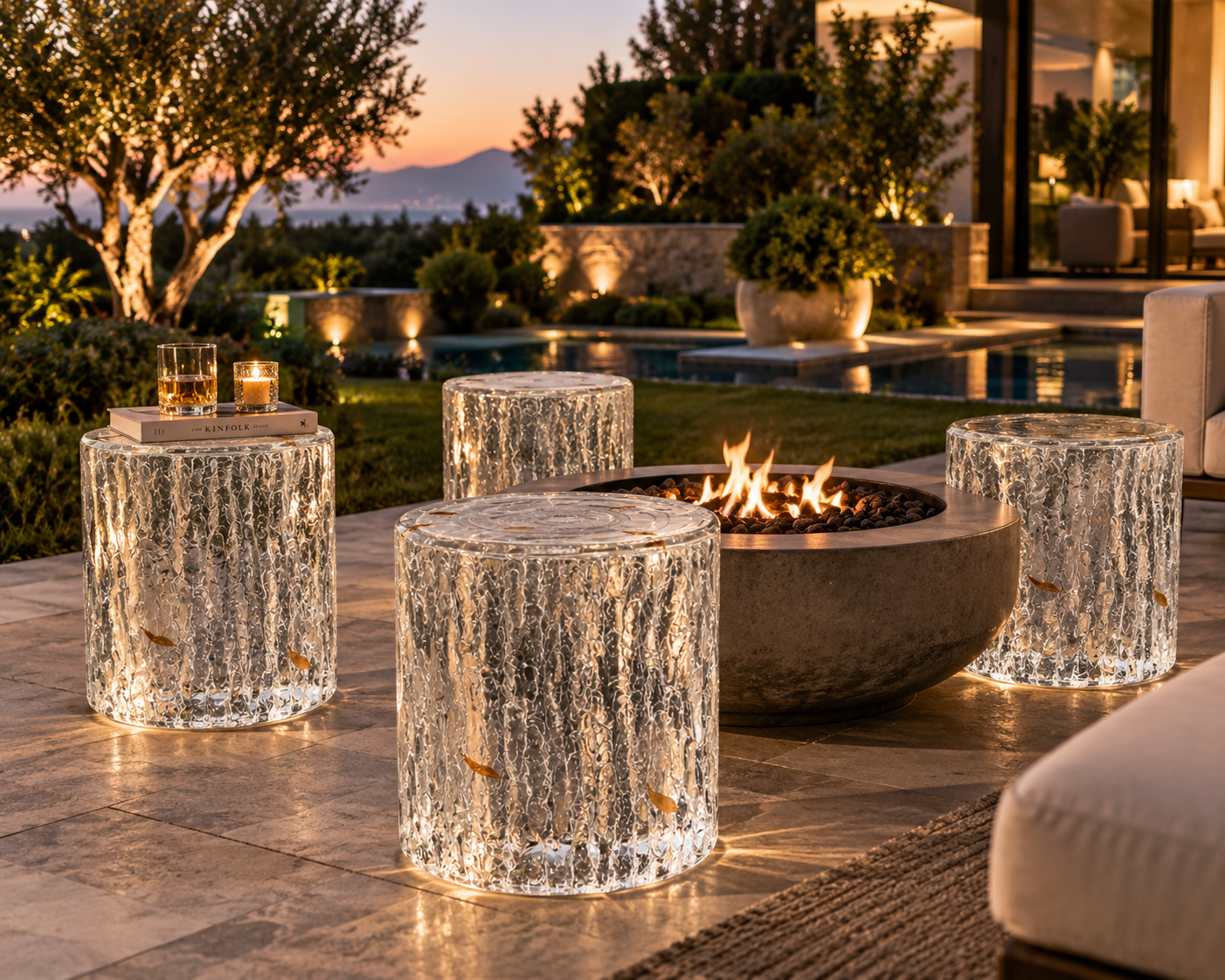
A synthetic-crystal side table often looks more sophisticated beside matte limestone, textured plaster, neutral upholstery, or dark timber than beside five other reflective materials.
Similarly, a deep amber high-end resin console can become dramatically more noticeable against an off-white wall than it would against a highly patterned stone background.
Interior Design's coverage of the Wild Palms Hotel offers another useful example. The renovated lobby uses a custom mobile made from acrylic discs as a central feature within an otherwise coordinated interior composition. The acrylic installation becomes memorable precisely because it has a clear role within the visual hierarchy.
For designers using platinum acrylic furniture, the contrast can also come from visual weight rather than color.
A transparent acrylic base under a solid stone dining tabletop creates a deliberate opposition between mass and invisibility. A clear console against a heavily textured wall allows the texture to remain visible through the furniture. A crystal detail inserted into a matte resin table provides one concentrated reflective moment instead of making the entire object sparkle.
The objective is not to make every material look expensive.
It is to make the relationship between ordinary, quiet, and exceptional materials feel intentional.
That sense of control is one of the strongest signals of luxury.

4. Use Lighting to Multiply the Value of a Small Decorative Surface
A premium material becomes significantly more effective when lighting is designed around it.
This is particularly true for synthetic crystal, resin, acrylic, textured glass, metallic finishes, and other materials whose appearance changes according to illumination.
The Illuminating Engineering Society specifically emphasizes visual hierarchy in hospitality environments. Effective hospitality lighting uses differences in brightness, contrast, shadow, and direction to attract guests toward important destinations and create atmosphere rather than illuminating everything uniformly.
For designers, this means a one-square-meter decorative feature can appear far more important than its actual dimensions suggest.
Imagine a narrow synthetic-crystal panel behind a hotel reception desk. Under ordinary ceiling lighting, it may simply appear decorative. Introduce concealed grazing light or controlled backlighting and the same small area can produce reflections and highlights that influence the entire reception zone.
High-end resin offers different possibilities.
A translucent champagne-colored resin console can be illuminated from beneath or behind so that the material develops an internal glow. Platinum acrylic can use edge lighting to reveal polished profiles while leaving the center relatively transparent. Synthetic-crystal inclusions can then provide sharper points of brilliance.
Color quality is critical when using this strategy.
The WELL Building Standard notes that lighting color quality directly affects visual appeal and the accurate appearance of illuminated objects. Poor color rendering can make surfaces, plants, food, and skin tones appear dull or incorrectly saturated. WELL's guidance has used a CRI threshold of at least 80 for general electric lighting covered by its color-quality requirements.
This matters when specifying expensive decorative materials.
There is little value in choosing a carefully formulated burgundy resin or champagne-tinted acrylic if the lighting makes the color appear flat. Likewise, synthetic crystal can lose much of its visual depth when illumination is too diffuse or when every nearby surface has the same brightness.
The designer therefore gets more value from premium materials when the furniture supplier, interior designer, and lighting designer coordinate early.
Sometimes the smartest way to make a room appear more expensive is not buying another expensive surface.
It is illuminating the one you already selected properly.
5. Invest in Bespoke Furniture Rather Than Expensive Finishes Everywhere
Small-area luxury becomes especially effective when premium material is concentrated in objects people can identify as custom-made.
A standard room with one unusual piece of furniture can feel more bespoke than a room filled with expensive but familiar products.
This is why reception desks, consoles, coffee tables, side tables, bar counters, display pedestals, and dining-table bases are strategically useful.
At the Boatyard Hotel in Suzhou, for example, Interior Design reported that a sculptural acrylic installation introduces a pop of color at the custom reception desk. The feature is concentrated around a key arrival moment rather than spread throughout the entire hotel.
Another hospitality project, the ME Sitges Terramar Hotel in Spain, used a custom reception desk topped in ash and faced with marble-resin panels, demonstrating how hybrid materials can give a functional object a project-specific identity.
For manufacturers working with synthetic crystal, high-end resin, and platinum acrylic, furniture provides an ideal bridge between art and function.
A sculptural resin console is not simply decoration: it stores or displays objects while establishing a visual signature. A transparent acrylic dining-table base solves a structural requirement while reducing visual mass. A synthetic-crystal coffee table can provide a usable surface while acting like a jewelry element within the room.
Furniture also offers flexibility that permanent architecture does not.
Hotels eventually renovate. Retail brands change merchandising. Villa owners rearrange rooms. A custom statement table can be relocated, refinished, replaced, or even transferred to another property more easily than an entire feature wall.
The U.S. Green Building Council emphasizes that interior designers influence environmental performance not only through architectural finishes but also through choices involving furniture, lighting, texture, colors, layouts, and custom casework.
This reinforces an important point: furniture should not be treated as the final layer added after the “real” interior has been designed.
In many projects, a relatively small piece of custom furniture can be the element that makes the entire interior memorable.
6. True Luxury Comes From Precision and Restraint, Not Simply Expensive Materials
There is one final reason small-area decoration can outperform large amounts of expensive material: it forces attention onto quality.
When a designer specifies only one transparent console in a lobby, every edge matters.
The polish matters. The joints matter. The optical clarity matters. The geometry matters. The relationship with the flooring matters. The way the light reaches it matters.
This is where premium synthetic crystal, high-end resin, and platinum acrylic have to be treated as serious design materials rather than simply decorative plastics.
A poorly polished acrylic edge immediately reduces perceived quality. Bubbles that were not intended as part of a resin design can look like fabrication defects. Visible adhesive or inaccurate crystal placement can destroy the precision that luxury clients expect.
Conversely, excellent craftsmanship allows even a relatively small object to communicate considerable value.
Material restraint also has a broader environmental logic. The World Green Building Council has reported that buildings account for approximately 39% of global energy-related carbon emissions, including around 11% associated with materials and construction. While this figure applies to the building sector broadly rather than decorative furniture alone, it reinforces the value of considering material quantity, longevity, and lifecycle rather than equating luxury with maximum consumption.
A sophisticated interior can therefore use premium materials selectively.
Let plaster remain plaster. Let timber provide warmth. Let stone anchor the architecture. Then decide where synthetic crystal, resin, acrylic, specialty glass, metal, or another distinctive material will produce the greatest visual return.
Perhaps it is a crystal console at the entrance.
Perhaps it is a translucent resin coffee table beneath a pendant light.
Perhaps it is a platinum acrylic dining-table base that almost disappears beneath a dramatic stone top.
Perhaps it is only a narrow illuminated crystal feature integrated into the reception desk.
The amount of material may be small, yet the impact can define how the entire project is perceived.
That is the real strategy behind making a space look more expensive.
It is not about convincing clients that every square meter needs a luxury finish. It is about understanding where people look first, what they remember, how materials react to light, and which details communicate customization and craftsmanship.
When visual hierarchy is clear, contrast is controlled, lighting is coordinated, and premium materials are concentrated at the right moments, a designer can achieve something far more convincing than simple extravagance.
The space does not merely contain expensive materials.
It feels considered—and that is what makes it feel truly luxurious.
READ MORE:
- Perché sempre più designer scelgono i mobili trasparenti negli interni contemporanei?
- Il cliente dice che il progetto “non è abbastanza speciale”? Parti dai materiali e dalla luce
- Oltre rattan e metallo: quali materiali scegliere per creare spazi outdoor davvero distintivi?
- Tavolini trasparenti, side table e mobili decorativi: come abbinarli senza far sembrare l’ambiente “economico”?
- Vuoi dare agli interni un aspetto più sofisticato? 5 idee di abbinamento con mobili in materiali trasparenti
- 2026 Spatial Material Trends: Why Designers Are Turning to Materials That Play With Light and Shadow
- Courtyards, Pools, and Landscape Walls: Creative Applications of Synthetic Crystal in Outdoor Spaces
- Lighting + Synthetic Crystal: Why This Combination Is Increasingly Suited to Hotels, Villas, and Commercial Spaces
- Beyond Marble and Metal: What Other Materials Can Designers Use to Create a Striking Interior Focal Point?


