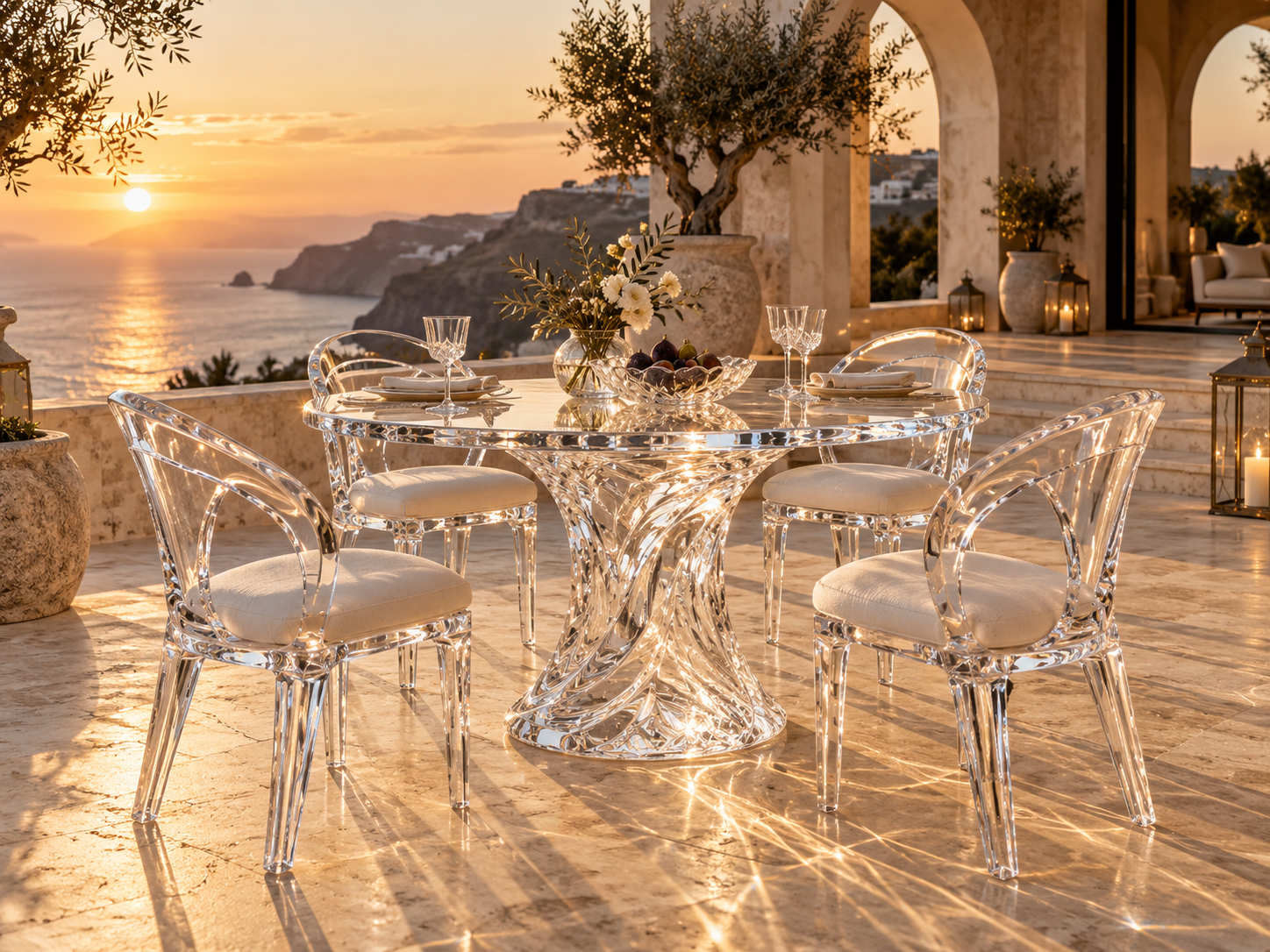
For decades, transparent materials in interiors were treated primarily as supporting elements: a glass partition, an acrylic display case, a decorative resin panel, or a translucent lighting feature. Today, that hierarchy is changing. Synthetic crystal, premium casting resin, and high-grade acrylic are increasingly moving from the background of interior design to the center of the room, becoming dining tables, coffee tables, consoles, benches, chairs, shelving systems, sculptural installations, and illuminated architectural furniture.
The shift is part of a broader transformation in luxury interiors. Contemporary clients are no longer defining premium design simply through expensive natural materials. Marble, solid timber, brass, leather, and natural stone remain important, but designers are increasingly interested in materials that can manipulate light, create unusual volumes, reduce visual heaviness, and deliver highly customized forms.
The American Society of Interior Designers identified both “quiet luxury” and the growing intersection of sustainability and wellness as important influences on contemporary interiors in its 2024 Trends Outlook. That combination is significant: luxury is becoming less about obvious ornament and more about material quality, atmosphere, craftsmanship, longevity, and a carefully controlled spatial experience.
Within that context, synthetic crystal and advanced transparent polymers are no longer substitutes for something else. Used intelligently, they represent a distinct design language of their own.
1. Transparency Has Evolved from Decoration into Furniture Architecture
Transparent furniture is not a completely new phenomenon. What is new is the confidence with which designers are allowing transparency itself to define the architecture of an object.
The history of modern design shows how radical that idea once appeared. The Museum of Modern Art holds a Gilbert Rohde chair from around 1938 made from stainless steel and Plexiglas, an early example of designers experimenting with transparent polymers as structural furniture materials. MoMA notes that acrylic materials such as Plexiglas and Lucite attracted considerable attention during the late 1930s, when synthetic transparency still seemed technologically futuristic.
Half a century later, Japanese designer Shiro Kuramata demonstrated how far the material language could go. His celebrated 1988 Miss Blanche Chair, now in MoMA's collection, is constructed from acrylic resin panels containing artificial red roses. Instead of applying decoration to the surface, Kuramata suspended the visual narrative inside the material itself. The resin simultaneously became structure, surface, color field, display case, and artistic medium.
This principle is particularly relevant to today's synthetic-crystal and high-end resin furniture. A transparent dining-table base, for example, does not have to behave like an invisible replacement for glass. A thick cast pedestal can refract light through its edges, encapsulate pigments or decorative objects, create controlled bubbles or textures, and produce changing visual effects as a person moves around it.
A console made from high-end resin can therefore function almost like a piece of sculpture. A synthetic-crystal coffee table can appear massive when viewed through its edges but almost disappear when seen through its clear surfaces. Platinum acrylic can form precise geometric legs, cantilevered shelves, transparent plinths, or layered architectural components.
The important change is conceptual: transparency is no longer simply an aesthetic finish. It has become a method of constructing visual space.
2. Synthetic Crystal Changes How Furniture Occupies Space
One of the most important advantages of crystal-clear engineered materials is not simply that they are transparent. It is that they change the perceived volume of furniture.
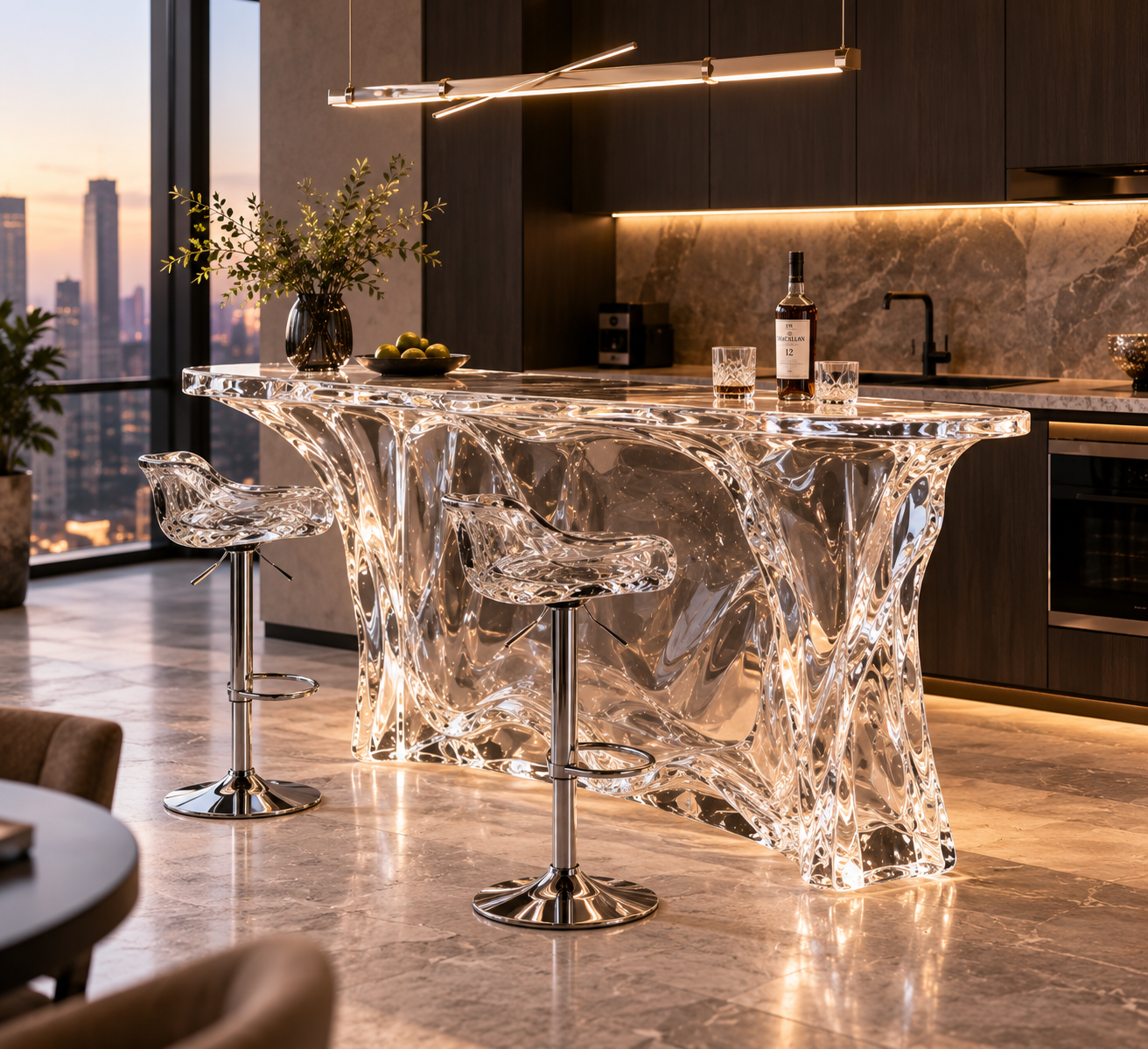
Traditional furniture creates visually solid boundaries. A dark timber dining table weighing heavily on four large legs can divide a room even when its physical footprint is relatively small. Replace those supports with highly transparent synthetic-crystal or acrylic structures, however, and the same functional object can occupy considerably less visual space.
This makes transparent furniture particularly valuable in luxury apartments, hotel suites, high-end retail environments, restaurants, galleries, penthouses, entrance halls, and other projects where designers want dramatic furniture without making the architecture feel crowded.
Material performance reinforces the design opportunity. Röhm states that clear PLEXIGLAS acrylic can provide visible-light transmission of up to 92 percent. Its published environmental and technical documentation gives PMMA a density of approximately 1,190 kg/m³, while the company describes acrylic as roughly half the weight of glass. Exact properties naturally depend on grade, thickness, production method, coatings, and manufacturer, but the figures illustrate why premium PMMA has become useful in applications requiring both optical clarity and easier fabrication.
There is also a deeper connection between transparent materials and contemporary approaches to light. Research published in the Journal of Clinical Sleep Medicine found meaningful differences in light exposure, sleep, and reported well-being between office workers with and without window access. Later research involving optimized daylight conditions also reported longer sleep duration and higher cognitive-performance scores among participants working under better daylight and view conditions. Transparent furniture obviously cannot create daylight, but it can help designers avoid unnecessarily blocking existing light, views, and visual connections within a space.
This is where a crystal table, acrylic console, or transparent resin bench becomes more than an attractive object. Its value is relational: it interacts with the architecture around it.
Placed near glazing, a thick transparent table can collect daylight along polished edges. Positioned above stone flooring, it allows the floor pattern to remain visually continuous. Combined with concealed LEDs, translucent resin can transform from furniture during the day into an ambient-light object at night.
The furniture is therefore not merely placed inside the space. It participates in how the space is perceived.
3. High-End Resin Turns Furniture into a Customizable Art Medium
Transparency alone does not explain the growing interest in advanced resin furniture. The second major attraction is freedom of expression.
Natural materials arrive with inherited limitations. A marble slab has geological veining. Timber carries grain direction, knots, color variation, and dimensional restrictions. These qualities are beautiful, but the designer works with characteristics created by nature.
Casting materials reverse that relationship. Depending on the resin chemistry, manufacturing process, mold technology, curing conditions, and finishing method, designers can influence color, translucency, internal inclusions, gradients, thickness, geometry, and surface appearance.
That freedom makes premium resin particularly suitable for limited-edition furniture and hospitality projects where differentiation matters. A hotel may request reception furniture incorporating a color associated with its brand. A fashion boutique may need display plinths whose transparency allows merchandise to remain visually dominant. A residence may commission a dining table containing artistic inclusions, mineral-like textures, metallic fragments, or controlled color transitions.
Historical museum collections demonstrate that resin has long been capable of moving between industry, furniture, and art. Besides Kuramata's acrylic-resin Miss Blanche Chair, The Metropolitan Museum of Art includes Zaha Hadid's 2006 Gyre lounge chair, produced in polyester resin and lacquer, in its modern design collection. Such works show that resin is not restricted to coatings or inexpensive molded products; in the hands of ambitious designers, it can become the principal medium through which a furniture concept is expressed.
This is especially relevant for manufacturers working with thick synthetic-crystal castings or high-end resin. The competitive advantage should not be presented merely as “we can make a transparent table.” Many materials can create transparency.
The more valuable proposition is the ability to engineer depth.
A polished 10-millimeter transparent sheet and a substantial cast-resin table base may share transparency, but emotionally they are entirely different. The thick object creates internal reflections, distorted perspectives, edge brilliance, shadow, refraction, and a sense of frozen volume. With careful finishing, it can resemble an enormous optical object rather than conventional plastic furniture.
That is where advanced casting, hand polishing, precision joining, pigment control, inclusion technology, and custom molding become part of luxury craftsmanship.
4. Platinum Acrylic Brings Precision to the Luxury-Transparency Concept
Where cast resin excels at sculptural mass and artistic depth, premium acrylic excels at optical precision, controlled geometry, and fabrication flexibility. Used together, the two materials can give designers a much broader vocabulary.
For a manufacturer marketing a premium furniture collection as platinum acrylic, the strongest positioning is therefore not simply “clear acrylic.” High-end buyers will want to understand what distinguishes the material and manufacturing process: optical quality, sheet or block thickness, polishing, edge clarity, bonding quality, UV behavior, tolerances, surface treatment, and long-term appearance.
Röhm's technical literature demonstrates why these specifications matter. Its optical PMMA products combine high transmission with low weight, while some grades offer hard-coated surfaces for improved abrasion and chemical resistance. The company specifically identifies furniture, shopfitting, exhibition construction, wall cladding, and display applications among appropriate uses for advanced acrylic products.
The design possibilities are significant. A platinum-acrylic dining-table base can support a stone, glass, resin, or matching acrylic top while remaining visually quiet. A console can combine polished acrylic legs with high-end resin slabs. Acrylic shelving can appear to float in a luxury retail environment. Transparent side tables can be nested without creating the visual clutter associated with multiple pieces of solid furniture.
Modern commercial interiors already demonstrate the value of this approach. ArchDaily has documented retail environments using transparent and matte acrylic together with stainless steel to create modular display furniture, as well as spaces where acrylic furniture helps preserve a sparkling, visually open environment.
The key is specification. Premium transparent furniture must be designed around its actual application. A decorative pedestal, a dining table, a hospitality bench, and a retail display have different requirements for loading, scratches, chemicals, fire performance, stability, joints, and maintenance.
Luxury is therefore created not only by visual purity but by engineering discipline behind that purity.
5. The Next Luxury Standard Is Transparency About the Material Itself
The irony of transparent furniture is that its appearance may be perfectly clear while its technical story remains opaque. That is becoming increasingly problematic in professional design.
Architects, interior designers, developers, and hospitality groups are paying closer attention to material ingredients, emissions, durability, sourcing, maintenance, end-of-life options, and environmental documentation.
WELL's material-transparency framework, for example, encourages ingredient disclosure for interior finishes, furnishings, workstations, and built-in furniture. LEED likewise treats furniture and material selection as part of indoor environmental quality, and its current requirements reference recognized testing frameworks for furniture emissions.
For suppliers of synthetic crystal, high-end resin, and acrylic furniture, this changes the sales conversation. Beautiful photography is still essential, but professional buyers increasingly need technical data sheets, material declarations, recommended cleaning procedures, load information, fire-test documentation where required, VOC information, packaging specifications, and guidance on repair or refurbishment.
Sustainability must also be discussed with precision rather than slogans. Transparent polymers are engineered materials, and different acrylic and resin systems can have very different environmental profiles. A credible premium brand should therefore avoid automatically describing every resin product as “eco-friendly.”
A stronger argument is longevity and responsible material design.
The U.S. Environmental Protection Agency estimates that approximately 600 million tons of construction and demolition debris were generated in the United States in 2018, more than twice the quantity of municipal solid waste generated that year. Furniture is only one part of the much wider built-environment material system, but the scale illustrates why architects increasingly think about durability, disassembly, repair, reuse, and material recovery.
The Ellen MacArthur Foundation similarly argues that circularity needs to be addressed upstream during design, because early decisions determine how resources are used and whether products and materials can remain in circulation.
For premium transparent furniture, the future belongs to manufacturers that can combine beauty with documentation: replaceable components, polished surfaces that can be restored where technically possible, modular connections, carefully selected resin systems, recyclable PMMA grades where appropriate, and products designed to remain desirable long enough that clients do not want to discard them.
6. Synthetic Crystal Is Becoming a Tool for Spatial Identity
The most important transformation is ultimately commercial as much as aesthetic. Furniture is becoming part of brand architecture.
In a luxury hotel lobby, one large crystal-clear reception desk can define the guest's first impression. In a jewelry store, transparent display furniture can allow the products rather than the fixtures to command visual attention. In a villa, a monumental synthetic-crystal dining table can become the centerpiece around which the entire interior composition is organized. In a restaurant or club, colored resin furniture illuminated from within can create an instantly recognizable atmosphere.
Contemporary architectural projects increasingly use translucent and transparent materials precisely for this ability to control identity through light. ArchDaily, for example, has documented interiors where transparent acrylic tubes, colored glass, and translucent materials were deliberately combined to evoke the appearance of crystals, as well as retail spaces where reflections between metal, wood, and acrylic create visual depth and communicate brand character.
This is the direction in which synthetic-crystal furniture has the greatest opportunity.
The market does not need another transparent coffee table simply because transparency is fashionable. What architects, designers, developers, furniture brands, and luxury homeowners can value is a material system capable of solving several design problems simultaneously: creating a strong visual signature without excessive visual weight, interacting with natural and artificial light, supporting customized colors and forms, integrating art inside the material, coordinating with stone and metal, and producing furniture that feels specific to a project rather than selected from a generic catalog.
Synthetic crystal, high-end resin, and platinum acrylic therefore work best when they are positioned not as alternatives to natural stone, glass, or wood, but as additional instruments available to contemporary designers.
That distinction matters.
Natural marble celebrates geological history. Timber expresses warmth and organic grain. Metal communicates strength and precision. Synthetic crystal and premium transparent resin offer something fundamentally different: the ability to design with optical depth, suspended imagery, light, transparency, and seemingly impossible volumes.
That is why these materials are moving from accessories and decoration toward tables, consoles, benches, chairs, counters, shelving, lighting objects, and large custom installations.
The future of transparent furniture will not be defined by how successfully it imitates crystal or glass. It will be defined by what designers can create when transparency itself becomes the material.
And at that point, synthetic crystal is no longer decorating the room.
It is helping design the room.


