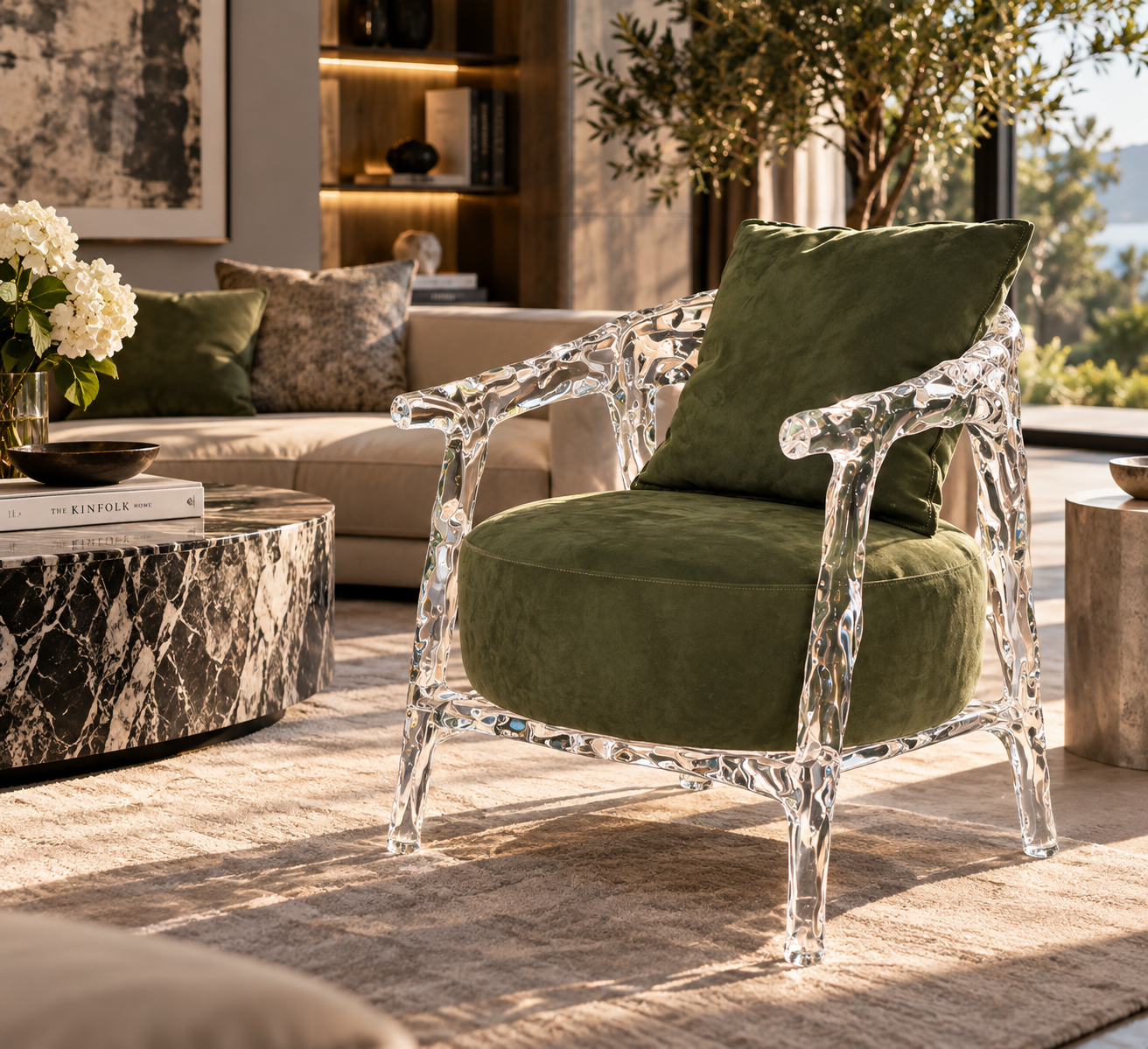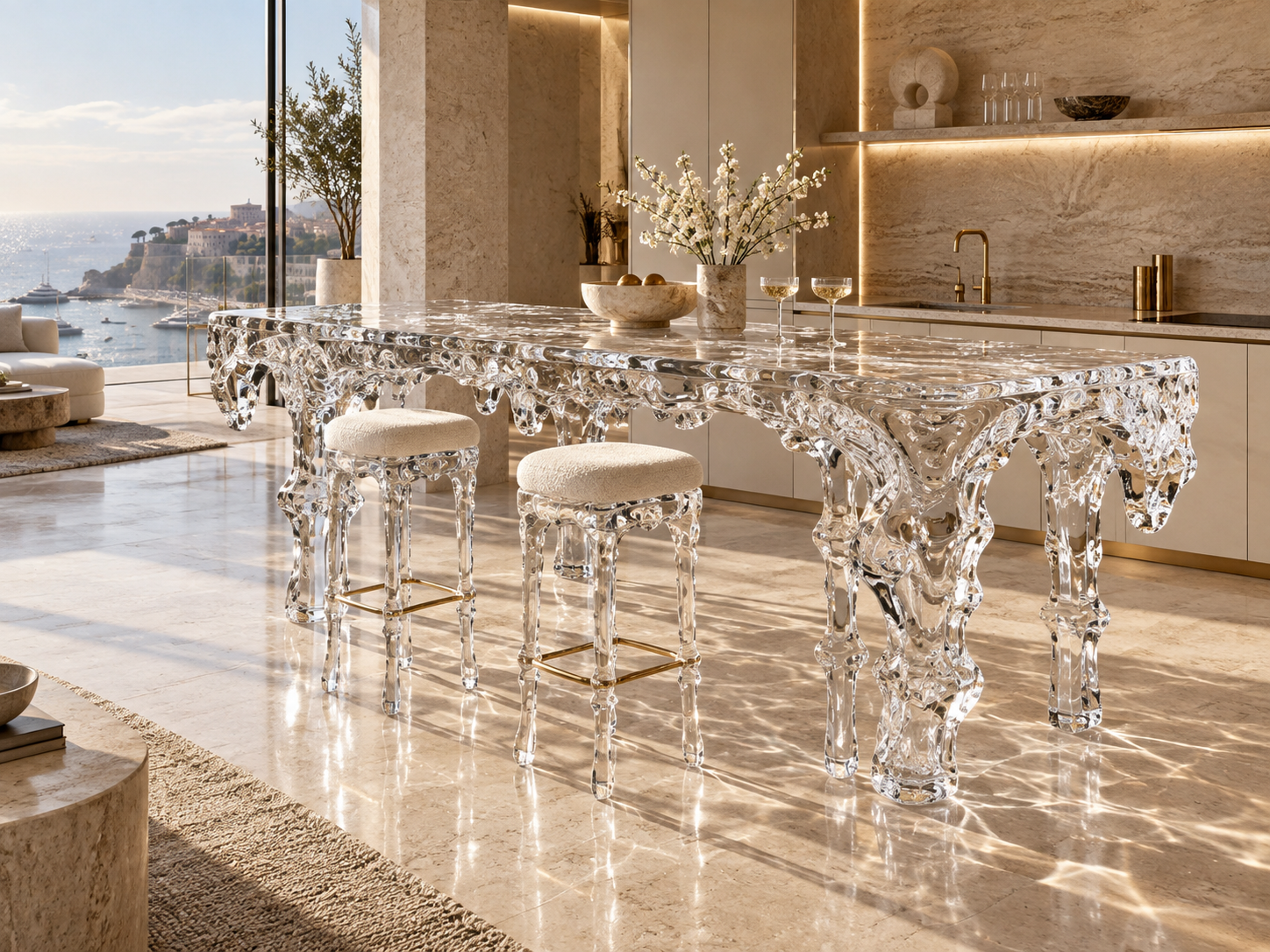
Transparent furniture can make an interior feel lighter, more open and architecturally precise. A synthetic crystal coffee table allows a statement rug to remain visible. A platinum acrylic dining-table base can support a substantial top without visually filling the room. A high-end resin console can catch daylight, reflect surrounding colors and create the impression of a sculptural object suspended in space.
Yet transparency also presents one of the most common challenges designers face with contemporary interiors: if clear furniture is combined with white walls, cool lighting, polished floors, glass and stainless steel without sufficient contrast, the room can begin to feel sterile rather than sophisticated.
The solution is not to avoid transparent furniture. It is to give transparency something to interact with.
Research increasingly supports what experienced interior designers already understand intuitively: materials influence emotional and sensory perceptions of a space. The WELL Building Standard, for example, specifically recognizes natural materials such as wood and stone as tools for supporting biophilic design and human connection with nature. Recent research published in Building and Environment also notes that wood is commonly perceived as warmer than plastic, marble, glass or steel and that color, texture and material distribution affect how people experience interiors.
For designers working with synthetic crystal, premium resin and platinum acrylic furniture, this creates an opportunity. Transparency can provide visual lightness, while wood, stone and metal provide warmth, gravity, texture and definition.
The most successful interiors do not ask one material to do everything. They create atmosphere through contrast.
1. Understand Why a Transparent Interior Can Feel “Cold” Before Adding Warmth
A room does not feel cold simply because it contains acrylic or resin. The impression usually comes from an accumulation of visual signals.
Consider a living room with white porcelain flooring, white walls, a clear acrylic coffee table, chrome lighting, glass partitions and cool 5000K illumination. Each material may be attractive individually, but together they create few tactile or chromatic interruptions. Light reflects repeatedly across smooth surfaces. There is little visible grain, irregularity or natural variation. The result may feel closer to a showroom than a home.
Transparent materials amplify their surroundings. That is one of their greatest strengths and also one of their greatest design risks.
Colorless PMMA can transmit extremely high levels of visible light. Röhm reports up to 92 percent visible-light transmission for clear PLEXIGLAS acrylic, which helps explain why premium acrylic furniture can visually recede into a space rather than behave like an opaque object.
But because transparent furniture has relatively little color of its own, surrounding materials become more important. Place a platinum acrylic side table beside white leather and polished steel, and the composition can feel technical. Place the same table beside walnut, wool upholstery and warm limestone, and the acrylic becomes a point of visual freshness rather than the dominant emotional language.
This distinction is essential when specifying synthetic crystal furniture.
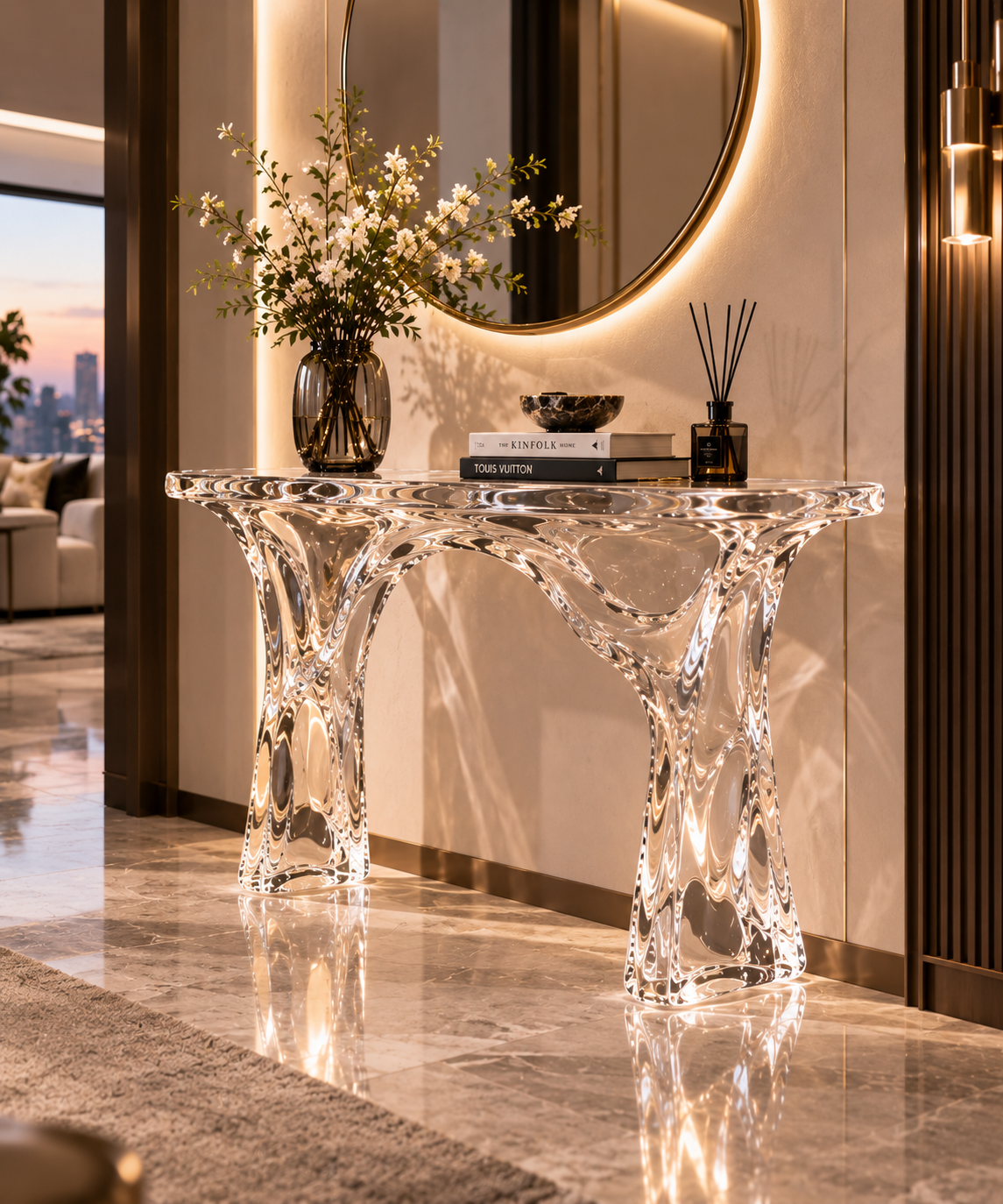
The objective should not always be to make the transparent object disappear. Designers can instead use its clarity as visual breathing room between more tactile materials. A thick synthetic crystal coffee table, for example, can separate a textured sofa from a strongly grained timber wall without introducing another competing color. A transparent resin console can sit against natural stone while allowing the stone pattern to remain visible through the furniture.
The problem, therefore, is rarely “too much transparency” in isolation.
It is insufficient material contrast.
2. Pair Synthetic Crystal with Wood When the Space Needs Warmth and Human Scale
Among all the materials that can be combined with transparent furniture, wood is usually the most direct way to introduce visual warmth.
There is scientific evidence behind that perception. A 2026 systematic review in Building and Environment found that indoor wood is commonly associated with well-being and positive psychological responses. The review notes that wood is often perceived as warm compared with materials such as plastic, marble, glass and steel and that its yellow-red visual spectrum contributes to perceptions of warmth.
Earlier experimental work reached similar conclusions. In one study involving a Japanese wooden table, participants reported greater comfort, relaxation and naturalness when viewing the wooden table than when viewing the control condition, while physiological measurements also indicated relaxation responses.
For designers, the implication is practical: if a clear synthetic crystal dining table feels visually sharp, timber chairs can immediately change its emotional character.
Walnut works especially well with colorless synthetic crystal because its deeper brown tones provide strong visual grounding. Oak produces a lighter Scandinavian effect. Smoked oak can give a transparent resin table more architectural drama, while ash or pale oak can preserve a lighter overall palette.
The contrast does not need to occur within the same piece of furniture. A platinum acrylic console can sit against a walnut-paneled wall. A transparent resin coffee table can be placed over oak flooring. A synthetic crystal dining-table base can support a wood top, or the reverse can be used: a transparent top over a sculptural timber base.
Designers should also resist the assumption that more wood automatically creates more comfort. Research reviewed in the nature-therapy literature suggests that material proportion matters. One experiment found calming physiological responses in an interior with approximately 30 percent wood, while other configurations produced different levels of stimulation.
That makes transparent furniture particularly useful: it can interrupt large fields of timber without introducing another visually heavy material.
The ideal relationship is often one of balance. Wood supplies grain, color and tactility. Synthetic crystal supplies lightness, precision and optical depth.
Together, neither material needs to dominate.
3. Use Stone to Give Transparent Furniture Visual Gravity
If wood makes a transparent interior warmer, stone can make it feel more grounded.
This is especially useful in high-end residential, hospitality and retail interiors, where designers may want a room to feel substantial without filling it with visually heavy furniture.
Natural stone introduces characteristics that transparent polymers deliberately lack: geological variation, opacity, mass and a strong connection to the ground. WELL's biophilic-design guidance explicitly identifies both wood and stone as natural materials that can be integrated into furniture and interior design to strengthen connections with nature.
The contrast between stone and transparency can therefore be very powerful.
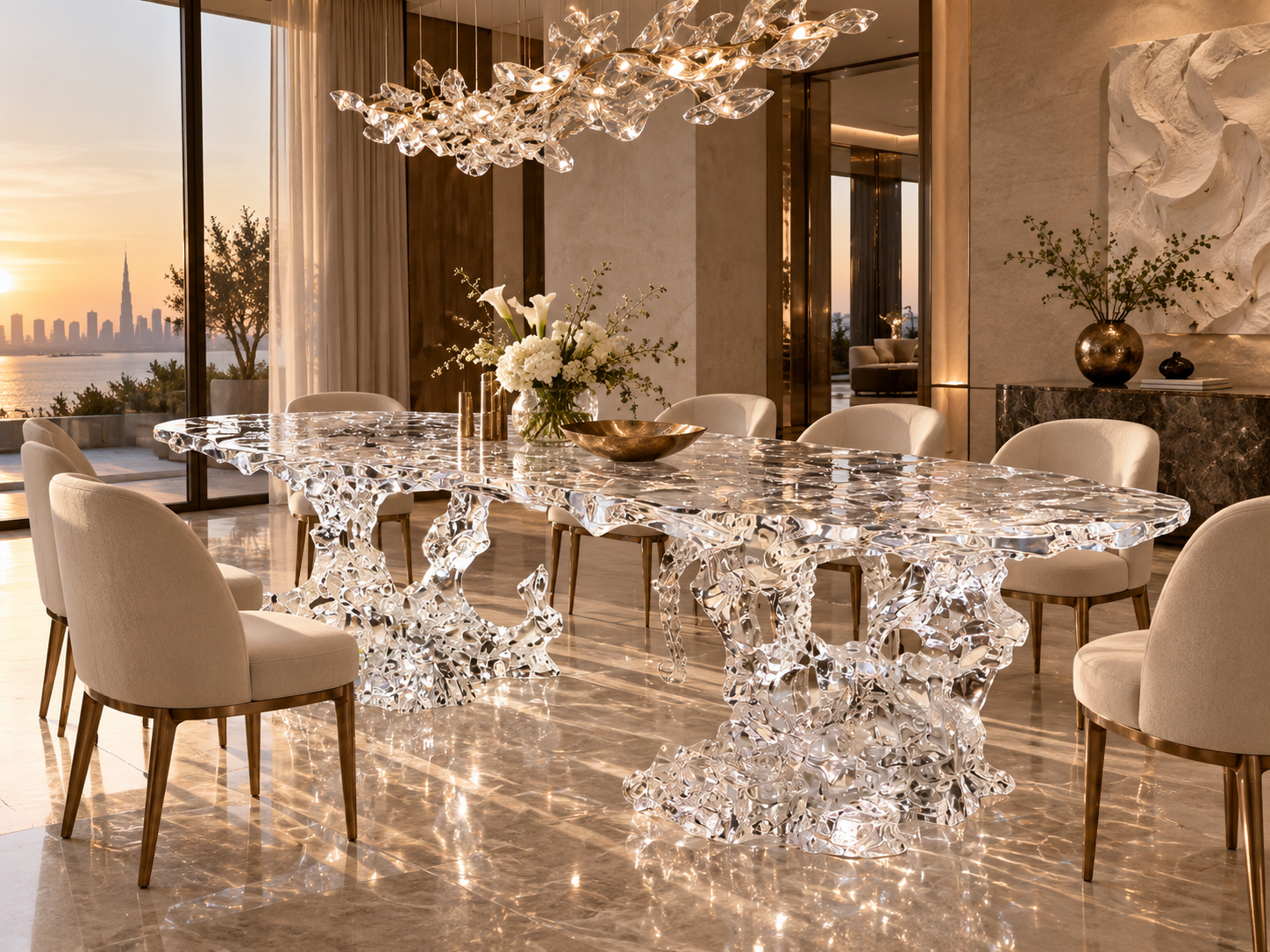
Imagine a thick transparent synthetic crystal dining-table base supporting a richly veined travertine or marble top. The stone provides weight and permanence, while the base reduces the apparent mass beneath it. From some angles, the tabletop appears almost to float.
The opposite combination is equally effective. A clear or lightly tinted high-end resin top can sit on a monolithic stone base. The stone anchors the composition while the transparent upper element prevents the table from becoming visually oppressive.
There are already strong precedents in contemporary design. Wallpaper* reported on Joseph Walsh Studio's Exilumen I table, where a Connemara marble top appears to float on transparent resin legs. The same studio has also explored black-dyed ash combined with sculptural amber resin, demonstrating how transparent or translucent polymers can act as a bridge between natural materials and contemporary fabrication.
ArchDaily has documented similarly useful spatial relationships. At Palazzo Zen in Venice, transparent acrylic tables were suspended above a historic marble floor, allowing the visual character of the stone to remain dominant rather than covering it with opaque exhibition furniture.
For luxury projects, stone also solves a positioning problem. Poorly presented transparent furniture can occasionally be read as “plastic.” Pairing premium acrylic or synthetic crystal with authentic marble, quartzite, travertine or limestone immediately changes the material conversation.
The transparent component begins to feel less like a substitute for glass and more like an intentionally engineered luxury material.
4. Use Metal to Define Transparency Without Making It Industrial
Metal performs a different role from wood and stone. It gives transparent furniture edges, rhythm and technical definition.
This can be extremely effective, but the finish matters.
Polished chrome and bright stainless steel reinforce the cool, precise character of transparent acrylic. That combination can be ideal for a futuristic retail store, contemporary gallery or minimalist penthouse. But if the goal is a softer luxury environment, warmer metals such as brushed brass, bronze, champagne stainless steel or aged metal finishes can produce a very different emotional result.
Research comparing indoor wall materials supports the general perception difference. A study of café environments found that light-colored wooden surfaces were perceived as warmer than environments using metal or concrete.
That does not mean designers should avoid metal. It means metal needs to be used intentionally.
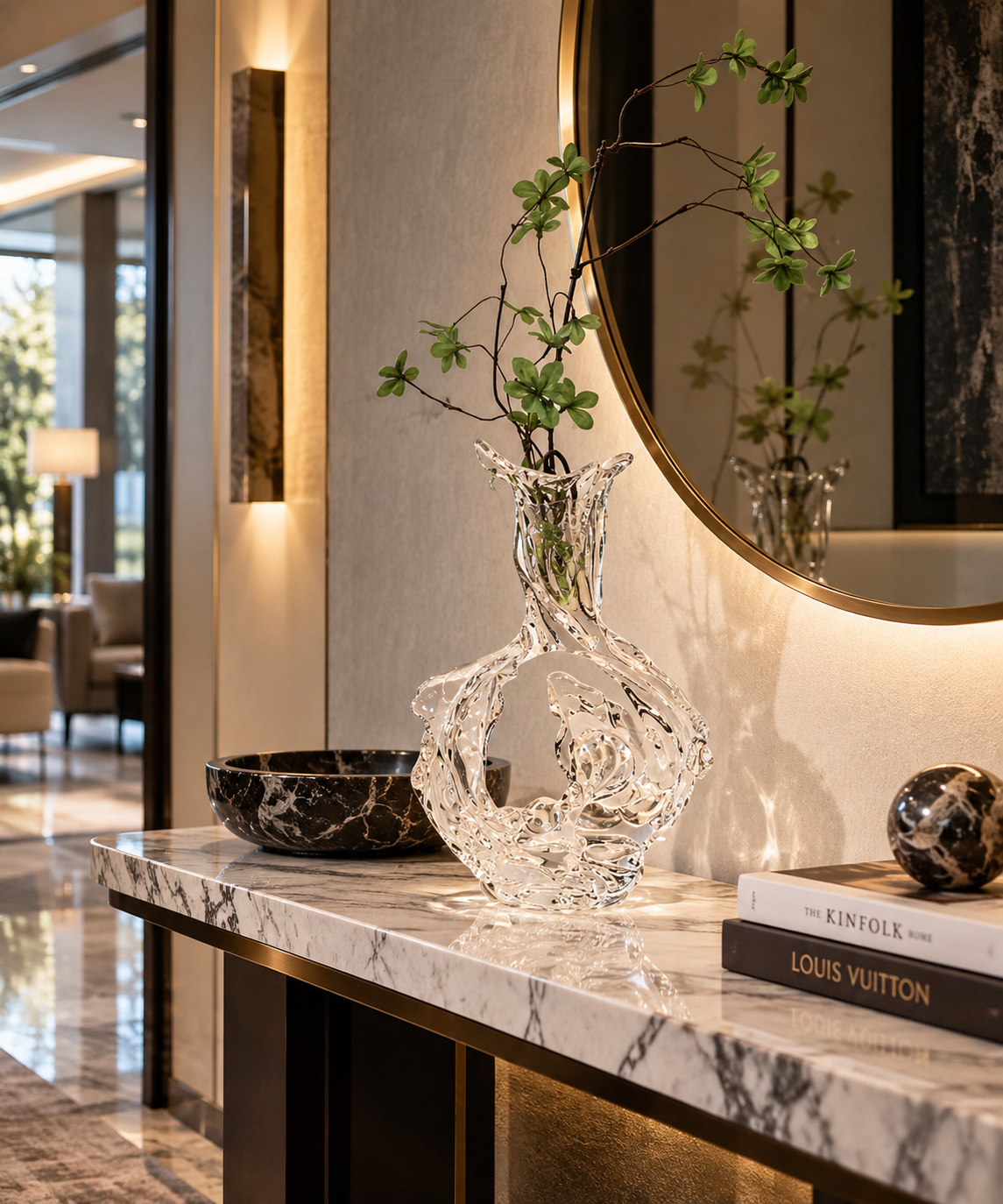
A platinum acrylic console with thin brushed-brass details can retain the visual lightness of transparency while gaining warmth and definition. A clear synthetic crystal dining table with bronze connectors can feel more residential than the same table fitted with polished chrome. Smoke-tinted resin combined with blackened steel can create a darker, more architectural luxury suitable for hotel bars, clubs or fashion retail.
Design history offers one of the strongest examples of transparent material and metal working together. Shiro Kuramata's famous 1988 Miss Blanche Chair, now held by MoMA, combines thick acrylic resin containing artificial roses with purple anodized aluminum legs. The transparency is not diminished by metal; the metal gives the transparent body definition and character.
Contemporary commercial interiors use the same principle. In the NOWSEE store documented by ArchDaily, transparent and matte acrylic components are combined with stainless steel, aluminum and birch board. The transparent fixtures reveal their internal structure, while the different materials prevent the space from becoming monotonous.
Another retail project, PLEATSMAMA Store, uses brushed metal frames, natural wood veneer and acrylic together. ArchDaily describes the wood and metal as balancing warmth and coolness while the acrylic contributes light and reflection.
That is exactly the role metal should play: not necessarily warming transparency, but controlling it.
5. Let Color, Texture and Light Soften Transparency Before Adding More Materials
A room can contain wood, marble and brass and still feel cold if every surface is glossy and every light source is harsh.
Material balance is therefore not only about material categories. Finish matters just as much.
Premium synthetic crystal and high-end resin do not have to be perfectly colorless. A slight champagne tint can connect a transparent table to brass details. Smoke-gray resin can relate to dark stone. Amber resin can bridge walnut, bronze and warm lighting. Soft green transparent elements can harmonize with marble, vegetation and natural views.
This is where high-end resin offers particularly interesting possibilities because color and inclusions can be incorporated into the material itself rather than applied only to the surface.
Shiro Kuramata's Miss Blanche demonstrates the principle at an artistic level. The clear acrylic resin contains red artificial roses that appear suspended inside the chair. SFMOMA describes Kuramata as a designer who exploited industrial materials including acrylic, aluminum and steel mesh for their psychological and expressive effects.
The lesson for contemporary furniture is that transparency does not have to mean visual neutrality.
A high-end resin console can contain subtle mineral-like textures. A synthetic crystal side table can use a champagne tint rather than absolute clarity. A platinum acrylic screen can employ satin or frosted sections to diffuse light.
Lighting then completes the effect.
Clear acrylic behaves strongly with light because of its high transmission and reflective edges. Röhm specifically highlights acrylic's ability to interact with illumination and produce intense edge and color effects.
For residential and hospitality environments, designers can exploit this without creating a nightclub effect. Warm indirect lighting behind a transparent console can softly illuminate polished edges. Side lighting can reveal the depth of a thick resin coffee table. Daylight passing through a crystal-clear dining base can create changing reflections across stone flooring throughout the day.
The more transparent the furniture, the more important its lighting environment becomes.
6. Design the Entire Material Palette as a Conversation, Not a Collection of Samples
The most convincing interior rarely comes from selecting the most beautiful version of every material independently.
It comes from relationships.
A designer may begin with a statement synthetic crystal dining table. If the surrounding floor is pale marble, introducing walnut chairs can provide warmth. A brushed-bronze pendant can connect the wood visually to the clear table. Upholstery in wool, leather or textured fabric can soften the polished surfaces. The final interior feels balanced because each material performs a different emotional role.
The same logic applies to a living room. A transparent high-end resin coffee table can preserve the visibility of a hand-knotted rug. A timber media wall adds warmth. Travertine introduces mineral texture. A small amount of blackened metal provides line and definition. Instead of five materials competing for attention, each one supports the others.
Designers can also use transparent furniture strategically as a visual pause. In an interior already rich in marble veining, timber grain and textured textiles, adding another opaque coffee table may create too much information. A platinum acrylic or synthetic crystal table provides function without introducing another large pattern.
This is one reason transparency has remained relevant in serious design rather than disappearing as a novelty.
The Museum of Modern Art's collection of Kuramata's work shows that acrylic can carry emotional meaning precisely because it can hold, reveal and contrast other materials. The National Museum of Modern Art, Kyoto similarly describes Kuramata's furniture as poetic explorations of acrylic, glass and steel mesh—materials that had previously been unusual in furniture and interiors.
For today's designers, the opportunity is broader because manufacturing capabilities are more advanced. Synthetic crystal can be cast into substantial sculptural forms. High-end resin can incorporate color, inclusions and gradients. Platinum acrylic can be precision-machined and polished into clean architectural components.
But technical capability should always serve atmosphere.
If a room needs warmth, pair transparency with visible wood grain. If it needs permanence, introduce stone. If it needs sharper architectural definition, use metal. If it needs more emotion, introduce subtle tint, texture and warmer light.
Transparent furniture should rarely be treated as an isolated object.
Its greatest strength is its ability to borrow from everything around it.
A synthetic crystal table beside walnut becomes warmer. Against marble, it becomes more monumental. With bronze, it becomes richer. Near natural light, it becomes more ephemeral. Combined with premium textiles, it becomes softer.
This is how designers prevent transparent furniture from making a space feel cold.
They do not hide the clarity of the material.
They give that clarity something meaningful to reveal.