One of their strongest advantages is the ability to make interiors feel larger and more fluid. Transparent furniture preserves sight lines, reveals flooring and architectural details, and supports open-plan layouts. It is particularly useful in compact apartments, hotel suites, boutiques, and urban spaces where every square meter matters.
Transparent materials also interact dynamically with light. Acrylic, glass, resin, and crystal-like surfaces can transmit, reflect, refract, and diffuse light, creating changing visual effects throughout the day. Advances in CNC machining, polishing, bonding, thermal forming, resin casting, and integrated lighting have expanded design possibilities and improved quality.
Luxury brands use transparent furniture to express innovation, precision, exclusivity, and modern identity. Its compatibility with wood, stone, metal, fabric, and leather also gives it lasting versatility. For these reasons, transparent furniture is evolving from a temporary trend into a long-term design language.
Luxury design is undergoing a significant transformation.
For many years, luxury interiors were defined by visible richness. Heavy furniture, carved wood, polished marble, gold details, deep fabrics, and complex decoration were commonly used to communicate status and value. The more material, ornament, and craftsmanship an interior displayed, the more luxurious it appeared.
That traditional idea has not disappeared, but it is no longer the only definition of luxury.
Today, many premium residences, boutique hotels, luxury retail stores, galleries, restaurants, and executive offices are moving toward a different visual language. These spaces often use fewer objects, cleaner lines, open circulation, controlled color palettes, and carefully selected statement pieces. Instead of demonstrating wealth through accumulation, they communicate quality through proportion, restraint, precision, and atmosphere.
Transparent furniture has become an important part of this shift.
Clear acrylic chairs, glass tables, resin benches, crystal-like consoles, transparent cabinets, and translucent display systems are increasingly used in high-end projects. These products can appear quiet and almost invisible, yet they can also become strong sculptural elements. They occupy physical space without creating the same visual weight as traditional furniture.
This unusual balance makes transparent furniture especially valuable in modern luxury design.
Its popularity is not based on novelty alone. Transparent furniture responds to several important changes in architecture, consumer behavior, manufacturing, and brand communication. It supports open-plan interiors, emphasizes light, preserves views, highlights valuable materials, and creates memorable visual experiences.
It also represents a new understanding of luxury.
Modern luxury is often less about showing more and more about controlling every detail. It values the quality of space, the experience of light, the relationship between objects, and the confidence to leave areas visually open.
Transparent furniture expresses this confidence.
It does not need to dominate the room to attract attention. Its value can be found in optical clarity, edge quality, structural precision, thickness, proportion, and the way it changes as people move around it.
This article examines six reasons transparent furniture is becoming an important trend in contemporary luxury design.
1. The Shift from Visible Opulence to Refined Minimalism
The meaning of luxury changes over time.
In earlier periods, expensive interiors were often designed to display abundance. Rare woods, decorative carvings, polished metals, embroidered fabrics, crystal lighting, and large furniture were used to demonstrate wealth and social position.
These elements still have value, especially in classical and decorative interiors. However, many contemporary luxury clients now prefer a more controlled expression.
They do not necessarily want every object to look expensive in an obvious way. They want spaces that feel calm, personal, intelligent, and carefully designed.
This shift has created greater interest in refined minimalism.
Refined minimalism is not the same as empty design. It does not mean removing comfort, craftsmanship, or personality. Instead, it means reducing unnecessary visual noise so that important elements can be seen more clearly.
In a successful minimalist luxury interior, every object has a purpose. Materials are selected with care. Proportions are carefully balanced. Lighting is designed to support architecture and texture. Furniture is chosen not only for function, but also for its contribution to the overall composition.
Transparent furniture fits naturally into this approach.
A clear acrylic chair provides seating without introducing a large block of color. A glass dining table supports daily use while allowing the floor, rug, and surrounding architecture to remain visible. A transparent console can define an entrance without covering a decorative wall.
These pieces allow designers to add function while maintaining visual calm.
This is important because modern luxury spaces often depend on negative space.
Negative space refers to the areas around and between objects. In high-end interiors, these empty areas are not wasted. They create breathing room, improve circulation, and allow materials and artwork to receive more attention.
Traditional solid furniture can sometimes interrupt this balance. Transparent furniture provides a way to occupy the room physically while protecting the visual openness of the design.
It can therefore make an interior feel more intentional.
The use of transparent furniture also reflects greater confidence in design.
An interior filled with decorative elements may attempt to create value through quantity. A restrained interior must rely on quality. Each selected piece becomes more visible and more important.
A transparent table may look simple at first, but its simplicity exposes every detail. The thickness, polishing, joints, reflections, and proportions must all be correct. Poor execution is difficult to hide.
For this reason, high-quality transparent furniture can communicate sophistication through precision rather than ornament.
Modern luxury clients often appreciate this subtlety.
They understand that a visually simple object may require advanced engineering and skilled craftsmanship. They are willing to pay for furniture that appears effortless because they recognize the complexity behind that appearance.
Transparent furniture also works well with the growing preference for personalized interiors.
Instead of following one decorative style, many clients combine contemporary art, vintage furniture, natural stone, custom lighting, and modern architectural details. Transparent pieces can connect these different elements without creating strong visual conflict.
They are present, but they do not impose a fixed color or texture on the room.
This neutrality makes transparent furniture a useful foundation for sophisticated design.
2. Transparency as a Tool for Expanding Space
One of the most practical reasons for the growth of transparent furniture is its ability to change the perception of space.
Every furniture object has physical volume. It occupies floor area, affects circulation, and creates boundaries. It also has visual volume, which refers to how large or heavy the object appears.
A solid dining table and a transparent dining table may have similar dimensions, but they create very different visual experiences.
The solid table blocks the view of the floor and creates a clear visual mass. The transparent table allows the eye to continue through its surface and structure. As a result, the room often feels more open.
This effect is especially useful in urban luxury interiors.
High-end apartments, hotel suites, private lounges, and boutique stores are not always large. In many major cities, space is one of the most valuable resources. Designers must provide comfort, storage, seating, and display functions without making rooms feel crowded.
Transparent furniture helps reduce visual congestion.
A clear coffee table can provide a large functional surface while allowing a patterned rug to remain visible. Transparent chairs can surround a dining table without creating a wall of color. A glass or acrylic desk can define a working area without separating it heavily from the rest of the room.
These solutions make compact spaces feel more fluid.
Transparency also preserves sight lines.
In luxury architecture, views are often carefully planned. A room may be organized around a landscape, artwork, fireplace, feature wall, staircase, or custom floor pattern. Solid furniture can block these features and weaken the architectural concept.
Transparent furniture allows the design to remain connected.
For example, an acrylic bench placed in front of a marble wall does not hide the natural pattern of the stone. A transparent console positioned near a window allows daylight and exterior views to remain visible. A glass table in a gallery preserves the relationship between visitors and the displayed artwork.
This visual continuity is one of the main reasons transparent furniture is used in high-end projects.
It also supports open-plan living.
Modern interiors often combine living, dining, working, and entertaining areas within one continuous space. Furniture is used to define zones, but designers usually want to avoid creating unnecessary barriers.
Transparent pieces can separate functions without closing the room.
A clear shelving system can organize objects while maintaining visibility. A transparent screen can create partial privacy without stopping light. An acrylic dining set can identify the dining area while preserving the overall openness of the floor plan.
This balance between separation and connection is highly valuable.
The effect is not limited to clear materials.
Translucent, frosted, smoke-colored, bronze, blue, or amber furniture can also reduce visual weight while adding atmosphere. These materials allow some light and background detail to remain visible, but they create a stronger sense of presence than fully transparent pieces.
Designers can therefore control the level of openness.
A clear chair may almost disappear, while a smoke-gray table may appear more architectural. A frosted cabinet can provide privacy while still allowing light to pass through. A bronze-tinted console can add warmth without becoming visually heavy.
This range gives transparent furniture significant design flexibility.
It is important, however, to use transparency with balance.
If every object in a room is transparent, the space may feel visually confusing or emotionally cold. Transparent furniture is often most effective when combined with solid, textured, and natural materials.
A clear acrylic table may be placed beside a velvet sofa. A glass desk may sit on a wool rug. A resin bench may be positioned against a timber wall.
These contrasts help the transparent object become more meaningful.
The goal is not to remove all visual weight. The goal is to manage it carefully.
.png)
3. The Interaction Between Light, Material, and Atmosphere
Light is one of the most important elements in luxury interior design.
It influences color, texture, mood, depth, and emotional comfort. Transparent furniture interacts with light in ways that solid furniture cannot, making it a powerful tool for creating atmosphere.
Clear materials can transmit light.
Instead of stopping light at the surface, they allow it to pass through. This can make the room feel brighter and more open. It also reduces strong shadows and helps natural daylight travel across the interior.
In spaces with limited windows, this quality can be particularly useful.
A heavy cabinet or large solid table may block light. A transparent version can provide the same function while allowing brightness to continue through the room.
Transparent materials can also reflect light.
Polished surfaces create highlights, reflections, and changing images. These effects can make furniture feel active and responsive. As people move around the room, the appearance of the object changes.
This movement adds visual interest.
A thick acrylic edge may catch light and appear brighter than the center of the panel. A curved resin surface may distort reflections and create a fluid effect. A glass tabletop may reflect a chandelier, ceiling detail, or nearby artwork.
These interactions make the furniture part of the lighting composition.
Refraction creates another layer of experience.
When light passes through thick or shaped transparent materials, it can bend and change direction. This can create glowing edges, optical distortions, and crystal-like depth.
High-quality acrylic furniture often uses thickness to maximize this effect.
A thin transparent panel may look simple and light. A thick polished block can look more luxurious because it creates greater depth and stronger internal reflections. The material begins to resemble ice, crystal, or water.
This is one reason thick acrylic tables and sculptural bases are increasingly used in premium interiors.
Tinted transparent materials create different emotional effects.
Smoke-gray glass can make a room feel architectural and restrained. Bronze acrylic can add warmth and complement brass, wood, or leather. Blue resin may create a cool and futuristic atmosphere. Amber materials can bring softness and a sense of intimacy.
These colors are often more complex than solid painted surfaces because they change according to light and background.
A bronze transparent table may appear dark against one wall and warm gold against another. A blue acrylic chair may look pale in daylight and more intense under artificial lighting.
This changing quality makes transparent furniture visually rich despite its simplicity.
Integrated lighting has expanded the possibilities further.
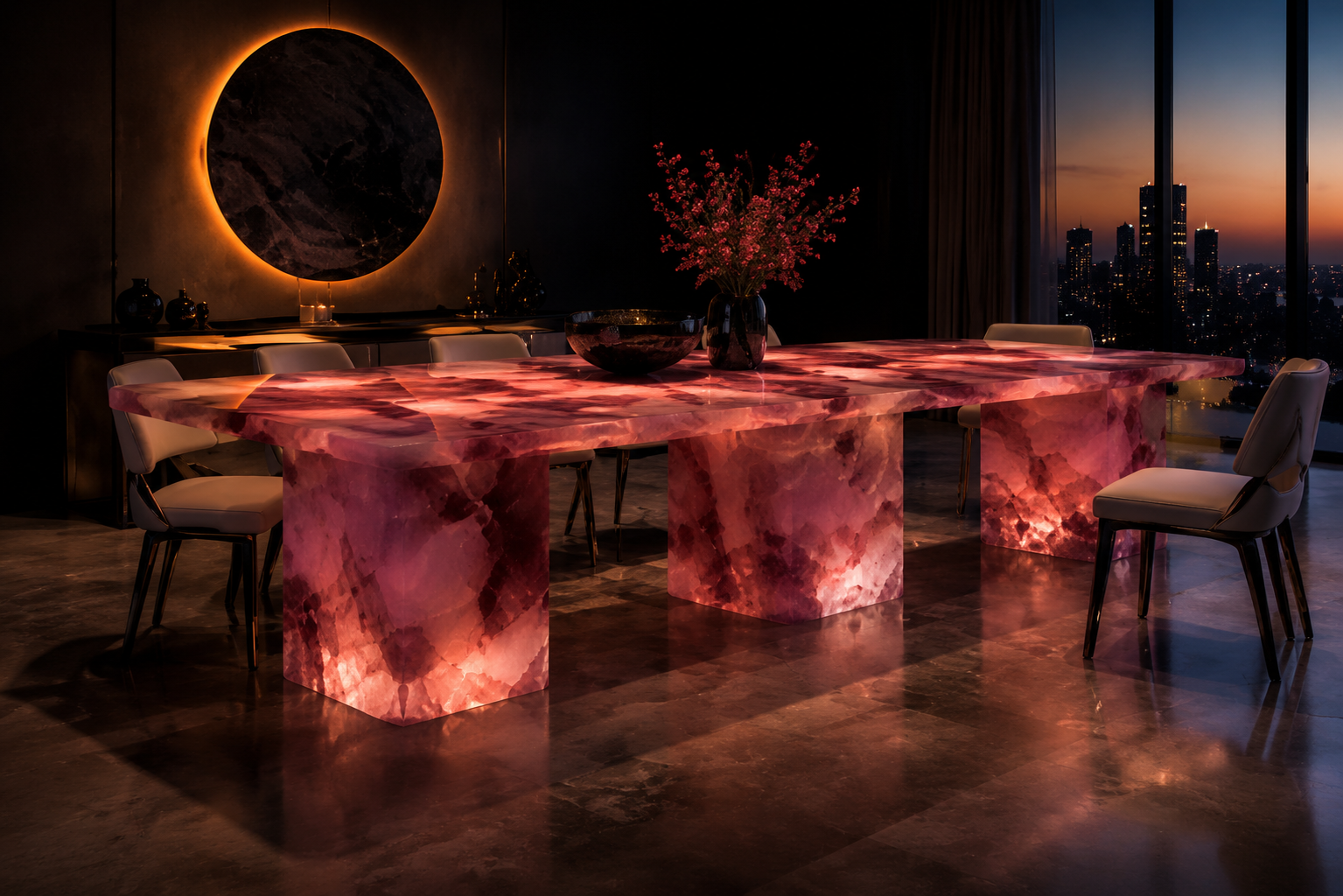
LED technology can be incorporated into acrylic panels, shelves, bases, counters, and display units. Light may enter through the edge and travel across the material, creating illuminated lines or glowing surfaces.
Frosted sections can diffuse the light, while clear sections remain transparent.
This technique is frequently used in luxury retail, hospitality, exhibitions, and entertainment spaces. An illuminated acrylic bar can become a dramatic evening feature. A display pedestal can make a product appear to glow. A hotel reception desk can use transparent layers to create depth and brand identity.
The furniture becomes both an object and a light source.
Transparent furniture also changes throughout the day.
In the morning, it may appear calm and almost invisible. During the afternoon, sunlight may create reflections and shadows. At night, controlled artificial lighting can make the same object feel dramatic and sculptural.
This ability to provide multiple experiences is highly valuable in luxury spaces.
Hotels, restaurants, clubs, and residences often need to support different moods at different times. A material that responds to changing light helps the interior remain dynamic.
The success of these effects depends on quality.
Low-grade transparent materials may look cloudy, distorted, or slightly discolored. Poorly polished edges may interrupt the light. Visible glue lines, bubbles, or scratches can destroy the sense of refinement.
Luxury transparent furniture must therefore be manufactured with exceptional precision.
The beauty of light reveals both the strengths and weaknesses of the product.
4. Technological Progress and New Design Possibilities
Transparent furniture is not a new idea.
Glass tables, clear chairs, and acrylic accessories have existed for decades. What has changed is the level of manufacturing technology, material quality, and design freedom available today.
These improvements have made transparent furniture more suitable for complex and high-end applications.
Acrylic is one of the most important materials in this development.
Compared with traditional glass, acrylic is lighter and easier to shape. It can be cut, drilled, machined, bonded, bent, engraved, polished, tinted, and layered. It can be formed into shapes that would be difficult, heavy, or expensive to produce in glass.
This flexibility allows designers to move beyond simple flat panels.
Acrylic furniture can include continuous curves, geometric folds, sculptural bases, thick blocks, layered structures, and integrated storage. It can also be combined with metal, stone, leather, wood, fabric, and lighting.
Advanced CNC machinery has improved cutting precision.
Complex shapes can be produced repeatedly. Holes, channels, curves, and structural details can be machined with greater accuracy. This helps manufacturers create cleaner joints and more reliable assemblies.
Polishing technology has also improved.
Edges can be finished through progressive sanding, mechanical polishing, diamond polishing, flame treatment, or hand finishing. When performed correctly, these processes create smooth, bright, crystal-like surfaces.
Bonding techniques have become more sophisticated.
Transparent furniture often depends on joints that are both strong and visually discreet. Specialized adhesives and controlled production methods can create clean connections with minimal interruption.
This is especially important in minimal designs, where every joint is visible.
Thermal forming allows acrylic sheets to be bent into curves and continuous structures. With accurate temperature control and custom molds, manufacturers can produce chairs, benches, tables, and decorative forms with greater consistency.
Casting and resin technology have also expanded the market.
Transparent and translucent resin can be used to create unique shapes, embedded objects, artistic surfaces, gradients, and color effects. These products may appear closer to sculpture than conventional furniture.
Some designers use resin to capture natural elements, metallic textures, fabric, or abstract patterns within the material.
Digital printing and engraving provide additional customization.
Logos, graphics, patterns, and artistic images can be added to transparent surfaces. These techniques are especially useful in branded retail environments, exhibitions, offices, and hospitality projects.
The development of stronger hardware and hidden reinforcement has improved structural performance.
Transparent furniture must often appear visually light while supporting significant loads. Metal frames, internal connections, specialized fasteners, and careful engineering can provide stability without damaging the transparent appearance.
This allows the production of larger tables, shelving systems, cabinets, and architectural furniture.
Technology has also improved prototyping.
Designers can use digital models, three-dimensional visualization, and physical samples to study transparency before production. They can test thickness, color, reflection, and structural behavior more accurately.
This is important because transparent materials are difficult to evaluate through drawings alone.
Their final appearance depends heavily on lighting, background, angle, and surrounding materials.
Customization has become one of the strongest commercial advantages of transparent furniture.
Clients can request specific dimensions, tints, edge profiles, curves, embedded details, and material combinations. Furniture can be developed for a particular wall, room, artwork, product display, or architectural feature.
This level of personalization supports the expectations of high-end buyers.
Luxury clients often do not want standard products that can be found in many other interiors. They want furniture that feels connected to their own space and identity.
Transparent materials provide an excellent platform for this customization.
5. The Role of Transparent Furniture in Luxury Branding
Luxury interiors are powerful communication tools.
A hotel lobby communicates the identity of the property before a guest reaches the room. A retail store shapes the customer’s perception of the products. An office reception area expresses the culture and ambition of the company.
Furniture plays a central role in these environments.
Transparent furniture is particularly valuable because it can communicate several premium qualities at the same time.
It can suggest innovation.
Clear acrylic, sculptural resin, and advanced glass structures are often associated with technology, art, fashion, and contemporary manufacturing. Their use can make a brand appear forward-looking and creative.
It can suggest precision.
Because transparent materials reveal joints, edges, and structural details, high-quality execution becomes visible. Clean transparent furniture communicates control and technical confidence.
It can also suggest exclusivity.
Custom transparent furniture often requires specialized manufacturing and careful installation. A unique acrylic reception desk or resin display structure cannot always be purchased from a standard catalog.
This makes the interior feel more personal and less easily copied.
Luxury retail has been one of the strongest areas for transparent furniture.
Jewelry, watches, cosmetics, fashion, and accessories are often displayed on clear or translucent structures. These materials support the product without creating visual competition.
A transparent pedestal can make an object appear suspended. A clear display case can protect valuable items while maintaining visibility. An illuminated acrylic shelf can emphasize the brilliance of jewelry or perfume bottles.
The furniture becomes part of the product presentation.
In hotels and restaurants, transparent furniture can create memorable guest experiences.
A sculptural table in a lobby may become a visual landmark. A clear bar with integrated lighting may define the evening atmosphere. Transparent side tables in guest rooms can make compact spaces feel more open.
Guests often photograph unusual interiors and share them online.
This gives distinctive furniture additional commercial value. A memorable object can become part of the property’s visual identity and social media presence.
In luxury residences, transparent furniture can communicate personal taste.
It may be used to highlight art collections, preserve views, or balance strong architectural materials. A custom acrylic console can appear refined without being traditional. A transparent dining table can make a formal room feel lighter and more contemporary.
For private clients, this balance between individuality and restraint is highly attractive.
Corporate environments also use transparent furniture to communicate openness and innovation.
A glass meeting table, acrylic reception desk, or transparent shelving system can support a clean and modern brand image. Technology, design, media, and creative companies often use these materials to reinforce their identity.
However, branding through transparent furniture must be subtle.
A poorly designed branded object can feel temporary or promotional. High-end projects require integration. Logos, colors, lighting, and forms should support the architecture rather than dominate it.
The strongest results occur when transparent furniture reflects the values of the brand without becoming an advertisement.
For example, a jewelry company may use crystal-like edges and precise geometry. A wellness brand may use soft translucent curves and diffused lighting. A technology company may prefer clean clear surfaces with hidden connections.
The material remains similar, but the design language changes.
This flexibility is one reason transparent furniture is valuable across many premium sectors.
.png)
6. From Temporary Trend to Long-Term Design Language
Some furniture trends disappear quickly because they depend on a specific color, shape, or social media image.
Transparent furniture has greater long-term potential because its value is based on fundamental design principles.
It supports light.
It preserves space.
It reduces visual weight.
It works with multiple materials.
It can be minimal, decorative, classical, futuristic, or artistic.
This adaptability makes it more than a temporary fashion.
Transparent furniture can fit into many interior styles.
In a minimalist home, it reinforces simplicity. In an Art Deco interior, it can be combined with brass, mirrored surfaces, and rich fabrics. In a classical room, a clear acrylic table can create contrast without competing with architectural details. In a futuristic project, transparent resin and integrated lighting can become central design features.
The material changes according to context.
This is important because luxury interiors are becoming increasingly mixed and personal. Designers are less dependent on strict style categories. They combine periods, textures, artworks, and cultural references.
Transparent furniture can connect these different elements.
Its relative neutrality allows it to remain useful even when surrounding colors and furnishings change. A clear console may work with one collection of art today and another collection in the future. A glass dining table can support different chairs, rugs, and lighting over time.
This flexibility can extend the life of the furniture.
Customization also supports long-term relevance.
Instead of producing only one recognizable form, manufacturers can continue developing new tints, thicknesses, shapes, surfaces, and combinations. Transparent furniture can evolve with technology and design preferences.
It can become softer, warmer, more colorful, more sculptural, or more architectural.
The growing focus on experiential design will also support its continued use.
Luxury consumers increasingly value spaces that feel memorable and emotionally engaging. Transparent furniture creates changing reflections, visual surprise, and interaction with light. These qualities contribute directly to experience.
It is not only seen. It is discovered from different angles and at different times.
Sustainability will influence the future of the category as well.
Transparent furniture manufacturers will need to focus on durable construction, efficient material use, repairability, responsible production, and recycling options where available.
Luxury buyers are increasingly interested in longevity.
A premium object should not be treated as temporary decoration. It should remain functional, attractive, and repairable for many years. High-quality transparent furniture can support this goal when it is designed carefully and maintained correctly.
Acrylic surfaces may develop scratches, but professional polishing can sometimes restore them. Components can be replaced. Modular structures can be updated. Timeless designs can adapt to new environments.
These qualities improve long-term value.
The future of transparent furniture will depend on balance.
Designers must avoid overusing the material. Manufacturers must avoid reducing quality to compete only on price. Brands must explain the craftsmanship and engineering behind the product.
When transparency is used without purpose, it can feel cold or ordinary.
When it is used with strong design intention, it can transform an interior.
The most successful projects will combine transparent furniture with rich textures, natural materials, comfortable forms, and carefully planned lighting. The contrast will create both openness and emotional warmth.
Conclusion
Transparent furniture is becoming an important trend in modern luxury design because it reflects a broader change in how luxury is understood.
Luxury is no longer defined only by visible richness or expensive decoration. It is increasingly expressed through space, light, precision, customization, and emotional experience.
Transparent furniture supports all of these values.
It allows rooms to feel more open. It preserves architecture, artwork, and views. It interacts with natural and artificial light. It can appear almost invisible or strongly sculptural. It can be customized to support residential, hospitality, retail, corporate, and cultural projects.
Its visual simplicity also reveals craftsmanship.
The clarity of the material, smoothness of the edges, accuracy of the joints, strength of the structure, and quality of the finish all determine whether the furniture feels premium.
This is why the best transparent furniture is not simply made from clear material.
It is designed as an optical, spatial, and emotional object.
Its growing popularity also reflects changes in consumer taste. High-end buyers increasingly prefer interiors that feel personal, calm, and intelligent. They value objects that create distinction without excessive decoration.
Transparent furniture offers this quiet distinction.
It can support the room without dominating it. It can create surprise without becoming visually aggressive. It can communicate innovation while remaining compatible with traditional materials.
For designers, it provides flexibility.
For luxury brands, it provides a strong visual language.
For property owners, it provides spatial and commercial value.
For users, it creates an environment that feels lighter, more open, and more memorable.
Transparent furniture is therefore unlikely to remain a temporary decorative trend.
As manufacturing technology, customization, and material innovation continue to develop, it will become an increasingly important part of contemporary luxury design.
Its greatest strength lies in a simple contradiction: it is physically present, yet visually light.
In modern luxury interiors, that balance is becoming more valuable than ever.
READ MORE:
- From Functional Furniture to Art Installation: How Transparent Materials Elevate Hotel Brand Recognition
- How Can One Transparent Piece of Furniture Activate Hotel Corners and Transitional Spaces?
- Luxury Without Excess: How Resin and Synthetic Crystal Create a Premium Furniture Aesthetic
- Transparency, Refraction and Light: How Synthetic Crystal Furniture Adds Depth to Hotel Interiors
- Hotel Corridors Should Never Be Boring: How Transparent Furniture Creates a Distinctive Spatial Memory
- Synthetic Crystal Acrylic Furniture: Creating Stronger Market Competitiveness Through a Distinctive Material
- Synthetic Crystal Acrylic Furniture: A Key Element in Creating Differentiated Experiences for High-End Projects
- From Material Selection to Brand Upgrading: An Analysis of the Commercial Value of Synthetic Crystal Acrylic Furniture
- Synthetic Crystal Acrylic Furniture: Why Are More High-End Buyers Willing to Pay for “Quality and Texture”?


