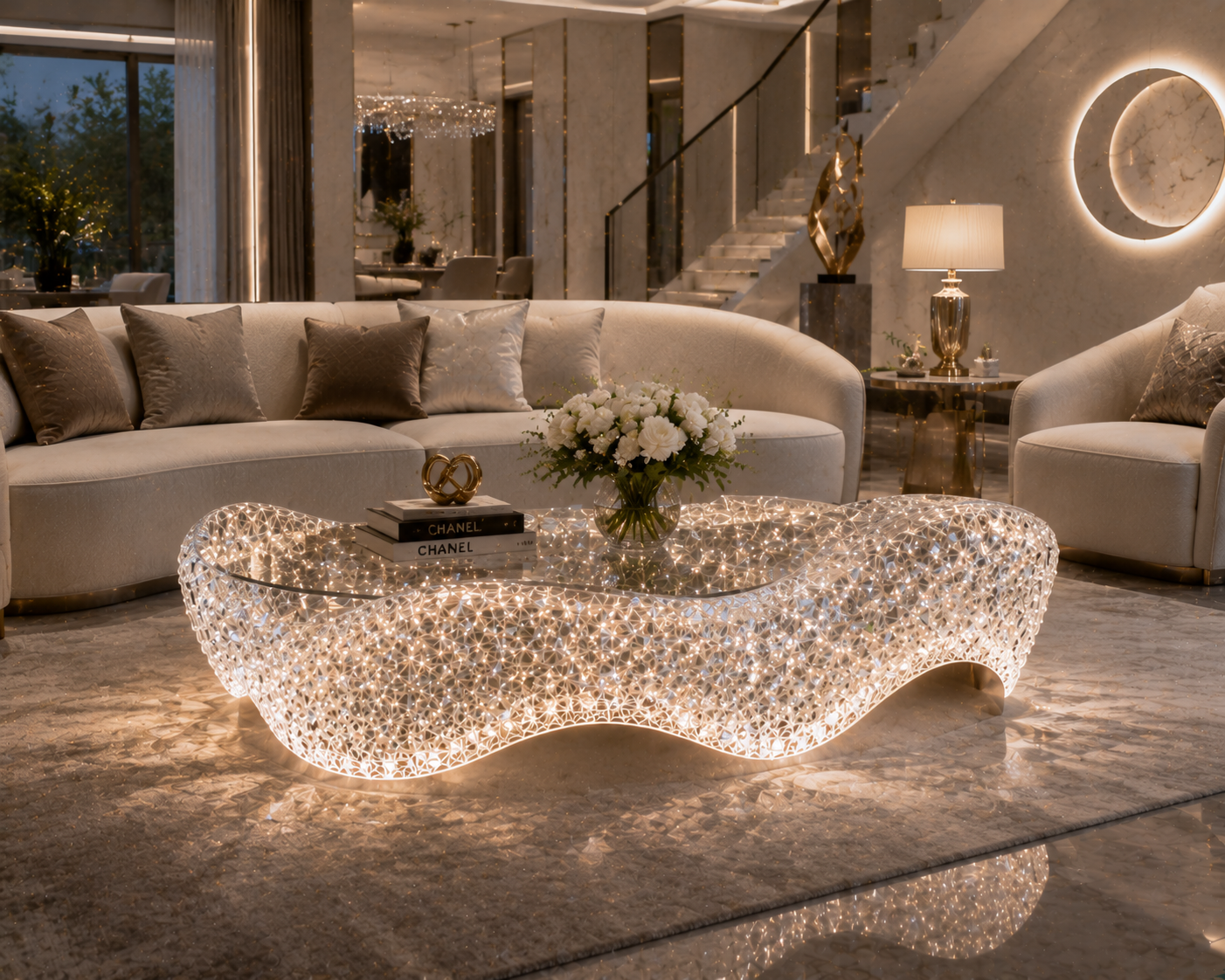
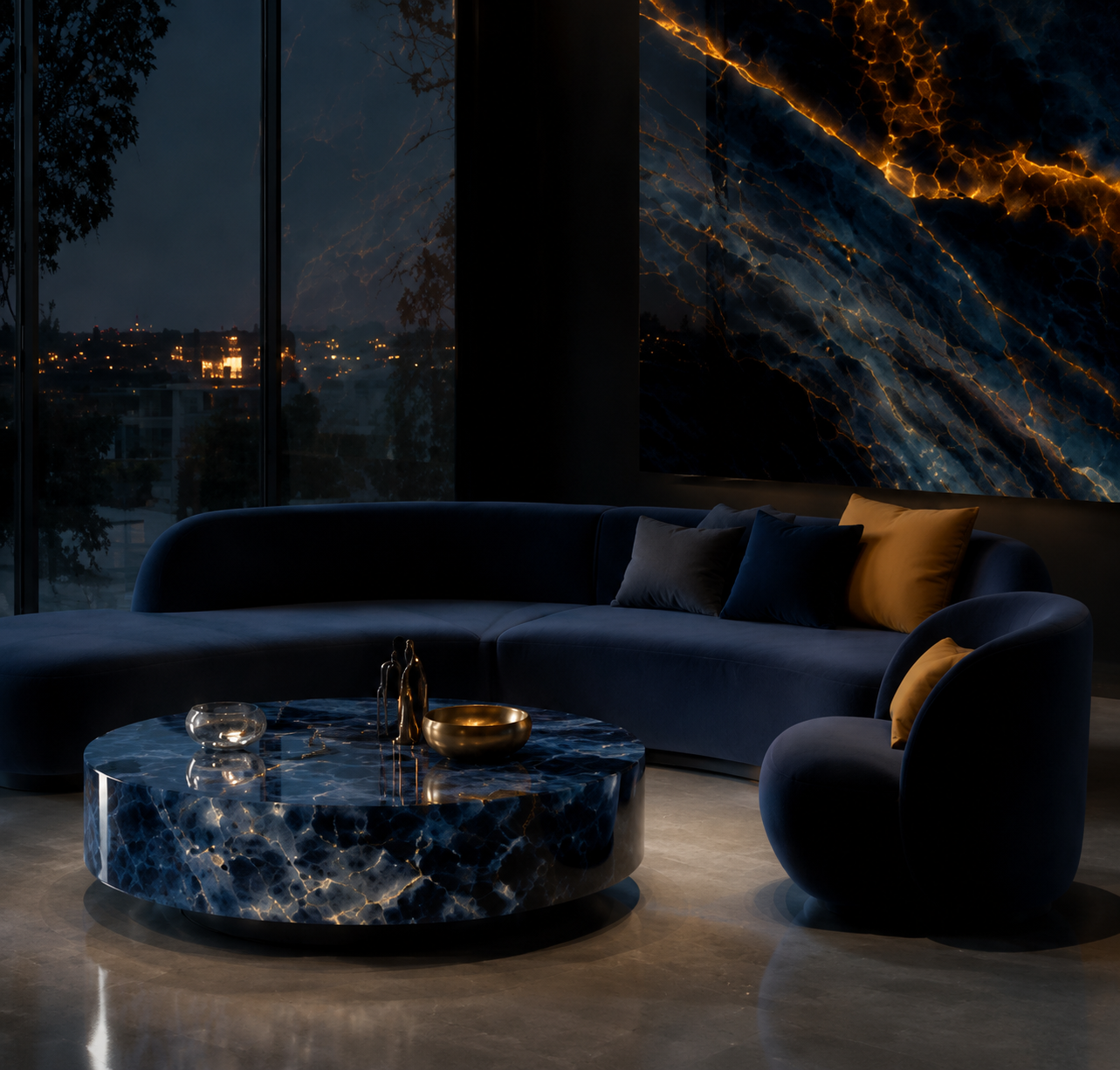
In premium furniture, luxury is often misunderstood as the result of adding more: more decorative metal, more carved details, more surface patterns and more visual effects. In practice, however, excessive decoration can make a product feel busy, trend-dependent or difficult to integrate into an interior.
A more sophisticated approach is to create value through material clarity, proportion, light and craftsmanship. High-end resin, synthetic crystal and optical-grade acrylic can support this approach particularly well. These materials can appear transparent, translucent, mineral-like, sculptural or almost weightless, allowing designers to create strong visual impact without covering a piece in ornament.
Research into aesthetic perception helps explain why restraint can be effective. The processing-fluency theory of aesthetics proposes that people tend to respond more positively to forms they can process easily. Symmetry, clear figure–ground relationships, visual contrast and coherent structure can all increase this sense of perceptual ease. In other words, a design does not have to be complicated to be memorable; it has to be visually understandable.
For furniture manufacturers, designers and project buyers, the objective should therefore not be to use resin and synthetic crystal everywhere. It should be to give each material a clear role.
1. Begin With Visual Hierarchy, Not Decoration
A premium-looking furniture piece normally has a recognizable hierarchy. The eye should be able to identify the primary form, the secondary detail and the supporting structure within seconds.
A practical formula is to select one hero material, one supporting material and one quiet background material. Synthetic crystal, for example, can become the hero element because of its brilliance and optical depth. High-end resin can provide the supporting mass, color or sculptural transition. Acrylic, metal, stone or timber can then act as the structural or visual anchor.
Consider a console table designed for a hotel lobby. Instead of adding multiple metal trims, decorative patterns and colored inserts, the designer could use a monolithic smoked-resin base, a clear synthetic-crystal connector and a simple stone or acrylic top. The premium effect would come from the contrast between opacity, translucency and clarity—not from the number of components.
This hierarchy should also be visible in the proportions. A crystal detail loses its significance when it competes with five other decorative features. A single clear or faceted component, occupying perhaps one carefully selected junction, can appear more valuable because the surrounding surfaces allow it to be noticed.
The same principle applies to product collections. Rather than changing every element from model to model, a manufacturer can create a recognizable design language through one consistent crystal cut, one signature resin tone or one distinctive acrylic edge. Repetition across a collection strengthens brand identity while keeping individual products visually restrained.
The commercial advantage is important. A visually coherent product is easier for interior designers to specify because it can work with more architectural styles. It is also easier for buyers to understand in photographs, digital catalogues and showrooms. Complexity may attract attention briefly, but clarity tends to communicate quality more efficiently.
2. Use Light as the Main Decorative Element
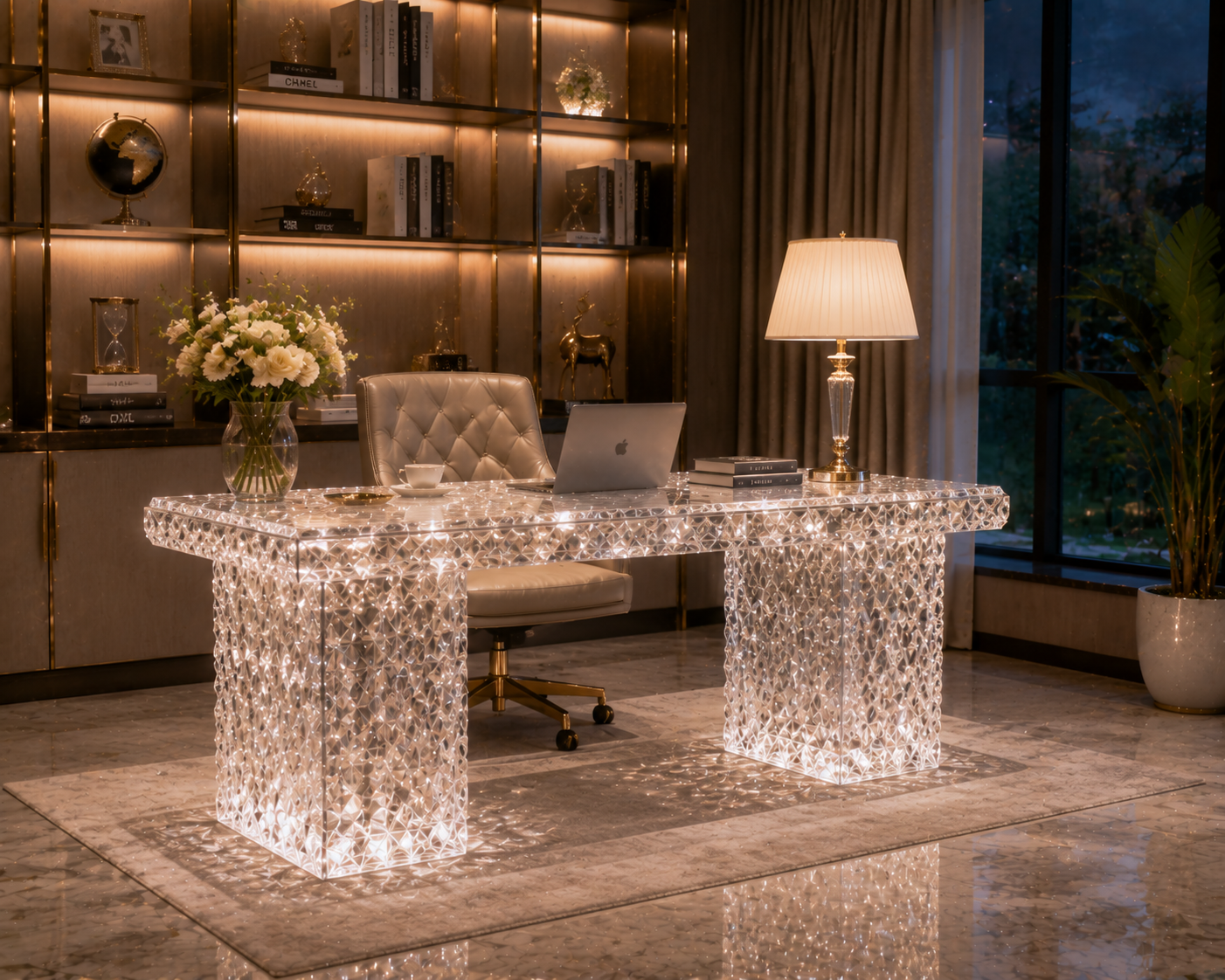
The strongest advantage of resin, synthetic crystal and premium acrylic is not simply transparency. It is their ability to receive, diffuse, bend, transmit and reflect light in different ways.
Research on translucency perception shows that people do not judge a translucent material through color alone. Illumination direction, surface geometry, background, object thickness and even the movement of the observer can influence how the material is perceived. A translucent object may therefore appear dense and stone-like under frontal light, yet luminous and almost liquid when backlit.
This makes lighting part of the furniture-design process rather than an afterthought.
A synthetic-crystal table leg placed under flat overhead lighting may look like an ordinary transparent block. The same component positioned near a window, wall washer or concealed LED source can develop internal highlights and visible depth. Similarly, a translucent resin panel can soften a light source, while a polished acrylic edge can create a controlled line of brightness.
Representative optical PMMA grades can transmit approximately 92 percent of visible light at a thickness of around 3 millimetres, although performance varies by formulation, color and thickness. A technical sheet for PLEXIGLAS Optical also reports less than 1 percent haze for a particular grade and describes PMMA as approximately half the weight of glass. These values should not be applied automatically to every acrylic product, but they demonstrate why optical acrylic is frequently considered for light-guiding and edge-lit applications.
For furniture development, the important question is not “How transparent is the material?” but “What should the light do?”
A dining-table base may need controlled internal reflection rather than complete transparency. A retail display plinth may require edge illumination that directs attention toward the merchandise. A hospitality side table may use semi-opaque resin to produce a soft glow without exposing the LED source. A residential console may depend entirely on daylight, using synthetic crystal to collect changing highlights during the day.
Lighting tests should be conducted with full-size material samples whenever possible. Small samples often look clearer and more uniform than large cast components. Thickness, pigment concentration, internal inclusions and polishing quality become more visible as scale increases. Testing the piece under warm, neutral and cool light can also prevent unexpected color shifts after installation.
3. Create Depth Through Precise Material Transitions
When decoration is reduced, construction details become more visible. The junction between resin and crystal, the polish on an acrylic edge and the alignment of two transparent surfaces can determine whether the final piece feels architectural or inexpensive.
This is why luxury minimalism is not necessarily simple to manufacture. It requires controlled tolerances, clean interfaces and disciplined finishing.
One effective technique is to create a deliberate transition rather than attempting to make two materials look identical. A clear synthetic-crystal element can meet a colored resin body through a narrow shadow gap. A polished acrylic panel can be separated from a resin frame by a thin metallic spacer. A transparent insert can extend slightly beyond an opaque surface so that the edge catches light.
These details create depth without introducing ornamental patterns.
For cast resin, internal features should also be intentional. Random bubbles, cloudy zones and uneven pigment distribution may be interpreted as defects unless the design clearly presents them as an artistic effect. If bubbles, metallic particles, fibers or mineral-like inclusions are part of the concept, their scale and distribution should be controlled and repeated consistently across production.
Polishing is equally important. A transparent material with an uneven edge, visible machining marks or cloudy adhesive lines will rarely communicate premium quality. The design team should specify which surfaces are high gloss, satin, frosted, textured or intentionally left with a cast finish. “Clear” is not a sufficient surface specification.
A realistic development process for a resin-and-crystal coffee table might include a small material coupon, a polished corner prototype, a full-scale junction sample and finally a complete pre-production unit. The junction sample is especially valuable because it allows the manufacturer to assess adhesive visibility, stress concentration, color compatibility and cleaning performance before investing in the full mould.
Different materials can also respond differently to temperature, load and chemicals. For this reason, joints should not be designed only for appearance. Mechanical fixing, adhesive selection, expansion allowance and structural support must be validated for the specific grades being used. A beautiful transparent connection that develops stress cracks after installation is not a luxury detail; it is a future warranty claim.
4. Control Color, Texture and Transparency as One System
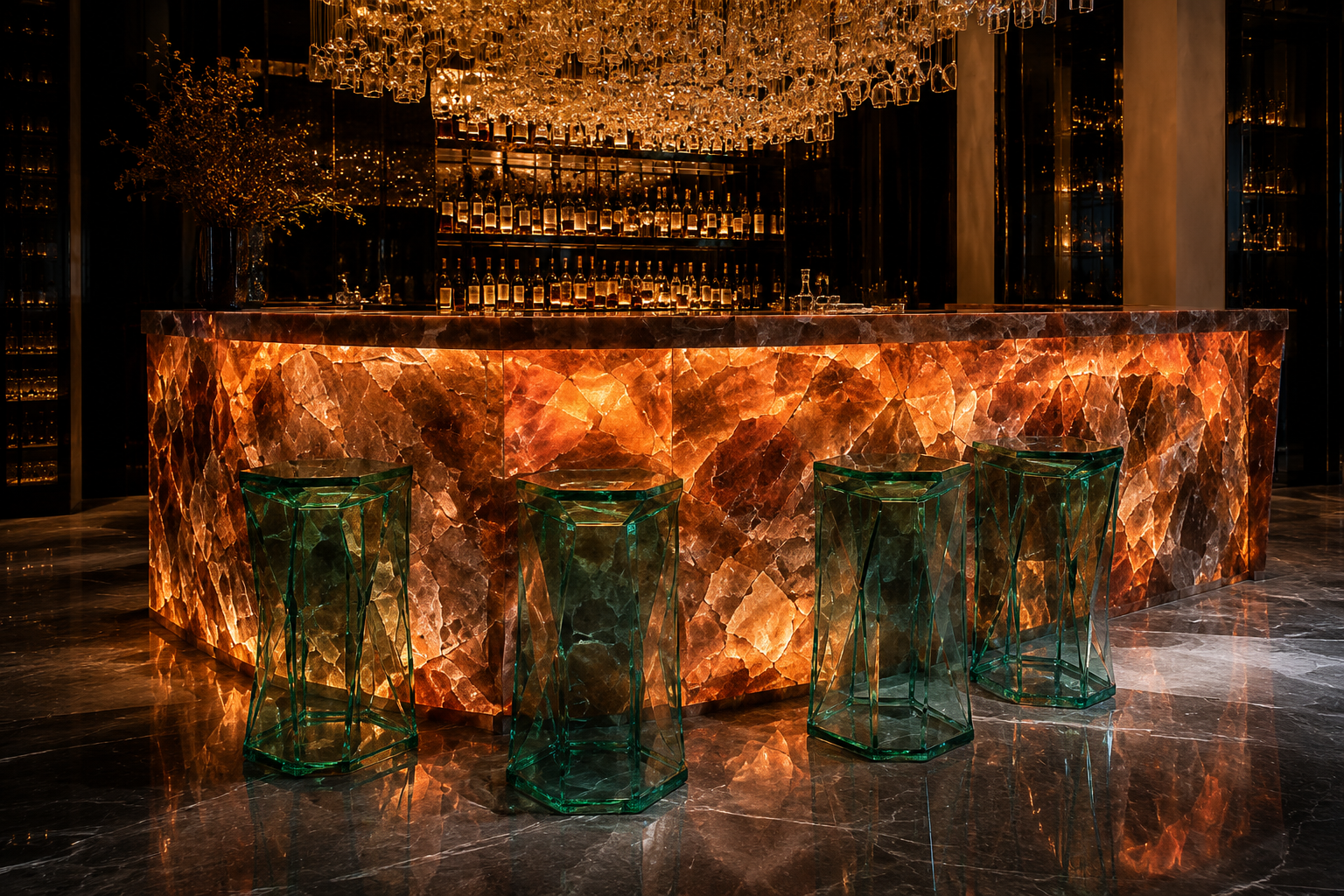
Premium material combinations are usually more successful when color, texture and transparency are developed together.
A common mistake is to choose a resin color first and add a crystal component later. This can produce two attractive materials that do not create a coherent product. Instead, designers should establish a complete material story at the beginning of the project.
A restrained palette might combine champagne-tinted resin, clear synthetic crystal and brushed warm metal. A cooler architectural palette could use smoke-grey resin, colorless acrylic and satin stainless steel. For residential furniture, an amber resin body may work with a lightly frosted crystal insert and dark timber. Each palette creates a different emotional position while maintaining a limited number of visual elements.
Transparency should also be treated as a gradient rather than a binary choice. A piece can move from opaque to translucent to transparent, guiding the eye through its structure. For example, the base of a console may be visually dense at floor level, become more translucent toward the centre and finish with a clear crystal junction beneath the top. This progression can make a heavy object appear lighter without hiding its structure.
Texture creates a similar contrast. Pairing gloss with gloss can produce strong brilliance, but it may also make fingerprints and minor scratches more visible. Combining a satin resin surface with one highly polished crystal detail concentrates attention on the most valuable area. Frosted acrylic can diffuse light and soften the transition between an illuminated component and a darker structure.
The aim is controlled contrast. Every difference should contribute to the hierarchy of the product.
This principle also improves product photography. Clear materials can disappear against white backgrounds, while multiple glossy surfaces may create uncontrolled reflections. A deliberate combination of clear, satin and opaque finishes gives photographers more visual information to work with and helps buyers understand the construction of the piece online.
Before final approval, the complete palette should be reviewed under the lighting and background conditions expected in the target market. A resin tone that looks neutral in the factory may appear green, blue or yellow beside a particular stone floor or wall finish. Material boards should therefore include adjacent architectural finishes whenever the furniture is being developed for a specific hotel, residence or retail project.
5. Make Performance Part of the Premium Story
A high-end appearance may secure attention, but professional buyers also evaluate safety, durability, maintenance and documentation. For contract furniture, visual quality and technical credibility must support each other.
Transparent polymers and resins should be specified according to their actual operating environment. A restaurant table may be exposed to alcohol, cleaning chemicals, hot dishes and repeated abrasion. A hotel-lobby console may experience luggage impacts and strong daylight. A retail display may include continuous lighting that produces localized heat. Each scenario requires different testing.
Manufacturers should provide grade-specific information covering load capacity, heat resistance, surface hardness, chemical compatibility, UV stability, fire behavior, cleaning instructions and repair options. Commercial names such as “premium resin,” “synthetic crystal” or “platinum acrylic” can support marketing, but they are not substitutes for measurable specifications.
Indoor-air quality is another increasingly formalized consideration. UL Solutions states that its GREENGUARD program evaluates products against chemical-emission limits, while GREENGUARD Gold applies stricter limits and addresses more than 360 VOCs and total chemical emissions. Furniture and furnishings are among the product groups covered by the certification program.
Building frameworks also influence procurement. WELL includes VOC-reduction requirements for furniture and furnishings, while LEED provides guidance for selecting low-emitting interior products. These systems demonstrate why adhesives, coatings and finishing processes matter alongside the main visible material.
For commercial furniture, the ANSI/BIFMA e3 Furniture Sustainability Standard provides another useful reference. BIFMA describes e3-2024 as the sixth edition of its consensus-based furniture sustainability standard, covering environmental, health, wellness and social impacts. Its LEVEL program uses independent third-party certification to assess products, manufacturing facilities and responsible companies against the standard’s criteria.
Not every furniture collection needs every certification. However, international buyers increasingly expect organized evidence. A professional technical package can include test reports, material declarations, VOC information, care instructions, packaging standards and installation guidance. This documentation turns “high quality” from an advertising phrase into a verifiable purchasing reason.

6. Design for Long-Term Value, Repair and Adaptability
The most convincing form of luxury is not short-term visual impact. It is a product that continues to look relevant and perform well over time.
Resin and synthetic crystal furniture should therefore be designed with maintenance and component replacement in mind. A damaged crystal connector could be mechanically removable rather than permanently embedded. An illuminated acrylic panel could use an accessible LED channel. A scratched tabletop could be refinished or replaced without discarding the entire base.
This approach is consistent with circular-design thinking. The Ellen MacArthur Foundation describes the circular economy through three design-led principles: eliminating waste and pollution, circulating products and materials at their highest value, and regenerating nature. Its Circular Design Guide, developed with IDEO and input from more than 400 contributors, encourages designers to consider longer-lasting value rather than the conventional make-use-dispose model.
For premium furniture, modularity does not have to look technical. Connections can be hidden beneath crystal collars, inside resin blocks or behind removable metal plates. The customer sees a clean, monolithic object, while the service team retains access to lighting, fixings and replaceable parts.
Long-term value also depends on visual longevity. Highly specific decorative motifs can date quickly. Clear geometry, controlled proportions and material depth are generally easier to place within changing interiors. A restrained resin-and-crystal piece may move from a residential setting to a boutique, office or hospitality space without losing relevance.
Manufacturers can strengthen this proposition by offering replacement components, refinishing services, color-matching records and archived mould or CNC data. For project customers, such support reduces risk. For dealers, it provides a stronger after-sales story. For designers, it makes the product easier to recommend for high-value environments.
Ultimately, the premium effect does not come from the material name alone. Synthetic crystal is not automatically luxurious, and resin is not automatically artistic. Their value depends on how precisely they are designed, manufactured, illuminated, documented and maintained.
The most effective formula is straightforward: establish one clear focal point, use light to reveal material depth, control every junction, limit the palette, verify real-world performance and plan for a long service life.
When these decisions are handled well, furniture does not need elaborate decoration to look expensive. The material itself becomes the decoration—and craftsmanship becomes the strongest expression of luxury.

READ MORE:
- From Functional Furniture to Art Installation: How Transparent Materials Elevate Hotel Brand Recognition
- How Can One Transparent Piece of Furniture Activate Hotel Corners and Transitional Spaces?
- Transparency, Refraction and Light: How Synthetic Crystal Furniture Adds Depth to Hotel Interiors
- Hotel Corridors Should Never Be Boring: How Transparent Furniture Creates a Distinctive Spatial Memory
- Synthetic Crystal Acrylic Furniture: Creating Stronger Market Competitiveness Through a Distinctive Material
- Why Is Transparent Furniture Becoming an Important Trend in Modern Luxury Design?
- Synthetic Crystal Acrylic Furniture: A Key Element in Creating Differentiated Experiences for High-End Projects
- From Material Selection to Brand Upgrading: An Analysis of the Commercial Value of Synthetic Crystal Acrylic Furniture
- Synthetic Crystal Acrylic Furniture: Why Are More High-End Buyers Willing to Pay for “Quality and Texture”?
READ MORE:
- Dalla prima installazione alla manutenzione: come preservare nel tempo l'aspetto di un arredo trasparente
- Come integrare un'opera scultorea negli spazi commerciali senza ostacolare il flusso delle persone
- Trasparenza, colore e spessore: come valutare davvero la qualità di un arredo in cristallo sintetico
- Come scegliere i materiali più adatti ai diversi climi senza compromettere estetica e durata
- Come rendere uno spazio memorabile anche di notte attraverso la luce
- From Functional Furniture to Art Installation: How Transparent Materials Elevate Hotel Brand Recognition
- How Can One Transparent Piece of Furniture Activate Hotel Corners and Transitional Spaces?
- Transparency, Refraction and Light: How Synthetic Crystal Furniture Adds Depth to Hotel Interiors
- Hotel Corridors Should Never Be Boring: How Transparent Furniture Creates a Distinctive Spatial Memory


