Luxury interiors are often misunderstood.
Many people assume that a luxurious space is created by adding more decorative objects, more finishes, more accessories, and more visual detail. In practice, the opposite is often true. The most convincing luxury interiors are rarely the most crowded. They are the most controlled.
They use fewer elements, but each element has a clear purpose.
A strong luxury interior does not ask the customer to look everywhere at once. It guides attention. It creates hierarchy. It gives the eye a place to rest and a reason to remember the space.
This is where statement pieces become essential.
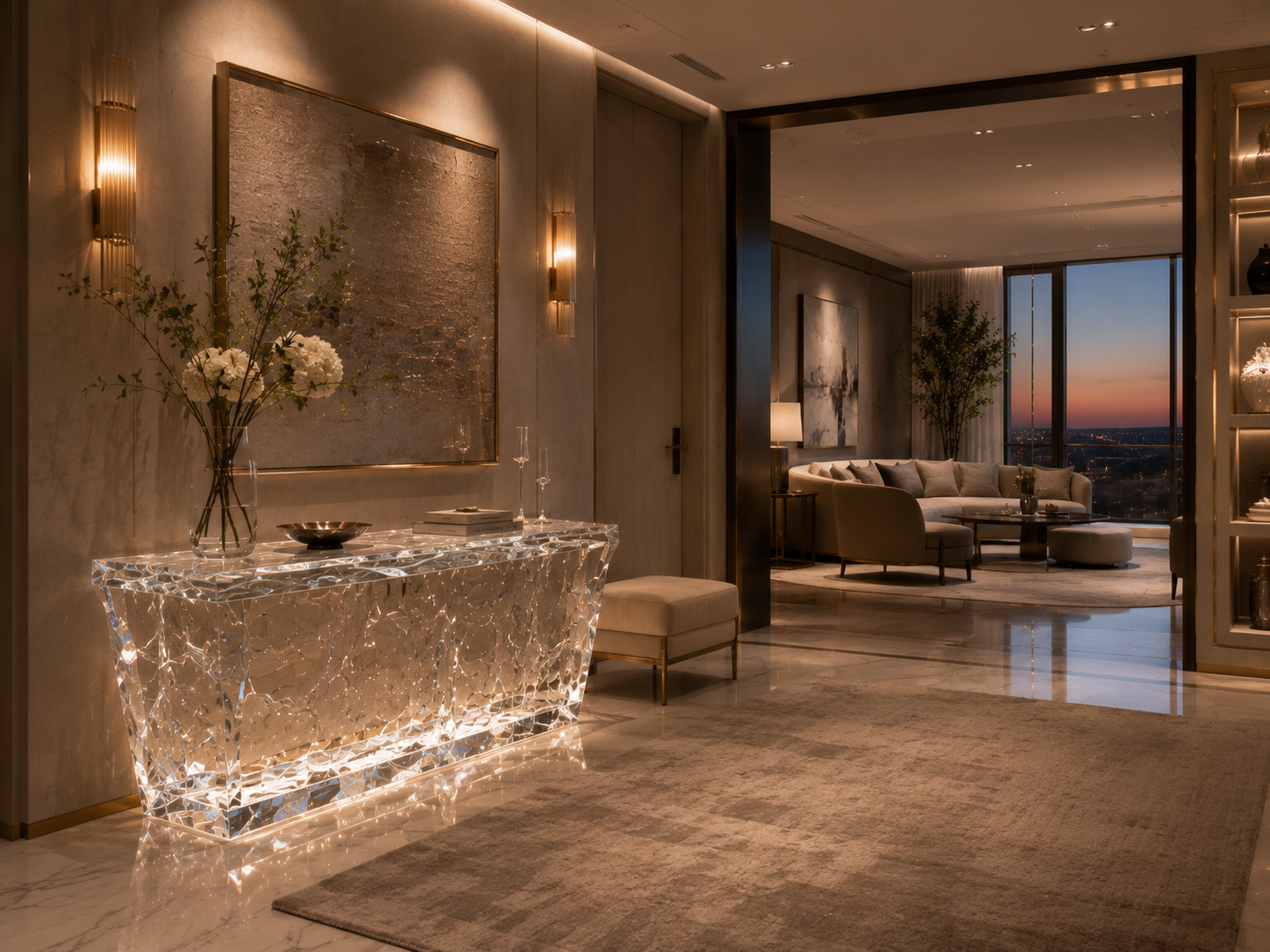
A statement piece is not simply a large or expensive object. It is an element with enough visual authority to organize the room around it. It may be a reception desk, a sculptural table, an illuminated bar counter, a central display, a console, or a custom furniture installation. Its role is not to fill space. Its role is to define it.
For premium commercial interiors, custom synthetic crystal furniture can perform this role with exceptional effectiveness. Its transparency, depth, reflective qualities, sculptural flexibility, and interaction with light allow it to become a focal point without making the room feel visually heavy.
A well-designed synthetic crystal statement piece can create more impact than dozens of smaller decorations.
It can make the space feel more refined, more intentional, and more valuable before a customer understands exactly why.
Luxury Depends on Visual Discipline
Luxury is closely connected to restraint.
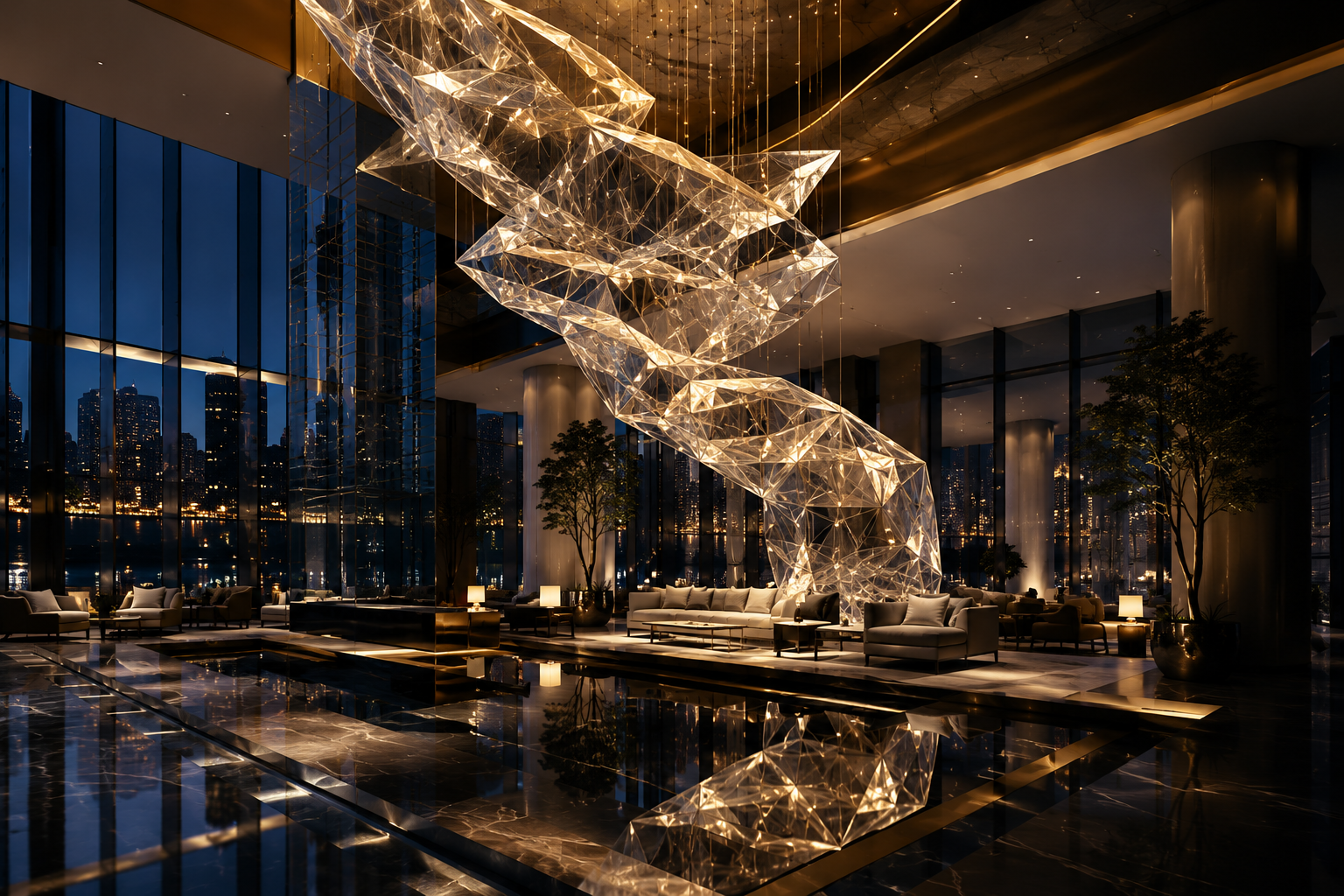
When every surface competes for attention, the space can feel busy, decorative, or even expensive, but it rarely feels truly luxurious. High-end interiors depend on editing. Designers decide what should stand out, what should support, and what should remain quiet.
This visual discipline is one of the clearest differences between decoration and design.
Decoration adds interest.
Design creates order.
A statement piece helps establish that order because it gives the interior a visual center. Once that center is defined, the surrounding materials, lighting, furniture, and accessories can be simplified.
This creates hierarchy.
The customer immediately understands which element matters most. In a hotel lobby, it may be the reception desk. In a jewelry boutique, it may be the central display table. In a private club, it may be the bar. In an executive office, it may be a sculptural conference table.
The statement piece becomes the anchor.
Without that anchor, designers often attempt to create interest by adding more objects. The result may include too many lamps, artworks, decorative panels, sculptures, plants, metallic details, and accessories. Each item may be attractive individually, but together they can weaken the overall impression.
Luxury does not come from the number of things in a room.
It comes from the confidence to choose the right things.
More Decoration Does Not Always Create More Value
Adding decoration is one of the fastest ways to make a space look different, but it is not always the best way to make it look better.
Small decorative elements can refresh an interior, but they rarely change the structure of perception. They may add color or texture, yet they do not necessarily create a stronger brand identity or improve the spatial hierarchy.
This is especially important in commercial environments.
Customers do not always remember the collection of decorative objects arranged around a room. They remember the feature that gave the space its character.
They remember the glowing reception desk.
They remember the transparent table with sculptural edges.
They remember the bar counter that seemed to capture light.
They remember the central installation that made the interior feel unlike anywhere else.
A statement piece creates memory because it gives the customer one clear image to associate with the brand.
More decorations often create more visual information. A statement piece creates a stronger visual idea.
That distinction matters.
Luxury brands need more than attractive surroundings. They need recognizable environments. They need spaces that can be photographed, recalled, and described. They need interiors that reinforce the brand rather than simply follow a trend.
A custom synthetic crystal furniture piece can serve as that recognizable element.
Statement Pieces Create Immediate Hierarchy
Every successful interior has a visual hierarchy.
Some elements should lead. Others should support. Without this hierarchy, the customer’s attention becomes scattered.
In luxury spaces, the focal point should feel deliberate.
A synthetic crystal reception desk, for example, can define the entire entrance. Its form can guide circulation, its transparency can preserve openness, and its lighting can draw attention without requiring excessive decoration around it.
The same principle applies to other commercial environments.
A large synthetic crystal display table can organize a retail space around a central product presentation. A sculptural console can give a hotel corridor a sense of destination. An illuminated counter can make a restaurant or bar immediately recognizable.
Once a statement piece is introduced, the rest of the interior becomes easier to control.
Supporting furniture can be simpler.
Wall finishes can be calmer.
Accessories can be reduced.
Lighting can be directed more precisely.
This creates a more sophisticated environment because every design decision has a clear relationship to the central element.
The room no longer feels like a collection of attractive objects. It feels like one complete composition.
Synthetic Crystal Creates Presence Without Visual Weight
Many statement pieces rely on size and mass to create impact.
Stone, solid wood, and metal can all produce strong visual presence, but large forms in these materials may also make a space feel heavier. This can be a problem in interiors where openness, brightness, and circulation are important.
Synthetic crystal offers a different kind of presence.
It can be physically substantial while remaining visually light.
Because the eye can see through or into the material, a large piece does not necessarily block the room. It can define the space without closing it. This makes synthetic crystal especially effective in luxury boutiques, compact hotel lobbies, private salons, galleries, and premium offices where the design must feel impressive without appearing crowded.
Thickness still plays an important role.
A thicker synthetic crystal form can create depth and authority. Polished edges can capture light and make the furniture appear jewel-like. Layered or sculpted surfaces can produce reflections that change as the viewer moves.
Yet the piece can still feel open because of its transparency.
This balance is difficult to achieve with many conventional materials.
It allows designers to create a clear focal point while preserving the feeling of space.
Light Turns Furniture Into an Experience
A statement piece becomes more powerful when it changes throughout the day.
Synthetic crystal interacts naturally with light. Daylight can reveal its clarity and internal depth. Spotlights can emphasize polished edges. Concealed LEDs can create a soft glow in the evening. Reflections from nearby stone, metal, or glass can shift the way the piece appears from different angles.
This means the furniture does not remain visually static.
It becomes part of the atmosphere.
However, lighting must be designed carefully.
The strongest effect usually comes from integrating the lighting system into the furniture from the beginning. If LEDs are added as an afterthought, the result may include visible strips, bright points, uneven illumination, or exposed wiring.
A premium statement piece should reveal the light, not the equipment.
The position, color temperature, diffusion, and intensity all matter.
Warm light may create a softer and more welcoming luxury environment. Neutral light can preserve clarity and suit retail or corporate settings. Cooler light may support a futuristic concept, but it should be used with control.
The goal is not to make the furniture brighter than everything else.
The goal is to make it feel alive.
One Strong Piece Supports Brand Recognition
Luxury interiors should not feel interchangeable.
A customer should not enter a boutique, hotel, restaurant, or private office and feel that the same design could belong to any business. The space should express something specific about the brand.
Statement pieces are effective because they can be customized around that identity.
A synthetic crystal piece can incorporate brand colors, geometric forms, layered textures, illuminated details, metal accents, engraved patterns, or sculptural references. It can reflect the architecture, the products, or the emotional tone of the company.
This creates recognition.
A fashion brand may prefer sharp geometry and polished metal details. A beauty brand may choose soft curves and warm translucent tones. A technology company may use clear forms with precise edge lighting. A luxury hotel may choose deeper colors and more sculptural surfaces.
The furniture becomes a physical expression of the brand.
Unlike small accessories, which can be replaced or copied easily, a custom statement piece is more difficult to imitate. It gives the interior a unique visual signature.
That signature can appear in customer photographs, marketing campaigns, social media content, press images, and event materials.
In this way, the furniture continues building brand recognition beyond the physical space.
Statement Pieces Improve Spatial Memory
Customers remember strong visual moments.
They may not recall the exact wall color, the number of decorative objects, or the type of flooring used. They are more likely to remember the one feature that made the space feel distinctive.
This is why luxury interiors benefit from a memorable focal point.
A statement piece creates a reference point in the customer’s mind.
It helps them describe the space to others.
They may say, “It was the hotel with the glowing reception desk,” or “It was the boutique with the transparent crystal table in the center.”
This kind of recognition has commercial value.
Memorable spaces are easier to recommend. They are more likely to be photographed. They create stronger emotional associations. They help customers distinguish one brand from another.
More decoration does not always improve memory because too many elements compete with each other.
A clear focal point simplifies the experience.
It gives the customer one powerful visual idea to keep.
Quality Matters More When There Is Less to Distract the Eye
Minimal luxury interiors can appear simple, but they are often more demanding to execute.
When there are fewer elements in the room, each one becomes more visible. There is less decoration available to hide weak proportions, poor finishing, or inconsistent details.
This is why statement pieces must be manufactured carefully.
Synthetic crystal is especially honest as a material.
Transparent surfaces can reveal internal structures, joints, adhesive lines, fixings, wiring, and polishing quality. Light can highlight inconsistencies that may not be obvious during production.
The material, structure, finishing, and installation must therefore be planned as one system.
Edges should appear controlled.
Joints should feel intentional.
Internal supports should not interrupt the visual effect.
Lighting components should be concealed.
The furniture should remain stable during daily use.
A statement piece attracts attention by design. Once it attracts that attention, it must reward close inspection.
This is where craftsmanship becomes part of the luxury experience.
Scale Must Be Designed, Not Guessed
A statement piece must have enough presence to influence the room, but it should not overpower the architecture.
Scale is one of the most important decisions.
A piece that is too small may feel like another accessory. A piece that is too large may interrupt circulation, block sightlines, or make the room feel less comfortable.
The right scale depends on the floor area, ceiling height, entrance position, viewing distance, surrounding furniture, and customer movement.
In a large hotel lobby, a long reception desk or sculptural table may be appropriate. In a smaller showroom, a more compact but visually strong console may create greater impact.
Thickness affects scale as well.
A substantial synthetic crystal form can feel architectural and permanent. A thinner structure may feel more delicate and elegant. Neither approach is automatically more luxurious.
The correct choice depends on the message.
A brand that wants to communicate strength may prefer bold proportions. A brand focused on refinement may choose lighter forms and carefully controlled edges.
The most successful statement pieces feel inevitable, as though they were designed specifically for that location.
Function Must Be Integrated Into the Design
A statement piece cannot succeed visually if it fails operationally.
Commercial furniture is used every day.
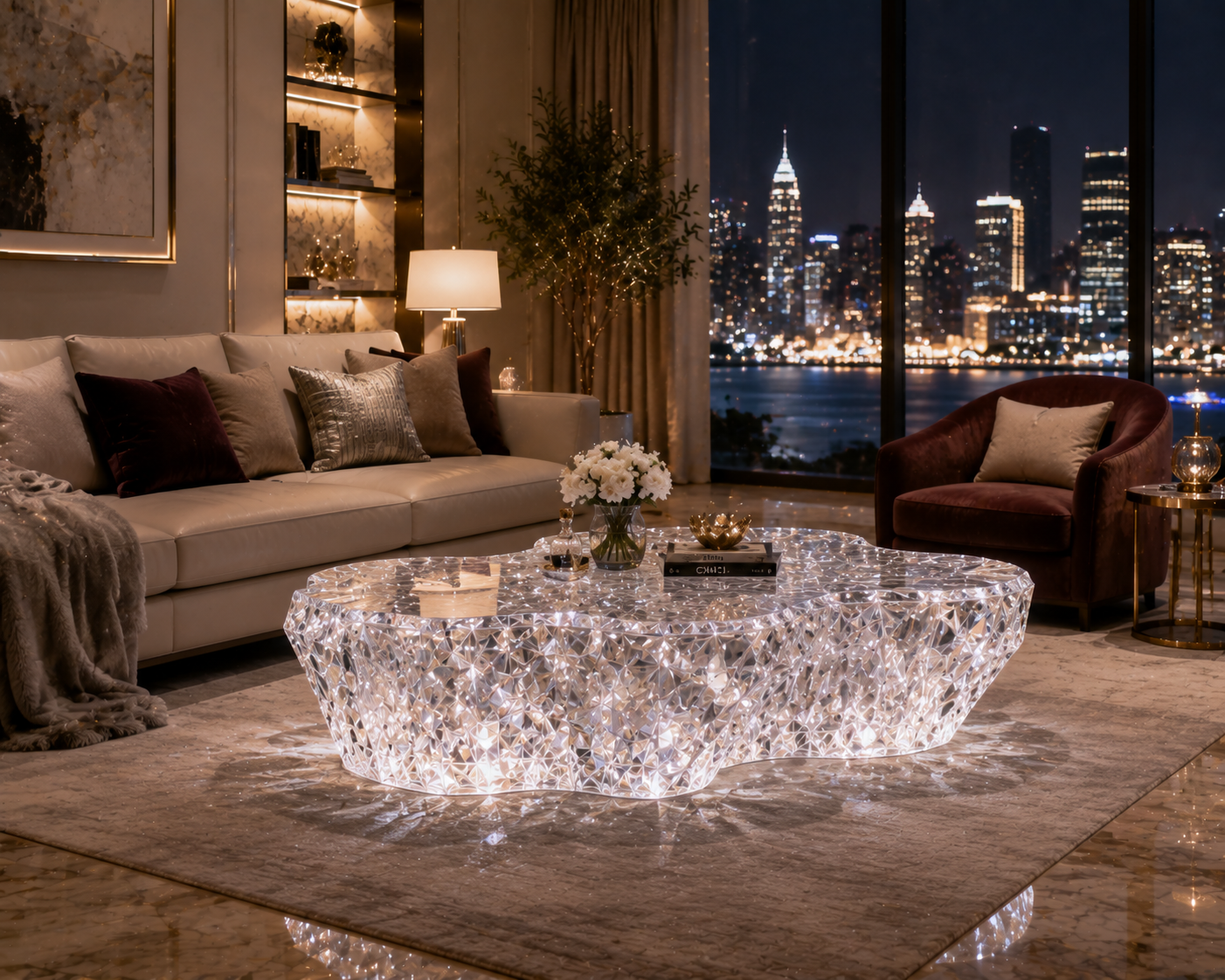
Reception desks need storage, cable routing, equipment access, working height, and staff comfort. Display tables need secure surfaces and flexible presentation options. Bar counters need cleaning access, electrical planning, and resistance to repeated contact.
These practical requirements should be integrated into the design before production.
A beautiful reception desk quickly becomes frustrating if the staff cannot organize equipment behind it. An illuminated counter loses value if the lighting components are difficult to replace. A sculptural table becomes a problem if the surface is impractical for its intended use.
High-end design should make these technical details disappear.
The customer should see a clean and effortless result.
The staff should experience a functional and reliable piece.
The manufacturer must solve both sides.
This is one reason custom furniture can be more effective than standard decoration. A custom statement piece can respond to the actual space, workflow, equipment, and brand requirements.
It does not simply look appropriate.
It works appropriately.
Fewer Pieces Can Improve Material Contrast
When a room contains too many decorative elements, material contrast becomes weaker.
Stone, metal, wood, glass, fabric, and synthetic crystal may all be present, but none of them has enough visual space to be appreciated.
A statement-led interior gives materials room to perform.
Synthetic crystal can look especially powerful when placed against quieter surfaces.
A transparent table may stand out against a matte stone floor. An illuminated crystal counter may contrast with dark timber walls. A polished console may gain depth beside soft textiles or textured plaster.
These relationships create richness without clutter.
Luxury often comes from contrast rather than quantity.
Transparent and solid.
Reflective and matte.
Cool and warm.
Geometric and organic.
Smooth and textured.
A statement piece can bring these contrasts together in one controlled element.
The surrounding interior can then remain calm, allowing the customer to notice the quality of each material more clearly.
Decorations Follow Trends, Statement Pieces Build Identity
Decorative trends move quickly.
A particular type of artwork, metallic accessory, wall panel, or color may become popular and then appear in hundreds of projects. These elements can help an interior feel current, but they do not always make it distinctive.
Statement pieces are more valuable when they are designed around the brand rather than a trend.
A custom synthetic crystal furniture piece can be created for a specific location, purpose, and visual identity. Its proportions, finish, color, structure, and lighting can all be developed together.
This makes it less dependent on fashion.
The piece may still feel contemporary, but it is not interchangeable with standard decorative products.
Luxury brands benefit from this because they need longevity.
A commercial interior should not feel outdated after one design season. The central elements should remain relevant even as smaller accessories, displays, or seasonal details change around them.
A strong statement piece provides continuity.
It becomes part of the brand’s visual language.
Statement Pieces Can Reduce Renovation Disruption
A full renovation is not always necessary to change perception.
In many commercial spaces, the architecture may still be functional, but the interior lacks a memorable focal point. In these cases, introducing one custom furniture element can create a significant visual shift without major construction.
A new synthetic crystal reception desk can redefine an entrance.
A central display table can reorganize a showroom.
An illuminated bar counter can transform the evening atmosphere.
A sculptural console can make a plain corridor feel intentional.
This approach can reduce the need to replace every decorative element.
Instead of adding more objects throughout the space, the design investment is concentrated in the area with the greatest visual and commercial impact.
This can also create a clearer result.
Rather than trying to upgrade the entire environment through multiple small changes, the business creates one decisive improvement.
The space feels new because the hierarchy has changed.
The Best Statement Pieces Encourage Interaction
Luxury furniture should not only be viewed from a distance.
The strongest statement pieces reward movement and interaction.
Synthetic crystal is particularly effective because its appearance changes according to angle, lighting, and distance. Customers may first notice the overall form, then see reflections, internal layers, polished edges, or illuminated details as they approach.
This creates discovery.
A reception desk may appear transparent from the entrance and more sculptural from the side. A display table may seem minimal from one direction and reveal complex depth from another. An illuminated counter may look calm during the day and dramatic at night.
The piece becomes more than a static object.
It becomes an experience within the room.
This interaction supports luxury because it slows down attention. Customers spend more time looking. They notice details. They become more aware of the environment.
More decorations can create visual activity, but a well-designed statement piece creates engagement.
Restraint Makes Premium Materials More Credible
High-end materials lose impact when they are overused.
If every surface is reflective, nothing feels special. If every element is dramatic, the room becomes exhausting. If synthetic crystal appears everywhere, it may begin to feel like a theme rather than a premium material.
Selective use is more effective.
A statement piece allows synthetic crystal to remain rare within the space.
Its clarity, light response, and sculptural character become more noticeable because they are not repeated excessively.
This also protects the overall design from becoming overly decorative.
The material is used where it matters most.
At the entrance.
At the point of customer interaction.
Around the most valuable products.
In the most photographed area.
At the center of the room.
This strategic placement creates greater impact with fewer elements.
Luxury often depends on scarcity, and the same principle applies to interior materials.
Manufacturing Quality Determines Whether the Piece Feels Timeless
A statement piece must survive close attention and long-term use.
Its design may create the initial impact, but manufacturing quality determines whether that impact lasts.
For synthetic crystal furniture, this includes material consistency, accurate cutting, controlled shaping, careful polishing, structural support, joint treatment, lighting integration, packaging, and installation.
Each stage affects the final perception.
Poorly polished edges can reduce clarity.
Visible hardware can interrupt the design.
Uneven lighting can create a temporary retail effect instead of a luxury appearance.
Weak internal support can affect stability.
Inadequate packaging can damage the surface before installation.
These details are especially important because statement pieces remain highly visible.
They are not background furniture.
They may appear in thousands of customer interactions and photographs. They become one of the most recognizable elements in the interior.
A luxury brand cannot afford for its most visible furniture to feel temporary.
Statement Pieces Create Better Commercial Value
A custom statement piece may require more investment than standard decoration, but its value should be measured differently.
Small decorative objects often have limited influence on customer behavior. They support the atmosphere, but they rarely define it.
A statement piece can contribute to multiple business goals at once.
It can improve first impressions.
It can support premium pricing.
It can create a recognizable photo location.
It can reinforce brand identity.
It can guide customer movement.
It can elevate product presentation.
It can become part of marketing content.
It can reduce the need for excessive decoration elsewhere.
This concentration of value makes statement pieces commercially effective.
The right piece does not only occupy space.
It performs.
Designing a Statement Piece Starts With the Brand
The process should not begin with the question, “What shape should the furniture be?”
It should begin with the brand.
What should customers feel when they enter?
Should the space feel precise, calm, futuristic, warm, exclusive, artistic, or powerful?
Which products or services should receive the greatest attention?
Where do customers pause?
Which area appears most often in photographs?
How should the furniture perform for staff?
These questions guide the material, proportions, color, lighting, and structure.
For synthetic crystal furniture, the design may then explore clear, frosted, smoke, amber, champagne, colored, layered, or sculptural finishes. It may combine crystal with metal, stone, wood, or lighting systems.
Every decision should support the same central idea.
A successful statement piece is not created by adding more effects.
It is created by removing everything that does not support the concept.
The Space Should Have One Clear Voice
Luxury interiors are persuasive when they feel confident.
They do not need to prove their value through constant decoration. They do not need every surface to be unusual. They do not need to fill every empty area.
They need one clear visual voice.
A statement piece gives the space that voice.
It establishes the level of quality, defines the mood, and helps every other element fall into place. When made from high-quality synthetic crystal, it can combine visual presence with openness, craftsmanship with lightness, and functionality with memorable design.
More decorations may make a room look fuller.
A statement piece can make it feel complete.
The real question is not how much more your interior can hold, but which single piece could make everything else unnecessary?
READ MORE:
- A New Approach to Building a High-End Furniture Brand: From Design Differentiation to Material Differentiation
- Why Is Synthetic Crystal Acrylic Becoming a New Symbol of High-End Furniture?
- Synthetic Crystal Acrylic Furniture: Giving Ordinary Furniture a High-End Design Language
- From Transparent Aesthetics to Commercial Value: Where Are the Growth Opportunities for Synthetic Crystal Acrylic Furniture?
- Synthetic Crystal Acrylic Furniture: Why Are High-End Spaces Paying More Attention to Material Identity?
- The Hidden Cost of Low-Quality Furniture in Premium Commercial Projects
- How Light Interacts with Crystal Materials to Create Memorable Commercial Spaces
- How Material Quality Shapes Brand Trust Before a Customer Speaks to You
- Commercial Space Upgrades: Choosing Materials That Transform Perception Fast


