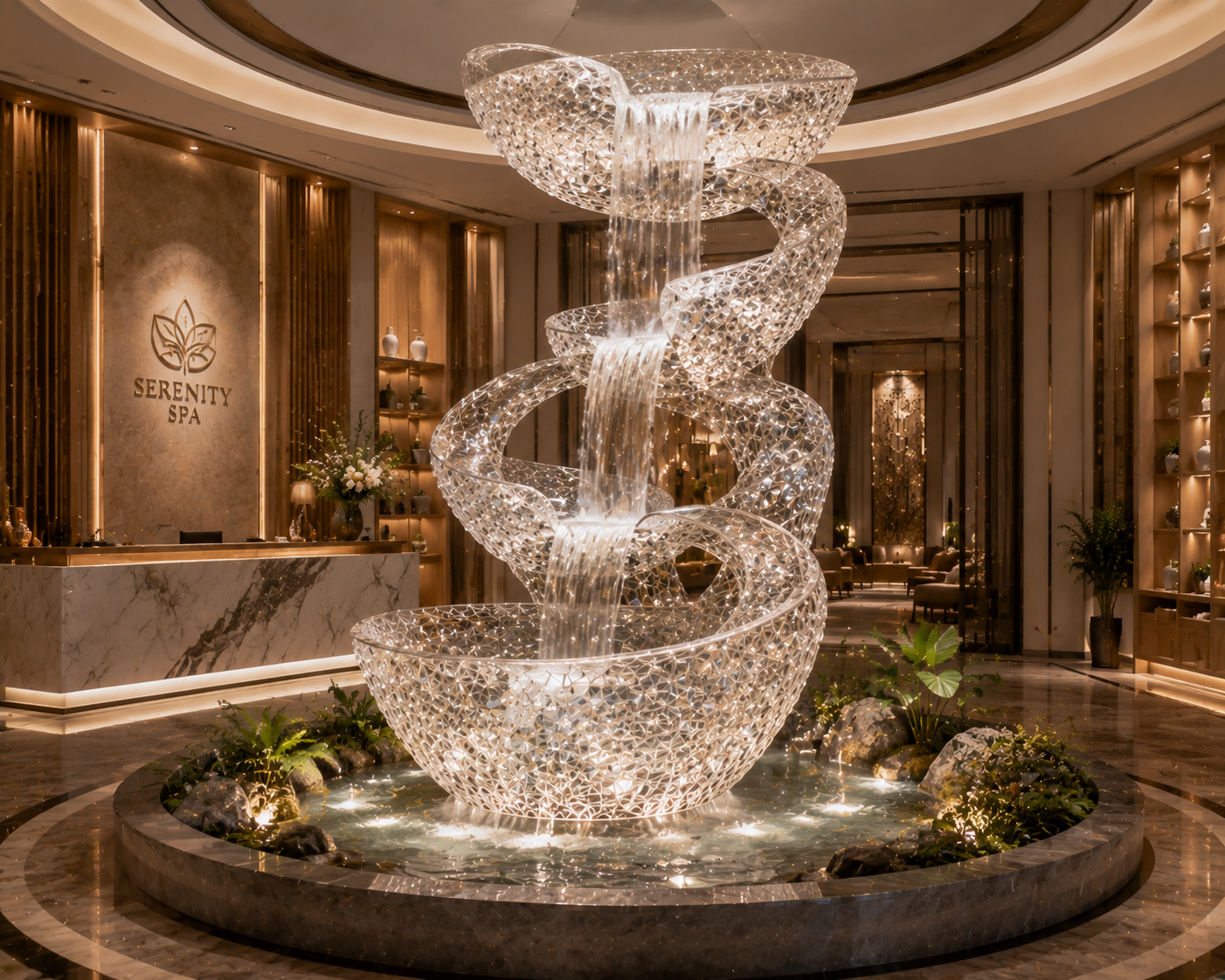
Light is one of the most powerful materials in commercial interior design, even though it cannot be touched.
It changes how surfaces appear, how colors are perceived, where customers look, how long they remain in a space, and what they remember after leaving. The same reception desk, display table, bar counter, or sculptural installation can feel ordinary under one lighting condition and extraordinary under another.
This is especially true when light interacts with synthetic crystal.
Unlike opaque materials, synthetic crystal does not simply reflect light from its surface. Depending on its clarity, thickness, color, texture, and edge treatment, it can transmit, diffuse, redirect, soften, concentrate, and visually contain light. These optical qualities allow furniture to become more than a functional object. It can become part of the atmosphere, a focal point, and a recognizable expression of the brand.
In luxury retail, hotels, restaurants, offices, beauty spaces, galleries, and entertainment venues, this interaction can transform how customers experience an interior.
A carefully illuminated synthetic crystal reception desk can create a strong sense of arrival. A transparent display table can make products appear lighter and more valuable. A sculptural counter can shift from subtle during the day to dramatic in the evening. A frosted crystal panel can create a calm glow without exposing the lighting source.
The effect may appear effortless, but successful illuminated furniture depends on careful decisions involving material quality, lighting position, color temperature, diffusion, structure, maintenance, and the surrounding environment.
When these elements are developed together, light and synthetic crystal can create a space that customers do not simply see. They remember it.
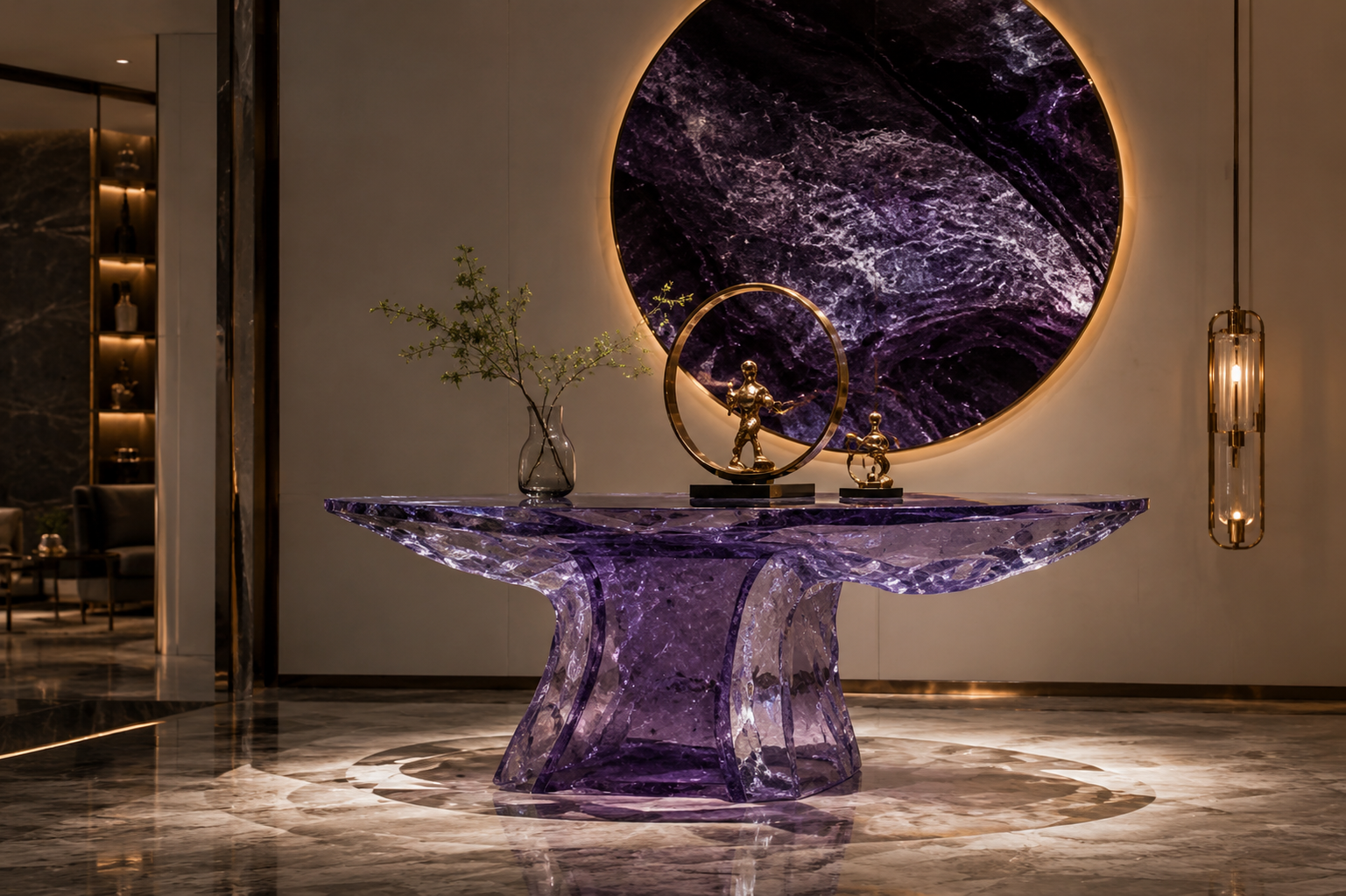
Light Changes the Meaning of a Material
Every material responds to light differently.
Wood absorbs much of the light that reaches it, creating warmth and visual stability. Metal produces sharp reflections and can feel precise or industrial. Stone reveals depth through veining, texture, and variation. Fabric softens both light and sound.
Synthetic crystal offers a different visual experience because light can enter the material.
This gives the furniture a sense of internal depth. The viewer is not only looking at the surface. They are also seeing light move through edges, layers, curves, textures, and transparent volumes.
The result can change according to the viewing angle.
From one position, a crystal table may appear almost invisible. From another, the polished edge may catch a strong line of light. A frosted section may look soft and quiet from a distance but reveal a bright internal glow when approached. A colored crystal element may appear pale in daylight and more saturated under artificial lighting.
This ability to change is one of the reasons synthetic crystal works so well in memorable commercial interiors.
Customers do not experience it as a flat finish. They experience it as an active material.
Transparency Creates Visual Openness
Commercial spaces often need strong furniture without feeling crowded.
Reception desks, counters, display units, and large tables must have enough physical presence to support their function, but opaque furniture can sometimes make a compact space feel heavier.
Transparent synthetic crystal can solve this problem by creating physical definition without blocking visual continuity.
The eye can move through the material and continue reading the space beyond it. This helps maintain openness, especially in boutiques, small hotel lobbies, private salons, showrooms, galleries, and premium offices.
Light strengthens this effect.
Natural daylight passing through a clear synthetic crystal structure can reduce its apparent weight. Carefully positioned artificial lighting can highlight the form without making it feel solid or bulky. The furniture remains noticeable, but it does not close the room.
This balance is important in luxury design.
A statement piece should attract attention, but it should not necessarily dominate the architecture. Synthetic crystal can create presence through light, reflection, and depth rather than through mass alone.
Refraction Adds Movement to Static Furniture
Furniture does not physically move, but light can make it appear dynamic.
When light enters synthetic crystal, it may change direction as it passes through different angles, thicknesses, or surface treatments. This can create shifts in brightness, layered reflections, highlighted edges, and changing patterns.
As customers move around the furniture, the visual effect changes.
A faceted edge may become bright from one angle and disappear from another. A sculptural surface may create multiple reflections that seem to travel across the form. A layered crystal structure may reveal internal depth only when viewed from a particular direction.
These changing effects encourage people to look longer.
They create discovery.
In a commercial interior, this matters because memorable spaces often contain elements that reward movement. A customer sees one impression from the entrance, another while approaching the reception desk, and another when standing beside it.
The furniture becomes part of the spatial experience rather than simply part of the floor plan.
Edge Lighting Creates Precision
One of the most effective ways to illuminate synthetic crystal is through the edges.
A polished edge can collect and emphasize light, creating a clean luminous line. This effect can make the furniture feel precise, architectural, and highly finished.
Edge lighting works especially well on reception desks, display tables, bar fronts, shelving, signage elements, and sculptural panels.
However, the quality of the effect depends on the quality of the edge.
If the polishing is inconsistent, the light may appear cloudy or uneven. If the edge shape changes unexpectedly, the brightness may vary. If the LED position is not carefully planned, individual bright points may remain visible.
For this reason, lighting cannot be separated from fabrication.
The crystal thickness, cut, edge profile, polishing method, and lighting channel should be considered together. Even a small change in the position of the light source can alter the final appearance.
A refined edge-lighting effect should feel controlled.
The customer should notice the luminous form, not the technical system behind it.
Frosted Crystal Softens Light
Clear synthetic crystal creates precision and depth, while frosted crystal creates softness.
A frosted surface diffuses light instead of allowing it to pass through in a completely direct way. This can produce an even glow and reduce the visibility of the lighting source.
The effect is especially useful in environments where the atmosphere should feel calm, welcoming, or private.
Beauty clinics, spas, hotel reception areas, wellness spaces, restaurants, and executive lounges can benefit from this softer visual language.
Frosted finishes can also help reduce harsh reflections.
In interiors with many glossy materials, clear glass, mirrors, or polished metal, adding a frosted synthetic crystal element can introduce balance. The material still responds to light, but the effect becomes more atmospheric than reflective.
This is useful when designers want the furniture to feel luminous without becoming visually aggressive.
A frosted crystal reception front, for example, can glow evenly while concealing internal components. A frosted display pedestal can make the product above it appear to float on a soft field of light.
The strongest results usually come from controlling both the degree of frosting and the distance between the material and the light source.
Color Temperature Changes Emotional Perception
The same synthetic crystal furniture can communicate very different emotions under different color temperatures.
Warm light tends to create comfort, intimacy, and hospitality. It can bring out amber, champagne, bronze, and warm gray tones. In hotel lobbies, private clubs, lounges, and restaurants, warm lighting can make crystal furniture feel inviting rather than cold.
Neutral light often creates a cleaner and more accurate appearance. It works well in retail, offices, galleries, showrooms, and beauty spaces where product color and material clarity are important.
Cooler light can create a futuristic, technological, or dramatic effect. It may suit entertainment venues, branded installations, modern offices, and concept retail spaces. However, it requires careful control. If the light is too blue or too intense, the environment may feel less comfortable.
Color temperature should also be considered in relation to surrounding materials.
Warm wood and brass may feel disconnected from very cool lighting. White stone and polished steel may look more coherent under neutral or slightly cooler light. Colored synthetic crystal may shift visibly under different light sources.
For this reason, lighting decisions should be tested with real material samples whenever possible.
A digital rendering can suggest an atmosphere, but it may not fully predict how the crystal color, nearby surfaces, and lighting temperature will interact in the finished space.
Daylight and Artificial Light Should Be Planned Together
Commercial interiors rarely rely on only one type of light.
During the day, windows and skylights may provide strong natural illumination. In the evening, the same space depends on ceiling lights, wall lights, spotlights, decorative fixtures, and integrated furniture lighting.
Synthetic crystal can look very different under these conditions.
In daylight, clear crystal may feel light, open, and almost invisible. Direct sunlight may create strong highlights or reflections. Tinted materials may appear brighter and less saturated.
At night, integrated lighting becomes more important. The crystal may appear deeper in color, more sculptural, and more dramatic. Concealed LEDs can make the furniture become a visual focal point.
A successful design should work in both conditions.
If a piece is designed only for evening lighting, it may appear weak during the day. If it relies only on daylight, it may lose its identity after sunset.
This is particularly important for hotels, restaurants, retail stores, and entertainment venues that operate across different times of day.
The furniture should have a daytime character and an evening character, while still feeling like the same design.
Reflections Can Strengthen or Weaken the Effect
Reflective surfaces are powerful, but they require control.
Synthetic crystal can reflect ceiling lights, windows, metallic finishes, polished floors, and nearby objects. These reflections can add depth and visual richness, but they can also create distraction.
A spotlight positioned directly above a polished horizontal surface may create uncomfortable glare. A highly reflective edge may expose an unattractive ceiling fixture. Mirrors placed too close to illuminated furniture may multiply the effect until the space feels visually busy.
The surrounding environment must therefore be considered.
Designers should review the main viewing angles and ask what the crystal will reflect from each position. They should also consider the experience of both standing and seated customers.
The goal is not to eliminate reflection. Reflection is one of the material’s strengths.
The goal is to make the reflection useful.
A controlled reflection can connect the furniture to the architecture. It can repeat a brand color, capture a feature light, or make the room feel more layered. An uncontrolled reflection can reduce clarity and make the design appear accidental.
Lighting Position Determines Visual Depth
The location of the light source changes how synthetic crystal is perceived.
Front lighting emphasizes the surface and overall shape. It can create clear reflections and make polished details visible.
Backlighting increases transparency and can reveal internal textures, color gradients, or layered forms. It can also make furniture appear lighter and more luminous.
Side lighting highlights edges, curves, and carved surfaces. It is effective for creating depth and emphasizing sculptural details.
Lighting from below can create a floating effect, especially for tables, counters, pedestals, and display elements. However, it must be used carefully to avoid exposing wiring or creating an overly theatrical appearance.
Internal lighting can produce the strongest transformation, but it also requires the most planning. The design must allow space for LEDs, diffusion, ventilation, wiring, power supplies, and maintenance access.
Each position creates a different visual message.
The correct choice depends on whether the furniture should feel minimal, dramatic, soft, jewel-like, technical, or artistic.
Concealed Lighting Usually Feels More Luxurious
In premium interiors, visible lighting equipment can weaken the visual effect.
Exposed LED strips, obvious cables, uneven light points, and poorly integrated power supplies make the system feel added rather than designed.
Concealed lighting usually creates a more refined result.
When customers see only the glow, the crystal appears to contain the light naturally. The furniture feels more complete and more valuable.
This requires careful detailing.
Lighting channels must be positioned so they remain hidden from normal viewing angles. Diffusers may be needed to prevent individual LED points from showing. Internal surfaces may need to be treated differently to control brightness. Access panels must be integrated without interrupting the design.
The lighting system also needs enough space for heat management.
Although modern LED systems produce less heat than many older light sources, enclosed areas still require responsible planning. Components should not be placed where they are difficult to inspect or replace.
Luxury is often created by hiding complexity.
The finished piece should look simple, even when the engineering behind it is not.
Synthetic Crystal Can Frame Products Without Competing With Them
In luxury retail, the furniture should support the product.
Jewelry, watches, cosmetics, fashion accessories, technology, and collectibles all need presentation surfaces that increase perceived value without distracting from the merchandise.
Synthetic crystal is particularly effective because it can create a strong display environment while remaining visually light.
A clear pedestal may appear almost absent, allowing the product to become the focus. A softly illuminated base can make an object feel more important. A tinted crystal surface can create contrast with the product. A faceted edge can add a premium visual detail without introducing a separate decorative object.
Lighting must be balanced carefully.
If the furniture is brighter than the product, the display hierarchy becomes confused. If the crystal receives too little light, its depth and craftsmanship may disappear.
The most effective solution often uses the furniture as a secondary source of atmosphere while dedicated product lighting creates the primary focus.
The customer should first notice the product, then recognize the quality of the display supporting it.
Illuminated Reception Desks Shape the First Impression
The reception desk is one of the most influential elements in many commercial spaces.
It is often the first large object customers see and the place where the first human interaction occurs. Its material, scale, lighting, and position all contribute to the brand impression.
Synthetic crystal allows a reception desk to feel substantial without becoming visually heavy.
A clear or lightly tinted body can preserve openness. Frosted sections can conceal storage and equipment. Polished edges can emphasize geometry. Integrated lighting can make the desk visible from the entrance and guide customers toward it.
However, the lighting should not interfere with staff comfort.
Bright internal lighting may create glare on screens or reflect into the eyes of employees. Light should be directed and diffused so the customer experiences the visual effect without making the working environment uncomfortable.
The back of the desk also needs practical planning.
Cable routing, power access, storage, equipment ventilation, and maintenance panels should be resolved before production. A beautiful illuminated front is not enough if the desk is difficult to operate every day.
The strongest reception desks combine a memorable customer-facing appearance with a calm, functional staff environment.
Bar Counters Benefit From Layered Lighting
Bars and hospitality counters are naturally connected to atmosphere.
They are experienced at close range, often in lower lighting conditions, and frequently become social focal points. Synthetic crystal can be especially effective in these environments because its optical qualities become more visible in the evening.
Layered lighting can create greater depth than a single bright source.
A soft internal glow may define the main crystal surface. Under-counter lighting can make the base appear lighter. Focused overhead lighting can highlight the countertop material. Additional wall or ceiling lighting can provide context without overpowering the bar.
Color-changing systems may be appropriate in entertainment venues or event spaces, but they should support the brand rather than function as a novelty.
For high-end hospitality interiors, a limited and carefully selected color palette often feels more refined than constant dramatic changes.
Maintenance should also be considered.
Hospitality environments involve spills, frequent cleaning, and repeated contact. Lighting components should be protected and accessible. The surface finish should be selected according to the expected use, and staff should receive suitable cleaning guidance.
A memorable counter must remain attractive after the opening event.

Texture Controls the Way Light Breaks Across the Surface
Synthetic crystal does not need to be perfectly smooth.
Carved, rippled, fluted, faceted, layered, or irregular surfaces can create more complex interactions with light. These textures break the light into patterns and can make the material appear deeper or more sculptural.
A fluted surface may create repeated vertical highlights.
A faceted surface can produce sharp, jewel-like reflections.
A rippled finish can soften the light and make it appear to move.
A carved pattern can create shadows that reveal the design only under certain lighting conditions.
Texture is useful when a piece needs stronger character without relying on intense color.
However, texture should be selected according to the function.
Highly detailed surfaces may be more difficult to clean in areas exposed to frequent contact. Sharp facets may not be appropriate near customer circulation. Deep carving may affect the weight and structure of the piece.
As with every high-end material decision, the visual effect must be balanced with practical use.
Thickness Influences Brightness and Depth
The thickness of synthetic crystal has a direct effect on how light behaves.
Thicker material can create stronger optical depth and more visible edge illumination. It can make the furniture feel substantial and architectural. Light may travel through the volume and become more concentrated at polished edges.
Thinner material can feel lighter and more delicate. It may be appropriate for shelves, panels, decorative screens, or smaller furniture elements.
The correct thickness depends on structure, scale, lighting, and visual intention.
Using greater thickness does not automatically create a better result. It also increases weight and may affect transportation, installation, internal support, and site access.
For large furniture, the design may need a reinforced internal structure or modular construction. These technical elements should be planned so they do not interrupt the optical clarity.
The goal is not simply to create the brightest edge or the thickest form.
The goal is to achieve the correct relationship between light, proportion, structure, and use.
The Surrounding Materials Affect the Crystal
Synthetic crystal never exists in isolation.
Its appearance depends on the materials around it.
Dark walls can increase contrast and make illuminated crystal appear brighter. Pale walls can create a softer, more integrated effect. Matte surfaces can help balance polished reflections. Metal can add precision. Stone can create visual weight. Wood can introduce warmth.
The floor is particularly important.
A polished floor may reflect the illuminated furniture and visually extend the effect. A textured floor may create stronger contrast. A dark floor can make clear crystal appear lighter, while a pale floor may reduce the visibility of transparent elements.
Ceiling conditions also matter.
The crystal may reflect ceiling lights, air-conditioning grilles, cameras, or unfinished technical elements. These reflections can become visible in photographs and from customer viewing angles.
A complete design process should therefore consider the entire visual field.
The furniture, architecture, lighting, and surrounding finishes must support the same atmosphere.
Lighting Tests Reduce Expensive Mistakes
Illuminated synthetic crystal furniture should be tested before final installation.
A lighting test can reveal whether the LED points are visible, whether the color temperature is correct, whether the brightness is even, and whether the polished edges respond as expected.
Testing can also identify problems with internal reflections.
A structural support that appears discreet without lighting may become highly visible when the crystal is illuminated. Adhesive lines may become more noticeable. A colored sample may shift under the selected light source.
These issues are easier to correct before final assembly.
Testing does not always require a full-size prototype. Material samples, edge samples, small lighting sections, and finish combinations can provide useful information.
For important statement pieces, however, a larger mock-up may help the design team understand proportions, brightness, and the relationship between the furniture and the surrounding interior.
The more visually important the piece is, the more valuable testing becomes.
Maintenance Access Protects the Long-Term Effect
Lighting systems eventually require inspection, adjustment, or replacement.
A high-end furniture piece should be designed with this reality in mind.
Power supplies, controllers, connectors, and LED components should be accessible without damaging the synthetic crystal or dismantling the entire structure. Access panels should be concealed but practical.
The design should also allow staff or technicians to identify the correct components.
If the lighting system is custom, clear documentation can make future maintenance easier. This may include wiring information, component specifications, control instructions, and recommended replacement procedures.
Cleaning access is equally important.
Dust can collect near lighting channels, edges, and recessed areas. If these areas cannot be reached, the glow may become uneven over time. Surface cleaning should be straightforward enough for regular commercial maintenance.
A memorable installation should not depend on perfect conditions only on the first day.
It should be designed to preserve its visual quality through daily use.
Packaging and Installation Affect the Lighting Result
The optical quality of synthetic crystal can be damaged during transportation if the furniture is not packaged correctly.
Polished surfaces, edges, corners, internal lighting components, and electrical connections all need protection. Movement inside the crate can cause marks, misalignment, or damage even when the exterior packaging appears secure.
For large illuminated pieces, transportation should be considered during the design stage.
The furniture may need to be divided into modules to fit through doorways, elevators, or corridors. The connection points should be planned so the lighting remains continuous and the joints remain visually controlled.
On site, the installation team must align the furniture accurately.
Even a small difference in level can affect reflections and visible light lines. Electrical connections should be completed safely and tested after the furniture is positioned. Protective films should remain in place until the highest-risk site work has been completed.
Installation is the final stage of the visual design.
A high-quality factory finish can still be weakened by poor alignment, exposed wiring, or incorrect lighting adjustment on site.
Memorable Does Not Mean Excessively Bright
One of the most common misconceptions about illuminated furniture is that stronger brightness creates stronger impact.
In luxury interiors, excessive brightness often reduces sophistication.
A very bright synthetic crystal piece may dominate the space, create glare, weaken the product display, or make the furniture feel temporary. It can also make surrounding areas appear darker and less welcoming.
Subtlety usually creates a more premium result.
A soft edge glow, a controlled internal gradient, or a gentle reflection may be enough to attract attention. The furniture should feel integrated into the environment rather than separated from it.
The correct brightness depends on the ambient lighting.
A reception desk in a brightly lit showroom may require more output than a bar counter in a dark lounge. An installation near a window must compete with daylight, while a feature in an enclosed corridor may need very little light.
Brightness should be evaluated in the final environment, not only in the workshop.
Memorable Spaces Use Light to Guide Attention
Commercial lighting should help customers understand the space.
It can guide them toward the reception desk, highlight important products, identify a service area, define circulation, and create visual destinations.
Synthetic crystal furniture can support this wayfinding function.
An illuminated reception desk becomes easy to locate from the entrance. A glowing display table can draw customers toward a new collection. A crystal bar front can define the social center of a hospitality venue. A luminous console can create a destination at the end of a corridor.
This guidance feels more natural than signage alone.
Customers move toward the light without needing to consciously analyze the design.
The furniture becomes both functional and directional.
When the lighting hierarchy is clear, customers feel more comfortable because the environment is easier to understand. This sense of clarity contributes to the overall perception of quality.
Light Can Turn Furniture Into Brand Language
A memorable commercial space should express something specific about the brand.
Synthetic crystal and light can be customized to support that identity.
A beauty brand may prefer soft, even illumination and warm translucent tones. A luxury jewelry store may use precise edge lighting to create a jewel-like effect. A technology company may choose clear geometry and neutral or cool light. A hotel may use amber tones and layered diffusion to create warmth.
The form, finish, color, and lighting behavior can all become part of the brand language.
This is more powerful than using decoration alone because the identity is built into the furniture.
Customers encounter the brand through the way the material behaves.
They see whether the space feels calm, bold, precise, artistic, exclusive, or futuristic.
Over time, a distinctive illuminated furniture piece can become recognizable in photographs and marketing content. It may become one of the visual details customers associate most strongly with the business.
The Strongest Effects Come From Coordination
Creating memorable illuminated synthetic crystal furniture requires coordination between designers, manufacturers, lighting specialists, contractors, and the client.
The furniture design must respond to the architecture.
The lighting system must fit the material.
The structure must support the form.
The electrical plan must allow safe installation.
The maintenance approach must protect the long-term effect.
The packaging must preserve the finish.
The installation team must align and test everything accurately.
When these decisions are made separately, problems often appear at the connection points. The lighting may not fit the structure. The structure may block the light. The furniture may not align with the power supply. The installed brightness may not match the surrounding environment.
When the disciplines are coordinated early, the result feels effortless.
This is the hidden work behind a successful statement piece.
A Memorable Space Begins With One Controlled Moment
Not every element in a commercial interior needs to glow.
In fact, illuminated synthetic crystal is often most effective when it is used selectively.
One strong reception desk may be enough to define the entrance. One central display table may organize the retail environment. One bar counter may establish the atmosphere of the entire venue.
Selective use creates contrast.
It allows the illuminated piece to remain special.
When too many elements use the same effect, the visual hierarchy becomes weaker. The room may feel themed rather than luxurious.
The strongest interiors usually create one controlled moment of surprise.
The customer enters, notices the light, approaches the material, and gradually discovers the detail.
That sequence creates memory.
Light Makes Quality Visible
High-quality synthetic crystal furniture rewards careful lighting.
The clarity becomes more apparent.
The polished edges become sharper.
The internal depth becomes richer.
The sculptural form becomes easier to read.
At the same time, lighting exposes weaknesses.
Poor polishing, visible joints, inconsistent material, exposed wiring, and uneven assembly may become more noticeable when illuminated.
This is why lighting and craftsmanship are inseparable.
A lighting system cannot compensate for weak manufacturing. It can only reveal what is already present.
When the material quality, fabrication, and lighting are all controlled, the result communicates precision without explanation.
Customers may not understand the production process, but they recognize the sense of quality.
Designing for Memory, Not Only Appearance
A commercial interior should do more than look attractive in a single photograph.
It should create an experience across time.
Customers should notice the furniture from the entrance, understand it as they approach, discover details at close range, and remember it after they leave.
Synthetic crystal supports this sequence because it changes with angle, distance, and lighting.
It can appear subtle from far away and complex up close. It can feel transparent during the day and luminous in the evening. It can reflect the surrounding architecture while still maintaining its own identity.
This layered experience is more memorable than a static decorative effect.
It gives customers something to observe, photograph, and describe.
When Light and Material Become One
The most successful illuminated synthetic crystal furniture does not feel like a crystal object with lighting added to it.
The light and material feel inseparable.
The glow appears to come from within the form. The edges respond naturally. The brightness supports the shape. The technical components disappear. The furniture belongs to the architecture and the brand.
This is when synthetic crystal becomes more than a premium material.
It becomes a medium for creating atmosphere, focus, identity, and memory.
In commercial spaces, those qualities have real value. They influence first impressions, support premium positioning, improve product presentation, strengthen brand recognition, and give customers a visual moment worth remembering.
Light can reveal the quality of a material, but when it is designed with enough precision, it can also reveal the character of the brand behind it.
The question is not simply how your furniture should be illuminated, but what unforgettable story could begin the moment the light turns on?
READ MORE:
- A New Approach to Building a High-End Furniture Brand: From Design Differentiation to Material Differentiation
- Why Is Synthetic Crystal Acrylic Becoming a New Symbol of High-End Furniture?
- Synthetic Crystal Acrylic Furniture: Giving Ordinary Furniture a High-End Design Language
- From Transparent Aesthetics to Commercial Value: Where Are the Growth Opportunities for Synthetic Crystal Acrylic Furniture?
- Synthetic Crystal Acrylic Furniture: Why Are High-End Spaces Paying More Attention to Material Identity?
- The Hidden Cost of Low-Quality Furniture in Premium Commercial Projects
- Why Luxury Interiors Need Statement Pieces Instead of More Decorations
- How Material Quality Shapes Brand Trust Before a Customer Speaks to You
- Commercial Space Upgrades: Choosing Materials That Transform Perception Fast


