When buyers compare furniture, price is often the first number they see.
It is easy to place two transparent tables side by side, compare the quotations, and assume that the lower price represents the better deal. From a distance, the pieces may appear similar. Both may have clear tops, polished edges, sculptural bases, and the same general dimensions. In product photography, the differences may seem almost invisible.
But high-end synthetic crystal furniture is not defined by appearance alone.
Its real value lies in what cannot always be understood from a single image or unit price: the quality of the raw material, the precision of the engineering, the depth of the polish, the control of the joints, the structural reliability, the suitability for the intended environment, the quality of the packaging, the consistency of production, the level of customization, and the support available after delivery.
A low purchase price can become expensive when the furniture arrives with scratches, cloudy edges, weak connections, visible adhesive lines, incorrect dimensions, inconsistent tint, or inadequate packaging. A higher-priced piece may represent better value when it arrives correctly, performs as intended, maintains its visual quality, and continues to support the space for years.
For designers, private clients, retailers, hospitality buyers, and procurement teams, evaluating synthetic crystal furniture therefore requires a broader question.
Not “How much does it cost?”
But “What am I actually receiving for that cost?”
Price and Value Are Not the Same
Price is immediate. Value is cumulative.
The purchase price tells you how much money is required to acquire the furniture. It does not tell you how well the piece will perform, how long it will remain visually convincing, how much maintenance it will require, or how much risk is involved in bringing it into a project.
A transparent dining table that costs less but arrives damaged may require repair, replacement, storage, additional freight, and project delays. A retail display that loses clarity quickly may need to be replaced before the surrounding store design changes. A hotel console with poor joints may weaken the perceived quality of an entire lobby.
These consequences are part of the real cost.
A high-end synthetic crystal furniture piece should be evaluated across its full life cycle, from design and production to shipping, installation, use, maintenance, restoration, and possible reordering.
Value is created when each stage has been considered carefully.
Start With the Quality of the Synthetic Crystal
The material is the foundation of the entire piece.
Transparent materials can look deceptively similar in photographs, especially when images are retouched or captured under controlled lighting. In person, however, differences in clarity, tint, internal consistency, and surface quality become much more obvious.
High-quality synthetic crystal should offer visual depth rather than simple transparency.
The material should look clean across broad surfaces and remain controlled through thicker sections. Edges should collect light without appearing cloudy or strongly discolored. Internal bubbles, haze, distortion, and inconsistent tint should be absent or limited according to clearly agreed tolerances.
Lower-grade material may still appear transparent, but it can lack the visual richness expected in a luxury environment.
The difference becomes especially noticeable in large pieces.
A small decorative object may hide minor optical inconsistencies. A dining table, console, display plinth, or hotel reception feature magnifies them. Thick bases and long transparent spans reveal color and clarity in ways that thin samples cannot.
This is why buyers should request material samples that represent the actual thickness of the finished product.
The value of premium material lies not only in how it looks on the day of delivery, but also in how confidently it supports the design over time.
Optical Quality Creates Perceived Luxury
Luxury synthetic crystal furniture should not look like an enlarged sheet of ordinary plastic.
It should have a sense of depth, density, and controlled reflection.
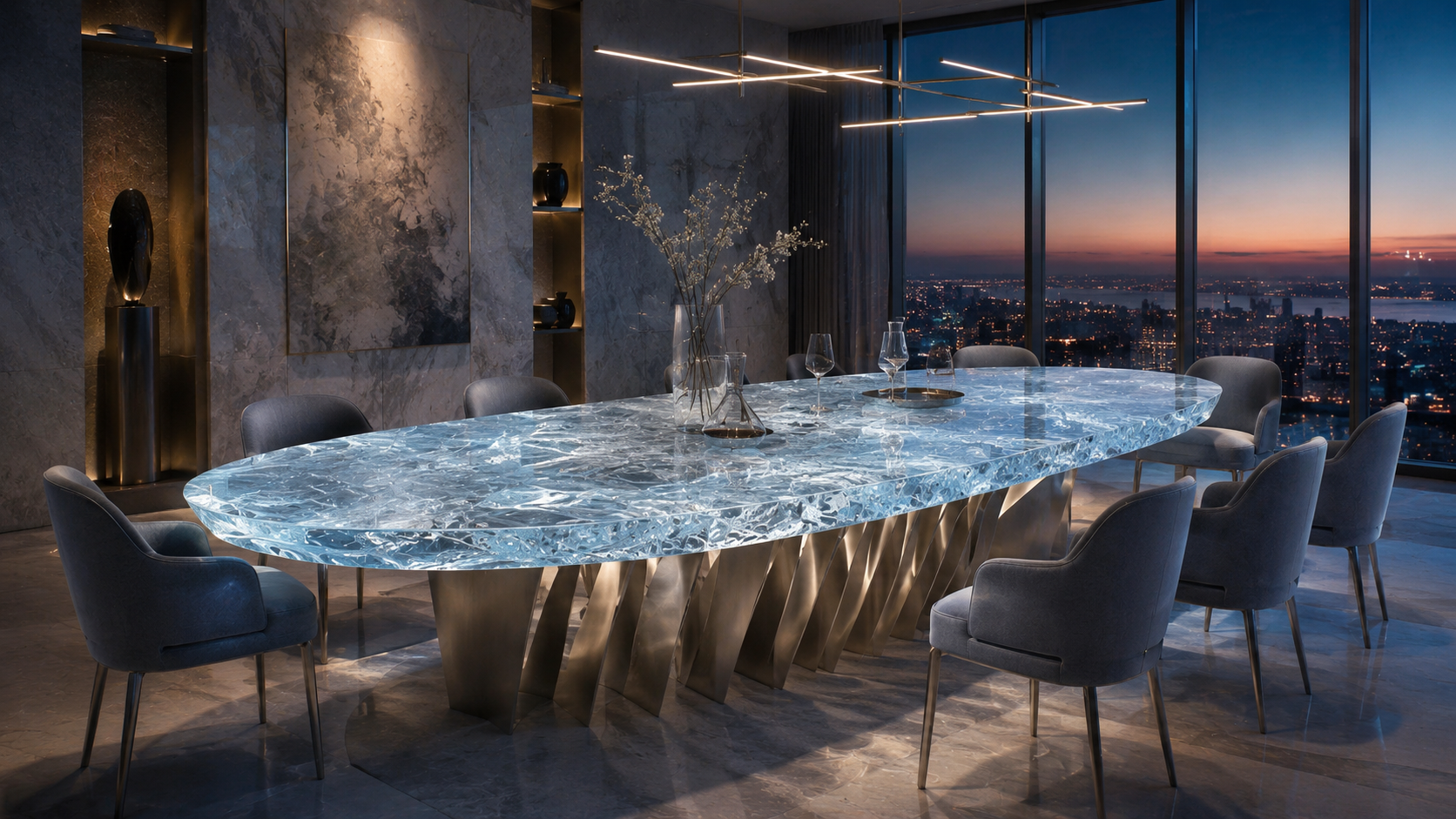
As light enters the material, it should create subtle changes along the edges, corners, and thicker components. The piece should appear different as the viewer moves around it. Natural light, artificial light, dark backgrounds, and surrounding materials should activate the form.
This optical behavior contributes significantly to perceived value.
A well-made transparent table can become one of the most memorable objects in a room even though it preserves the view of everything around it. It feels visually light but materially substantial.
A low-quality piece may be transparent without being expressive. It may look flat, thin, or temporary. Its surfaces may reflect harshly rather than richly. Its edges may appear dull instead of luminous.
These qualities are difficult to communicate through price alone.
The buyer must assess how the material behaves in real space.
Thickness Is Both an Aesthetic and Structural Investment
Material thickness affects appearance, stability, weight, engineering, shipping, and cost.
In high-end synthetic crystal furniture, thickness is often used to create visual authority. A substantial tabletop or sculptural base can make the furniture feel permanent and architectural. Thick polished edges create stronger light effects and greater depth.
However, thickness must be designed intelligently.
A piece should not be made heavier simply to appear expensive. Excessive thickness can increase freight cost, complicate installation, and create unnecessary visual weight. Insufficient thickness can make the furniture appear weak or unsuitable for its intended use.
The true value lies in selecting the correct thickness for the scale, structure, and environment.
A residential side table has different requirements from a hotel lobby table. A retail display plinth has different requirements from a dining table. A console with a long span may require different engineering from a compact pedestal.
A professional manufacturer should be able to explain why each component has been dimensioned as proposed.
When thickness is properly resolved, the buyer is paying not only for more material, but for better proportion, stronger structure, and a more convincing visual result.
Engineering Is Part of the Design
Transparent furniture often appears visually simple.
A table may consist of a top and two bases. A console may look like one continuous form. A bench may seem to float. Yet the engineering behind that simplicity may be highly demanding.
Loads must be transferred safely. Long spans must be controlled. Joints must remain stable. Weight distribution must be considered. The furniture must sit correctly on the floor and respond to the way people will use it.
This engineering has real value.
A piece that looks beautiful but flexes, shifts, rocks, or places stress on its joints is not a successful luxury product.
For large or custom synthetic crystal furniture, buyers should request detailed drawings and technical explanations. The manufacturer should understand the expected load, the intended use, the floor conditions, and whether the piece will be moved after installation.
In hospitality and retail environments, engineering becomes even more important because the furniture may experience repeated contact, frequent cleaning, changing displays, luggage impact, or heavier daily use.
The lowest quotation may not include the same level of structural development.
A higher-value piece has usually been designed to perform, not merely to resemble a concept image.
Joints Reveal Manufacturing Quality
In transparent furniture, joints cannot be treated as hidden construction details.
They remain visible through the material and directly influence the overall appearance.
A high-quality joint should look intentional. Components should align precisely. Adhesive areas should be controlled. Bubbles, residue, cloudy bonding, and uneven gaps should not distract from the form.
Some designs aim for nearly seamless construction. Others use visible metal or architectural connections. Either approach can be successful when executed consistently.
Poor joints immediately reduce perceived value because they reveal manufacturing shortcuts.
They may also create long-term concerns if the connection is not appropriate for the load or use.
The buyer should ask how the piece is assembled, how the joints are inspected, and what visual tolerances are considered acceptable. For large orders, consistency across every unit should be confirmed.
The time, skill, and control required to produce clean transparent joints are part of what makes a high-end piece valuable.
Edge Finishing Is a Major Cost Driver for a Reason
Edges are among the most visually important areas of synthetic crystal furniture.
They collect light, reveal thickness, define geometry, and communicate the quality of the polishing. A poorly finished edge can make premium material look ordinary. A beautifully polished edge can transform a simple form into something jewel-like.
Achieving that result requires multiple stages of machining, refinement, polishing, inspection, and sometimes hand finishing.
Corners and curves require particular care.
The finish should remain consistent around transitions. Tool marks, waviness, dull areas, and irregular radii can become highly visible because transparency magnifies surface changes.
When comparing quotations, buyers should confirm what kind of edge finishing is included.
A basic machine-cut edge is not equivalent to a carefully polished architectural edge. A standard corner is not equivalent to a custom radius or faceted detail.
The price difference may reflect hours of skilled labor rather than a simple material markup.
Surface Quality Determines the First Impression
Synthetic crystal furniture depends on a highly controlled surface.
Dust, fingerprints, fine scratches, polishing marks, residue, and handling damage can all affect its appearance. This makes factory inspection, protective handling, and packaging essential.
A premium manufacturer should have clear surface standards.
The piece should be inspected under strong light and from multiple angles before packing. Broad surfaces, edges, joints, and corners should be reviewed separately.
The buyer should understand what condition the furniture will be in when it arrives.
A lower-cost supplier may reduce inspection time or accept surface variations that would be unacceptable in a luxury project. The piece may still be usable, but it may not create the intended impression.
This matters because transparent furniture often occupies a focal position.
A clear dining table may sit at the center of a residence. A synthetic crystal console may be placed directly beneath artwork. A retail display may be illuminated under strong directional lighting. A hotel lobby table may be one of the first objects guests see.
Surface quality is therefore not a minor technical detail. It is part of the brand and design experience.
Customization Adds More Than a Different Dimension
Custom synthetic crystal furniture is often priced higher than standard catalog furniture, but the value of customization goes far beyond changing length or height.
A custom piece can be designed around the architecture, circulation, lighting, furniture layout, visual balance, and functional needs of a specific space.
A console can align with wall panels. A dining table can be proportioned to the room and seating plan. A retail fixture can support a defined product category. A hotel table can accommodate guest behavior and housekeeping requirements. A display plinth can be designed around the exact dimensions of an artwork or object.
This integration creates value because the furniture feels intentional.
It belongs to the project rather than simply being placed inside it.
Customization may also involve new edge profiles, special base geometries, mixed-material details, branding, hardware, or unique construction methods.
These changes require drawings, technical review, material planning, prototyping, and communication.
The buyer is not only paying for a different object. They are paying for a design process that reduces compromise.
Design Originality Has Long-Term Value
A generic piece may satisfy an immediate functional need, but a distinctive piece can shape the identity of a room or brand.
High-end synthetic crystal furniture has the potential to become visually memorable because it combines transparency with sculptural form.
Original design increases value when it is supported by strong proportion and appropriate use.
A dramatic base, an unusual curve, a refined transition, or a thoughtful combination of synthetic crystal with metal, stone, or wood can give the furniture lasting relevance.
This is particularly important in hospitality and retail.
Guests may not remember every chair or lamp, but they may remember the extraordinary transparent table in the lobby. Customers may associate a sculptural display fixture with the brand itself.
In residential interiors, an original piece can become a long-term anchor that continues to work through changes in rugs, upholstery, artwork, and color.
The value of strong design is not limited to visual novelty. It lies in the ability to remain compelling after the initial surprise has passed.
The Furniture’s Relationship With the Space Matters
Synthetic crystal furniture often creates value by allowing other elements to remain visible.
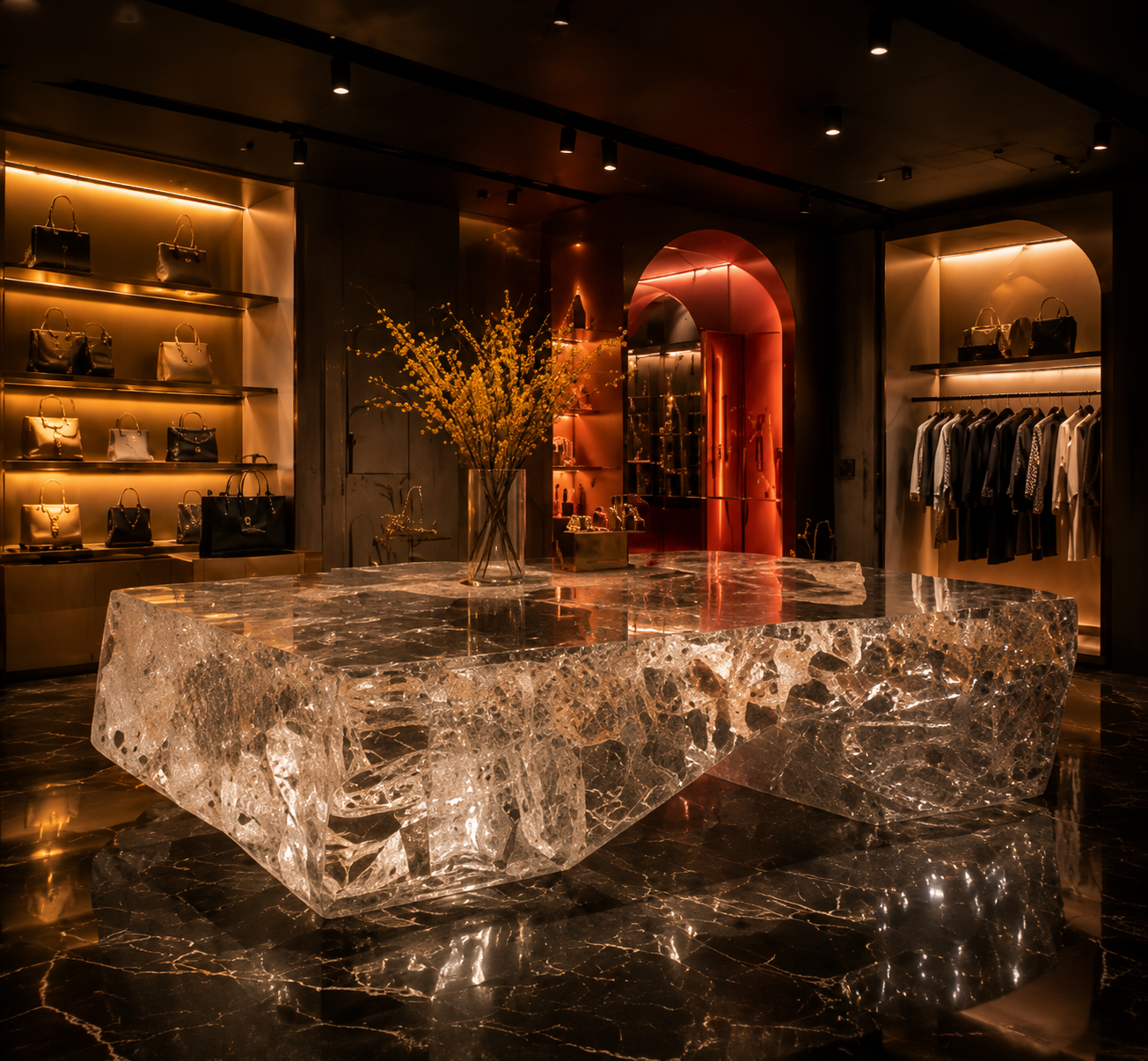
A transparent coffee table preserves the view of a rug. A clear dining table reveals the floor. A console allows a textured wall to remain uninterrupted. A display stand supports merchandise without competing with it.
This spatial value can be significant.
An opaque piece may be less expensive but visually heavier. It may block sightlines, dominate a compact room, or hide expensive architectural finishes.
Synthetic crystal can provide function while reducing visual obstruction.
For small spaces, this can make the room feel larger. For richly detailed interiors, it can prevent visual overload. For luxury retail, it can keep attention on the product. For hotels, it can preserve openness in public areas.
When evaluating price, buyers should consider what the furniture enables in the overall design.
A piece may justify its cost by improving the entire composition, not only by looking attractive on its own.
Versatility Extends Useful Life
High-end synthetic crystal furniture can adapt to different interiors more easily than many highly specific materials or finishes.
Because it is transparent, it can work with changing color schemes, artwork, textiles, rugs, and architectural details. It does not depend on matching a particular wood tone or painted finish.
This adaptability can extend the useful life of the piece.
A transparent console may move from an entry to a living room. A clear side table may work beside different sofas over time. A synthetic crystal display unit may support changing collections or merchandising themes.
For hotels and retailers, versatile furniture may be reused during renovations or seasonal changes.
This does not mean every transparent piece is universally adaptable. Scale, geometry, and style still matter. However, well-designed synthetic crystal furniture often has a visual neutrality that allows it to evolve with the environment.
Longevity is one of the clearest forms of value.
A piece that remains relevant through multiple interior updates may ultimately cost less per year of use than a cheaper piece replaced several times.
Durability Must Be Evaluated Realistically
Value should not be based on exaggerated claims.
No luxury furniture material is completely resistant to wear.
Synthetic crystal can scratch if abrasive objects are dragged across the surface. It can be affected by unsuitable chemicals, poor handling, intense environmental exposure, or incorrect maintenance.
The important issue is whether the furniture is appropriate for the intended use and whether its performance characteristics are clearly understood.
A responsible manufacturer should explain how the piece should be used, cleaned, protected, and maintained.
Buyers should ask whether light surface scratches can be professionally polished, which cleaning products are approved, whether the piece is intended for indoor use, and how environmental conditions may affect it.
Honest technical guidance adds value because it protects the investment.
A supplier who promises that the furniture can never scratch or change may be offering reassurance rather than expertise.
A supplier who explains both strengths and limitations helps the buyer make a more informed decision.
Maintenance Costs Should Be Included in the Evaluation
The long-term cost of furniture includes maintenance.
Synthetic crystal furniture requires regular, gentle cleaning to preserve its clarity. It should be cleaned with appropriate products and soft, non-abrasive cloths. Hard accessories may need protective pads. Objects should be lifted rather than dragged.
These requirements are manageable, but they should be considered before purchase.
In a residence, the owner may be comfortable following specific care instructions. In a hotel or store, multiple staff members may clean the furniture, so written procedures and training become important.
A piece that requires frequent specialist treatment may have a higher ownership cost. A piece that can be maintained with a simple, consistent routine may represent better long-term value.
Buyers should also ask whether restoration is possible.
Professional repolishing may extend the life of a piece affected by fine surface wear. Access to technical support or approved service providers can prevent unnecessary replacement.
Maintenance becomes more economical when it is planned rather than improvised.
Packaging Is Part of the Product
A beautifully manufactured synthetic crystal table has little value if it is damaged before reaching the site.
Transparent furniture requires careful protection during transport. Polished surfaces, edges, corners, joints, and large components may all be vulnerable to impact, vibration, abrasion, and improper handling.
Quality packaging may include protective film, soft wrapping, foam supports, corner guards, internal bracing, moisture protection, custom crates, and clear handling instructions.
These measures increase cost, but they reduce risk.
A lower quotation may exclude the level of packaging required for international transport or repeated handling. The buyer may then face scratches, chipped edges, broken components, or difficult insurance claims.
Packed dimensions and weight also affect freight and site access.
Professional packaging should be designed around the specific furniture piece, not selected as an afterthought.
When comparing prices, buyers should confirm exactly how the product will be protected and whether the packaging is suitable for the journey.
Shipping and Installation Can Change the True Cost
The unit price is only one part of the delivered cost.
Synthetic crystal furniture can be heavy, especially when thick components are used. Large pieces may require specialized freight, custom crating, lifting equipment, additional labor, or on-site assembly.
The buyer should confirm the net weight, packed weight, crate dimensions, delivery method, access requirements, and installation process.
A less expensive piece may become more costly if it is designed without regard for doorways, elevators, corridors, or site conditions.
Custom furniture should be coordinated with the installation environment before production.
The value of an experienced supplier becomes clear here.
They can recommend whether the piece should ship assembled or in components, how it should be lifted, where supports should be placed, and how the furniture should be leveled.
Good planning prevents expensive problems on installation day.
Project Risk Has a Financial Value
In professional interiors, failure has consequences beyond the furniture itself.
A delayed hotel table can affect opening schedules. An incorrect retail display can disrupt merchandising. A damaged residential piece can delay photography, handover, or occupancy. A poor-quality custom item may be impossible to replace quickly.
These risks should be considered when evaluating value.
A reliable supplier reduces uncertainty through accurate drawings, material samples, production updates, quality-control documentation, packing photographs, and clear communication.
Consistency is particularly important for multi-unit orders.
A retailer or hotel group may need dozens of pieces to match in clarity, dimensions, finish, and joint quality. A small inconsistency may become obvious when units are placed in the same environment.
The lowest unit price may not represent the lowest project risk.
Procurement teams should assess the cost of delay, replacement, management time, and brand impact when comparing suppliers.
Reliability is a form of value even though it does not appear as a physical material.
Quality Control Protects the Investment
A professional quality-control process adds cost because it requires time, trained staff, documentation, and sometimes multiple approval stages.
But it also protects the buyer.
For high-end synthetic crystal furniture, quality control may include approval of material samples, shop drawings, edge samples, finish references, joint details, prototype photographs, production images, final dimension checks, surface inspection, and packaging verification.
These stages reduce the chance of misunderstanding.
For custom work, approved drawings should confirm dimensions, material thickness, base position, edge profiles, hardware, and construction. Written records create accountability.
Pre-shipment inspection is particularly valuable.
Images and videos should show the furniture under varied lighting and from multiple angles. Close-ups should document edges, joints, corners, surfaces, and any integrated materials.
A supplier who invests in transparent quality control is helping the buyer avoid hidden costs.
Consistency Matters for Repeat Orders
Retailers, hospitality groups, designers, and dealers often require additional pieces after the original order.
The ability to reproduce a design consistently has commercial value.
A responsible manufacturer should retain relevant production records, including drawings, dimensions, material specifications, edge details, hardware finishes, and approved samples.
Without these records, a repeat order may differ in tint, proportion, polishing, or construction.
This can be particularly problematic in branded environments where pieces are distributed across several locations.
Buyers should ask whether the supplier can maintain consistency over time and whether reference samples will be preserved.
A product that can be reordered reliably may be more valuable than a cheaper one produced without documentation.
After-Sales Support Extends Product Value
The relationship with the supplier should not end when the furniture leaves the factory.
After-sales support may include installation guidance, cleaning instructions, advice on scratch repair, replacement components, restoration recommendations, and assistance with future orders.
This support becomes especially important when the product is custom.
Local cleaners, installers, or repair technicians may not understand how to handle synthetic crystal furniture correctly. Incorrect treatment can create more damage.
A knowledgeable supplier can help identify whether an issue is caused by surface residue, micro-scratching, chemical exposure, joint damage, or transport impact.
They can then recommend an appropriate response.
The value of expert support may not be obvious at the time of purchase, but it becomes significant when the furniture needs attention.
Brand Reputation Influences Confidence
A supplier’s reputation should not replace technical verification, but it can provide useful context.
A manufacturer with experience in high-end synthetic crystal furniture is more likely to understand the specific challenges of clear material, including optical quality, bonding, polishing, packaging, and handling.
Buyers should look for evidence of completed projects, consistent workmanship, clear communication, and technical competence.
References, detailed case studies, production images, and professional documentation can be more meaningful than broad luxury claims.
The supplier should be willing to answer detailed questions.
How is the material selected? How are joints controlled? How is the furniture inspected? What happens if damage is found? How are custom designs developed? What packaging is used? What care instructions are provided?
Confidence should be built through evidence.
Emotional Impact Is Part of Real Value
Furniture is not purchased only for function.
High-end furniture is often selected because of how it makes a person feel and how it changes the experience of a space.
Synthetic crystal furniture can create surprise, lightness, sophistication, and visual calm. It can make a room feel larger. It can reveal a beautiful floor or rug. It can add a modern layer without overwhelming traditional architecture.
In a hotel, it can contribute to the guest’s first impression. In a boutique, it can elevate merchandise. In a residence, it can become a conversation piece. In a gallery or showroom, it can support an object while almost disappearing.
These effects have value.
They influence how long people remember the space, how photographs communicate the project, and how the environment supports a brand or lifestyle.
Emotional and aesthetic impact may be difficult to calculate, but it is central to luxury design.
Sustainability Includes Longevity
Sustainability is not only about what a product is made from.
It is also about how long the product remains useful, relevant, and desirable.
A poorly made piece that is replaced quickly creates more waste than a high-quality piece kept for many years. A design that becomes visually dated may be discarded even when it remains functional.
Well-designed synthetic crystal furniture can support longevity through durable construction, timeless proportion, adaptability, and the possibility of professional maintenance.
Buyers should ask whether the furniture can be repaired, repolished, moved, reused, or reordered.
Longevity improves both environmental and financial value.
A lasting piece does not need to be replaced every time the interior evolves.
The Cost Per Year Can Be More Useful Than the Initial Price
One practical way to think about value is to consider cost over the expected life of the furniture.
A lower-priced piece replaced after a few years may cost more over time than a premium piece used for a decade or longer.
This calculation should also include freight, installation, repair, downtime, replacement labor, and disposal.
For commercial buyers, the cost of disruption may be significant. Replacing furniture in an operating hotel or retail store can affect staff, guests, customers, and daily operations.
A piece with a higher initial cost may provide better value if it remains visually strong, structurally reliable, and compatible with future interior changes.
The most economical choice is not always the one with the smallest invoice.
How to Compare Two Quotations Properly
When comparing suppliers, buyers should make sure the quotations describe equivalent products and services.
Confirm the material grade, component thicknesses, dimensions, edge finishing, joint methods, hardware, structural design, quality-control process, packaging, shipping terms, installation support, warranty, and after-sales service.
Ask whether drawings and samples are included.
Clarify whether the price covers custom development, prototyping, protective crating, export documentation, and pre-shipment inspection.
A quotation that appears more expensive may include services missing from another offer.
Without this detail, a price comparison can be misleading.
The buyer should also assess communication quality.
Slow, vague, or inconsistent communication during the quotation stage may indicate future project risk. Clear questions and detailed answers suggest that the supplier is considering the project seriously.
Know Where Saving Money Is Safe
Not every project requires the most complex design or the thickest possible material.
Value does not mean selecting the most expensive option in every category.
Savings may be possible through simpler geometry, standard dimensions, efficient material use, fewer custom components, or easier packaging.
The key is to save money without compromising the features that define the success of the piece.
Reducing unnecessary complexity may be sensible. Reducing polish quality, structural stability, material consistency, or protective packaging may not be.
An experienced manufacturer can help identify where costs can be reduced responsibly.
The best value often comes from simplifying the design intelligently rather than lowering the production standard.
Recognize the Signs of False Economy
A quotation may represent false economy when the price is low because essential work has been removed or underestimated.
Warning signs include vague material descriptions, missing thickness information, no technical drawings, limited close-up photography, unrealistic lead times, minimal packaging details, unsupported performance claims, and uncertainty about after-sales service.
A supplier may also quote a standard product while the buyer assumes the price includes customization.
These misunderstandings often become expensive later.
A low price is not automatically suspicious, but it should be understood.
The buyer should know exactly why one offer costs less.
Perhaps the design is simpler. Perhaps the material is thinner. Perhaps less polishing is included. Perhaps the supplier has a more efficient production process.
Transparency in the quotation process is essential, especially when the product itself is transparent.
The Best Piece Is the One That Fits the Entire Project
A high-end synthetic crystal furniture piece has real value when it succeeds across multiple dimensions.
It should look appropriate in the room, support the intended use, fit the site, arrive safely, install correctly, remain maintainable, and reflect the quality of the wider project.
A spectacular design that cannot pass through the doorway has poor value. A perfectly clear table that is unsuitable for heavy hospitality use has poor value. An inexpensive console that weakens a luxury retail environment has poor value.
The right piece balances beauty, engineering, practicality, and long-term performance.
That balance is more important than any single specification.
Final Thoughts
The true value of high-end synthetic crystal furniture cannot be measured by purchase price alone.
It is found in the quality of the material, the depth of the clarity, the accuracy of the proportions, the strength of the engineering, the precision of the joints, the polish of the edges, the control of the surfaces, and the quality of the design.
It is also found in less visible areas: technical drawings, customization expertise, inspection, packaging, shipping planning, installation support, maintenance guidance, restoration options, repeat-order consistency, and after-sales service.
A premium piece may cost more because more thought, skill, time, and protection have been invested at every stage.
That investment becomes worthwhile when the furniture arrives correctly, enhances the entire interior, performs reliably, remains visually relevant, and continues to create impact long after the invoice has been forgotten.
The most valuable synthetic crystal furniture is not simply the piece with the highest price or the lowest price, but the one whose quality keeps proving itself every time light passes through it, and the next question is whether the piece you are considering will still feel exceptional when the price tag is no longer part of the story.
READ MORE:
- How to Use Transparent Furniture Without Making an Interior Feel Cold, Empty, or Overly Modern
- Will It Scratch, Yellow, or Lose Its Clarity? A Practical Guide to the Long-Term Performance of Synthetic Crystal Furniture
- What Designers, Retailers, and Hospitality Buyers Should Verify Before Specifying Synthetic Crystal Furniture
- Why Some Crystal-Clear Furniture Looks Luxurious—and Some Simply Looks Like Plastic
- How Premium Resin and Platinum Acrylic Elevate Brand Perception in High-End Furniture
- Synthetic Crystal, Resin, or Acrylic Furniture: Which Material Is Right for Each Commercial Space?
- Lighting and Transparent Furniture: How to Make an Interior Feel Brighter, Deeper, and More Refined
- Does Spatial Quality Really Affect How Long Customers Stay?
- How Can Commercial Spaces Increase Average Transaction Value Through Material Upgrades? Start with the Quality of the Furniture


