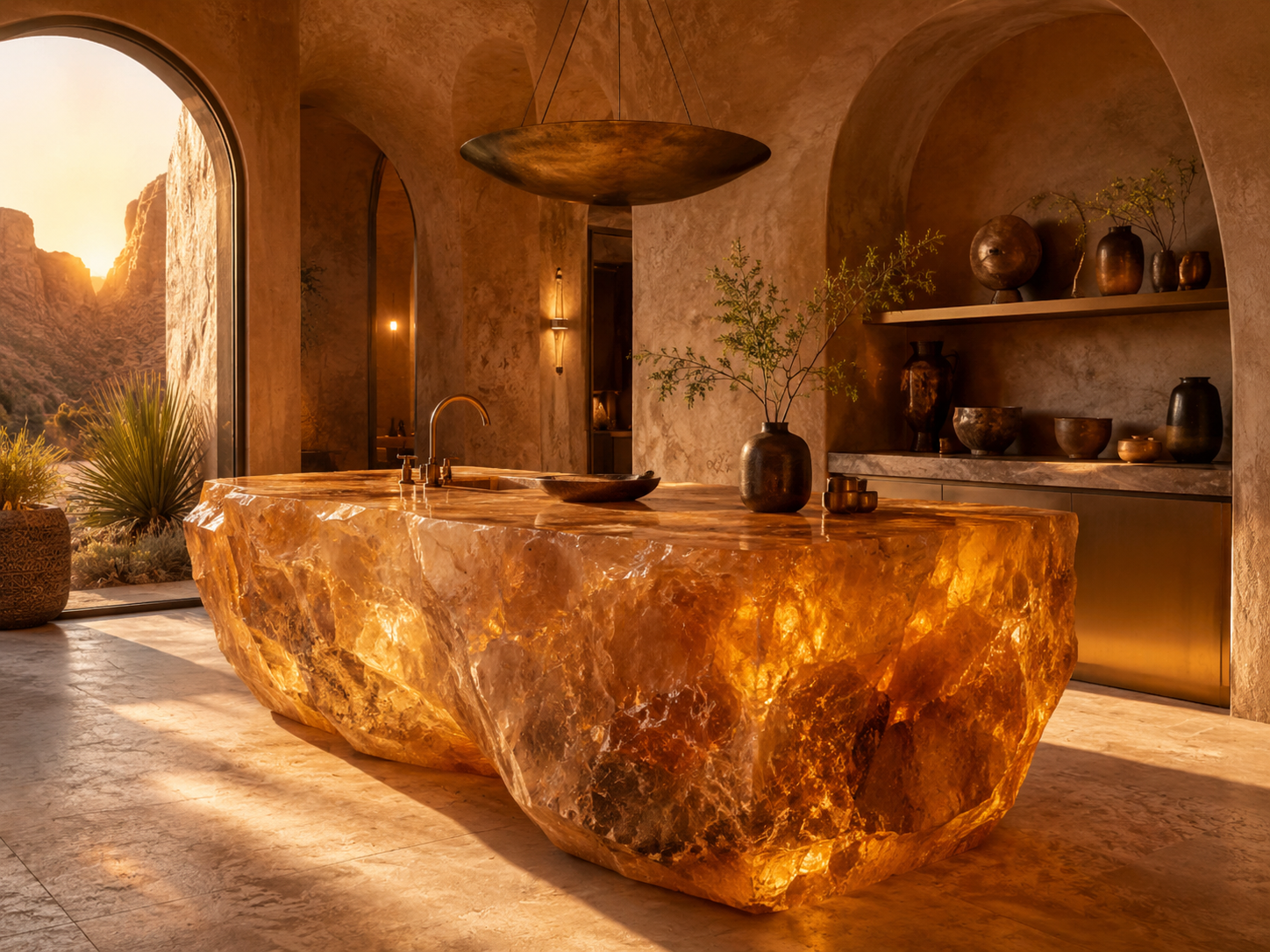
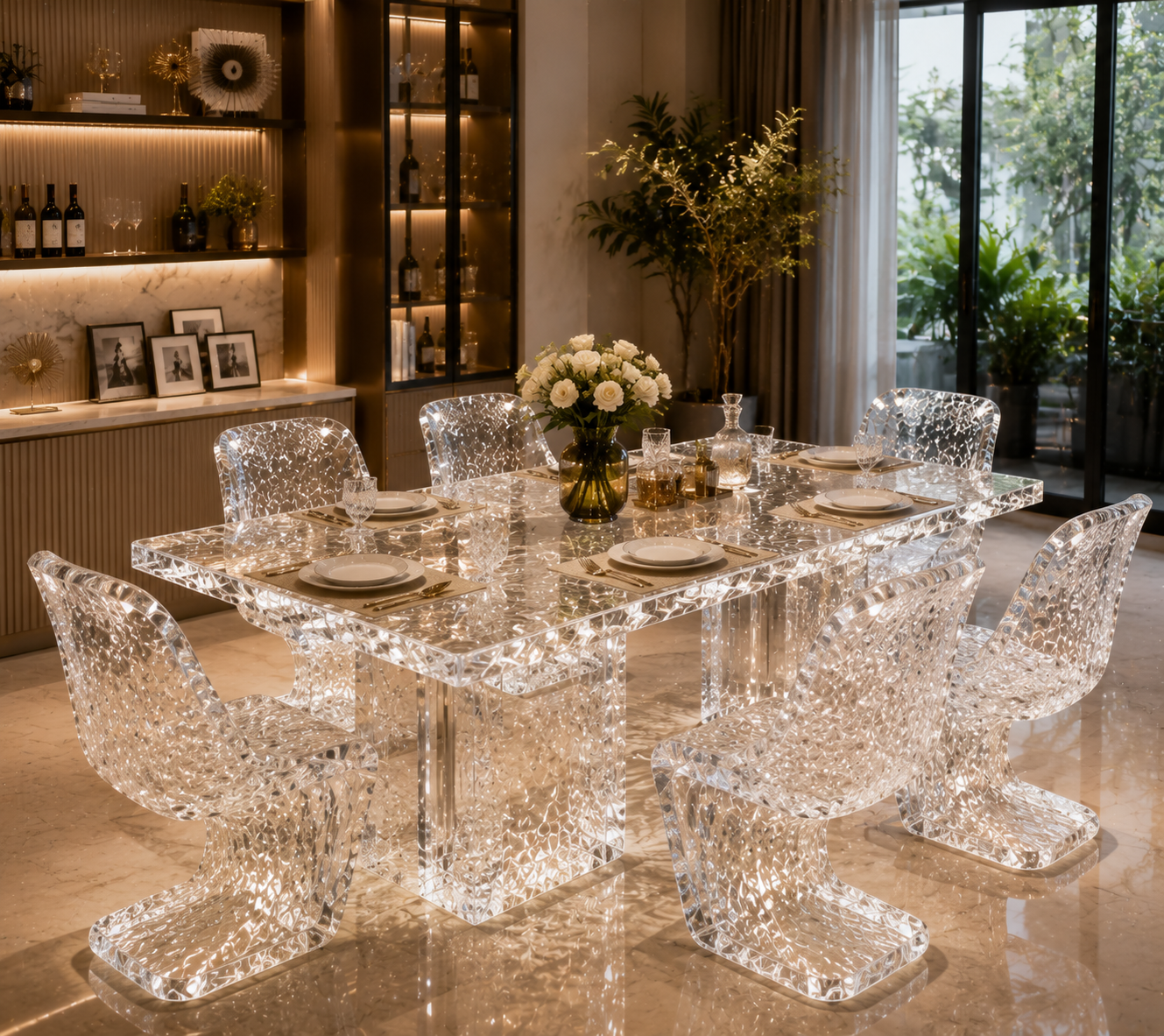
In physical retail, furniture showrooms, hotel lobbies, restaurants, galleries, and commercial reception areas, customer dwell time is often treated as a simple performance indicator: the longer people stay, the greater the opportunity to sell. Yet this assumption is incomplete. A customer may remain in a space because it is engaging and comfortable, or because the layout is confusing, the service is slow, or the checkout process is inefficient. Only the first kind of dwell time creates meaningful commercial value.
Spatial quality affects dwell time when it changes how customers feel, how easily they understand the environment, and how confidently they evaluate the products around them. Lighting, circulation, furniture placement, color, sound, surface finish, and material contrast work together as a system. For brands selling synthetic crystal, high-end resin, platinum acrylic, and other visually distinctive furniture materials, this system is especially important. Transparent and reflective products cannot communicate their full value through specifications alone. Their depth, clarity, craftsmanship, weight, finish, and interaction with light must be experienced in a carefully designed setting.
The real question, therefore, is not simply whether a beautiful space keeps customers longer. It is whether the space gives them more reasons to look, touch, compare, imagine, discuss, and eventually buy.
1. Spatial Quality Influences Dwell Time Through Emotion
Customers rarely enter a commercial space and consciously analyze its lighting temperature, furniture proportions, circulation width, or material palette. They respond first through emotion. A space can feel calm, intimidating, inspiring, confusing, exclusive, cold, welcoming, or visually exhausting before the customer has examined a single product.
Research into store atmospherics has repeatedly connected these emotional reactions with approach and avoidance behavior. A well-known study by Robert Donovan and his colleagues examined actual shoppers rather than relying only on stated intentions. It found that pleasure experienced within the store predicted customers’ willingness to spend extra time and more money. Importantly, the effect remained relevant even when cognitive judgments such as price, quality, and product variety were considered. In other words, customers did not stay only because the merchandise was good; they also stayed because the environment made continued exploration feel rewarding.
An eye-tracking study of retail interiors reached a related conclusion. Researchers found that different applications of the same color combinations could change perceived luxury and people’s preference to remain in a space. The study demonstrates that spatial quality is not determined by whether an expensive color or material is present. What matters is how visual elements are arranged in three-dimensional space and how they guide attention.
This distinction is critical for transparent furniture. Synthetic-crystal tables, platinum-acrylic consoles, and polished-resin objects can create fascination through refraction, reflection, and layered depth. However, when they are placed beneath harsh lighting or surrounded by too many glossy surfaces, the result may feel clinical or overstimulating. Customers may admire the pieces briefly but have little emotional desire to remain.
A stronger environment balances visual brilliance with comfort. A transparent acrylic table can be paired with a textured rug, upholstered seating, warm timber, or softly finished stone. A resin sculpture can be illuminated from the side to reveal depth without creating direct glare. Spatial quality emerges from this balance between stimulation and reassurance. Customers stay when the environment offers something new to discover without demanding too much effort from their senses.
2. The Space Becomes Evidence of Product Quality
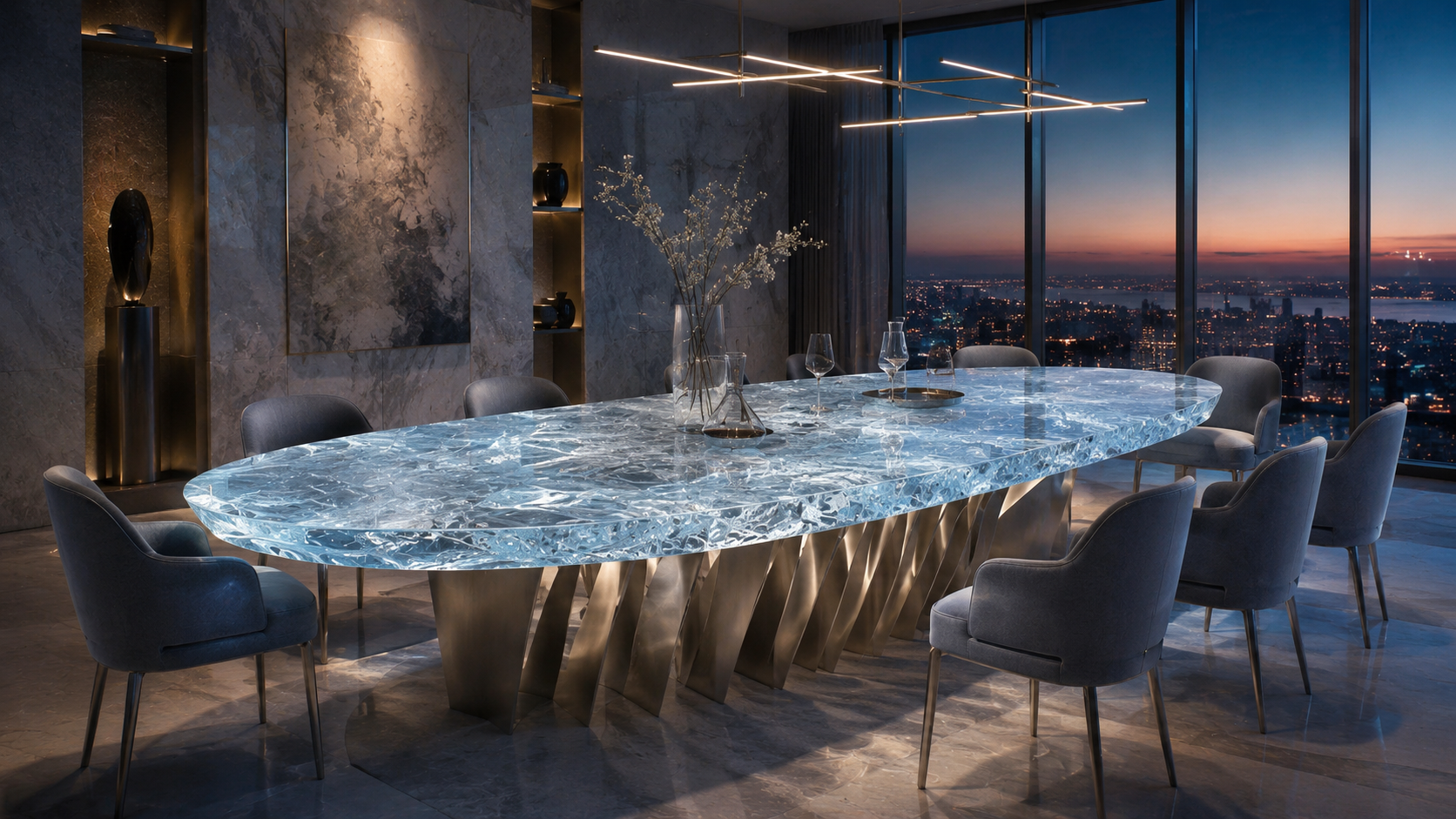
For premium furniture brands, the showroom is not a neutral container. Customers use the quality of the space to judge the credibility of the products, the competence of the manufacturer, and the value of the brand.
This is becoming more important as physical stores compete with efficient digital purchasing. PwC’s Retail Monitor reported that around 60 percent of consumers expect the physical store of the future to provide an experience. PwC also concluded that product interaction is becoming more important as stores gradually shift away from functioning only as locations that hold inventory.
Deloitte similarly reported that nearly two-thirds of consumers want to see and touch products before purchasing them. This need is particularly strong when quality, material, fit, and physical feel influence the decision. For premium furniture, a showroom must therefore do something that a website cannot: turn abstract product claims into physical proof.
Consider a synthetic-crystal console table. Online, it may be described as clear, substantial, precisely polished, and visually luxurious. In a poorly designed showroom, however, dull ambient lighting can flatten its optical depth, a visually noisy background can obscure its silhouette, and fingerprints can immediately weaken the perception of quality. The customer sees “transparent plastic” rather than engineered clarity and craftsmanship.
The same principle applies to high-end resin. Resin furniture can contain controlled color transitions, mineral-like patterns, encapsulated objects, metallic pigments, or deliberately formed textures. These features become persuasive only when lighting reveals their internal depth and customers can view the piece from multiple angles. A single overhead light may conceal the very details that justify a premium price.
Platinum acrylic furniture also requires carefully controlled presentation. Clear acrylic visually borrows information from its surroundings, so background color, light direction, neighboring objects, edge finishing, and surface cleanliness directly influence its appearance. Research into material perception has shown that transparent layers can alter judgments of gloss. One experimental study found that the perceived gloss of an object could shift significantly when it was viewed through materials with different transparency and reflectance properties.
This means the showroom is part of the product demonstration. Good spatial design does not merely make the furniture look attractive. It helps the customer verify clarity, finish, scale, stability, optical performance, color consistency, and manufacturing precision. The better the space performs this verification role, the more time customers are willing to invest in examining the furniture.
3. Transparent and Reflective Materials Can Create Productive Visual Exploration
Customers stay longer when a space continues to reveal new information. This does not require filling every available area with products. In many cases, fewer objects with stronger visual relationships create more exploration than a crowded display.
Synthetic crystal, high-end resin, and platinum acrylic are especially effective in this context because they interact with the environment rather than simply occupying it. Their appearance changes as the customer moves. Edges brighten or disappear, embedded details become visible, reflections shift, and objects behind the furniture remain partially visible. The customer is encouraged to change position, approach more closely, and inspect the material from different angles.
This movement can be understood as productive visual dwell time. The customer is not passively standing in the showroom. The material is generating a sequence of small discoveries.
A clear acrylic coffee table, for example, can be positioned over a richly textured rug. From a distance, the furniture preserves the visual openness of the room. At closer range, polished edges, joinery, thickness, and reflections become visible. A colored-resin dining table can be placed where natural or controlled light moves across the surface, allowing customers to observe changes in translucency and pigment density. A synthetic-crystal side table can be located at the transition between two showroom zones, creating a visual pause that naturally slows movement.
The effectiveness of these materials depends on contrast. Transparent furniture placed against a transparent or highly reflective background can lose definition. Glossy resin displayed on polished flooring may create excessive visual noise. A better composition places reflective materials beside matte, soft, or naturally textured surfaces. Wool, timber, leather, brushed metal, plaster, and honed stone provide perceptual reference points that make clarity and gloss appear more intentional.
This is also why empty space has commercial value. Negative space allows the eye to isolate form, notice craftsmanship, and understand proportion. When every table is covered with accessories and every circulation route contains promotional fixtures, the customer sees inventory rather than design.
Transparent furniture can make a showroom appear more open, but it does not eliminate the physical footprint of the furniture. A clear table can still obstruct movement even when it does not visually block the room. The layout must therefore consider both visual openness and actual navigation. Spatial quality occurs when transparency creates curiosity while circulation remains intuitive.
4. Furniture Placement Determines Whether Customers Explore or Escape
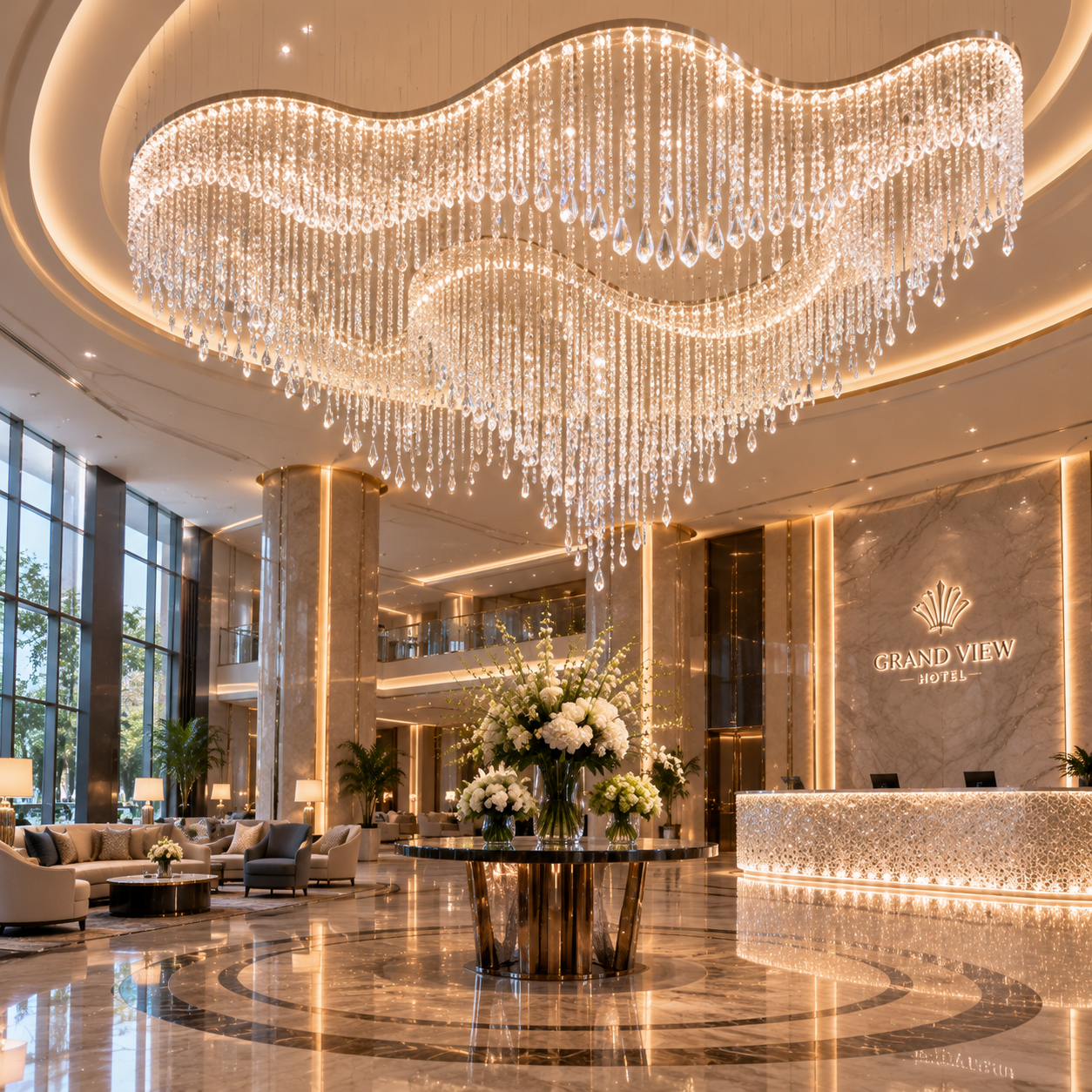
A visually impressive showroom can still shorten customer visits when its layout creates stress. Customers need to understand where to go, what they are permitted to touch, where they can pause, and how different furniture collections relate to one another.
Recent research on retail crowding provides a useful warning. Across a 12-week field experiment, a behavioral-tracking study, and a laboratory experiment, researchers found that fixture-induced spatial crowding reduced purchase behavior. In one field experiment, removing mid-aisle fixtures increased sales even though fewer products were displayed. The research connected the effect with reduced navigability and a lower sense of control.
For premium furniture showrooms, this means adding more display pieces does not automatically create more sales opportunities. If a customer must turn sideways between tables, repeatedly avoid sharp corners, or struggle to see a complete furniture silhouette, the space communicates pressure rather than luxury.
A stronger layout creates a natural rhythm. An important statement piece establishes the first impression. Secondary products encourage movement into the showroom. Comfortable seating creates permission to pause. Material samples and consultation tables give customers a reason to transition from browsing to conversation. Clear sightlines provide reassurance that the environment is easy to navigate.
Transparent materials can support this rhythm because they preserve visual continuity between zones. A platinum-acrylic console can define a boundary without creating a solid visual wall. A clear synthetic-crystal pedestal can display an object without hiding the collection behind it. A translucent resin screen can divide consultation and display areas while allowing light to pass through.
However, the furniture should not be treated only as scenery. Customers need enough room to walk around a table, view edge construction, understand thickness, test seating relationships, and imagine the product in a real interior. When furniture is pushed too close to a wall or surrounded by decorative objects, the customer cannot complete this evaluation.
Good placement turns physical movement into a sales conversation. Each step provides more information, and each zone makes the next action feel natural. Customers remain because they are progressing, not because the layout has trapped them.
5. Longer Dwell Time Matters Only When It Builds Purchase Confidence
Dwell time should never be interpreted without context. A customer who spends twenty minutes comparing finishes, touching samples, photographing details, and discussing custom dimensions is demonstrating meaningful engagement. A customer who spends the same twenty minutes looking for a salesperson or waiting for basic information is experiencing friction.
The Wall Street Journal reported that retailers including Canada Goose, Coach, and Tanger have invested in lounges, cafés, experiential displays, and more comfortable environments to encourage longer visits. Coach executives reported that selected immersive stores were generating stronger traffic, longer dwell times, and more frequent return visits than other locations. The report also emphasized an important limitation: longer visits can indicate confusion, difficulty locating products, or excessive waiting rather than positive engagement.
For furniture brands, productive dwell time should increase confidence in three areas. Customers should become more certain that the material is genuinely premium, more certain that the product will work in their space, and more certain that the supplier can deliver the required quality.
Material interaction is particularly important. A field study conducted in a furniture flagship store tested a multisensory customer journey combining virtual furniture configurations with real tactile samples. Fifty customers responded positively in terms of satisfaction, perceived realism, and acceptance. The research suggests that combining visualization with physical material experience can strengthen purchase confidence.
A showroom selling resin and acrylic furniture can apply the same principle without complex technology. Customers can be given access to polished samples, color variations, thickness options, edge treatments, connection details, and examples showing how the materials behave under different lighting. Instead of presenting the product as a finished object that must be accepted immediately, the showroom turns it into an experience customers can investigate.
The goal is not to delay the decision artificially. It is to make the time spent in the showroom useful. Every additional minute should reduce uncertainty, strengthen emotional attachment, or help the customer imagine ownership. That is the difference between dwell time and decision time.
6. Spatial Quality Must Be Designed and Measured as a Commercial System
The most effective showrooms do not rely on intuition alone. They treat spatial quality as a measurable part of the sales process.
Average visit duration can provide a starting point, but it should be examined alongside zone-level dwell time, product interaction, material-sample handling, consultation requests, quotation rates, conversion, average order value, repeat visits, and customer photography or sharing behavior. These indicators reveal whether people are merely present or genuinely engaged.
For synthetic-crystal furniture, a brand can observe whether customers stop when light reaches the product, move around it, inspect the edges, or ask about weight and manufacturing. For high-end resin, the relevant behaviors may include touching samples, comparing colors, studying embedded details, and discussing customization. For platinum acrylic, the brand can examine whether customers understand its clarity, construction, visual lightness, and relationship with surrounding furniture.
Small changes can then be tested in practice. A resin table can be displayed under two lighting arrangements. An acrylic console can be compared against light and dark backgrounds. A synthetic-crystal object can be tested as a central feature or as a transition piece between collections. The objective is not simply to discover which option looks best in photographs. It is to identify which presentation creates more qualified interaction and stronger sales outcomes.
The answer to the original question is therefore yes: spatial quality really does affect how long customers stay. But its influence does not come from luxury decoration alone. Customers stay when the space makes them feel comfortable, gives them control, rewards exploration, and helps them understand why a product deserves attention.
For brands working with synthetic crystal, high-end resin, and platinum acrylic, the opportunity is especially significant. These materials can shape light, preserve openness, create depth, and transform as the viewer moves. When displayed without spatial strategy, they may appear cold, artificial, or difficult to evaluate. When supported by controlled lighting, tactile contrast, thoughtful furniture placement, and clear product storytelling, they become reasons to pause.
The most commercially effective space is not the one that forces customers to remain. It is the one that continuously gives them a reason not to leave.
READ MORE:
- Beyond the Purchase Price: How to Evaluate the Real Value of a High-End Synthetic Crystal Furniture Piece
- How to Use Transparent Furniture Without Making an Interior Feel Cold, Empty, or Overly Modern
- Will It Scratch, Yellow, or Lose Its Clarity? A Practical Guide to the Long-Term Performance of Synthetic Crystal Furniture
- What Designers, Retailers, and Hospitality Buyers Should Verify Before Specifying Synthetic Crystal Furniture
- Why Some Crystal-Clear Furniture Looks Luxurious—and Some Simply Looks Like Plastic
- How Premium Resin and Platinum Acrylic Elevate Brand Perception in High-End Furniture
- Synthetic Crystal, Resin, or Acrylic Furniture: Which Material Is Right for Each Commercial Space?
- Lighting and Transparent Furniture: How to Make an Interior Feel Brighter, Deeper, and More Refined
- How Can Commercial Spaces Increase Average Transaction Value Through Material Upgrades? Start with the Quality of the Furniture


