
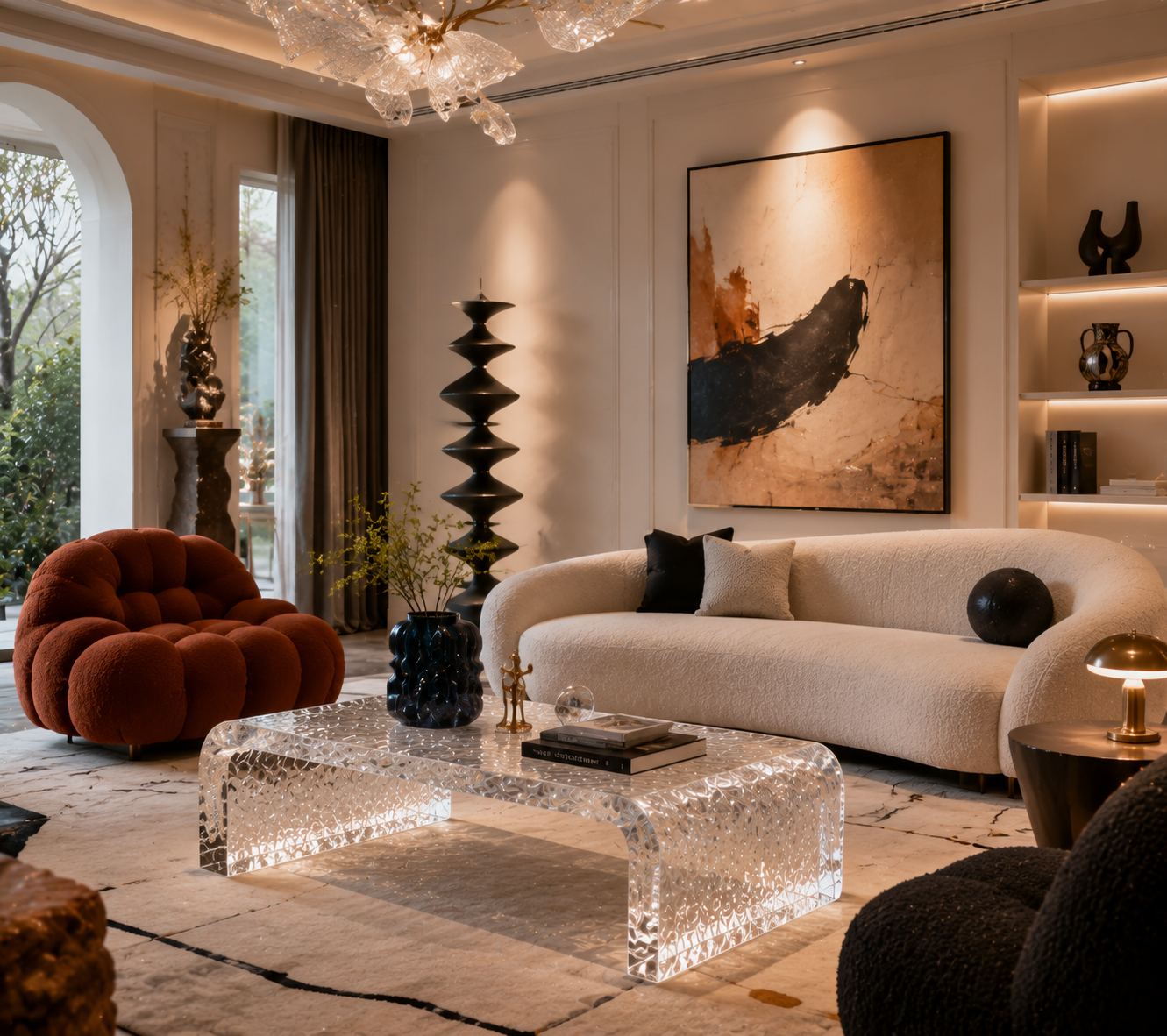
Transparent furniture is often described as “visually weightless,” but transparency alone does not automatically make a room feel spacious or sophisticated. A clear acrylic table placed under a harsh spotlight can create distracting reflections. A crystal-like resin console positioned in direct afternoon sun may produce excessive glare. Even the clearest piece of furniture can appear dull when the surrounding lighting lacks contrast or accurate color rendering.
Successful interiors treat lighting and transparent furniture as one integrated system. Light must pass through the furniture, reveal its edges, create controlled reflections and establish a visual relationship with floors, walls and surrounding objects. This is especially important when working with synthetic crystal, high-end cast resin and platinum-grade acrylic furniture, because their value lies not only in transparency but also in optical clarity, depth, craftsmanship and the way they interact with light.
The following six principles explain how designers, architects, hotel operators, retailers and homeowners can combine lighting with transparent furniture to create interiors that feel open, layered and luxurious.
1. Use Daylight as the Foundation, but Control Direct Sunlight
Natural light should be the starting point of any lighting plan involving transparent furniture. Clear materials preserve sightlines and allow daylight to travel through the space instead of being visually blocked by large, opaque surfaces. A transparent coffee table, for example, can maintain the visual continuity between a sofa, rug and window. A clear console can provide function without creating a heavy barrier in a narrow entrance or hotel corridor.
However, more sunlight does not always produce a better result. The WELL Building Standard emphasizes the need to balance useful daylight with excessive solar exposure. Its daylight-modeling guidance uses a target in which at least 55 percent of regularly occupied space receives a minimum of 300 lux for at least 50 percent of annual operating hours, while limiting areas exposed to more than 1,000 lux for 250 hours per year to no more than 10 percent. These figures demonstrate an important design principle: successful daylighting is about controlled distribution, not maximum brightness.
In a residential living room, a platinum-grade acrylic coffee table can be positioned near a window, but it should not sit directly in the path of intense low-angle sunlight. Moving it slightly away from the glazing, using a sheer curtain or introducing an adjustable shade allows softer daylight to reveal the polished edges without creating blinding highlights. In a hotel lobby, synthetic crystal side tables can be arranged where they receive reflected daylight from walls or ceilings rather than direct solar beams.
The U.S. Department of Energy similarly explains that good daylighting must provide useful illumination while controlling glare and excessive heat. It also recommends integrating daylight with electric lighting rather than treating the two as separate systems. Transparent furniture performs best within this balanced environment, where daylight establishes openness and electric light maintains consistency when outdoor conditions change.
2. Understand How Each Transparent Material Interacts with Light
Synthetic crystal, high-end resin and acrylic may all appear transparent, but they do not interact with light in exactly the same way. Designers should therefore select lighting according to the optical characteristics, thickness, surface treatment and internal structure of each furniture piece.
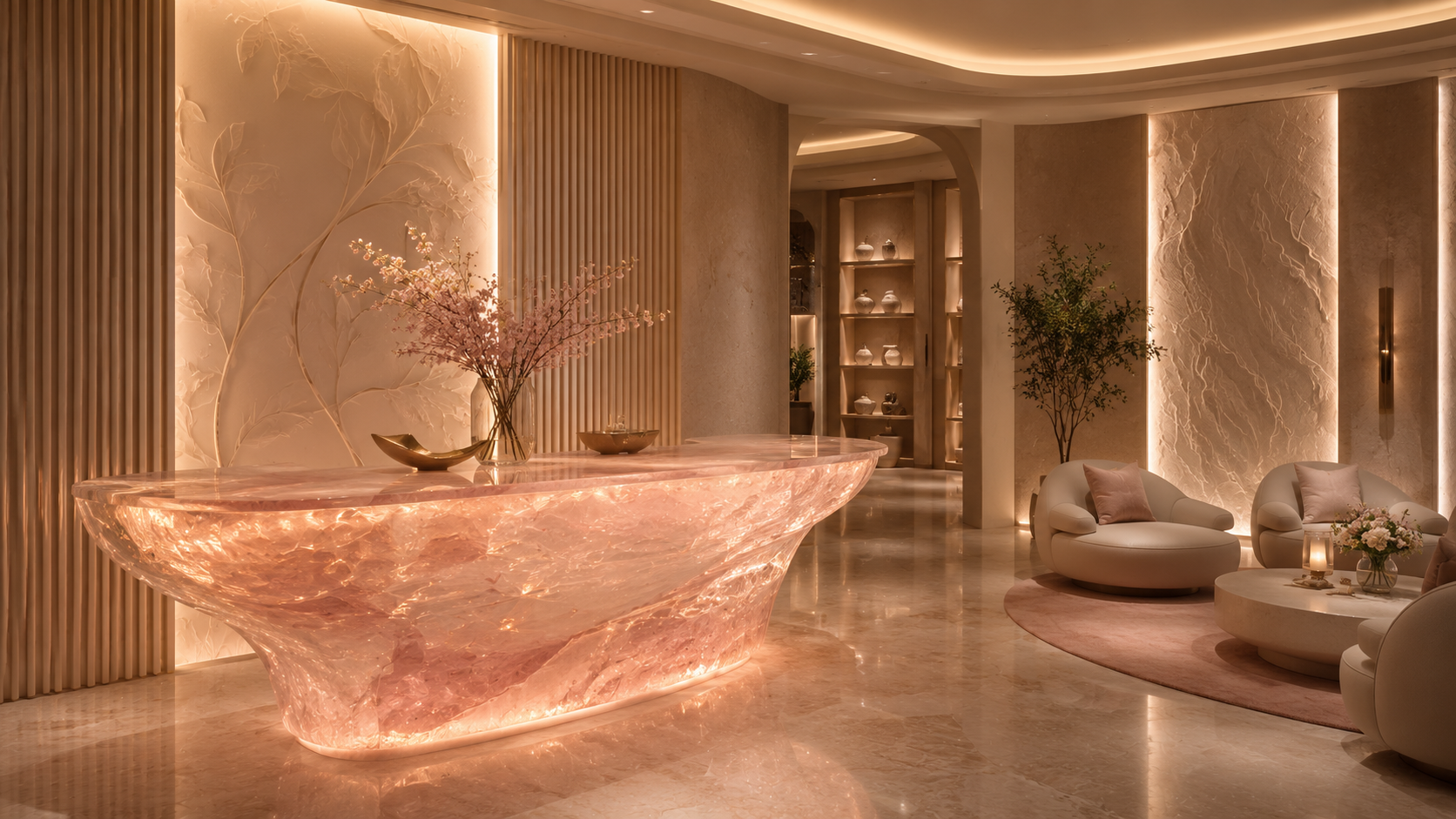
Premium clear acrylic can transmit a very high proportion of visible light. PLEXIGLAS reports visible-light transmittance of up to 92 percent for certain clear products. The manufacturer also notes that surface reflections at the entry and exit points account for much of the remaining light loss. This means that a thick acrylic table may remain highly transparent while its polished edges appear brighter and more defined. When an LED source is positioned at a controlled side angle, those edges can capture the light and produce a refined, jewel-like outline.
High-end cast resin behaves differently. Depending on its formulation, thickness, pigments, embedded objects and casting quality, it may transmit light clearly, diffuse it softly or create visible internal layers. Instead of trying to make every resin product look completely invisible, lighting can be used to emphasize its depth. A softly illuminated resin dining table with subtle inclusions, for example, can appear more sculptural when light grazes across the surface and reveals the internal composition.
ASTM D1003, the standard test method for haze and luminous transmittance in transparent plastics, explains that scattered light can create a smoky appearance or veiling glare. It also identifies haze and transmittance measurements as important tools for product specification and quality control. For designers and buyers, this means that “clear” should not be treated as a sufficient technical description.
For platinum-grade acrylic furniture, request measurable information such as luminous transmittance, haze, material thickness, UV performance, edge-finishing method and surface hardness. Samples should be reviewed against both dark and light backgrounds and under warm, neutral and daylight-white illumination. This simple procedure reveals color casts, internal bubbles, bonding lines and surface distortion before the furniture is installed in a completed project.
3. Build the Room with Ambient, Task and Accent Light
Transparent furniture becomes visually interesting when it is illuminated by more than one type of light. A room relying only on ceiling downlights often feels flat because every object is lit from approximately the same direction. A layered lighting system creates depth by giving different surfaces different levels of brightness.
The Illuminating Engineering Society defines ambient lighting as general illumination throughout an area. It also defines task-ambient lighting as a combination in which the general ambient level is lower than, and complementary to, the light provided for specific activities. These definitions provide a useful framework for interiors containing transparent furniture.
Ambient light should establish a comfortable overall brightness without making the ceiling the brightest visual element. Indirect cove lighting, concealed linear lighting and light reflected from walls can produce a soft background in which clear furniture remains visible but does not become excessively reflective. Task lighting can then be added where people read, work, dine or prepare products. Accent lighting should be reserved for selected transparent pieces, artwork or architectural features.
Consider a dining area with a transparent acrylic table. Instead of using several narrow-beam spotlights, a wide, diffused pendant can illuminate the tabletop and faces around it. A wall washer can create a brighter vertical background behind the table, helping its outline remain readable. A concealed linear light near a resin base can then reveal the material’s internal depth without turning the entire piece into a glowing object.
In a luxury retail environment, synthetic crystal display plinths may receive carefully aimed accent lighting, while shelving and circulation areas remain more softly illuminated. This hierarchy guides attention and prevents every transparent object from competing for visual dominance. Layering is therefore not simply a decorative technique; it determines which transparent elements appear functional, which appear sculptural and which quietly support the overall spatial composition.

4. Control Glare, Reflections and Multiple Images
One of the most common mistakes in lighting transparent furniture is aiming a bright, exposed light source directly at a glossy horizontal surface. This may create a dramatic photograph from one angle, but it often produces discomfort for people moving around the room. Clear furniture can reflect luminaires, windows, screens and other bright objects, sometimes producing several overlapping images.
The U.S. Department of Energy notes that discomfort glare is influenced by factors including the brightness, size and position of a light source, as well as the brightness of the surrounding background. DOE-supported research also recognizes that glare cannot be evaluated from the luminaire alone; the room, viewing direction and visual environment all matter.
To reduce glare, light sources should be shielded from normal viewing angles. Wide-beam, diffused or indirect fixtures are usually more comfortable around transparent dining tables, desks and reception counters than exposed point sources. Accent lights should be positioned so that their strongest reflection does not fall directly into the eyes of seated users. Changing a spotlight’s angle by only a small amount can move a disturbing reflection away from the primary viewing position.
Background brightness is equally important. A clear resin desk in front of a completely dark wall may reflect every luminaire in the room. Introducing a softly illuminated wall, textured curtain or matte architectural surface reduces the contrast between the bright reflection and its surroundings. Rugs, timber, fabric and stone can also visually anchor transparent furniture, preventing the interior from becoming cold or optically confusing.
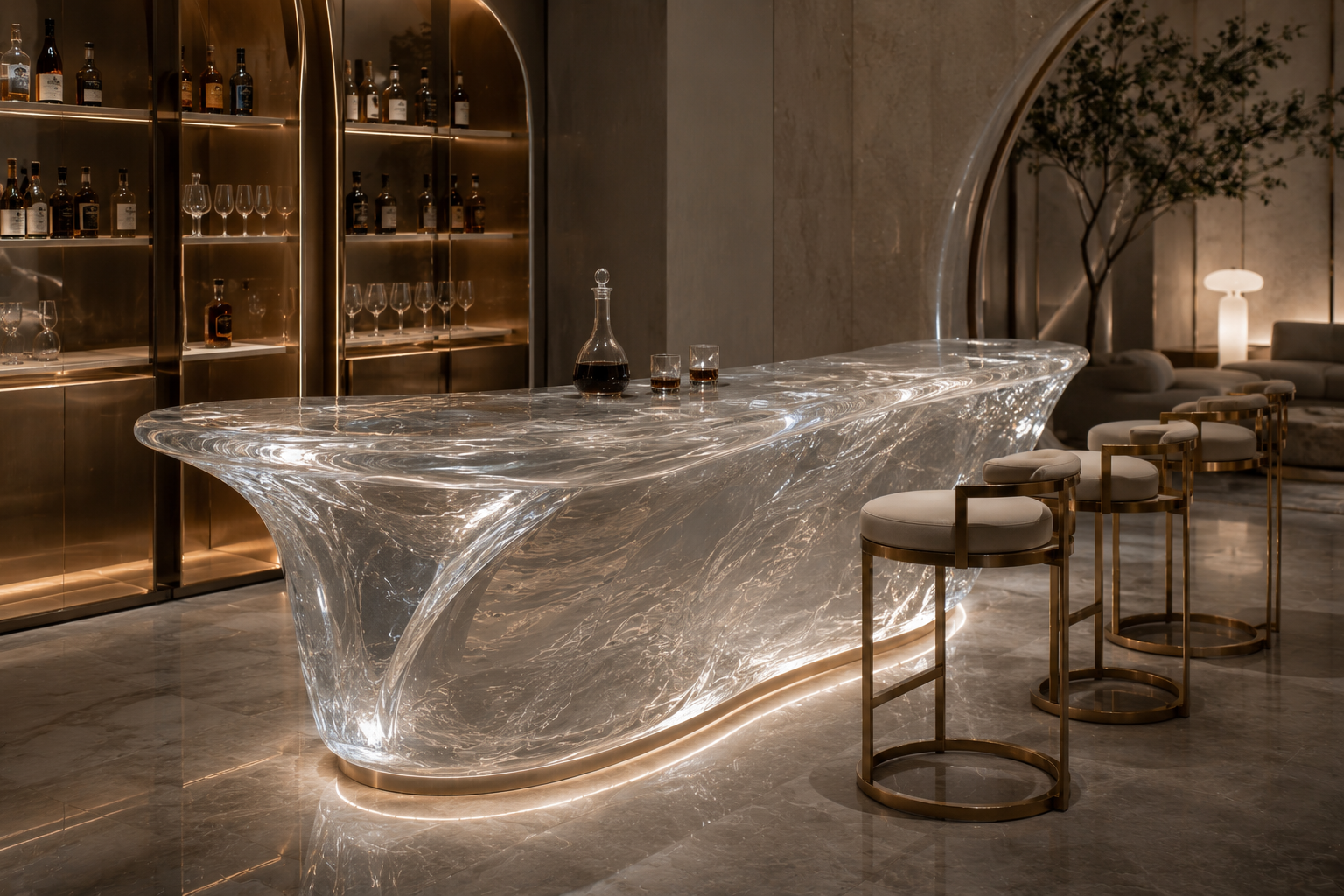
In an office reception area, for example, a platinum-grade acrylic desk can be illuminated with a combination of ceiling-reflected ambient light and a soft wall wash behind the receptionist. Concealed light may be used to emphasize the desk’s lower edge, but it should not be aimed directly through the material toward arriving visitors. The result is a reception desk that looks clear and luxurious without becoming a source of visual discomfort.
5. Select Light Sources That Preserve Material and Color Quality
Transparent materials reveal the quality of the light falling on them. Poor-quality LEDs can make clear resin appear greenish, blue-gray or yellow, while colored inclusions may look dull or unnatural. For this reason, lighting specifications should consider more than brightness and color temperature.
The Illuminating Engineering Society’s TM-30 method evaluates color rendition through several measures, including overall color fidelity, gamut area and hue-specific shifts. This provides more detailed information than relying on a single general color-rendering number. For interiors featuring synthetic crystal, tinted resin or colored acrylic, this additional information is valuable because small spectral differences can change the perceived color of the material, nearby fabrics, skin tones and decorative objects.
Warm light between approximately 2700 K and 3000 K can create an intimate residential, restaurant or hospitality atmosphere, particularly when transparent furniture is combined with timber, brass, bronze or warm stone. Neutral light around 3000 K to 3500 K often works well in contemporary showrooms, galleries and reception spaces because it maintains warmth while revealing material detail. Cooler light may be appropriate in selected commercial or futuristic environments, but it should be tested carefully to avoid making the interior feel clinical.
Consistency is also important. A transparent table illuminated simultaneously by LEDs with different color temperatures can display conflicting reflections across its surface. Where different lighting layers are used, their color characteristics should be intentionally coordinated.
For colored resin furniture, the best source is not always the one with the highest apparent saturation. Excessively saturated lighting can make the product look impressive in person but inaccurate in photography or online marketing. A balanced source with good fidelity allows customers to see the material as it was designed. Full-scale testing should therefore include human observation, professional photography and, where relevant, video recording.
.png)
6. Create Depth Through Placement, Contrast and Real-Space Testing
Transparent furniture should not be treated as empty space. Its edges, joints, thickness, shadows and reflections all contribute to the composition. To create depth, designers must place transparent pieces in relation to visible backgrounds and allow enough negative space for their outlines to be understood.
A clear console positioned directly in front of a glass wall may almost disappear. Moving it in front of a textured plaster wall, curtain or softly illuminated surface gives the eye a reference point. Similarly, a synthetic crystal side table placed partly over a patterned rug and partly over a plain floor can reveal its volume through the change visible beneath it. The goal is not to make the furniture invisible, but to make it visually light while preserving its craftsmanship.
Museum collections demonstrate how transparency can become a design language rather than a novelty. MoMA describes Shiro Kuramata’s 1988 Miss Blanche Chair as an acrylic-resin structure in which artificial roses appear to float inside the transparent body. The impact comes from the relationship between clear material, embedded objects and surrounding space. MoMA’s clear Two-Way Side Table provides another example: its transparent acrylic planes interact with surrounding colors and reflections, allowing its appearance to change according to the environment.
The same principle applies to commercial interiors. A transparent resin table with embedded metallic fragments should be given a calm background and controlled side lighting so that its internal elements become the focus. A clear acrylic shelving system may work best against a wall washer that produces a gradual brightness transition. Synthetic crystal furniture with faceted details can be highlighted selectively, allowing several edges to sparkle while other surfaces remain quiet.
Finally, every project should be reviewed in the actual space during both daytime and nighttime conditions. Designers should sit, stand and walk through the room at normal eye levels, checking reflections from windows, luminaires, screens and decorative lighting. Furniture should also be inspected after cleaning, because fine scratches, residue and incompatible cleaning products can increase visible haze and reduce optical clarity. Lighting positions, dimming levels and furniture orientation should be adjusted only after this real-space evaluation.
Conclusion
Lighting transparent furniture successfully requires more than placing a spotlight above a clear table. Daylight must be controlled, material properties must be understood, lighting layers must be coordinated and glare must be evaluated from the user’s position. Color quality, background contrast, furniture placement and maintenance also influence the final result.
When synthetic crystal, high-end resin and platinum-grade acrylic furniture are treated as optical and architectural elements, they can preserve sightlines, reflect selected details and reveal depth without adding visual heaviness. The most refined spaces do not simply contain transparent furniture; they use light to make transparency an active part of the interior experience.
READ MORE:
- Beyond the Purchase Price: How to Evaluate the Real Value of a High-End Synthetic Crystal Furniture Piece
- How to Use Transparent Furniture Without Making an Interior Feel Cold, Empty, or Overly Modern
- Will It Scratch, Yellow, or Lose Its Clarity? A Practical Guide to the Long-Term Performance of Synthetic Crystal Furniture
- What Designers, Retailers, and Hospitality Buyers Should Verify Before Specifying Synthetic Crystal Furniture
- Why Some Crystal-Clear Furniture Looks Luxurious—and Some Simply Looks Like Plastic
- How Premium Resin and Platinum Acrylic Elevate Brand Perception in High-End Furniture
- Synthetic Crystal, Resin, or Acrylic Furniture: Which Material Is Right for Each Commercial Space?
- Does Spatial Quality Really Affect How Long Customers Stay?
- How Can Commercial Spaces Increase Average Transaction Value Through Material Upgrades? Start with the Quality of the Furniture


