Two custom furniture pieces can share nearly the same dimensions and still carry very different price tags. That difference is rarely arbitrary. In premium transparent furniture, the budget is built from dozens of decisions that affect material use, processing time, rejection risk, assembly difficulty, and finishing standards. For buyers, dealers, designers, and project managers, understanding these variables makes it much easier to control cost without weakening the visual effect.
At first glance, synthetic crystal furniture may appear to be priced mainly by size. In reality, size is only the starting point. A simple rectangular console with generous proportions can sometimes be easier to manufacture than a smaller table with tight curves, concealed joints, multiple materials, and high-polish details. The right way to evaluate cost is to ask not only how much material is used, but also how difficult the piece is to produce consistently.

1. Material Thickness Changes More Than Material Cost
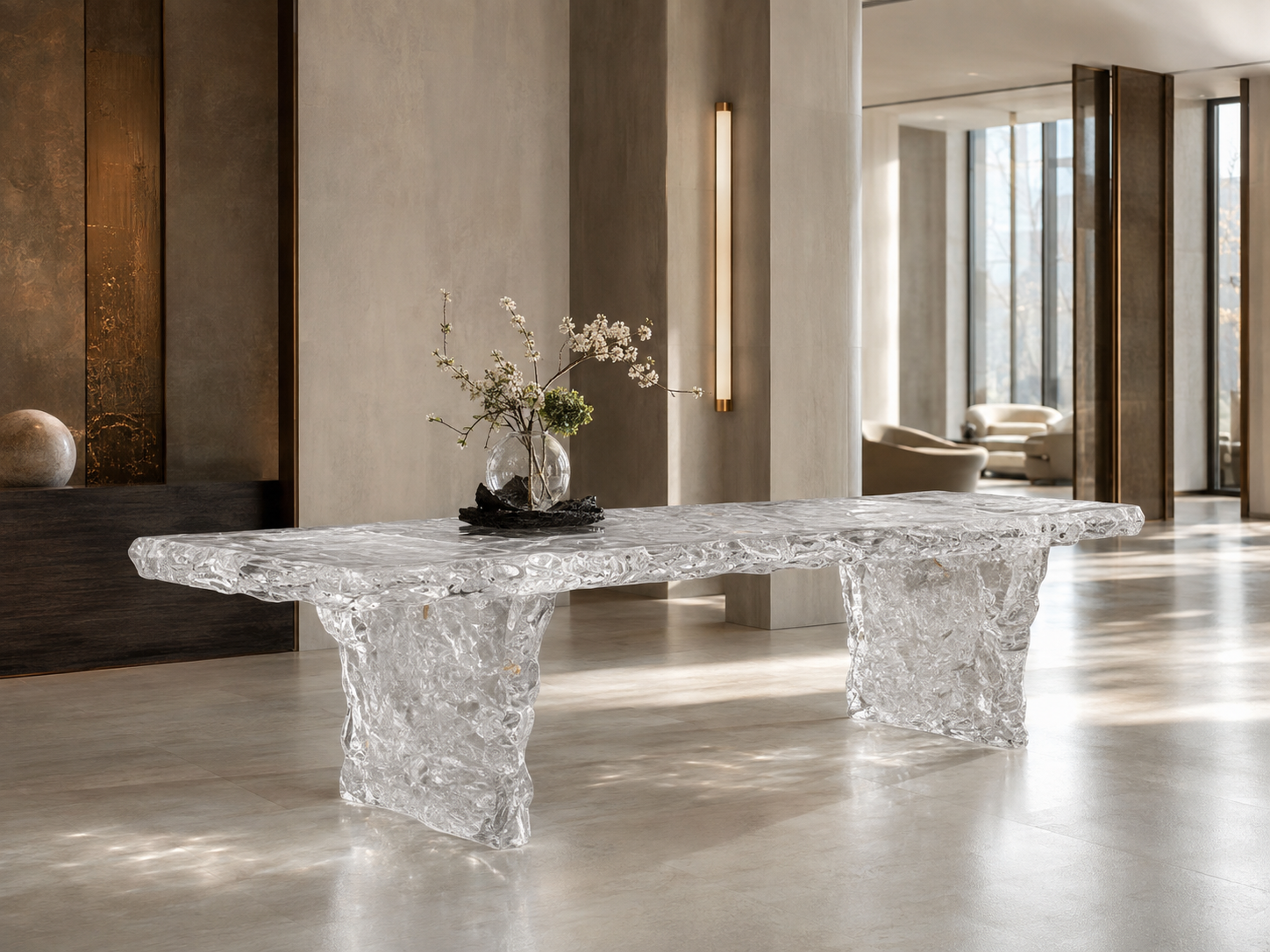
Thickness affects visual presence, weight, machining time, edge depth, bonding area, polishing labor, and handling difficulty. A thicker panel can create the heavy, jewel-like appearance many premium buyers want, but it also increases production complexity at every stage.
More material means more cost, but that is only part of the picture. Thicker components require longer cutting cycles, more careful handling, and more polishing to achieve optically clean edges. They also create more demanding joints because even small misalignments become easier to see through transparent surfaces. A design that looks stronger because of thicker sections may therefore require disproportionately more finishing work.
This is one reason synthetic crystal projects should be developed with a clear design hierarchy. Thickness should be concentrated where it creates the greatest visual impact, such as structural supports, sculptural legs, or major framing elements. Using maximum thickness everywhere can increase the budget without improving the final appearance at the same rate.
2. Curves and Sculpted Forms Increase Processing Time
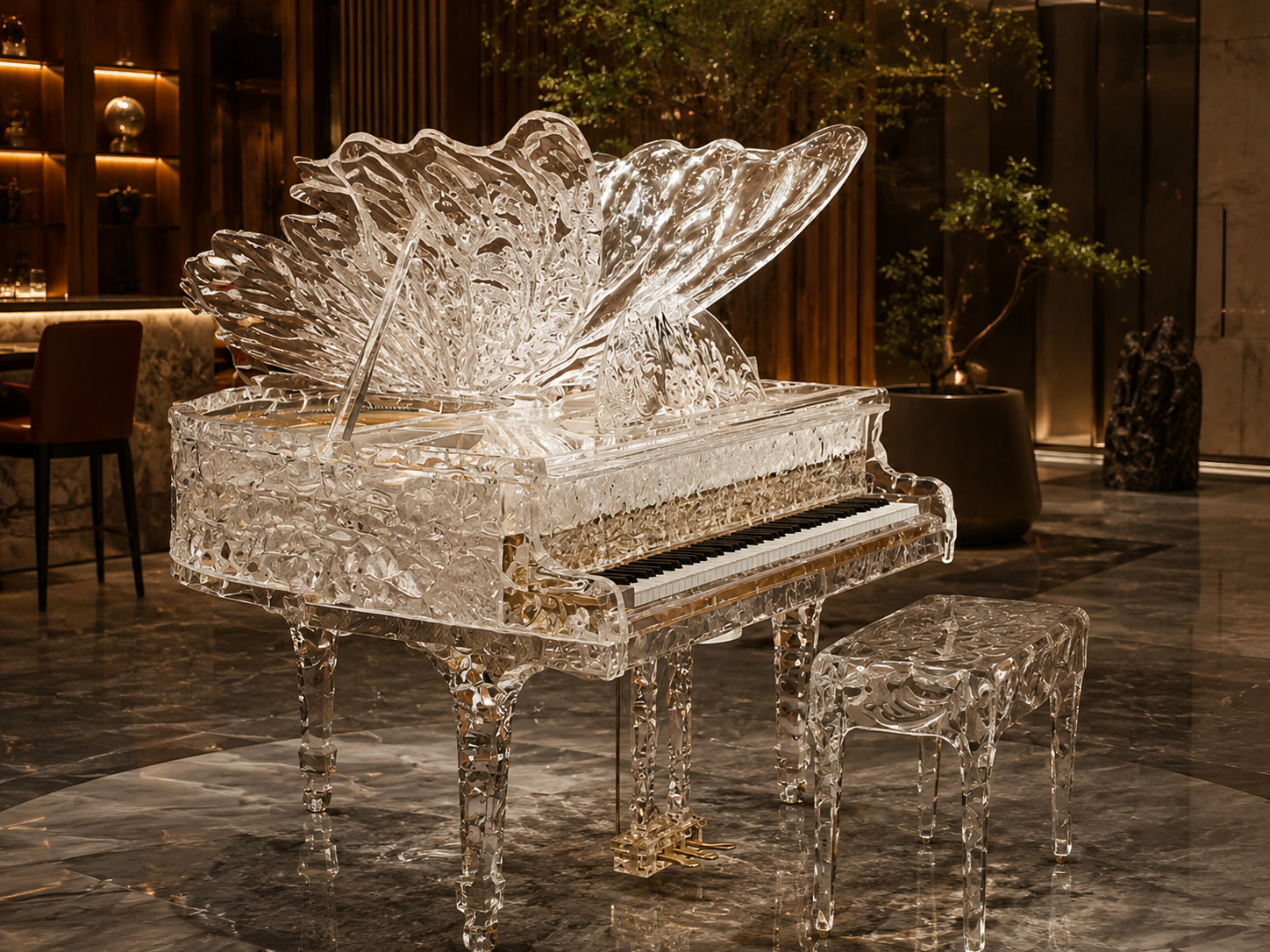
Flat, straight components are generally easier to cut, polish, inspect, and assemble. Curves change the equation. A soft radius, a fully rounded leg, a shaped base, or a sculptural edge may require specialized machining, repeated polishing, custom fixtures, and more manual correction.
The cost impact depends on how many curved surfaces are visible and how exact the geometry must remain across multiple pieces. A curve on one prototype can be adjusted by an experienced technician. The same curve repeated across fifty identical units becomes a production-control issue. The tighter the visual tolerance, the more time must be built into machining and inspection.
Buyers should therefore ask whether every curve is essential to the concept. A small number of well-placed sculptural details can often create a premium identity more effectively than adding complex shaping to every surface.
3. Bonding Complexity Is Often Invisible but Expensive
One of the most underestimated cost drivers is the way transparent components are connected. In opaque furniture, many joints can be hidden. In transparent furniture, the joint itself becomes part of the visual language.
Clean bonding demands precise preparation, controlled adhesive application, careful positioning, and disciplined finishing. Any trapped bubble, excess adhesive, visible seam, or slight offset can become noticeable from multiple viewing angles. This raises both labor time and rejection risk.
Complex multi-angle assemblies are especially demanding because one inaccurate connection can affect the alignment of the entire piece. A minimalist design can therefore be more difficult to execute than a visually busier product. When there are fewer decorative elements, every technical detail is exposed.
For premium synthetic crystal furniture, buyers should evaluate bonding quality as part of the design rather than treating it as a hidden production step. If the visual concept depends on near-invisible connections, that expectation should be defined clearly at the quotation stage.
4. Polishing Standards Have a Major Effect on Labor
Polishing is one of the most important areas where production cost and perceived value meet. A transparent edge can look flat and ordinary, or it can look deep, refined, and jewel-like. The difference comes from time, technique, and consistency.
Highly polished surfaces require several controlled stages. Corners must remain accurate, edges must not become wavy, and the final finish should maintain optical clarity under showroom lighting. The larger the exposed edge area, the greater the finishing workload.
This becomes especially important for thick pieces. A deep edge acts almost like a lens, making imperfections more visible. For projects where the furniture will be viewed at close range in luxury residences, hotel suites, galleries, or premium retail spaces, polishing quality can matter more than adding decorative hardware.
5. Hardware Can Either Simplify or Complicate the Design
Hardware is often assumed to be a small cost item, but its effect depends on how it is integrated. Standard exposed fittings are relatively straightforward. Custom metal inserts, concealed fasteners, precision brackets, flush-mounted components, and decorative connections can significantly increase both part cost and assembly time.
There is also a visual issue. Transparent furniture reveals more of the internal construction than wood or upholstered furniture. Hardware that looks acceptable on an opaque cabinet may appear too industrial when surrounded by clear material.
Premium designs often benefit from reducing visible hardware, but hiding hardware is not automatically cheaper. Concealed systems may require more accurate machining, tighter tolerances, and additional prototypes to confirm strength and appearance.
6. Mixed Materials Add Integration Cost, Not Just Material Cost
Marble, metal, wood, leather, glass, and stone can all work beautifully with transparent furniture. However, adding a premium material does not automatically make a product feel premium. The cost comes not only from purchasing the second material but also from integrating two materials with different properties.
Each material may react differently to temperature, load, drilling, adhesive, surface protection, and transportation. Connection details must account for these differences. Metal may require custom finishes. Stone may need reinforced support. Wood movement may need to be considered. Color temperature must also be managed so that the clear structure and secondary material feel visually intentional.
A successful mixed-material synthetic crystal piece feels designed as one object rather than assembled from separate components. Achieving that unity usually requires more development time, but it also creates a stronger reason for the customer to accept a higher price.
7. Finishing Tolerance Determines How Much Rework Is Acceptable
Every custom project should define what level of variation is acceptable. If a buyer expects extremely tight dimensional tolerance, near-perfect visual alignment, and highly consistent polishing across a batch, the production process must include more inspection and possibly more rework.
That does not mean strict standards are unnecessary. It means the standards should match the real use of the product. A hotel project with repeated bedside tables needs consistency across rooms. A one-off sculptural console may allow more handcrafted character. A retail display fixture may prioritize visual effect from a defined viewing distance rather than microscopic inspection from every angle.
Clear approval criteria help avoid spending money on refinements customers will never notice while still protecting the details that genuinely support a premium positioning.
8. Order Quantity Changes the Cost Structure
The cost of one prototype and the cost per piece in a larger order are built differently. A prototype carries development, setup, testing, tooling, and adjustment costs that cannot be spread across multiple units. As quantity increases, some of those costs become more efficient.
However, larger quantities also introduce new requirements. Fixtures may be needed to control repeatability. Inspection must become more systematic. Packaging needs to be standardized. Production scheduling becomes more important. If the design is complicated, these controls may add cost even while the unit price falls.
Project buyers should therefore avoid assuming that a successful sample guarantees effortless mass production. The sample proves the concept. The production plan proves repeatability.
9. Design Changes Late in the Process Are Expensive
One of the easiest ways to increase custom furniture cost is to change dimensions, thickness, hardware, color, or connection details after drawings, samples, or production fixtures have already been approved.
Early design decisions are relatively inexpensive to adjust. Late decisions can require remachining, repurchasing components, revising packaging, or repeating finishing work. This is why detailed approval of drawings, material references, surface standards, and hardware specifications is so important before production begins.
For dealers and project teams, a disciplined approval process is not bureaucracy. It is a cost-control tool.
10. Spend More Where Customers Can See and Feel the Difference
The best custom furniture budgets are not simply high or low. They are intentional. More money should be allocated to the elements that directly shape perception: proportion, edge quality, clarity, stability, joint execution, material transitions, and the details customers notice in person.
By contrast, design features that add hidden complexity without improving appearance, function, or storytelling should be challenged. A premium product does not need every possible expensive detail. It needs the right expensive details.
When buyers understand how cost is created, conversations with manufacturers become more productive. Instead of asking only for a lower price, they can ask which design changes will reduce cost with the least visual sacrifice. Instead of specifying premium features everywhere, they can identify the areas that carry the most commercial value.
That is the real advantage of understanding custom furniture pricing: it gives buyers more control over both the budget and the final result. And once you know which design decisions truly earn their cost, the next question becomes even more interesting: which premium details are your customers actually willing to pay more to see?


