Producing one beautiful custom piece is an important achievement, but it is not the same as delivering fifty pieces that all look, fit, and perform the way the buyer expects. Once a design moves from prototype to project quantity, the challenge changes from craftsmanship alone to controlled repeatability.
For synthetic crystal furniture, this transition is especially important because transparent surfaces reveal small differences in alignment, polishing, joint quality, and hardware placement. A sample can be adjusted by hand until it looks right. A project order needs a process that makes the approved result repeatable across every unit.
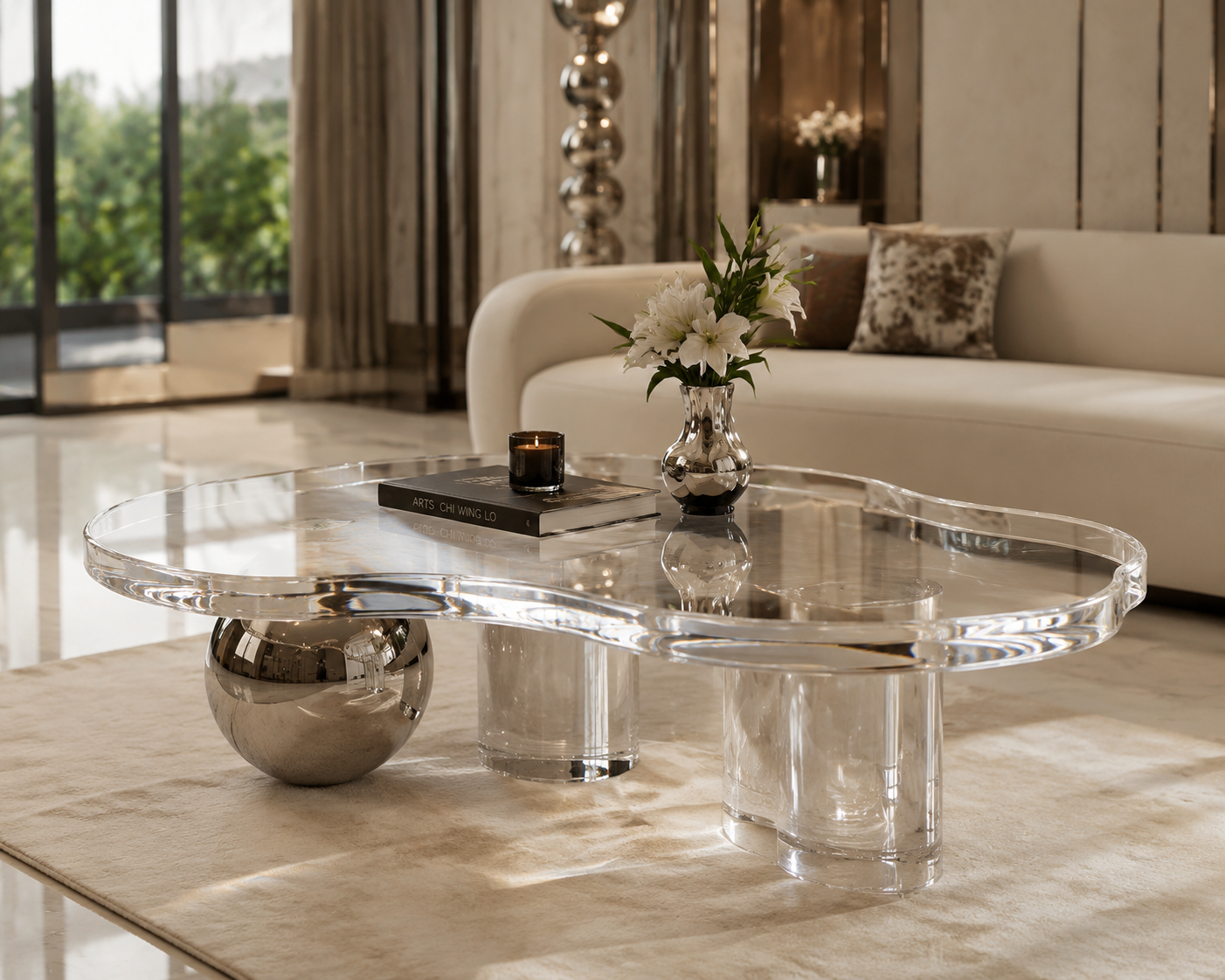
1. The Approved Sample Becomes the Production Reference
The sample should not be treated as a marketing object only. It should become a measurable reference for production. Dimensions, edge profiles, joint positions, material thickness, hardware, polishing level, and visible finishing details should all be documented.
Project buyers should confirm exactly what the sample is approving. Is it approving dimensions? Color? Edge treatment? Hardware finish? Overall visual standard? Packaging? The clearer the approval scope, the fewer arguments arise later.
Photographs are helpful, but they are not enough for critical details. Drawings, material samples, and written inspection points should support the physical reference wherever possible.
2. Repeatability Requires Fixtures and Process Control
A craftsman can solve a one-off alignment issue manually. That approach becomes inefficient and risky in a larger batch. Repeated components often require fixtures, guides, templates, or standardized machining programs so that the same dimensions and positions can be achieved consistently.
These controls may add setup cost at the beginning of a project, but they reduce variation and rework later. They are especially useful for repeated joints, hole positions, metal inserts, and assemblies where transparent edges must line up precisely.
When synthetic crystal pieces are ordered for multiple rooms or stores, buyers should ask how the factory plans to control repeatability rather than only whether the sample looks good.
3. Dimensional Tolerance Must Match the Installation
Not every dimension needs the same tolerance. A freestanding side table may allow slightly more variation than a built-in fixture that must align with millwork, stone, wall panels, or electrical components.
Project teams should identify critical dimensions early. Overall height, mounting points, leg positions, hardware interfaces, and top dimensions may matter more than less visible measurements. Tight tolerances should be assigned where they protect installation or visual alignment.
Over-specifying every dimension can raise cost unnecessarily. Under-specifying critical dimensions can create expensive site problems. Good project control means being strict in the right places.

4. Finishing Standards Must Be Described Clearly
Terms such as high polish, premium finish, or clear edge can mean different things to different people. For a project order, subjective language should be supported by physical samples or specific acceptance criteria.
Buyers should define which faces are presentation surfaces, what level of minor variation is acceptable, how joints should look from normal viewing distance, and which areas will be hidden after installation.
This protects both sides. The buyer receives a consistent standard, while the manufacturer avoids spending excessive time correcting details that were never commercially important.
5. Color and Optical Consistency Become More Important in Batches
Transparent furniture is often chosen because it feels visually light and clean, so consistency matters when several pieces appear in the same interior. Small differences that would be unnoticed in separate homes can become obvious when multiple units are installed side by side.
Material batches, metal finishes, stone tones, wood stains, and adhesives should therefore be controlled where relevant. If the project includes mixed materials, approved ranges for natural variation should also be established.
For premium synthetic crystal projects, consistency is not about making every natural material identical. It is about ensuring that variation stays within a deliberate visual range.
6. Inspection Needs to Move From Informal to Systematic
One prototype can be checked by looking at the whole piece. Fifty pieces require a repeatable inspection method. The factory should know what to inspect, when to inspect it, and what happens if a unit falls outside the agreed standard.
Critical checks may include overall dimensions, surface condition, edge polish, joint alignment, hardware position, stability, mixed-material fit, and packaging condition. Some inspections should happen before final assembly because defects can be harder to correct later.
A documented checklist does not need to be complicated. It needs to focus on the details most likely to affect appearance, installation, and customer acceptance.
7. Packaging Becomes Part of the Product
Project orders often involve multiple handling stages: factory, warehouse, freight, local delivery, site storage, and final installation. A beautiful piece that arrives damaged is still a failed delivery.
Packaging should be designed for the actual route, not copied from a one-piece shipment. Repeated units may benefit from standardized crates, corner protection, surface films, component separation, and clear handling labels.
For hotel or retail projects, packaging sequence can also matter. If the installation team must open dozens of units, consistent labeling and component organization can save substantial labor on site.

8. Production Scheduling Must Include Inspection and Correction Time
Project lead time is not just machining time. It includes material preparation, component production, finishing, assembly, inspection, correction, packaging, and release.
One common mistake is to plan the schedule as if every unit will pass every stage without adjustment. Premium furniture usually needs a realistic quality-control buffer. This is not inefficiency; it is part of delivering a consistent result.
Buyers should also understand which components have the longest lead times. Custom hardware, stone, special metal finishes, and unique accessories may control the entire schedule even if the transparent structure itself can be produced faster.
9. Changes After Sample Approval Must Be Managed Carefully
Once a sample is approved, every later change should be evaluated for its effect on cost, timing, drawings, fixtures, packaging, and inspection criteria. A small dimension change can affect several production steps.
Project teams benefit from keeping a clear revision record. Everyone should know which drawing and specification are current. This is particularly important when dealers, designers, contractors, and end clients are all involved in approvals.
Uncontrolled revisions create inconsistency because different departments may work from different information.
10. Batch Production Is About Consistent Value, Not Identical Handwork
Premium project furniture does not need to feel mass-produced in a negative sense. The goal is to preserve the visual quality of the approved sample while building a process that can repeat it reliably.
That may involve more fixtures, more documentation, more inspection, and more disciplined scheduling than a one-off commission. Those controls are not separate from craftsmanship. They are what allow craftsmanship to survive scale.
For buyers, the most important questions change once quantity increases. Instead of asking only, “Can you make this?” they should ask, “How will you make every unit meet the same standard?” A manufacturer that can answer that question clearly is better prepared for hospitality, residential, retail, and dealer programs.
The real test of a custom synthetic crystal supplier is not whether one sample can impress a client, but whether the fiftieth piece still carries the same visual confidence as the first. And before your next project moves into production, ask one question that can expose the entire manufacturing plan: what exactly will you measure, compare, and reject when the sample is no longer the only piece in the room?


